
Rotations
A rotation turns a figure around a fixed point, called the center of rotation, by a given angle. Counterclockwise is the usual direction. About the origin, a 90° rotation uses (x, y) \to (-y, x), and a 180° rotation uses (x, y) \to (-x, -y). The image is congruent to the original figure.
Before this lesson: You should know Reflections, Measuring and Classifying Angles and the Coordinate Plane.
What Is a Rotation?
Think of a Ferris wheel. Every car moves around the center in a circle. The center stays still. That turning motion is a rotation.
Every rotation has three parts.
- The center of rotation: the fixed point the figure turns around.
- The angle of rotation: how far it turns, in degrees.
- The direction: counterclockwise or clockwise. If no direction is given, use counterclockwise.
Each point stays the same distance from the center as it turns. The angle from a point to the center to its image equals the angle of rotation.
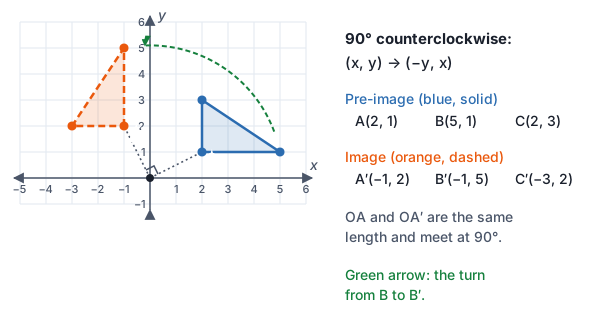
A rotation is a rigid motion, so the image is congruent to the pre-image. Unlike a reflection, a rotation does not flip the figure. The vertices keep the same order around the shape.
Rotation Rules About the Origin
These rules work when the center of rotation is the origin, (0, 0).
| Rotation | Same as | Rule | Example with (4, 1) |
|---|---|---|---|
| 90° counterclockwise | 270° clockwise | (x, y) \to (-y, x) | (-1, 4) |
| 180° | 180° either way | (x, y) \to (-x, -y) | (-4, -1) |
| 270° counterclockwise | 90° clockwise | (x, y) \to (y, -x) | (1, -4) |
| 360° | A full turn | (x, y) \to (x, y) | (4, 1) |
For 90° and 270°, you swap the coordinates and change one sign. For 180°, you keep the order and change both signs.
To check a 90° counterclockwise turn, picture the point (4, 1) in the first quadrant. A quarter turn counterclockwise moves it into the second quadrant, where x is negative. That matches (-1, 4).
How to Rotate a Figure
- Find the center, the angle and the direction.
- If the center is the origin, pick the rule from the table.
- Apply the rule to every vertex.
- Plot the image points and connect them in the same order.
- Label the image with prime marks.
- Check: each point and its image should be the same distance from the center.
Worked Examples
Example 1: Rotate a point 180°
Rotate P(3, -2) 180° about the origin.
- Use the rule (x, y) \to (-x, -y).
- Take the opposite of x: -(3) = -3
- Take the opposite of y: -(-2) = 2
- Write the image: P'(-3, 2)
Answer: P'(-3, 2)
Example 2: Rotate a triangle 90° counterclockwise
Triangle ABC has vertices A(2, 1), B(5, 1) and C(2, 3). Rotate it 90° counterclockwise about the origin. This is the triangle in the graph above.
The rule is (x, y) \to (-y, x). The new x is the opposite of the old y. The new y is the old x.
| Vertex | New x: opposite of y | New y: old x | Image |
|---|---|---|---|
| A(2, 1) | -(1) = -1 | 2 | A'(-1, 2) |
| B(5, 1) | -(1) = -1 | 5 | B'(-1, 5) |
| C(2, 3) | -(3) = -3 | 2 | C'(-3, 2) |
Check one side. AB is horizontal and 3 units long. A'B' is vertical, from y = 2 to y = 5, so it is also 3 units long. The side turned a quarter turn and kept its length.
Answer: A'(-1, 2), B'(-1, 5), C'(-3, 2)
Example 3: Rotate 90° clockwise
Rotate Q(-4, 5) 90° clockwise about the origin.
- A 90° clockwise turn is the same as 270° counterclockwise. Use (x, y) \to (y, -x).
- The new x is the old y: 5
- The new y is the opposite of the old x: -(-4) = 4
- Write the image: Q'(5, 4)
- Check the distance from the origin for Q (see distance formula): \sqrt{(-4)^2 + 5^2} = \sqrt{16 + 25} = \sqrt{41}
- Check the distance for Q′: \sqrt{5^2 + 4^2} = \sqrt{25 + 16} = \sqrt{41}. They match.
Answer: Q'(5, 4)
Example 4: Rotate about a point that is not the origin
Rotate P(5, 3) 90° counterclockwise about the point C(2, 1).
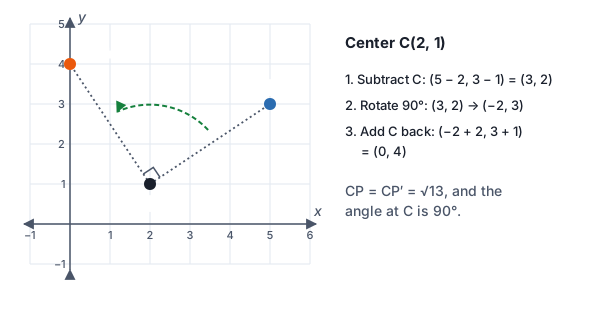
The rules in the table only work around the origin. So slide everything until C sits at the origin, turn, and then slide back.
- Subtract the center from P. x: 5 - 2 = 3
- y: 3 - 1 = 2. Now the point is (3, 2).
- Rotate 90° counterclockwise with (x, y) \to (-y, x): (3, 2) \to (-2, 3)
- Add the center back. x: -2 + 2 = 0
- y: 3 + 1 = 4
- Write the image: P'(0, 4)
Check that the angle at C is 90°. The slope of CP is \frac{3 - 1}{5 - 2} = \frac{2}{3}. The slope of CP' is \frac{4 - 1}{0 - 2} = \frac{3}{-2} = -\frac{3}{2}. These slopes are opposite reciprocals, so the segments are perpendicular (see parallel and perpendicular lines).
Answer: P'(0, 4)
Example 5: Word problem (Ferris wheel)
Put the center of a Ferris wheel at the origin. Each unit is 1 meter. A car starts at the bottom, at (0, -20). The wheel turns 90° counterclockwise. Where is the car? Then the wheel turns 180° more. Where is the car now?
- First turn, 90° counterclockwise. Use (x, y) \to (-y, x).
- The new x is the opposite of y: -(-20) = 20
- The new y is the old x: 0. The car is at (20, 0).
- Second turn, 180°. Use (x, y) \to (-x, -y).
- The opposite of 20 is −20. The opposite of 0 is 0. The car is at (-20, 0).
- Check: in all, the wheel turned 90^\circ + 180^\circ = 270^\circ. The 270° rule (x, y) \to (y, -x) sends (0, -20) to (-20, 0). It matches.
Answer: After 90°, the car is at (20, 0), level with the center on the right. After 180° more, it is at (-20, 0), level with the center on the left.
Common Mistakes
| Mistake | Example of the error | Fix |
|---|---|---|
| Turning the wrong way | Using the clockwise rule when no direction is given | No direction means counterclockwise. |
| Wrong sign in the 90° rule | (4, 1) \to (1, -4) for 90° counterclockwise | Counterclockwise 90° is (-y, x): (-1, 4) |
| Forgetting to swap | (4, 1) \to (-4, 1) for 90° | For 90° and 270°, swap x and y. |
| Using origin rules for another center | Rotating about (2, 1) with (-y, x) directly | Subtract the center, rotate, then add it back. |
| Thinking a rotation flips the figure | Listing the image vertices in reverse order | A rotation keeps the order. Only a reflection flips it. |
More About Rotations
- A 180° rotation sends every point straight through the center to the other side. The center is the midpoint of each point and its image.
- Two reflections make a rotation. Reflect (3, 1) over the x-axis to get (3, -1). Then reflect over y = x to get (-1, 3). That is the same as a 90° counterclockwise turn of (3, 1). The lines meet at a 45° angle, and the turn is twice that.
- Finding the angle: join a point and its image to the center. The angle between those two segments is the angle of rotation.
- Rotations and symmetry: some figures match themselves after a turn of less than 360°. You will see this in the Symmetry lesson later in this unit.
Practice Problems
- Rotate (6, 1) 90° counterclockwise about the origin.
- Rotate (-2, -7) 180° about the origin.
- Rotate (3, -8) 270° counterclockwise about the origin.
- Rotate (-5, 4) 90° clockwise about the origin.
- Triangle DEF has vertices D(1, 2), E(3, 2) and F(1, 5). Rotate it 180° about the origin.
- Which rotation about the origin maps (2, 7) to (-7, 2)?
- Rotate (4, 0) 90° counterclockwise about the point (1, 1).
- P(6, 8) is rotated 90° counterclockwise about the origin. Find P'. Then find the distance from the origin to P and to P'.
- Reflect (3, 1) over the x-axis, then reflect the result over the line y = x. Which single rotation gives the same result?
- A clock’s minute hand is 6 cm long. Put the center at the origin. At 12:00 the tip is at (0, 6). Where is the tip at 12:15? At 12:30?
Show answers
- Use (-y, x)
New x: -(1) = -1
New y: 6
Image: (-1, 6) - Use (-x, -y)
-(-2) = 2 and -(-7) = 7
Image: (2, 7) - Use (y, -x)
New x: −8
New y: -(3) = -3
Image: (-8, -3) - 90° clockwise is 270° counterclockwise, so use (y, -x)
New x: 4
New y: -(-5) = 5
Image: (4, 5) - Use (-x, -y) on each vertex
D(1, 2) \to D'(-1, -2)
E(3, 2) \to E'(-3, -2)
F(1, 5) \to F'(-1, -5) - The coordinates swapped and the new x is the opposite of the old y
That is (-y, x), a 90° counterclockwise rotation - Subtract the center: (4 - 1, 0 - 1) = (3, -1)
Rotate with (-y, x): (3, -1) \to (1, 3)
Add the center back: (1 + 1, 3 + 1) = (2, 4) - P'(-8, 6)
Distance to P: \sqrt{6^2 + 8^2} = \sqrt{36 + 64} = \sqrt{100} = 10
Distance to P′: \sqrt{(-8)^2 + 6^2} = \sqrt{64 + 36} = \sqrt{100} = 10
Both are 10. - Over the x-axis: (3, 1) \to (3, -1)
Over y = x, swap: (3, -1) \to (-1, 3)
A 90° counterclockwise rotation gives (-1, 3) too, so it is the same. - In 15 minutes, the hand turns a quarter turn, 90° clockwise. Use (y, -x)
(0, 6) \to (6, -0) = (6, 0) at 12:15
In 30 minutes, it turns 180°. Use (-x, -y)
(0, 6) \to (0, -6) at 12:30
FAQ
What is a rotation in geometry?
A rotation turns a figure around a fixed point by a given angle. Each point stays the same distance from the center.
What is the rule for a 90 degree rotation counterclockwise?
About the origin, the rule is (x, y) \to (-y, x). Swap the coordinates, then change the sign of the new x.
Is a 90° clockwise rotation the same as 270° counterclockwise?
Yes. Both use the rule (x, y) \to (y, -x). Turning 90° one way lands in the same place as 270° the other way.
Does a rotation change the size of a figure?
No. A rotation is a rigid motion, so lengths and angles stay the same. The image is congruent to the pre-image.
Summary
- A rotation turns a figure around a center by an angle.
- Counterclockwise is the default direction.
- About the origin: 90° is (-y, x), 180° is (-x, -y) and 270° is (y, -x).
- 90° clockwise is the same as 270° counterclockwise.
- For another center, subtract the center, rotate, then add it back.
- A rotation is a rigid motion and does not flip the figure.
Previous lesson: Reflections
Next lesson: Compositions of Transformations
Back to the Geometry Index