
Differentials
Differentials estimate how much a function’s output changes when its input changes a little. If y = f(x) and x changes by a small amount dx, the differential of y is dy = f'(x)\,dx. Then the true change Δy is close to dy. Differentials are often used to estimate measurement errors.
Before this lesson: Linear Approximation, Power Rule and Chain Rule
dy versus Δy
When x changes from x to x + dx, the curve rises by Δy = f(x + dx) − f(x). The tangent line rises by dy = f′(x) dx. For a small dx, the two are almost the same, and dy is much easier to compute.
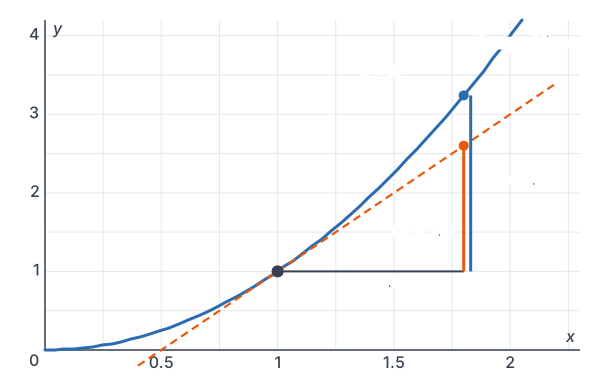
This is the same idea as linear approximation, written in terms of changes instead of values.
Differential formulas
dy = f'(x)\,dx, \qquad \Delta y \approx dy
| Term | Meaning | Formula |
|---|---|---|
| Absolute error | Estimated change or error in y | dy = f'(x)\,dx |
| Relative error | Error compared to the size of y | \frac{dy}{y} |
| Percent error | Relative error as a percent | \frac{dy}{y} \times 100\% |
A useful shortcut: if y = kx^n, then \frac{dy}{y} = n\,\frac{dx}{x}. The percent error in y is n times the percent error in x. For a cube’s volume (n = 3), a 1% error in the side gives about a 3% error in the volume.
Differentials examples
Example 1: Finding a differential
Find dy for y = x^3 - 2x.
\frac{dy}{dx} = 3x^2 - 2Differentiate with the power rule.
dy = (3x^2 - 2)\,dx
Multiply both sides by dx.
Answer: dy = (3x^2 - 2)\,dx.
Example 2: Comparing dy and Δy
Let y = x^2. Find Δy and dy when x changes from 3 to 3.1.
\Delta y = (3.1)^2 - 3^2 = 9.61 - 9 = 0.61
The exact change in y.
dx = 3.1 - 3 = 0.1
The change in x.
dy = 2x\,dx = 2(3)(0.1) = 0.6
The differential at x = 3.
\Delta y - dy = 0.61 - 0.6 = 0.01
The difference is exactly (dx)² for this function.
Answer: Δy = 0.61 and dy = 0.6. The differential misses by only 0.01.
Example 3: Error in the volume of a cube
A cube’s side is measured as 10 cm, with a possible error of ±0.1 cm. Estimate the possible error in its volume, and the percent error.
V = s^3
Volume of a cube.
dV = 3s^2\,ds
Find the differential.
dV = 3(10)^2(0.1) = 30
Substitute s = 10 and ds = 0.1.
\frac{dV}{V} = \frac{30}{1000} = 0.03Divide by V = 10³ = 1000.
0.03 \times 100\% = 3\%
Write as a percent.
Answer: the volume could be off by about ±30 cm³, a 3% error. The side’s 1% error tripled, matching the shortcut with n = 3.
Example 4: Error in a sphere’s surface area
A ball’s radius is measured as 5 cm ± 0.05 cm. Estimate the error in its surface area S = 4\pi r^2, and the percent error.
dS = 8\pi r\,dr
Differentiate S = 4πr².
dS = 8\pi(5)(0.05) = 2\pi \approx 6.28
Substitute r = 5 and dr = 0.05.
S = 4\pi(5)^2 = 100\pi
Find the surface area.
\frac{dS}{S} = \frac{2\pi}{100\pi} = 0.02 = 2\%Divide; π cancels.
Answer: the error is about ±6.28 cm², or 2%. The radius had a 1% error, and n = 2 doubles it.
Example 5: Word problem with paint
A dome is a hemisphere with radius 10 m. Estimate the volume of paint needed for a coat 1 mm thick.
V = \frac{2}{3}\pi r^3Volume of a hemisphere.
dV = 2\pi r^2\,dr
Find the differential.
dr = 1 \text{ mm} = 0.001 \text{ m}The coat adds 0.001 m to the radius. Use the same units.
dV = 2\pi(10)^2(0.001) = 0.2\pi
Substitute r = 10 and dr = 0.001.
0.2\pi \approx 0.628
Multiply by π.
Answer: about 0.628 m³, or 628 liters of paint. dV is the curved surface area 2πr² times the thickness, which makes sense for a thin layer.
Common mistakes
| Mistake | Example of the error | Fix |
|---|---|---|
| Leaving off dx | dy = 3x^2 - 2 | A differential has dx in it: dy = (3x^2 - 2)\,dx. |
| Substituting the new x | Using x = 3.1 in dy = 2x dx | Use the starting value x = 3. |
| Mixing units | Using dr = 1 with r in meters for a 1-mm coat | Convert first: dr = 0.001 m. |
| Calling dy the exact change | “Δy = 0.6” for x = 3 to 3.1 | dy is an estimate. The exact change is Δy = 0.61. |
| Confusing absolute and relative error | Reporting 30 as the percent error | Percent error is (dV/V) × 100% = 3%. |
Related methods
Differentials and linear approximation
The estimate f(x + dx) ≈ f(x) + dy is the linearization L(x) written another way. Use whichever form fits the question: L(x) for a value, dy for a change.
Differentials in integration
The notation dy = f′(x) dx comes back in u-substitution for integrals, later in Calculus 1, where du = g′(x) dx is a key step.
Practice problems
- Find dy for y = \sqrt{x}.
- Find dy for y = \sin(2x).
- Find dy for y = e^{x^2}.
- For y = x^3, compare dy and Δy when x changes from 2 to 2.01.
- A circle’s radius is measured as 20 cm ± 0.2 cm. Estimate the error in its area and the percent error.
- A square tile’s side is 12 cm ± 0.05 cm. Estimate the error in its area and the percent error.
- Estimate the change in a sphere’s volume when its radius grows from 6 cm to 6.1 cm.
- Use differentials to estimate \sqrt{4.1}.
- A pendulum’s period is T = k\sqrt{L} for a constant k. If L is measured with a 2% error, about what percent error results in T?
- A can has radius 3 cm and height 10 cm. Estimate the change in volume if the radius grows by 0.1 cm and the height stays the same.
Show answers
1.
\frac{dy}{dx} = \frac{1}{2\sqrt{x}}Differentiate x^(1/2).
dy = \frac{dx}{2\sqrt{x}}Multiply both sides by dx.
Answer: dy = \frac{dx}{2\sqrt{x}}
2.
dy = 2\cos(2x)\,dx
Chain rule: the inside 2x has derivative 2.
Answer: dy = 2\cos(2x)\,dx
3.
dy = 2x\,e^{x^2}\,dxChain rule on e^(x²).
Answer: dy = 2xe^{x^2}\,dx
4.
dy = 3x^2\,dx = 3(4)(0.01) = 0.12
Use x = 2 and dx = 0.01.
\Delta y = (2.01)^3 - 8 = 8.120601 - 8 = 0.120601
Exact change.
Answer: dy = 0.12 and Δy = 0.120601
5.
dA = 2\pi r\,dr = 2\pi(20)(0.2) = 8\pi \approx 25.1
Differentiate A = πr² and substitute.
\frac{dA}{A} = \frac{8\pi}{400\pi} = 0.02A = π(20)² = 400π.
Answer: about ±25.1 cm², a 2% error
6.
dA = 2s\,ds = 2(12)(0.05) = 1.2
Differentiate A = s² and substitute.
\frac{dA}{A} = \frac{1.2}{144} \approx 0.0083A = 12² = 144.
Answer: about ±1.2 cm², about 0.83%
7.
dV = 4\pi r^2\,dr = 4\pi(36)(0.1) = 14.4\pi
Differentiate V = (4/3)πr³ and substitute r = 6, dr = 0.1.
14.4\pi \approx 45.2
Multiply by π.
Answer: about 45.2 cm³
8.
dy = \frac{dx}{2\sqrt{x}} = \frac{0.1}{2(2)} = 0.025Use x = 4 and dx = 0.1.
\sqrt{4.1} \approx 2 + 0.025 = 2.025Add dy to √4 = 2.
Answer: about 2.025
9.
\frac{dT}{T} = \frac{1}{2}\cdot\frac{dL}{L}T = kL^(1/2), so n = ½ in the shortcut.
\frac{dT}{T} = \frac{1}{2}(2\%) = 1\%Substitute the 2% error.
Answer: about 1%
10.
V = \pi r^2 h \Rightarrow dV = 2\pi rh\,dr
Differentiate with h fixed.
dV = 2\pi(3)(10)(0.1) = 6\pi \approx 18.8
Substitute r = 3, h = 10 and dr = 0.1.
Answer: about 18.8 cm³
Differentials FAQ
What is a differential in calculus?
If y = f(x), the differential dy = f′(x) dx is the change in y along the tangent line when x changes by dx. It estimates the true change Δy.
What is the difference between dy and Δy?
Δy is the exact change in the function’s value. dy is the change along the tangent line. They are close when dx is small.
How do you use differentials to estimate error?
Treat the measurement error as dx and compute dy = f′(x) dx. Divide by y for the relative error, and multiply by 100% for the percent error.
Why does the percent error triple for a cube’s volume?
V = s³, so dV/V = 3 ds/s. Each power of s adds the side’s relative error once.
Summary
- dy = f'(x)\,dx estimates the change Δy.
- Use the starting x, not the new x.
- Relative error is dy/y; percent error is that times 100%.
- For y = kx^n, the percent error in y is n times the percent error in x.
- Keep the units consistent before you substitute.
Previous lesson: Linear Approximation
Next lesson: L’Hôpital’s Rule
Back to the Calculus 1 Index