
Double Integrals in Polar Coordinates
Double integrals in polar coordinates replace x and y with r and θ, using x = r cos θ and y = r sin θ. The area piece becomes dA = r dr dθ, with an extra factor of r. Use polar coordinates when the region is a disk, a ring or a sector, or when the integrand contains x² + y².
Before this lesson: Double Integrals over General Regions, Polar Coordinates and Area in Polar Coordinates
Why dA = r dr dθ
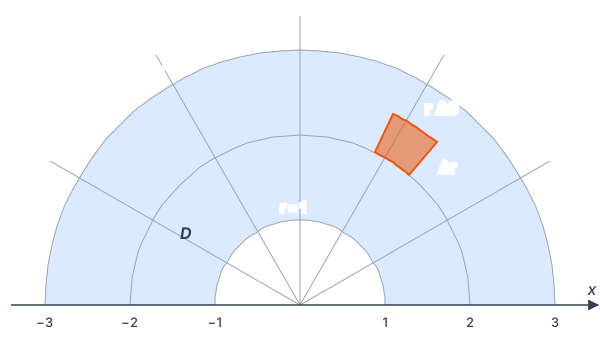
In x and y, you cut a region into small rectangles of area Δx Δy. In polar coordinates, you cut it with circles (r = constant) and rays (θ = constant). Each piece is a polar rectangle: a thin curved box.
Its depth is Δr. Its width is an arc of a circle of radius r, which has length r Δθ (see arc length). So its area is about r Δr Δθ. Pieces far from the origin are wider, and the factor r accounts for that.
Double integral in polar coordinates formula
\iint_D f(x, y)\,dA = \int_{\alpha}^{\beta} \int_{r_1(\theta)}^{r_2(\theta)} f(r\cos\theta, r\sin\theta)\,r\,dr\,d\theta- Describe the region with r and θ. A disk of radius a centered at the origin is 0 ≤ r ≤ a and 0 ≤ θ ≤ 2π.
- Replace x with r cos θ and y with r sin θ. Replace x² + y² with r².
- Replace dA with r dr dθ. Do not forget the extra r.
- Integrate in r first, then in θ.
Double integrals in polar coordinates examples
Example 1: A function of x² + y² on a disk
Evaluate \iint_D (x^2 + y^2)\,dA, where D is the disk x² + y² ≤ 4.
0 \le r \le 2, \quad 0 \le \theta \le 2\pi
The disk has radius 2 and goes all the way around.
\iint_D (x^2 + y^2)\,dA = \int_0^{2\pi} \int_0^2 r^2 \cdot r\,dr\,d\thetaReplace x² + y² with r² and dA with r dr dθ.
\int_0^2 r^3\,dr = \Big[\dfrac{r^4}{4}\Big]_0^2Multiply r² · r = r³ and integrate in r.
= 4
Substitute r = 2 and r = 0.
\int_0^{2\pi} 4\,d\theta = 8\piIntegrate in θ: 4 · 2π.
Answer: 8π ≈ 25.13. In x and y, this needs limits like ±√(4 − x²) and a much harder integral.
Example 2: A half ring
Evaluate \iint_D y\,dA, where D is the upper half of the ring between the circles x² + y² = 1 and x² + y² = 9.
1 \le r \le 3, \quad 0 \le \theta \le \pi
Describe the half ring: radii from 1 to 3, angles from 0 to π.
\iint_D y\,dA = \int_0^{\pi} \int_1^3 (r\sin\theta)\,r\,dr\,d\thetaReplace y with r sin θ and dA with r dr dθ.
\int_1^3 r^2 \sin\theta\,dr = \sin\theta\Big[\dfrac{r^3}{3}\Big]_1^3Integrate in r. The factor sin θ is a constant.
= \dfrac{26}{3}\sin\thetaSubstitute: 27/3 − 1/3 = 26/3.
\int_0^{\pi} \dfrac{26}{3}\sin\theta\,d\theta = \dfrac{26}{3}\Big[-\cos\theta\Big]_0^{\pi}Integrate in θ.
= \dfrac{26}{3}(1 + 1)Substitute: −cos π = 1 and −cos 0 = −1, so the bracket is 1 − (−1).
= \dfrac{52}{3}Multiply.
Answer: 52/3 ≈ 17.33.
Example 3: An integral you can’t do in x and y
Evaluate \iint_D e^{-(x^2 + y^2)}\,dA, where D is the disk x² + y² ≤ 9.
\iint_D e^{-(x^2 + y^2)}\,dA = \int_0^{2\pi} \int_0^3 e^{-r^2}\,r\,dr\,d\thetaReplace x² + y² with r² and dA with r dr dθ.
\int_0^3 e^{-r^2}\,r\,dr = \Big[-\dfrac{1}{2}e^{-r^2}\Big]_0^3Integrate in r with u-substitution, u = −r², du = −2r dr.
= -\dfrac{1}{2}e^{-9} + \dfrac{1}{2}Substitute r = 3 and r = 0, using e⁰ = 1.
= \dfrac{1 - e^{-9}}{2}Combine.
\int_0^{2\pi} \dfrac{1 - e^{-9}}{2}\,d\theta = \pi(1 - e^{-9})Integrate in θ: multiply by 2π.
\pi(1 - e^{-9}) \approx 3.1412Evaluate.
Answer: π(1 − e⁻⁹) ≈ 3.1412. The function e^(−x²) has no elementary antiderivative, so the extra r is what makes this work.
Example 4: Convert an iterated integral to polar
Evaluate \int_0^2 \int_0^{\sqrt{4 - x^2}} (x + y)\,dy\,dx by switching to polar coordinates.
0 \le x \le 2, \quad 0 \le y \le \sqrt{4 - x^2}Read the region. The top edge y = √(4 − x²) is the upper half of x² + y² = 4.
0 \le r \le 2, \quad 0 \le \theta \le \dfrac{\pi}{2}The region is the quarter disk of radius 2 in the first quadrant.
\int_0^{\pi/2} \int_0^2 (r\cos\theta + r\sin\theta)\,r\,dr\,d\thetaReplace x, y and dA.
\int_0^2 r^2(\cos\theta + \sin\theta)\,dr = \dfrac{8}{3}(\cos\theta + \sin\theta)Integrate in r: the integral of r² from 0 to 2 is 8/3.
\int_0^{\pi/2} \dfrac{8}{3}(\cos\theta + \sin\theta)\,d\theta = \dfrac{8}{3}\Big[\sin\theta - \cos\theta\Big]_0^{\pi/2}Integrate in θ.
= \dfrac{8}{3}\Big((1 - 0) - (0 - 1)\Big)Substitute θ = π/2 and θ = 0.
= \dfrac{16}{3}Simplify: (8/3)(2).
Answer: 16/3.
Example 5: Air inside a dome
A dome-shaped tent has the roof z = 9 − x² − y² over a circular floor, in feet. Find the volume of air inside.
9 - r^2 = 0 \Rightarrow r = 3
The roof meets the floor (z = 0) on the circle of radius 3.
V = \int_0^{2\pi} \int_0^3 (9 - r^2)\,r\,dr\,d\thetaSet up the volume over the disk 0 ≤ r ≤ 3.
\int_0^3 (9r - r^3)\,dr = \Big[\dfrac{9r^2}{2} - \dfrac{r^4}{4}\Big]_0^3Distribute the r and integrate.
= \dfrac{81}{2} - \dfrac{81}{4}Substitute r = 3. The value at r = 0 is 0.
= \dfrac{81}{4}Subtract.
\int_0^{2\pi} \dfrac{81}{4}\,d\theta = \dfrac{81\pi}{2}Integrate in θ: multiply by 2π.
\dfrac{81\pi}{2} \approx 127.2Evaluate.
Answer: about 127.2 ft³ of air.
Common mistakes
| Mistake | Example of the error | Fix |
|---|---|---|
| Forgetting the extra r | Using r² dr dθ in Example 1 and getting 16π/3 | Always write dA = r dr dθ. Example 1 needs r² · r = r³. |
| Wrong range for θ | Using 0 to π for a full disk | A full circle is 0 to 2π. The upper half is 0 to π. The first quadrant is 0 to π/2. |
| Replacing x² + y² with r | Writing e^(−r) in Example 3 | x² + y² = r², and √(x² + y²) = r. |
| Leaving x or y in the integrand | \int\int x\,r\,dr\,d\theta | Replace x with r cos θ and y with r sin θ before integrating. |
| Using the wrong center | Treating x² + y² ≤ 4 as radius 4 | The radius is the square root: x² + y² ≤ 4 means r ≤ 2. |
Related methods
Area of a polar region
With f = 1, the double integral gives the area: A = \int_{\alpha}^{\beta} \int_0^{r(\theta)} r\,dr\,d\theta = \int_{\alpha}^{\beta} \dfrac{1}{2}r(\theta)^2\,d\theta. That is the area in polar coordinates formula from Calculus 2.
Regions bounded by polar curves
The inner limits can depend on θ. For the disk inside r = 2 cos θ, use −π/2 ≤ θ ≤ π/2 and 0 ≤ r ≤ 2 cos θ, as in Practice 7.
When to stay in x and y
If the region is a rectangle or a triangle with straight sides, x and y are usually simpler. Polar coordinates pay off for circles and for integrands with x² + y².
Practice problems
- Use a polar double integral to find the area of the disk x² + y² ≤ 25.
- Evaluate \iint_D (x^2 + y^2)\,dA over the ring 1 ≤ x² + y² ≤ 4.
- Evaluate \iint_D x\,dA over the right half of the disk x² + y² ≤ 9.
- Evaluate \iint_D \sqrt{x^2 + y^2}\,dA over the disk x² + y² ≤ 9.
- Evaluate \iint_D e^{x^2 + y^2}\,dA over the disk x² + y² ≤ 1.
- Convert to polar and evaluate \int_{-1}^{1} \int_0^{\sqrt{1 - x^2}} (x^2 + y^2)^{3/2}\,dy\,dx.
- Use a double integral to find the area inside the circle r = 2 cos θ.
- Evaluate \iint_D xy\,dA over the quarter disk x² + y² ≤ 4 in the first quadrant.
- Find the volume under z = 4 − x² − y² and above the xy-plane.
- A sprinkler wets a disk of radius 6 m. The water depth is d = 0.03 − 0.005r meters at distance r from the sprinkler. How much water lands on the lawn?
Show answers
1.
A = \int_0^{2\pi} \int_0^5 r\,dr\,d\thetaUse f = 1 with 0 ≤ r ≤ 5 and 0 ≤ θ ≤ 2π.
\int_0^5 r\,dr = \Big[\dfrac{r^2}{2}\Big]_0^5Integrate in r.
= \dfrac{25}{2}Substitute r = 5 and r = 0.
\int_0^{2\pi} \dfrac{25}{2}\,d\theta = 25\piIntegrate in θ: multiply by 2π.
Answer: 25π ≈ 78.54, which matches πr²
2.
\int_0^{2\pi} \int_1^2 r^2 \cdot r\,dr\,d\thetaUse 1 ≤ r ≤ 2 and 0 ≤ θ ≤ 2π.
\int_1^2 r^3\,dr = \Big[\dfrac{r^4}{4}\Big]_1^2Integrate in r.
= 4 - \dfrac{1}{4}Substitute r = 2 and r = 1.
= \dfrac{15}{4}Subtract.
\int_0^{2\pi} \dfrac{15}{4}\,d\theta = \dfrac{15\pi}{2}Multiply by 2π.
Answer: 15π/2 ≈ 23.56
3.
-\dfrac{\pi}{2} \le \theta \le \dfrac{\pi}{2}, \quad 0 \le r \le 3The right half is where x ≥ 0.
\int_{-\pi/2}^{\pi/2} \int_0^3 (r\cos\theta)\,r\,dr\,d\thetaReplace x and dA.
\int_0^3 r^2\,dr = 9
Integrate in r: 27/3 = 9.
\int_{-\pi/2}^{\pi/2} 9\cos\theta\,d\theta = 9\Big[\sin\theta\Big]_{-\pi/2}^{\pi/2}Integrate in θ.
= 9(1 - (-1))
Substitute θ = π/2 and θ = −π/2.
= 18
Multiply.
Answer: 18
4.
\int_0^{2\pi} \int_0^3 r \cdot r\,dr\,d\thetaReplace √(x² + y²) with r and dA with r dr dθ.
\int_0^3 r^2\,dr = 9
Integrate in r.
\int_0^{2\pi} 9\,d\theta = 18\piMultiply by 2π.
Answer: 18π ≈ 56.55
5.
\int_0^{2\pi} \int_0^1 e^{r^2}\,r\,dr\,d\thetaReplace x² + y² with r² and dA with r dr dθ.
\int_0^1 e^{r^2}\,r\,dr = \Big[\dfrac{e^{r^2}}{2}\Big]_0^1Integrate in r with u = r².
= \dfrac{e - 1}{2}Substitute r = 1 and r = 0.
\int_0^{2\pi} \dfrac{e - 1}{2}\,d\theta = \pi(e - 1)Multiply by 2π.
Answer: π(e − 1) ≈ 5.398
6.
0 \le r \le 1, \quad 0 \le \theta \le \pi
The region is the upper half of the unit disk.
\int_0^{\pi} \int_0^1 r^3 \cdot r\,dr\,d\thetaReplace (x² + y²)^(3/2) with r³ and dA with r dr dθ.
\int_0^1 r^4\,dr = \dfrac{1}{5}Integrate in r.
\int_0^{\pi} \dfrac{1}{5}\,d\theta = \dfrac{\pi}{5}Multiply by π.
Answer: π/5 ≈ 0.628
7.
-\dfrac{\pi}{2} \le \theta \le \dfrac{\pi}{2}, \quad 0 \le r \le 2\cos\thetaThe circle r = 2 cos θ is traced once for these angles.
\int_0^{2\cos\theta} r\,dr = \Big[\dfrac{r^2}{2}\Big]_0^{2\cos\theta}Integrate in r with f = 1.
= 2\cos^2\theta
Substitute: (2 cos θ)²/2.
= 1 + \cos 2\theta
Use cos² θ = (1 + cos 2θ)/2 (see double angle formulas).
\int_{-\pi/2}^{\pi/2} (1 + \cos 2\theta)\,d\theta = \Big[\theta + \dfrac{\sin 2\theta}{2}\Big]_{-\pi/2}^{\pi/2}Integrate in θ.
= \dfrac{\pi}{2} - \Big(-\dfrac{\pi}{2}\Big)Substitute θ = π/2 and θ = −π/2; sin π = sin(−π) = 0.
= \pi
Subtract.
Answer: π, the area of a circle of radius 1
8.
\int_0^{\pi/2} \int_0^2 (r\cos\theta)(r\sin\theta)\,r\,dr\,d\thetaReplace x, y and dA.
\int_0^2 r^3\,dr = 4
Integrate in r: 16/4 = 4.
\int_0^{\pi/2} 4\sin\theta\cos\theta\,d\theta = 4\Big[\dfrac{\sin^2\theta}{2}\Big]_0^{\pi/2}Integrate in θ with u = sin θ.
= 4 \cdot \dfrac{1}{2}Substitute: sin²(π/2) = 1 and sin² 0 = 0.
= 2
Multiply.
Answer: 2
9.
4 - r^2 = 0 \Rightarrow r = 2
The surface meets the xy-plane on the circle of radius 2.
\int_0^2 (4 - r^2)\,r\,dr = \Big[2r^2 - \dfrac{r^4}{4}\Big]_0^2Distribute the r and integrate.
= 8 - 4
Substitute r = 2. The value at r = 0 is 0.
= 4
Subtract.
\int_0^{2\pi} 4\,d\theta = 8\piMultiply by 2π.
Answer: 8π ≈ 25.13 cubic units
10.
V = \int_0^{2\pi} \int_0^6 (0.03 - 0.005r)\,r\,dr\,d\thetaTotal water = depth integrated over the disk.
\int_0^6 (0.03r - 0.005r^2)\,dr = \Big[0.015r^2 - \dfrac{0.005r^3}{3}\Big]_0^6Distribute the r and integrate.
= 0.54 - 0.36
Substitute r = 6: 0.015 · 36 = 0.54 and 0.005 · 216/3 = 0.36.
= 0.18
Subtract.
\int_0^{2\pi} 0.18\,d\theta = 0.36\piMultiply by 2π.
0.36\pi \approx 1.131
Evaluate.
Answer: about 1.13 m³ of water
Double integrals in polar coordinates FAQ
Why is there an extra r in polar double integrals?
A small polar rectangle has depth Δr and curved width r Δθ, so its area is r Δr Δθ. Without the r, pieces far from the origin would count as too small.
When should I use polar coordinates for a double integral?
Use them when the region is a disk, a ring, a sector or a region bounded by a polar curve. They also help when the integrand contains x² + y², as in e^(−(x² + y²)).
How do you convert a double integral to polar coordinates?
Describe the region with r and θ, replace x with r cos θ and y with r sin θ, and replace dA with r dr dθ. Then integrate in r first and θ second.
What are the limits for a full disk in polar coordinates?
For the disk x² + y² ≤ a², use 0 ≤ r ≤ a and 0 ≤ θ ≤ 2π.
Summary
- Polar substitution: x = r cos θ, y = r sin θ, x² + y² = r².
- The area piece is dA = r dr dθ; never drop the extra r.
- Disk of radius a: 0 ≤ r ≤ a, 0 ≤ θ ≤ 2π. Use smaller θ ranges for halves and quarters.
- Inner limits on r can depend on θ, as for r = 2 cos θ.
- Use polar coordinates for round regions and for integrands with x² + y².
Previous lesson: Double Integrals over General Regions
Next lesson: Applications of Double Integrals
Back to the Calculus 3 Index