
Applications of Double Integrals
Applications of double integrals add up a quantity spread over a flat region. With a density ρ(x, y), the double integral of ρ gives the mass of a thin plate. Dividing its moments by the mass gives the center of mass. The double integral of √(1 + fx² + fy²) gives the area of a surface z = f(x, y).
Before this lesson: Double Integrals in Polar Coordinates, Center of Mass and Partial Derivatives
Adding up mass, balance and area
Think of a thin metal plate shaped like a region D. A small piece of area ΔA with density ρ(x, y) has mass about ρ ΔA. Adding all the pieces gives the total mass, a double integral.
To find the balance point, weight each piece’s position by its mass. These sums are the moments. Divide each moment by the total mass to get the average position, which is the center of mass. If the density is constant, this point is the centroid.
Mass, center of mass and surface area formulas
m = \iint_D \rho(x, y)\,dA
M_y = \iint_D x\,\rho(x, y)\,dA, \qquad M_x = \iint_D y\,\rho(x, y)\,dA
\bar{x} = \dfrac{M_y}{m}, \qquad \bar{y} = \dfrac{M_x}{m}S = \iint_D \sqrt{1 + f_x^2 + f_y^2}\,dAMy is the moment about the y-axis, so it uses x, the distance from that axis. Mx uses y. In the surface area formula, fx and fy are the partial derivatives of the surface, and D is the shadow of the surface in the xy-plane.
Applications of double integrals examples
Example 1: Mass of a plate
A square plate covers [0, 2] × [0, 2], in meters. Its density is ρ(x, y) = 1 + x + y kilograms per square meter. Find its mass.
m = \int_0^2 \int_0^2 (1 + x + y)\,dy\,dx
Integrate the density over the square.
\int_0^2 (1 + x + y)\,dy = \Big[y + xy + \dfrac{y^2}{2}\Big]_0^2Integrate in y.
= 2 + 2x + 2
Substitute y = 2. The value at y = 0 is 0.
= 4 + 2x
Combine like terms.
\int_0^2 (4 + 2x)\,dx = \Big[4x + x^2\Big]_0^2
Integrate in x.
= 8 + 4
Substitute x = 2. The value at x = 0 is 0.
= 12
Add.
Answer: the plate has a mass of 12 kg.
Example 2: Center of mass of the same plate
Find the center of mass of the plate in Example 1.
M_y = \int_0^2 \int_0^2 x(1 + x + y)\,dy\,dx
Weight each piece by its distance x from the y-axis.
\int_0^2 (x + x^2 + xy)\,dy = \Big[xy + x^2 y + \dfrac{xy^2}{2}\Big]_0^2Distribute x and integrate in y.
= 2x + 2x^2 + 2x
Substitute y = 2. The value at y = 0 is 0.
= 4x + 2x^2
Combine like terms.
\int_0^2 (4x + 2x^2)\,dx = \Big[2x^2 + \dfrac{2x^3}{3}\Big]_0^2Integrate in x.
= 8 + \dfrac{16}{3}Substitute x = 2. The value at x = 0 is 0.
= \dfrac{40}{3}Add.
\bar{x} = \dfrac{40/3}{12}Divide the moment by the mass from Example 1.
= \dfrac{10}{9}Simplify: 40/36 = 10/9.
\bar{y} = \dfrac{10}{9}The density 1 + x + y treats x and y the same way, and so does the square. So Mx = My.
Answer: the center of mass is (10/9, 10/9) ≈ (1.11, 1.11). It sits a little above and right of the center (1, 1), toward the heavier corner.
Example 3: A triangle with changing density
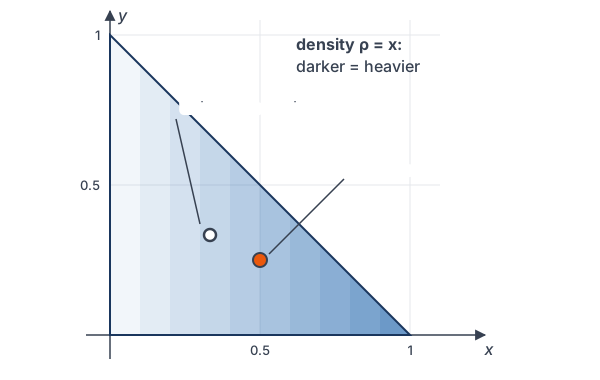
A thin plate is the triangle with corners (0, 0), (1, 0) and (0, 1). Its density is ρ = x. Find its center of mass.
m = \int_0^1 \int_0^{1 - x} x\,dy\,dxThe slanted edge is y = 1 − x.
\int_0^{1 - x} x\,dy = x - x^2Integrate in y and substitute: x(1 − x).
\int_0^1 (x - x^2)\,dx = \dfrac{1}{2} - \dfrac{1}{3}Integrate in x and substitute x = 1.
= \dfrac{1}{6}Subtract.
M_y = \int_0^1 \int_0^{1 - x} x^2\,dy\,dxSet up the moment about the y-axis: x · ρ = x².
\int_0^{1 - x} x^2\,dy = x^2 - x^3Integrate in y and substitute.
\int_0^1 (x^2 - x^3)\,dx = \dfrac{1}{3} - \dfrac{1}{4}Integrate in x and substitute x = 1.
= \dfrac{1}{12}Subtract.
\bar{x} = \dfrac{1/12}{1/6} = \dfrac{1}{2}Divide by the mass.
M_x = \int_0^1 \int_0^{1 - x} xy\,dy\,dxSet up the moment about the x-axis: y · ρ = xy.
\int_0^{1 - x} xy\,dy = \dfrac{x(1 - x)^2}{2}Integrate in y and substitute.
= \dfrac{x - 2x^2 + x^3}{2}Expand (1 − x)² and multiply by x.
\int_0^1 \dfrac{x - 2x^2 + x^3}{2}\,dx = \dfrac{1}{2}\Big(\dfrac{1}{2} - \dfrac{2}{3} + \dfrac{1}{4}\Big)Integrate in x and substitute x = 1.
= \dfrac{1}{24}Simplify: 1/2 − 2/3 + 1/4 = 1/12, and half of that is 1/24.
\bar{y} = \dfrac{1/24}{1/6} = \dfrac{1}{4}Divide by the mass.
Answer: the center of mass is (1/2, 1/4). The uniform triangle balances at (1/3, 1/3), but this plate is heavier on the right, so the balance point moves right.
Example 4: Centroid of a half disk
Find the centroid of the upper half of the disk x² + y² ≤ 9, with constant density ρ = 1.
m = \dfrac{1}{2}\pi(3)^2 = \dfrac{9\pi}{2}With ρ = 1, the mass is the area of the half disk.
\bar{x} = 0The half disk is symmetric about the y-axis.
M_x = \int_0^{\pi} \int_0^3 (r\sin\theta)\,r\,dr\,d\thetaSet up Mx in polar coordinates: y = r sin θ and dA = r dr dθ.
\int_0^3 r^2\,dr = 9
Integrate in r: 27/3 = 9.
\int_0^{\pi} 9\sin\theta\,d\theta = 9 \cdot 2Integrate in θ: the integral of sin θ from 0 to π is 2.
= 18
Multiply.
\bar{y} = \dfrac{18}{9\pi/2}Divide the moment by the mass.
= \dfrac{4}{\pi} \approx 1.273Simplify: 18 · 2/(9π) = 4/π.
Answer: the centroid is (0, 4/π) ≈ (0, 1.273). In general, a half disk of radius a balances at height 4a/(3π).
Example 5: Glass for a bowl-shaped skylight
A skylight has the shape of the surface z = x² + y² from z = 0 up to z = 4, in meters. How much glass does it need?
f_x = 2x, \quad f_y = 2y
Find the partial derivatives of f(x, y) = x² + y².
\sqrt{1 + 4x^2 + 4y^2} = \sqrt{1 + 4r^2}Substitute into the formula and use x² + y² = r².
x^2 + y^2 \le 4 \Rightarrow 0 \le r \le 2
The shadow D is the disk where z ≤ 4.
S = \int_0^{2\pi} \int_0^2 \sqrt{1 + 4r^2}\,r\,dr\,d\thetaSet up the surface area in polar coordinates.
\int_0^2 \sqrt{1 + 4r^2}\,r\,dr = \Big[\dfrac{1}{12}(1 + 4r^2)^{3/2}\Big]_0^2Integrate in r with u-substitution, u = 1 + 4r², du = 8r dr.
= \dfrac{17^{3/2} - 1}{12}Substitute r = 2 and r = 0.
\int_0^{2\pi} \dfrac{17^{3/2} - 1}{12}\,d\theta = \dfrac{\pi}{6}\Big(17\sqrt{17} - 1\Big)Multiply by 2π.
\dfrac{\pi}{6}\Big(17\sqrt{17} - 1\Big) \approx 36.18Evaluate.
Answer: about 36.18 m² of glass. The flat disk underneath has area 4π ≈ 12.57 m², so the curved surface needs almost three times as much.
Common mistakes
| Mistake | Example of the error | Fix |
|---|---|---|
| Mixing up Mx and My | Using x ρ to find ȳ | My uses x and gives x̄. Mx uses y and gives ȳ. |
| Forgetting to divide by the mass | Reporting 40/3 as x̄ in Example 2 | The center of mass is moment ÷ mass: (40/3) ÷ 12 = 10/9. |
| Leaving out the density in the moments | Using \iint x\,dA for a plate with ρ = x | The moment is \iint x\,\rho\,dA, which is \iint x^2\,dA here. |
| Forgetting the 1 under the square root | S = \iint \sqrt{f_x^2 + f_y^2}\,dA | The formula is √(1 + fx² + fy²). A flat surface must give back the area of D. |
| Integrating over the wrong region for surface area | Using z from 0 to 4 as limits | D is the shadow in the xy-plane. For Example 5, it is the disk r ≤ 2. |
Related methods
Center of mass with single integrals
For a plate with constant density, the center of mass lesson in Calculus 2 uses single integrals of strips. Double integrals give the same answers and also handle density that changes with both x and y.
Average value and totals
The same idea gives totals of anything with a density: people per square kilometer, rainfall per square meter or charge per square centimeter. Dividing a total by the area gives the average value, as in double integrals.
Moments of inertia
In physics, the moments of inertia Ix = ∬ y² ρ dA and Iy = ∬ x² ρ dA measure how hard a plate is to spin about each axis.
Practice problems
- Find the mass of the rectangle [0, 3] × [0, 2] with density ρ = xy.
- Find the mass of the disk x² + y² ≤ 4 with density ρ = √(x² + y²).
- Find the center of mass of the square [0, 1] × [0, 1] with density ρ = x.
- Find the centroid of the region under y = x² for 0 ≤ x ≤ 1.
- Find the centroid of the quarter disk x² + y² ≤ 4 in the first quadrant.
- Find the area of the part of the plane z = 2x + 2y + 1 above [0, 1] × [0, 2].
- Find the area of the part of the plane z = 6 − 2x − 3y in the first octant.
- Find the area of the part of z = x² + y² below z = 1.
- A town is a disk of radius 5 km. Its population density is 3000 − 400r people per km² at distance r from the center. Estimate its population.
- Find the mass of the triangle with corners (0, 0), (2, 0) and (0, 2) and density ρ = 1 + x.
Show answers
1.
m = \Big(\int_0^3 x\,dx\Big)\Big(\int_0^2 y\,dy\Big)
The density xy is a product and the region is a rectangle, so split.
= \dfrac{9}{2} \cdot 2Integrate each factor: 9/2 and 4/2 = 2.
= 9
Multiply.
Answer: 9
2.
m = \int_0^{2\pi} \int_0^2 r \cdot r\,dr\,d\thetaReplace √(x² + y²) with r and dA with r dr dθ.
\int_0^2 r^2\,dr = \dfrac{8}{3}Integrate in r.
\int_0^{2\pi} \dfrac{8}{3}\,d\theta = \dfrac{16\pi}{3}Multiply by 2π.
Answer: 16π/3 ≈ 16.76
3.
m = \iint x\,dA = \dfrac{1}{2}The integral of x over [0, 1] times the length 1 in y.
M_y = \iint x^2\,dA = \dfrac{1}{3}x · ρ = x².
\bar{x} = \dfrac{1/3}{1/2} = \dfrac{2}{3}Divide by the mass.
M_x = \iint xy\,dA = \dfrac{1}{2} \cdot \dfrac{1}{2}y · ρ = xy; split into two single integrals, each equal to 1/2.
= \dfrac{1}{4}Multiply.
\bar{y} = \dfrac{1/4}{1/2} = \dfrac{1}{2}Divide by the mass.
Answer: (2/3, 1/2)
4.
m = \int_0^1 \int_0^{x^2} 1\,dy\,dx = \int_0^1 x^2\,dxWith ρ = 1, the mass is the area. Integrate in y first.
= \dfrac{1}{3}Integrate in x.
M_y = \int_0^1 x \cdot x^2\,dx = \dfrac{1}{4}The inner integral of x dy is x · x².
\bar{x} = \dfrac{1/4}{1/3} = \dfrac{3}{4}Divide by the mass.
M_x = \int_0^1 \dfrac{x^4}{2}\,dx = \dfrac{1}{10}The inner integral of y dy from 0 to x² is x⁴/2.
\bar{y} = \dfrac{1/10}{1/3} = \dfrac{3}{10}Divide by the mass.
Answer: (3/4, 3/10)
5.
m = \dfrac{1}{4}\pi(2)^2 = \piThe area of the quarter disk.
M_y = \int_0^{\pi/2} \int_0^2 r\cos\theta \cdot r\,dr\,d\theta = 1 \cdot \dfrac{8}{3}The θ integral of cos θ is 1, and the r integral of r² is 8/3.
\bar{x} = \dfrac{8/3}{\pi} = \dfrac{8}{3\pi} \approx 0.849Divide by the mass.
\bar{y} = \dfrac{8}{3\pi}The quarter disk is symmetric about the line y = x.
Answer: (8/(3π), 8/(3π)) ≈ (0.849, 0.849)
6.
f_x = 2, \quad f_y = 2
Find the partial derivatives.
\sqrt{1 + 4 + 4} = 3The square root is a constant.
S = 3 \cdot \text{Area}(D) = 3 \cdot 2 = 6The area of [0, 1] × [0, 2] is 2.
Answer: 6
7.
f_x = -2, \quad f_y = -3
Find the partial derivatives.
\sqrt{1 + 4 + 9} = \sqrt{14}The square root is a constant.
\text{Area}(D) = \dfrac{1}{2}(3)(2) = 3D is the triangle under 2x + 3y = 6, with intercepts x = 3 and y = 2.
S = 3\sqrt{14} \approx 11.22Multiply.
Answer: 3√14 ≈ 11.22
8.
\sqrt{1 + 4r^2}As in Example 5, with D the disk r ≤ 1.
\int_0^1 \sqrt{1 + 4r^2}\,r\,dr = \dfrac{5^{3/2} - 1}{12}Use u = 1 + 4r² and substitute r = 1 and r = 0.
S = 2\pi \cdot \dfrac{5\sqrt{5} - 1}{12} = \dfrac{\pi}{6}\Big(5\sqrt{5} - 1\Big)Multiply by 2π.
\dfrac{\pi}{6}\Big(5\sqrt{5} - 1\Big) \approx 5.330Evaluate.
Answer: about 5.330
9.
P = \int_0^{2\pi} \int_0^5 (3000 - 400r)\,r\,dr\,d\thetaIntegrate the density over the disk in polar coordinates.
\int_0^5 (3000r - 400r^2)\,dr = \Big[1500r^2 - \dfrac{400r^3}{3}\Big]_0^5Distribute the r and integrate.
= 37{,}500 - 16{,}666.7Substitute r = 5.
= 20{,}833.3Subtract.
2\pi \cdot 20{,}833.3 \approx 130{,}900Multiply by 2π.
Answer: about 130,900 people
10.
m = \int_0^2 \int_0^{2 - x} (1 + x)\,dy\,dxThe slanted edge is y = 2 − x.
\int_0^{2 - x} (1 + x)\,dy = (1 + x)(2 - x)Integrate in y; 1 + x is a constant.
= 2 + x - x^2
Multiply the binomials (see multiplying binomials).
\int_0^2 (2 + x - x^2)\,dx = \Big[2x + \dfrac{x^2}{2} - \dfrac{x^3}{3}\Big]_0^2Integrate in x.
= 4 + 2 - \dfrac{8}{3}Substitute x = 2. The value at x = 0 is 0.
= \dfrac{10}{3}Simplify.
Answer: 10/3
Applications of double integrals FAQ
How do you find mass with a double integral?
Integrate the density over the region: m = ∬ ρ(x, y) dA. If the density is constant, the mass is the density times the area.
How do you find the center of mass of a lamina?
A lamina is a thin flat plate. Find its mass m and its moments My = ∬ xρ dA and Mx = ∬ yρ dA. Then x̄ = My/m and ȳ = Mx/m.
What is the difference between the centroid and the center of mass?
The centroid is the center of mass when the density is constant, so it depends only on the shape. With changing density, the center of mass moves toward the heavier part.
What is the surface area formula with a double integral?
For z = f(x, y) over a region D, S = ∬ √(1 + fx² + fy²) dA. The square root measures how much the surface tilts compared with the flat region below it.
Summary
- Mass: m = ∬ ρ dA.
- Moments: My = ∬ xρ dA and Mx = ∬ yρ dA.
- Center of mass: (x̄, ȳ) = (My/m, Mx/m). Use symmetry when you can.
- With constant density, the center of mass is the centroid.
- Surface area: S = ∬ √(1 + fx² + fy²) dA over the shadow D.
Previous lesson: Double Integrals in Polar Coordinates
Next lesson: Triple Integrals
Back to the Calculus 3 Index