
Triple Integrals
A triple integral adds up the values of f(x, y, z) over a solid region E in space. You evaluate triple integrals as iterated integrals, one variable at a time from the inside out, usually z first. With f = 1, the triple integral gives the volume of E. With a density f, it gives the mass.
Before this lesson: Double Integrals over General Regions, Applications of Double Integrals and 3D Coordinate System
From double integrals to triple integrals
A double integral adds up f over a flat region. A triple integral adds up f over a solid. Cut the solid into tiny boxes of volume ΔV, multiply each by the value of f there, and add. As the boxes shrink, the sum approaches the triple integral.
To compute it, stand at a point (x, y) of the floor region D and look straight up. A vertical column rises from a bottom surface z = u₁(x, y) to a top surface z = u₂(x, y). Integrate f up that column in z. Then do a double integral of the result over D.
Triple integral formula
\iiint_E f(x, y, z)\,dV = \iint_D \Big[\int_{u_1(x, y)}^{u_2(x, y)} f(x, y, z)\,dz\Big]\,dA\text{Volume of } E = \iiint_E 1\,dV- Sketch the solid. Find the bottom surface z = u₁(x, y) and the top surface z = u₂(x, y).
- Find D, the shadow of the solid on the xy-plane. Describe it as a Type I or Type II region.
- Integrate in z, then do the double integral over D from the inside out.
- For a box [a, b] × [c, d] × [p, q], all six limits are numbers, and any order works.
Triple integrals examples
Example 1: A box
Evaluate \iiint_B xyz\,dV, where B = [0, 1] × [0, 2] × [0, 3].
\int_0^3 xyz\,dz = xy\Big[\dfrac{z^2}{2}\Big]_0^3Integrate in z. Treat x and y as constants.
= \dfrac{9xy}{2}Substitute z = 3 and z = 0.
\int_0^2 \dfrac{9xy}{2}\,dy = \dfrac{9x}{2}\Big[\dfrac{y^2}{2}\Big]_0^2Integrate in y.
= 9x
Substitute: (9x/2)(2).
\int_0^1 9x\,dx = \Big[\dfrac{9x^2}{2}\Big]_0^1Integrate in x.
= \dfrac{9}{2}Substitute x = 1 and x = 0.
Answer: 9/2.
Example 2: Volume of a tetrahedron
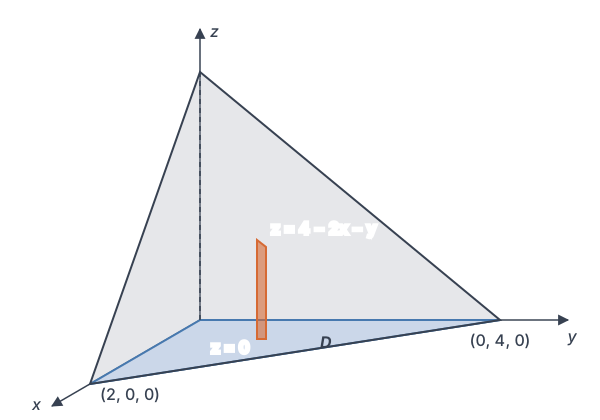
Find the volume of the solid in the first octant under the plane 2x + y + z = 4.
z = 4 - 2x - y
Solve the plane for z. The bottom surface is z = 0.
0 \le x \le 2, \quad 0 \le y \le 4 - 2x
The shadow D is the triangle under the line 2x + y = 4, where z = 0.
V = \int_0^2 \int_0^{4 - 2x} \int_0^{4 - 2x - y} 1\,dz\,dy\,dxSet up the volume.
\int_0^{4 - 2x - y} 1\,dz = 4 - 2x - yIntegrate in z.
\int_0^{4 - 2x} (4 - 2x - y)\,dy = \dfrac{(4 - 2x)^2}{2}Integrate in y. With c = 4 − 2x, this is c · c − c²/2 = c²/2.
= 8 - 8x + 2x^2
Square the binomial and divide by 2: (16 − 16x + 4x²)/2.
\int_0^2 (8 - 8x + 2x^2)\,dx = \Big[8x - 4x^2 + \dfrac{2x^3}{3}\Big]_0^2Integrate in x.
= 16 - 16 + \dfrac{16}{3}Substitute x = 2. The value at x = 0 is 0.
= \dfrac{16}{3}Simplify.
Answer: the volume is 16/3. Check with the volume of a pyramid: (1/3)(base area 4)(height 4) = 16/3.
Example 3: A function over a tetrahedron
Evaluate \iiint_E z\,dV, where E is the tetrahedron in the first octant under x + y + z = 1.
\int_0^{1 - x - y} z\,dz = \dfrac{(1 - x - y)^2}{2}Integrate in z from 0 up to the plane z = 1 − x − y.
\int_0^{1 - x} \dfrac{(1 - x - y)^2}{2}\,dy = \Big[-\dfrac{(1 - x - y)^3}{6}\Big]_0^{1 - x}Integrate in y with u-substitution, u = 1 − x − y.
= \dfrac{(1 - x)^3}{6}Substitute: at y = 1 − x the bracket is 0, and at y = 0 it is −(1 − x)³/6.
\int_0^1 \dfrac{(1 - x)^3}{6}\,dx = \Big[-\dfrac{(1 - x)^4}{24}\Big]_0^1Integrate in x with u = 1 − x.
= \dfrac{1}{24}Substitute x = 1 and x = 0.
Answer: 1/24.
Example 4: A solid with a curved side
Find the volume of the solid under the plane z = y and above the region D in the xy-plane between y = x² and y = 1.
x^2 = 1 \Rightarrow x = \pm 1
The curves meet at x = −1 and x = 1.
V = \int_{-1}^{1} \int_{x^2}^{1} \int_0^{y} 1\,dz\,dy\,dxThe column runs from z = 0 up to z = y over D.
\int_0^{y} 1\,dz = yIntegrate in z.
\int_{x^2}^{1} y\,dy = \dfrac{1 - x^4}{2}Integrate in y and substitute: 1/2 − x⁴/2.
\int_{-1}^{1} \dfrac{1 - x^4}{2}\,dx = \dfrac{1}{2}\Big[x - \dfrac{x^5}{5}\Big]_{-1}^{1}Integrate in x.
= \dfrac{1}{2}\Big(2 - \dfrac{2}{5}\Big)Substitute: (1 − 1/5) − (−1 + 1/5) = 2 − 2/5.
= \dfrac{4}{5}Simplify: (1/2)(8/5).
Answer: the volume is 4/5.
Example 5: Mass and balance height of a block
A cube of material fills [0, 2] × [0, 2] × [0, 2], in meters. It gets lighter toward the top: its density is ρ = 3 − z kilograms per cubic meter. Find its mass and the height of its center of mass.
m = \int_0^2 \int_0^2 \int_0^2 (3 - z)\,dz\,dy\,dx
Mass = density integrated over the cube.
\int_0^2 (3 - z)\,dz = \Big[3z - \dfrac{z^2}{2}\Big]_0^2Integrate in z.
= 6 - 2
Substitute z = 2. The value at z = 0 is 0.
= 4
Subtract.
m = 4 \cdot 4
The y and x integrals multiply by the floor area 2 · 2 = 4.
= 16
Multiply.
M_{xy} = \int_0^2 \int_0^2 \int_0^2 z(3 - z)\,dz\,dy\,dxSet up the moment about the floor: weight by height z.
\int_0^2 (3z - z^2)\,dz = \Big[\dfrac{3z^2}{2} - \dfrac{z^3}{3}\Big]_0^2Integrate in z.
= 6 - \dfrac{8}{3}Substitute z = 2. The value at z = 0 is 0.
= \dfrac{10}{3}Subtract.
M_{xy} = 4 \cdot \dfrac{10}{3}Multiply by the floor area.
= \dfrac{40}{3}Multiply.
\bar{z} = \dfrac{40/3}{16}Divide the moment by the mass.
= \dfrac{5}{6}Simplify: 40/48 = 5/6.
Answer: the mass is 16 kg, and the center of mass is 5/6 ≈ 0.83 m above the floor. That is below the middle height of 1 m, because the bottom is heavier.
Common mistakes
| Mistake | Example of the error | Fix |
|---|---|---|
| Numbers where the inner limits should be functions | Using z from 0 to 4 in Example 2 | The column stops at the top surface, so the upper limit is z = 4 − 2x − y. |
| A variable left in the outer limits | \int_0^{4 - 2x} \int_0^2 \int_0^{4 - 2x - y} \ldots\,dz\,dx\,dy | Only inner limits may contain outer variables. The outermost limits must be numbers. |
| Wrong shadow region D | Using the square [0, 2] × [0, 4] as D in Example 2 | D is where the solid sits on the floor: set z = 0 in the top surface to find its edge. |
| Integrating 1 when asked for a function | Finding the volume in Example 3 instead of the integral of z | Keep the integrand f; use 1 only for volume. |
| Mixing up dz and dy | Writing dy dz dx but using y limits on the inside | Each set of limits stays with its own differential, from the inside out. |
Related methods
Other orders of integration
There are six orders, such as dz dy dx or dx dz dy. Choose the one where the inner limits are easy to read from the solid. Project onto the plane that gives the simplest shadow.
Round solids
For cylinders, cones and spheres, the limits are simpler in cylindrical or spherical coordinates. Start with triple integrals in cylindrical coordinates; spherical coordinates come right after.
Triple integrals as double integrals
When f = 1, the inner integral is top − bottom, so the volume is ∬D (u₂ − u₁) dA. That is the volume under a surface from double integrals.
Practice problems
- Evaluate \int_0^1 \int_0^1 \int_0^1 (x + y + z)\,dz\,dy\,dx.
- Evaluate \int_0^2 \int_0^1 \int_0^3 x y^2 z\,dz\,dy\,dx.
- Evaluate \int_0^1 \int_0^{x} \int_0^{x + y} 1\,dz\,dy\,dx.
- Find the volume of the tetrahedron in the first octant under x + y + z = 3.
- Evaluate \iiint_E y\,dV, where E is given by 0 ≤ x ≤ 2, 0 ≤ y ≤ x and 0 ≤ z ≤ y.
- Find the volume of the solid between the paraboloid z = x² + y² and the plane z = 4.
- Evaluate \iiint_B e^{x + y + z}\,dV over the cube B = [0, 1] × [0, 1] × [0, 1].
- Find the volume of the solid under z = 4 − y² and above the rectangle 0 ≤ x ≤ 3, −2 ≤ y ≤ 2.
- Find the average value of f(x, y, z) = x + y + z over the cube [0, 2] × [0, 2] × [0, 2].
- A wedge-shaped block fills the tetrahedron in the first octant under x + y + z = 1, in meters. Its density is 2400z kilograms per cubic meter. Find its mass.
Show answers
1.
\int_0^1 (x + y + z)\,dz = x + y + \dfrac{1}{2}Integrate in z and substitute z = 1 and z = 0.
\int_0^1 \Big(x + y + \dfrac{1}{2}\Big)dy = x + 1Integrate in y: x + 1/2 + 1/2.
\int_0^1 (x + 1)\,dx = \dfrac{3}{2}Integrate in x: 1/2 + 1.
Answer: 3/2
2.
\Big(\int_0^2 x\,dx\Big)\Big(\int_0^1 y^2\,dy\Big)\Big(\int_0^3 z\,dz\Big)
The integrand is a product and the region is a box, so split.
= 2 \cdot \dfrac{1}{3} \cdot \dfrac{9}{2}Integrate each factor.
= 3
Multiply.
Answer: 3
3.
\int_0^{x + y} 1\,dz = x + yIntegrate in z.
\int_0^{x} (x + y)\,dy = x^2 + \dfrac{x^2}{2}Integrate in y and substitute y = x.
= \dfrac{3x^2}{2}Combine like terms.
\int_0^1 \dfrac{3x^2}{2}\,dx = \dfrac{1}{2}Integrate in x.
Answer: 1/2
4.
V = \int_0^3 \int_0^{3 - x} \int_0^{3 - x - y} 1\,dz\,dy\,dxThe top is z = 3 − x − y and D is the triangle under x + y = 3.
\int_0^{3 - x - y} 1\,dz = 3 - x - yIntegrate in z.
\int_0^{3 - x} (3 - x - y)\,dy = \dfrac{(3 - x)^2}{2}Integrate in y, as in Example 2.
\int_0^3 \dfrac{(3 - x)^2}{2}\,dx = \Big[-\dfrac{(3 - x)^3}{6}\Big]_0^3Integrate in x with u = 3 − x.
= \dfrac{27}{6}Substitute x = 3 and x = 0.
= \dfrac{9}{2}Reduce.
Answer: 9/2
5.
\int_0^{y} y\,dz = y^2Integrate in z: y · y.
\int_0^{x} y^2\,dy = \dfrac{x^3}{3}Integrate in y.
\int_0^2 \dfrac{x^3}{3}\,dx = \Big[\dfrac{x^4}{12}\Big]_0^2Integrate in x.
= \dfrac{16}{12}Substitute x = 2 and x = 0.
= \dfrac{4}{3}Reduce.
Answer: 4/3
6.
V = \iint_D (4 - x^2 - y^2)\,dA
The column runs from z = x² + y² up to z = 4.
x^2 + y^2 \le 4
D is where the surfaces meet or the paraboloid is lower: the disk of radius 2.
V = \int_0^{2\pi} \int_0^2 (4 - r^2)\,r\,dr\,d\thetaSwitch D to polar coordinates.
\int_0^2 (4r - r^3)\,dr = \Big[2r^2 - \dfrac{r^4}{4}\Big]_0^2Distribute the r and integrate.
= 8 - 4
Substitute r = 2. The value at r = 0 is 0.
= 4
Subtract.
V = 2\pi \cdot 4 = 8\pi
Integrate in θ: multiply by 2π.
Answer: 8π ≈ 25.13
7.
(e - 1)(e - 1)(e - 1)
Split e^(x + y + z) = e^x e^y e^z; each integral from 0 to 1 is e − 1.
(e - 1)^3 \approx 5.073
Evaluate: 1.71828³.
Answer: (e − 1)³ ≈ 5.073
8.
V = \int_0^3 \int_{-2}^{2} \int_0^{4 - y^2} 1\,dz\,dy\,dxColumns from z = 0 to z = 4 − y².
\int_0^{4 - y^2} 1\,dz = 4 - y^2Integrate in z.
\int_{-2}^{2} (4 - y^2)\,dy = \Big[4y - \dfrac{y^3}{3}\Big]_{-2}^{2}Integrate in y.
= \Big(8 - \dfrac{8}{3}\Big) - \Big(-8 + \dfrac{8}{3}\Big)Substitute y = 2 and y = −2.
= \dfrac{32}{3}Subtract: 16/3 + 16/3.
V = 3 \cdot \dfrac{32}{3} = 32Integrate in x: multiply by the length 3.
Answer: 32
9.
\iiint_B (x + y + z)\,dV = 3\iiint_B x\,dV
By symmetry, x, y and z each contribute the same.
\iiint_B x\,dV = \Big(\int_0^2 x\,dx\Big)(2)(2)
Split: the y and z lengths are 2 each.
= 2 \cdot 4
The x integral is 2.
= 8
Multiply.
3 \cdot 8 = 24
Multiply.
f_{\text{avg}} = \dfrac{24}{8} = 3Divide by the volume of the cube, 2³ = 8.
Answer: 3
10.
m = 2400\iiint_E z\,dV
Mass = density integrated over the solid.
\iiint_E z\,dV = \dfrac{1}{24}Use the result of Example 3, which is the same solid.
m = 2400 \cdot \dfrac{1}{24} = 100Multiply.
Answer: 100 kg
Triple integrals FAQ
What does a triple integral represent?
It adds up f(x, y, z) over a solid. With f = 1 it gives volume. With a density it gives mass, and with other functions it gives totals such as charge or heat.
How do you find the limits of a triple integral?
Find the bottom and top surfaces for the z limits. Then find the shadow D on the xy-plane and give it limits as in a double integral. The outer limits must be numbers.
How do you find volume with a triple integral?
Integrate 1 over the solid: V = ∭E 1 dV. The inner z integral gives the height of each column, top minus bottom.
Does the order of integration matter in a triple integral?
For a continuous function, every correct order gives the same answer. The work can be much easier in one order, so pick the order with the simplest limits.
Summary
- A triple integral adds f(x, y, z) dV over a solid E.
- Integrate in z from the bottom surface to the top surface, then over the shadow D.
- Inner limits can contain outer variables; the outermost limits are numbers.
- Volume: integrate 1. Mass: integrate the density.
- Center of mass: divide each moment by the mass.
Previous lesson: Applications of Double Integrals
Next lesson: Triple Integrals in Cylindrical Coordinates
Back to the Calculus 3 Index