
Triple Integrals in Cylindrical Coordinates
Triple integrals in cylindrical coordinates use r, θ and z in place of x, y and z. You write x = r cos θ and y = r sin θ, keep z, and replace dV with r dz dr dθ. This makes integrals over cylinders, cones and paraboloids much easier, because their limits become constants or simple functions of r.
Before this lesson: Triple Integrals, Double Integrals in Polar Coordinates and Polar Coordinates
What cylindrical coordinates are
Cylindrical coordinates are polar coordinates on the floor plus a height. A point P has a distance r from the z-axis, an angle θ measured from the positive x-axis, and the same height z as before.
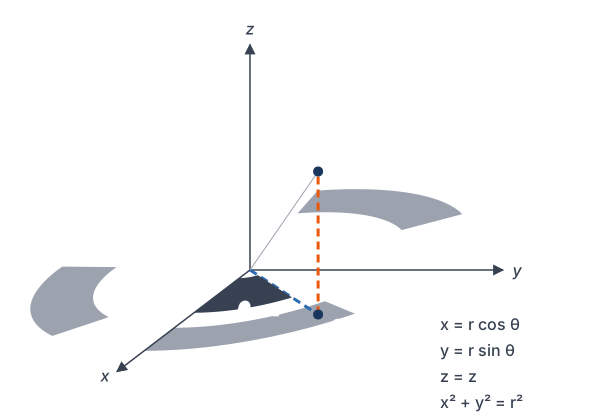
Shapes that are round about the z-axis have simple equations in these coordinates. The cylinder x² + y² = 4 is just r = 2. The paraboloid z = x² + y² is z = r². The cone z = √(x² + y²) is z = r.
Triple integral in cylindrical coordinates formula
x = r\cos\theta, \quad y = r\sin\theta, \quad z = z, \quad x^2 + y^2 = r^2
\iiint_E f(x, y, z)\,dV = \int_{\alpha}^{\beta} \int_{h_1(\theta)}^{h_2(\theta)} \int_{u_1(r, \theta)}^{u_2(r, \theta)} f(r\cos\theta, r\sin\theta, z)\,r\,dz\,dr\,d\thetaThe extra factor r is the same one you met in double integrals in polar coordinates. A small cylindrical box has sides dr, r dθ and dz, so its volume is dV = r dz dr dθ.
- Find the bottom surface z = u₁ and the top surface z = u₂, written in r and θ.
- Find the shadow D of the solid on the xy-plane, and describe it in polar form: θ from α to β, r from h₁(θ) to h₂(θ).
- Replace x² + y² with r², x with r cos θ and y with r sin θ.
- Multiply by r, then integrate in z, then r, then θ.
Triple integrals in cylindrical coordinates examples
Example 1: A function over a cylinder
Evaluate \iiint_E z\,dV, where E is the solid cylinder x² + y² ≤ 4, 0 ≤ z ≤ 3.
0 \le \theta \le 2\pi, \quad 0 \le r \le 2, \quad 0 \le z \le 3
The shadow is a disk of radius 2, and the solid runs from z = 0 to z = 3.
\iiint_E z\,dV = \int_0^{2\pi} \int_0^2 \int_0^3 z\,r\,dz\,dr\,d\thetaSet up. Do not forget the factor r.
\int_0^3 z\,r\,dz = r\Big[\dfrac{z^2}{2}\Big]_0^3Integrate in z. Treat r as a constant.
= \dfrac{9r}{2}Substitute z = 3 and z = 0.
\int_0^2 \dfrac{9r}{2}\,dr = \Big[\dfrac{9r^2}{4}\Big]_0^2Integrate in r.
= 9
Substitute r = 2 and r = 0.
\int_0^{2\pi} 9\,d\theta = 18\piIntegrate in θ: multiply by 2π.
Answer: 18π ≈ 56.55.
Example 2: Volume under a paraboloid
Find the volume of the solid under the paraboloid z = 9 − x² − y² and above the xy-plane.
z = 9 - r^2
Write the top surface in cylindrical coordinates.
9 - r^2 = 0 \Rightarrow r = 3
The paraboloid meets the floor z = 0 on the circle r = 3.
V = \int_0^{2\pi} \int_0^3 \int_0^{9 - r^2} r\,dz\,dr\,d\thetaSet up the volume: integrate 1 times r.
\int_0^{9 - r^2} r\,dz = (9 - r^2)rIntegrate in z: r times the height of the column.
= 9r - r^3
Distribute the r.
\int_0^3 (9r - r^3)\,dr = \Big[\dfrac{9r^2}{2} - \dfrac{r^4}{4}\Big]_0^3Integrate in r.
= \dfrac{81}{2} - \dfrac{81}{4}Substitute r = 3. The value at r = 0 is 0.
= \dfrac{81}{4}Subtract.
V = 2\pi \cdot \dfrac{81}{4}Integrate in θ: multiply by 2π.
= \dfrac{81\pi}{2}Simplify.
Answer: the volume is 81π/2 ≈ 127.23.
Example 3: Converting a rectangular integral
Evaluate \int_{-1}^{1} \int_{-\sqrt{1 - x^2}}^{\sqrt{1 - x^2}} \int_0^2 \sqrt{x^2 + y^2}\,dz\,dy\,dx.
-\sqrt{1 - x^2} \le y \le \sqrt{1 - x^2}, \quad -1 \le x \le 1Read the shadow: the y limits are the bottom and top halves of the circle x² + y² = 1.
0 \le \theta \le 2\pi, \quad 0 \le r \le 1
So D is the full disk of radius 1.
\sqrt{x^2 + y^2} = rConvert the integrand. The z limits stay 0 to 2.
\int_0^{2\pi} \int_0^1 \int_0^2 r \cdot r\,dz\,dr\,d\thetaRewrite the integral with the extra factor r.
\int_0^2 r^2\,dz = 2r^2
Integrate in z.
\int_0^1 2r^2\,dr = \Big[\dfrac{2r^3}{3}\Big]_0^1Integrate in r.
= \dfrac{2}{3}Substitute r = 1 and r = 0.
\int_0^{2\pi} \dfrac{2}{3}\,d\theta = \dfrac{4\pi}{3}Integrate in θ: multiply by 2π.
Answer: 4π/3 ≈ 4.19.
Example 4: The solid between a cone and a paraboloid
Find the volume of the solid that lies above the cone z = √(x² + y²) and below the paraboloid z = 2 − x² − y².
z = r \quad \text{and} \quad z = 2 - r^2Write both surfaces in cylindrical coordinates. The cone is the bottom.
r = 2 - r^2
Set the heights equal to find where the surfaces meet.
r^2 + r - 2 = 0
Move every term to one side.
(r + 2)(r - 1) = 0
Factor (see solving quadratic equations by factoring).
r = 1
Keep the root with r ≥ 0. So D is the disk of radius 1.
V = \int_0^{2\pi} \int_0^1 \int_r^{2 - r^2} r\,dz\,dr\,d\thetaSet up: z runs from the cone up to the paraboloid.
\int_r^{2 - r^2} r\,dz = r(2 - r^2 - r)Integrate in z: r times (top − bottom).
= 2r - r^3 - r^2
Distribute the r.
\int_0^1 (2r - r^3 - r^2)\,dr = \Big[r^2 - \dfrac{r^4}{4} - \dfrac{r^3}{3}\Big]_0^1Integrate in r.
= 1 - \dfrac{1}{4} - \dfrac{1}{3}Substitute r = 1. The value at r = 0 is 0.
= \dfrac{5}{12}Use the common denominator 12: 12/12 − 3/12 − 4/12.
V = 2\pi \cdot \dfrac{5}{12}Integrate in θ: multiply by 2π.
= \dfrac{5\pi}{6}Simplify.
Answer: the volume is 5π/6 ≈ 2.62. This solid looks like an ice cream cone with a rounded top.
Example 5: Mass of a log
A log stands upright. It is a solid cylinder of radius 0.5 m and height 2 m. The wood is denser near the bark: its density is ρ = 600 + 400r kilograms per cubic meter, where r is the distance from the center line. Find the mass of the log.
m = \int_0^{2\pi} \int_0^{0.5} \int_0^2 (600 + 400r)\,r\,dz\,dr\,d\thetaMass = density integrated over the solid. Put the z-axis along the center line.
(600 + 400r)r = 600r + 400r^2
Distribute the r.
\int_0^2 (600r + 400r^2)\,dz = 1200r + 800r^2
Integrate in z: multiply by the height 2.
\int_0^{0.5} (1200r + 800r^2)\,dr = \Big[600r^2 + \dfrac{800r^3}{3}\Big]_0^{0.5}Integrate in r.
= 600(0.25) + \dfrac{800(0.125)}{3}Substitute r = 0.5. The value at r = 0 is 0.
= 150 + \dfrac{100}{3}Multiply.
= \dfrac{550}{3}Add: 450/3 + 100/3.
m = 2\pi \cdot \dfrac{550}{3}Integrate in θ: multiply by 2π.
= \dfrac{1100\pi}{3} \approx 1151.9Simplify and evaluate.
Answer: the log has a mass of about 1152 kg. As a check, the volume is π(0.5)²(2) ≈ 1.571 m³, so the average density is about 733 kg/m³, between 600 and 800 as expected.
Common mistakes
| Mistake | Example of the error | Fix |
|---|---|---|
| Forgetting the factor r | Writing dz dr dθ alone in Example 2 and getting 36π | Always use dV = r dz dr dθ. |
| Converting x² + y² to r instead of r² | Writing the paraboloid z = 9 − x² − y² as z = 9 − r | x² + y² = r², and √(x² + y²) = r. |
| Wrong θ limits for a full disk | Using 0 ≤ θ ≤ π for the disk x² + y² ≤ 4 | A full turn is 0 ≤ θ ≤ 2π. Use 0 to π only for the upper half (y ≥ 0). |
| Bottom and top surfaces swapped | Integrating z from 2 − r² down to r in Example 4 | The lower surface goes in the lower limit. Test one point, such as r = 0. |
| Wrong intersection radius | Using r = 2 in Example 4 because the paraboloid has z = 2 at the top | Set the two surfaces equal and solve for r. |
Related methods
Converting points
To go from cylindrical to rectangular, use x = r cos θ and y = r sin θ. To go the other way, use r = √(x² + y²) and tan θ = y/x, choosing θ in the right quadrant. For example, (r, θ, z) = (2, π/3, 5) is the point (1, √3, 5).
When to use cylindrical coordinates
Use them when the solid is round about the z-axis or the integrand contains x² + y². Use rectangular coordinates for boxes and slanted planes, as in triple integrals. If the solid is round about a different axis, such as the y-axis, let r and θ describe the xz-plane instead.
Spheres
Cylindrical coordinates work for spheres, but the z limits become ±√(a² − r²). Spherical coordinates, the next lesson, often make sphere problems simpler.
Practice problems
- Evaluate \int_0^{2\pi} \int_0^1 \int_0^4 r\,dz\,dr\,d\theta. What solid does it measure?
- Evaluate \iiint_E (x^2 + y^2)\,dV, where E is the cylinder x² + y² ≤ 4, 0 ≤ z ≤ 1.
- Find the volume of the solid under z = 1 − x² − y² and above the xy-plane.
- Evaluate \iiint_E z\,dV, where E lies above the xy-plane, below the cone z = √(x² + y²) and inside the cylinder x² + y² = 4.
- Convert to cylindrical coordinates and evaluate: \int_{-2}^{2} \int_{-\sqrt{4 - x^2}}^{\sqrt{4 - x^2}} \int_0^3 1\,dz\,dy\,dx.
- Find the volume of the solid inside both the sphere x² + y² + z² = 4 and the cylinder x² + y² = 1.
- Evaluate \iiint_E x\,dV, where E is the part of the cylinder x² + y² ≤ 4, 0 ≤ z ≤ 3, in the first octant.
- Find the volume of the solid between the paraboloids z = x² + y² and z = 8 − x² − y².
- Evaluate \iiint_E \sqrt{x^2 + y^2}\,dV, where E lies above the cone z = √(x² + y²) and below the plane z = 2.
- A concrete pipe stands on end. Its inner radius is 1 m, its outer radius is 1.5 m and its height is 2 m. Concrete has a density of 2400 kg/m³. Find the volume of concrete and the mass of the pipe.
Show answers
1.
\int_0^4 r\,dz = 4r
Integrate in z.
\int_0^1 4r\,dr = 2
Integrate in r: [2r²] from 0 to 1.
\int_0^{2\pi} 2\,d\theta = 4\piIntegrate in θ.
Answer: 4π ≈ 12.57. It is the volume of a cylinder of radius 1 and height 4: π(1)²(4) = 4π.
2.
(x^2 + y^2)\,dV = r^2 \cdot r\,dz\,dr\,d\theta
Convert the integrand and include the factor r.
\int_0^1 r^3\,dz = r^3
Integrate in z.
\int_0^2 r^3\,dr = \Big[\dfrac{r^4}{4}\Big]_0^2 = 4Integrate in r.
\int_0^{2\pi} 4\,d\theta = 8\piIntegrate in θ.
Answer: 8π ≈ 25.13
3.
V = \int_0^{2\pi} \int_0^1 \int_0^{1 - r^2} r\,dz\,dr\,d\thetaThe top is z = 1 − r², which meets the floor at r = 1.
\int_0^{1 - r^2} r\,dz = r - r^3Integrate in z and distribute the r.
\int_0^1 (r - r^3)\,dr = \dfrac{1}{2} - \dfrac{1}{4}Integrate in r and substitute r = 1.
= \dfrac{1}{4}Subtract.
V = 2\pi \cdot \dfrac{1}{4} = \dfrac{\pi}{2}Integrate in θ.
Answer: π/2 ≈ 1.57
4.
\int_0^{2\pi} \int_0^2 \int_0^{r} z\,r\,dz\,dr\,d\thetaSet up: z runs from 0 up to the cone z = r.
\int_0^{r} z\,r\,dz = r \cdot \dfrac{r^2}{2} = \dfrac{r^3}{2}Integrate in z.
\int_0^2 \dfrac{r^3}{2}\,dr = \Big[\dfrac{r^4}{8}\Big]_0^2 = 2Integrate in r.
\int_0^{2\pi} 2\,d\theta = 4\piIntegrate in θ.
Answer: 4π ≈ 12.57
5.
0 \le \theta \le 2\pi, \quad 0 \le r \le 2
The shadow is the disk x² + y² ≤ 4.
\int_0^{2\pi} \int_0^2 \int_0^3 r\,dz\,dr\,d\thetaRewrite with the factor r.
\int_0^3 r\,dz = 3r
Integrate in z.
\int_0^2 3r\,dr = 6
Integrate in r: [3r²/2] from 0 to 2.
\int_0^{2\pi} 6\,d\theta = 12\piIntegrate in θ.
Answer: 12π ≈ 37.70 (a cylinder of radius 2 and height 3)
6.
-\sqrt{4 - r^2} \le z \le \sqrt{4 - r^2}, \quad 0 \le r \le 1Solve the sphere for z: z² = 4 − r².
\int_{-\sqrt{4 - r^2}}^{\sqrt{4 - r^2}} r\,dz = 2r\sqrt{4 - r^2}Integrate in z: r times (top − bottom).
\int_0^1 2r\sqrt{4 - r^2}\,dr = \Big[-\dfrac{2}{3}(4 - r^2)^{3/2}\Big]_0^1Integrate in r with u-substitution, u = 4 − r².
= -\dfrac{2}{3}(3)^{3/2} + \dfrac{2}{3}(4)^{3/2}Substitute r = 1 and r = 0.
= \dfrac{16}{3} - 2\sqrt{3}Simplify: 3^(3/2) = 3√3 and 4^(3/2) = 8.
V = 2\pi\Big(\dfrac{16}{3} - 2\sqrt{3}\Big) = \dfrac{32\pi}{3} - 4\sqrt{3}\,\piIntegrate in θ: multiply by 2π.
Answer: 32π/3 − 4√3 π ≈ 11.74
7.
0 \le \theta \le \dfrac{\pi}{2}The first octant is a quarter turn.
x\,dV = r\cos\theta \cdot r\,dz\,dr\,d\theta
Convert x and include the factor r.
\int_0^3 r^2\cos\theta\,dz = 3r^2\cos\theta
Integrate in z.
\int_0^2 3r^2\cos\theta\,dr = 8\cos\theta
Integrate in r: [r³] from 0 to 2 is 8.
\int_0^{\pi/2} 8\cos\theta\,d\theta = 8Integrate in θ: 8[sin θ] from 0 to π/2.
Answer: 8
8.
r^2 = 8 - r^2 \Rightarrow r = 2
The surfaces meet where 2r² = 8.
\int_{r^2}^{8 - r^2} r\,dz = 8r - 2r^3Integrate in z: r(8 − r² − r²).
\int_0^2 (8r - 2r^3)\,dr = 16 - 8 = 8
Integrate in r: [4r² − r⁴/2] from 0 to 2.
V = 2\pi \cdot 8 = 16\pi
Integrate in θ.
Answer: 16π ≈ 50.27
9.
r \le z \le 2, \quad 0 \le r \le 2
The cone z = r meets the plane z = 2 at r = 2.
\int_r^2 r \cdot r\,dz = r^2(2 - r) = 2r^2 - r^3
Integrate in z and distribute.
\int_0^2 (2r^2 - r^3)\,dr = \dfrac{16}{3} - 4 = \dfrac{4}{3}Integrate in r: [2r³/3 − r⁴/4] from 0 to 2.
2\pi \cdot \dfrac{4}{3} = \dfrac{8\pi}{3}Integrate in θ.
Answer: 8π/3 ≈ 8.38
10.
V = \int_0^{2\pi} \int_1^{1.5} \int_0^2 r\,dz\,dr\,d\thetaThe shadow is a ring: r runs from 1 to 1.5.
\int_0^2 r\,dz = 2r
Integrate in z.
\int_1^{1.5} 2r\,dr = 1.5^2 - 1^2 = 1.25Integrate in r: [r²] from 1 to 1.5.
V = 2\pi(1.25) = 2.5\pi \approx 7.854
Integrate in θ.
m = 2400 \cdot 2.5\pi = 6000\pi \approx 18850
Mass = density × volume, since the density is constant.
Answer: about 7.85 m³ of concrete and a mass of about 18,850 kg
Triple integrals in cylindrical coordinates FAQ
Why is there an extra r in cylindrical coordinates?
A small piece of the solid has sides dr, r dθ and dz. The arc side is r dθ because arcs farther from the z-axis are longer, so dV = r dz dr dθ.
When should I use cylindrical coordinates instead of rectangular?
Use them when the solid is a cylinder, cone or paraboloid around the z-axis, or when the integrand contains x² + y². Then the limits are much simpler.
What is the difference between cylindrical and spherical coordinates?
Cylindrical coordinates use the distance r from the z-axis, the angle θ and the height z. Spherical coordinates use the distance ρ from the origin and two angles, which suits spheres and cones.
How do you convert a triple integral to cylindrical coordinates?
Describe the shadow D in polar form, write the bottom and top surfaces in r and θ, replace x and y with r cos θ and r sin θ, and multiply by r.
Summary
- Cylindrical coordinates: x = r cos θ, y = r sin θ, z = z, and x² + y² = r².
- The volume element is dV = r dz dr dθ.
- Describe the shadow D in polar form, then integrate z from the bottom surface to the top surface.
- Cylinders become r = a, cones become z = kr, and paraboloids become z = a ± r².
- Use them for solids that are round about the z-axis.
Previous lesson: Triple Integrals
Next lesson: Triple Integrals in Spherical Coordinates
Back to the Calculus 3 Index