
Double Integrals over General Regions
Double integrals over general regions handle regions with curved or slanted edges. For a region where y runs from a bottom curve g₁(x) to a top curve g₂(x) as x goes from a to b, integrate y first between those curves, then x from a to b. The inner limits can be functions; the outer limits must be numbers.
Before this lesson: Double Integrals and Area Between Curves
From rectangles to curved regions
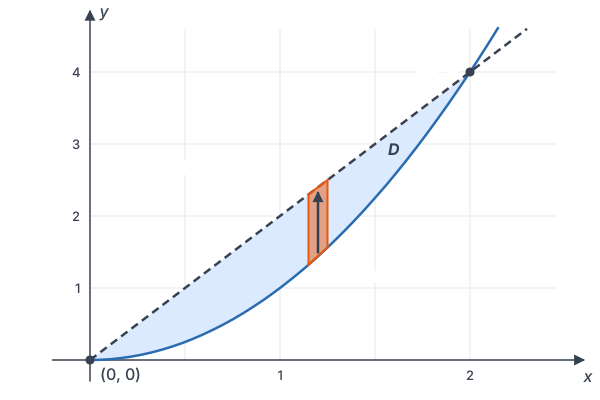
Over a rectangle, every vertical strip runs between the same two numbers. Over a curved region D, a vertical strip at x starts on a bottom curve and stops on a top curve. So the inner limits become functions of x.
The outer integral then sweeps the strip across the region. Its limits are the smallest and largest x in D, so they are plain numbers. The final answer is a number with no variables left.
Type I and Type II regions
A Type I region lies between two curves of x. A Type II region lies between two curves of y.
\text{Type I: } \iint_D f\,dA = \int_a^b \int_{g_1(x)}^{g_2(x)} f(x, y)\,dy\,dx\text{Type II: } \iint_D f\,dA = \int_c^d \int_{h_1(y)}^{h_2(y)} f(x, y)\,dx\,dy- Sketch the region and find where the boundary curves meet.
- Choose an order. For dy dx, draw a vertical strip: it enters D on the bottom curve and leaves on the top curve. For dx dy, draw a horizontal strip from the left curve to the right curve.
- Write the inner limits as those curves. Write the outer limits as the numbers where the strips start and stop.
- Integrate from the inside out, as in double integrals over rectangles.
Double integrals over general regions examples
Example 1: A Type I region
Evaluate \iint_D x\,dA, where D is the region between y = x² and y = 2x.
x^2 = 2x
Find where the curves meet.
x(x - 2) = 0
Subtract 2x and factor out x (see factoring out the GCF).
x = 0 \text{ or } x = 2Use the zero product property.
\iint_D x\,dA = \int_0^2 \int_{x^2}^{2x} x\,dy\,dxSet up Type I. At x = 1 the line (y = 2) is above the parabola (y = 1), so y runs from x² to 2x.
\int_{x^2}^{2x} x\,dy = x\Big[y\Big]_{x^2}^{2x}Integrate in y. Treat x as a constant.
= x(2x - x^2)
Substitute the limits.
= 2x^2 - x^3
Distribute.
\int_0^2 (2x^2 - x^3)\,dx = \Big[\dfrac{2x^3}{3} - \dfrac{x^4}{4}\Big]_0^2Integrate in x.
= \dfrac{16}{3} - 4Substitute x = 2. The value at x = 0 is 0.
= \dfrac{4}{3}Subtract.
Answer: 4/3.
Example 2: A Type II region for area
Find the area of the region bounded by the parabola x = y² and the line x = y + 2.
y^2 = y + 2
Find where the curves meet.
y^2 - y - 2 = 0
Subtract y + 2 from both sides.
(y - 2)(y + 1) = 0
Factor (see factoring trinomials).
y = 2 \text{ or } y = -1Use the zero product property.
A = \int_{-1}^{2} \int_{y^2}^{y + 2} 1\,dx\,dySet up Type II with f = 1. At y = 0 the line (x = 2) is right of the parabola (x = 0).
\int_{y^2}^{y + 2} 1\,dx = y + 2 - y^2Integrate in x and substitute the limits.
\int_{-1}^{2} (y + 2 - y^2)\,dy = \Big[\dfrac{y^2}{2} + 2y - \dfrac{y^3}{3}\Big]_{-1}^{2}Integrate in y.
= \Big(2 + 4 - \dfrac{8}{3}\Big) - \Big(\dfrac{1}{2} - 2 + \dfrac{1}{3}\Big)Substitute y = 2 and y = −1.
= \dfrac{10}{3} - \Big(-\dfrac{7}{6}\Big)Simplify each group.
= \dfrac{9}{2}Add: 20/6 + 7/6 = 27/6 = 9/2.
Answer: the area is 9/2. In dy dx order, the bottom edge changes from the parabola to the line at x = 1, so you would need two integrals. Type II needs only one.
Example 3: Reverse the order of integration
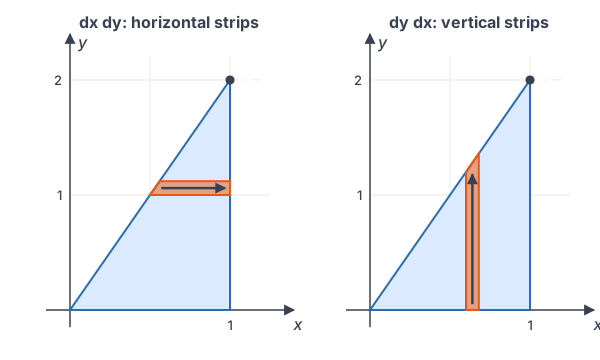
Evaluate \int_0^2 \int_{y/2}^{1} e^{x^2}\,dx\,dy.
\int e^{x^2}\,dxThis inner integral has no formula in elementary functions, so reverse the order.
0 \le y \le 2, \quad \dfrac{y}{2} \le x \le 1Read the region from the limits.
0 \le x \le 1, \quad 0 \le y \le 2x
Describe the same triangle with vertical strips. The edge x = y/2 is the line y = 2x.
\int_0^1 \int_0^{2x} e^{x^2}\,dy\,dxWrite the reversed integral.
\int_0^{2x} e^{x^2}\,dy = 2x e^{x^2}Integrate in y. The factor e^(x²) is a constant.
\int_0^1 2x e^{x^2}\,dx = \Big[e^{x^2}\Big]_0^1Integrate in x with u-substitution, u = x².
= e - 1 \approx 1.718
Substitute x = 1 and x = 0.
Answer: e − 1 ≈ 1.718. Reversing the order turned an impossible inner integral into an easy one.
Example 4: A triangle from its corners
Evaluate \iint_D y\,dA, where D is the triangle with corners (0, 0), (2, 0) and (0, 4).
y = 4 - 2x
Find the slanted edge through (2, 0) and (0, 4): slope −2 and y-intercept 4 (see slope-intercept form).
\iint_D y\,dA = \int_0^2 \int_0^{4 - 2x} y\,dy\,dxSet up Type I: x from 0 to 2, y from the x-axis up to the line.
\int_0^{4 - 2x} y\,dy = \Big[\dfrac{y^2}{2}\Big]_0^{4 - 2x}Integrate in y.
= \dfrac{(4 - 2x)^2}{2}Substitute the limits.
= \dfrac{16 - 16x + 4x^2}{2}Square the binomial (see special products of binomials).
= 8 - 8x + 2x^2
Divide each term by 2.
\int_0^2 (8 - 8x + 2x^2)\,dx = \Big[8x - 4x^2 + \dfrac{2x^3}{3}\Big]_0^2Integrate in x.
= 16 - 16 + \dfrac{16}{3}Substitute x = 2. The value at x = 0 is 0.
= \dfrac{16}{3}Simplify.
Answer: 16/3.
Example 5: Volume of a concrete wedge
A concrete block fills the space under the plane z = 6 − 2x − y and above the floor in the first octant, in feet. How much concrete is in the block?
2x + y = 6
The plane meets the floor (z = 0) along this line.
0 \le x \le 3, \quad 0 \le y \le 6 - 2x
The base is the triangle under this line in the first quadrant. The line meets the x-axis at x = 3.
V = \int_0^3 \int_0^{6 - 2x} (6 - 2x - y)\,dy\,dxSet up the volume.
\int_0^{6 - 2x} (6 - 2x - y)\,dy = \Big[(6 - 2x)y - \dfrac{y^2}{2}\Big]_0^{6 - 2x}Integrate in y. Treat 6 − 2x as a constant.
= (6 - 2x)^2 - \dfrac{(6 - 2x)^2}{2}Substitute y = 6 − 2x. The value at y = 0 is 0.
= \dfrac{(6 - 2x)^2}{2}Combine like terms.
= \dfrac{36 - 24x + 4x^2}{2}Square the binomial.
= 18 - 12x + 2x^2
Divide each term by 2.
\int_0^3 (18 - 12x + 2x^2)\,dx = \Big[18x - 6x^2 + \dfrac{2x^3}{3}\Big]_0^3Integrate in x.
= 54 - 54 + 18
Substitute x = 3. The value at x = 0 is 0.
= 18
Add.
Answer: 18 ft³ of concrete. The block is a pyramid with a triangular base of area 9 ft² and height 6 ft, and the volume of a pyramid formula gives (1/3)(9)(6) = 18 ft³ too.
Common mistakes
| Mistake | Example of the error | Fix |
|---|---|---|
| A variable in the outer limits | \int_{x^2}^{2x} \int_0^2 x\,dx\,dy | The outer limits must be numbers. Only the inner limits can contain the outer variable. |
| Top and bottom swapped | \int_0^2 \int_{2x}^{x^2} x\,dy\,dx gives −4/3 | Test a point: at x = 1, 2x = 2 is above x² = 1, so 2x is the upper limit. |
| Reversing by swapping the limits | Turning \int_0^2 \int_{y/2}^{1} into \int_{y/2}^{1} \int_0^2 | Sketch the region and describe it again with strips in the new direction. |
| Wrong intersection points | Using x from 0 to 1 for y = x² and y = 2x | Solve x² = 2x to get x = 0 and x = 2. |
| Ignoring a change in the boundary | Using one dy dx integral in Example 2 | If the bottom or top edge changes partway, split the region or switch to the other order. |
Related methods
Area between curves as a double integral
With f = 1, the inner integral of a Type I region is just top − bottom. That is the area between curves formula from Calculus 1. Example 2 is the “right minus left” version.
Splitting a region
If neither order gives one integral, cut D into pieces that are each Type I or Type II, and add the integrals.
Round regions
For disks and other round regions, the limits are much simpler in polar coordinates. That is the next lesson, double integrals in polar coordinates.
Practice problems
- Evaluate \int_0^1 \int_0^{x} (x + y)\,dy\,dx.
- Evaluate \int_1^2 \int_0^{y} xy\,dx\,dy.
- Evaluate \iint_D y\,dA, where D is the region between y = x² and y = x.
- Use a double integral to find the area between y = 4 − x² and the x-axis.
- Evaluate \iint_D x\,dA, where D is the region with 0 ≤ y ≤ 2 and 0 ≤ x ≤ y².
- Reverse the order and evaluate \int_0^1 \int_{x}^{1} \sin(y^2)\,dy\,dx.
- Reverse the order and evaluate \int_0^4 \int_{\sqrt{x}}^{2} e^{y^3}\,dy\,dx.
- Evaluate \iint_D xy\,dA, where D is the triangle with corners (0, 0), (1, 0) and (1, 3).
- Find the volume under z = x + y over the triangle with corners (0, 0), (2, 0) and (2, 2).
- A garden bed covers the region between y = x² and y = 4, in meters. The soil depth is 0.2 + 0.1y meters. How much soil is in the bed?
Show answers
1.
\int_0^{x} (x + y)\,dy = \Big[xy + \dfrac{y^2}{2}\Big]_0^{x}Integrate in y.
= x^2 + \dfrac{x^2}{2}Substitute y = x. The value at y = 0 is 0.
= \dfrac{3x^2}{2}Combine like terms.
\int_0^1 \dfrac{3x^2}{2}\,dx = \Big[\dfrac{x^3}{2}\Big]_0^1Integrate in x.
= \dfrac{1}{2}Substitute x = 1 and x = 0.
Answer: 1/2
2.
\int_0^{y} xy\,dx = y\Big[\dfrac{x^2}{2}\Big]_0^{y}Integrate in x. The factor y is a constant.
= \dfrac{y^3}{2}Substitute x = y.
\int_1^2 \dfrac{y^3}{2}\,dy = \Big[\dfrac{y^4}{8}\Big]_1^2Integrate in y.
= 2 - \dfrac{1}{8}Substitute y = 2 and y = 1.
= \dfrac{15}{8}Subtract.
Answer: 15/8
3.
x^2 = x \Rightarrow x = 0 \text{ or } x = 1The curves meet at x = 0 and x = 1. At x = 1/2, the line is on top.
\int_{x^2}^{x} y\,dy = \Big[\dfrac{y^2}{2}\Big]_{x^2}^{x}Integrate in y.
= \dfrac{x^2 - x^4}{2}Substitute the limits.
\int_0^1 \dfrac{x^2 - x^4}{2}\,dx = \dfrac{1}{2}\Big[\dfrac{x^3}{3} - \dfrac{x^5}{5}\Big]_0^1Integrate in x.
= \dfrac{1}{2}\Big(\dfrac{1}{3} - \dfrac{1}{5}\Big)Substitute x = 1 and x = 0.
= \dfrac{1}{2} \cdot \dfrac{2}{15}Subtract the fractions.
= \dfrac{1}{15}Multiply.
Answer: 1/15
4.
4 - x^2 = 0 \Rightarrow x = \pm 2
The parabola meets the x-axis at x = −2 and x = 2.
A = \int_{-2}^{2} \int_0^{4 - x^2} 1\,dy\,dxSet up Type I with f = 1.
\int_0^{4 - x^2} 1\,dy = 4 - x^2Integrate in y and substitute.
\int_{-2}^{2} (4 - x^2)\,dx = \Big[4x - \dfrac{x^3}{3}\Big]_{-2}^{2}Integrate in x.
= \Big(8 - \dfrac{8}{3}\Big) - \Big(-8 + \dfrac{8}{3}\Big)Substitute x = 2 and x = −2.
= \dfrac{16}{3} + \dfrac{16}{3}Simplify each group.
= \dfrac{32}{3}Add.
Answer: 32/3
5.
\int_0^{y^2} x\,dx = \Big[\dfrac{x^2}{2}\Big]_0^{y^2}Type II: integrate in x first.
= \dfrac{y^4}{2}Substitute x = y².
\int_0^2 \dfrac{y^4}{2}\,dy = \Big[\dfrac{y^5}{10}\Big]_0^2Integrate in y.
= \dfrac{32}{10}Substitute y = 2 and y = 0.
= \dfrac{16}{5}Reduce.
Answer: 16/5
6.
0 \le x \le 1, \quad x \le y \le 1
Read the region: the triangle above y = x.
0 \le y \le 1, \quad 0 \le x \le y
Describe it with horizontal strips.
\int_0^1 \int_0^{y} \sin(y^2)\,dx\,dyWrite the reversed integral.
\int_0^{y} \sin(y^2)\,dx = y\sin(y^2)Integrate in x. The factor sin(y²) is a constant.
\int_0^1 y\sin(y^2)\,dy = \Big[-\dfrac{\cos(y^2)}{2}\Big]_0^1Integrate in y with u = y².
= -\dfrac{\cos 1}{2} + \dfrac{1}{2}Substitute y = 1 and y = 0, using cos 0 = 1.
= \dfrac{1 - \cos 1}{2} \approx 0.230Combine.
Answer: (1 − cos 1)/2 ≈ 0.230
7.
0 \le x \le 4, \quad \sqrt{x} \le y \le 2Read the region.
0 \le y \le 2, \quad 0 \le x \le y^2
Describe it with horizontal strips: y = √x is x = y².
\int_0^2 \int_0^{y^2} e^{y^3}\,dx\,dyWrite the reversed integral.
\int_0^{y^2} e^{y^3}\,dx = y^2 e^{y^3}Integrate in x.
\int_0^2 y^2 e^{y^3}\,dy = \Big[\dfrac{e^{y^3}}{3}\Big]_0^2Integrate in y with u = y³.
= \dfrac{e^8 - 1}{3} \approx 993.3Substitute y = 2 and y = 0.
Answer: (e⁸ − 1)/3 ≈ 993.3
8.
0 \le x \le 1, \quad 0 \le y \le 3x
The slanted edge through (0, 0) and (1, 3) is y = 3x.
\int_0^{3x} xy\,dy = x\Big[\dfrac{y^2}{2}\Big]_0^{3x}Integrate in y.
= \dfrac{9x^3}{2}Substitute: x · 9x²/2.
\int_0^1 \dfrac{9x^3}{2}\,dx = \Big[\dfrac{9x^4}{8}\Big]_0^1Integrate in x.
= \dfrac{9}{8}Substitute x = 1 and x = 0.
Answer: 9/8
9.
0 \le x \le 2, \quad 0 \le y \le x
The slanted edge through (0, 0) and (2, 2) is y = x.
\int_0^{x} (x + y)\,dy = x^2 + \dfrac{x^2}{2}Integrate in y and substitute.
= \dfrac{3x^2}{2}Combine like terms.
\int_0^2 \dfrac{3x^2}{2}\,dx = \Big[\dfrac{x^3}{2}\Big]_0^2Integrate in x.
= 4
Substitute x = 2 and x = 0.
Answer: 4 cubic units
10.
-2 \le x \le 2, \quad x^2 \le y \le 4
The curves meet where x² = 4, at x = ±2.
\int_{x^2}^{4} (0.2 + 0.1y)\,dy = \Big[0.2y + 0.05y^2\Big]_{x^2}^{4}Integrate in y.
= (0.8 + 0.8) - (0.2x^2 + 0.05x^4)
Substitute y = 4 and y = x².
= 1.6 - 0.2x^2 - 0.05x^4
Simplify.
\int_{-2}^{2} (\ldots)\,dx = 2\int_0^2 (1.6 - 0.2x^2 - 0.05x^4)\,dxThe integrand is even, so double the integral from 0 to 2 (see even and odd functions).
= 2\Big[1.6x - \dfrac{0.2x^3}{3} - 0.01x^5\Big]_0^2Integrate in x.
= 2\Big(3.2 - \dfrac{1.6}{3} - 0.32\Big)Substitute x = 2. The value at x = 0 is 0.
= \dfrac{352}{75} \approx 4.69Simplify: 2(2.88 − 0.5333) ≈ 4.69.
Answer: about 4.69 m³ of soil
Double integrals over general regions FAQ
What is the difference between Type I and Type II regions?
A Type I region lies between two curves y = g₁(x) and y = g₂(x), so you integrate y first. A Type II region lies between x = h₁(y) and x = h₂(y), so you integrate x first.
How do you reverse the order of integration?
Read the region from the old limits and sketch it. Then describe the same region with strips in the other direction, and write new limits from the sketch. Never just swap the limits.
How do you find the limits of integration for a double integral?
Draw a strip across the region in the direction of the inner variable. Where it enters and leaves gives the inner limits. Where the strips start and stop gives the outer limits.
Can a double integral find the area of a region?
Yes. Integrate f = 1 over the region: the result is its area. This matches the area between curves from Calculus 1.
Summary
- Over a general region, the inner limits are curves and the outer limits are numbers.
- Type I: vertical strips, dy dx. Type II: horizontal strips, dx dy.
- Find intersection points and test a point to see which curve is on top or on the right.
- To reverse the order, sketch the region and describe it again; never just swap the limits.
- Choose the order that gives one integral and an easy inner integral.
Previous lesson: Double Integrals
Next lesson: Double Integrals in Polar Coordinates
Back to the Calculus 3 Index