
Cross Product
The cross product a × b of two 3D vectors is a new vector perpendicular to both of them. Its components are ⟨a₂b₃ − a₃b₂, a₃b₁ − a₁b₃, a₁b₂ − a₂b₁⟩, which come from a 3 × 3 determinant. Its length, ‖a‖‖b‖ sin θ, equals the area of the parallelogram the two vectors span.
Before this lesson: Vectors in 3D and Determinant of a Matrix
What the cross product means
The dot product turns two vectors into a number. The cross product turns two vectors into a third vector. That vector does two jobs at once: its direction is perpendicular to both original vectors, and its length measures how much area they span.
Take a = ⟨2, 0, 0⟩ and b = ⟨0, 3, 0⟩. They lie in the xy-plane and form a 2-by-3 rectangle with area 6. Their cross product is ⟨0, 0, 6⟩: it points straight up, perpendicular to the rectangle, and its length is the area, 6.
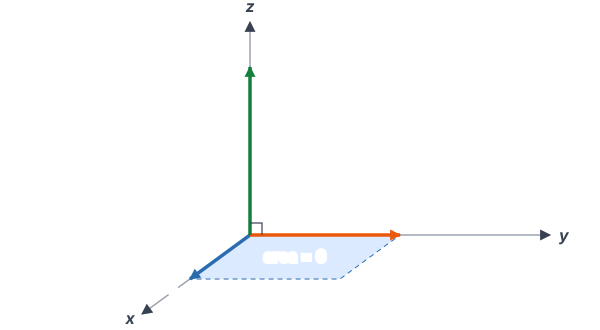
Which way does it point? Use the right-hand rule: point your fingers along a, curl them toward b, and your thumb points along a × b. Swapping the order flips the direction, so b × a = −(a × b).
Cross product formula
\mathbf{a} \times \mathbf{b} = \begin{vmatrix} \mathbf{i} & \mathbf{j} & \mathbf{k} \\ a_1 & a_2 & a_3 \\ b_1 & b_2 & b_3 \end{vmatrix}= (a_2 b_3 - a_3 b_2)\,\mathbf{i} - (a_1 b_3 - a_3 b_1)\,\mathbf{j} + (a_1 b_2 - a_2 b_1)\,\mathbf{k}\|\mathbf{a} \times \mathbf{b}\| = \|\mathbf{a}\| \, \|\mathbf{b}\| \sin\theta- Each component is a 2 × 2 determinant. Cover the column of the component you want and cross-multiply what is left. The middle (j) term gets a minus sign.
- a × b is orthogonal to a and to b, so (a × b) · a = 0 and (a × b) · b = 0.
- ‖a × b‖ is the area of the parallelogram with sides a and b. Half of it is the area of the triangle with sides a and b.
- a × b = 0 exactly when a and b are parallel (or one is the zero vector).
- i × j = k, j × k = i and k × i = j. Reversing any of these gives the negative.
Cross product examples
Example 1: Computing a cross product
Find a × b for a = ⟨2, 1, −1⟩ and b = ⟨1, 3, 2⟩, and check that it is orthogonal to both.
1 \cdot 2 - (-1) \cdot 3 = 2 + 3
i-component, a₂b₃ − a₃b₂: multiply (see determinant of a matrix).
= 5
Add.
-(2 \cdot 2 - (-1) \cdot 1) = -(4 + 1)
j-component, −(a₁b₃ − a₃b₁): multiply.
= -5
Add, then apply the minus sign.
2 \cdot 3 - 1 \cdot 1 = 6 - 1
k-component, a₁b₂ − a₂b₁: multiply.
= 5
Subtract.
\mathbf{a} \times \mathbf{b} = \langle 5, -5, 5 \rangleWrite the three components together.
2 \cdot 5 + 1 \cdot (-5) + (-1) \cdot 5 = 10 - 5 - 5 = 0
Check with a: the dot product is 0 (see dot product).
1 \cdot 5 + 3 \cdot (-5) + 2 \cdot 5 = 5 - 15 + 10 = 0
Check with b: the dot product is 0.
Answer: a × b = ⟨5, −5, 5⟩, and it is orthogonal to both a and b.
Example 2: Area of a parallelogram
Find the area of the parallelogram with sides u = ⟨3, −2, 1⟩ and v = ⟨1, 0, 2⟩.
(-2) \cdot 2 - 1 \cdot 0 = -4 - 0
i-component: multiply.
= -4
Subtract.
-(3 \cdot 2 - 1 \cdot 1) = -(6 - 1)
j-component: multiply.
= -5
Subtract, then apply the minus sign.
3 \cdot 0 - (-2) \cdot 1 = 0 + 2
k-component: multiply.
= 2
Add.
\mathbf{u} \times \mathbf{v} = \langle -4, -5, 2 \rangleWrite the components together.
\sqrt{(-4)^2 + (-5)^2 + 2^2} = \sqrt{16 + 25 + 4}Find the magnitude: square each component (see vectors in 3D).
= \sqrt{45}Add.
= 3\sqrt{5} \approx 6.71Simplify the root (see simplifying square roots).
Answer: the area is 3√5 ≈ 6.71 square units.
Example 3: Area of a triangle in space
Find the area of the triangle with vertices P(1, 0, 2), Q(3, 1, 0) and R(0, 2, 3).
\overrightarrow{PQ} = \langle 3 - 1, \; 1 - 0, \; 0 - 2 \rangle = \langle 2, 1, -2 \rangleSubtract P from Q.
\overrightarrow{PR} = \langle 0 - 1, \; 2 - 0, \; 3 - 2 \rangle = \langle -1, 2, 1 \rangleSubtract P from R.
1 \cdot 1 - (-2) \cdot 2 = 1 + 4
i-component: multiply.
= 5
Add.
-(2 \cdot 1 - (-2) \cdot (-1)) = -(2 - 2)
j-component: multiply.
= 0
Subtract, then apply the minus sign.
2 \cdot 2 - 1 \cdot (-1) = 4 + 1
k-component: multiply.
= 5
Add.
\|\langle 5, 0, 5 \rangle\| = \sqrt{25 + 0 + 25}Find the magnitude of the cross product.
= \sqrt{50}Add.
= 5\sqrt{2}Simplify the root.
\dfrac{5\sqrt{2}}{2} \approx 3.54Take half for the triangle.
Answer: the triangle’s area is 5√2/2 ≈ 3.54 square units.
Example 4: Unit vector perpendicular to two vectors
Find a unit vector perpendicular to both a = ⟨2, 0, 1⟩ and b = ⟨1, 2, 2⟩.
0 \cdot 2 - 1 \cdot 2 = 0 - 2
i-component: multiply.
= -2
Subtract.
-(2 \cdot 2 - 1 \cdot 1) = -(4 - 1)
j-component: multiply.
= -3
Subtract, then apply the minus sign.
2 \cdot 2 - 0 \cdot 1 = 4 - 0
k-component: multiply.
= 4
Subtract.
\sqrt{(-2)^2 + (-3)^2 + 4^2} = \sqrt{4 + 9 + 16}Find the magnitude of ⟨−2, −3, 4⟩: square each component.
= \sqrt{29}Add.
\left\langle -\dfrac{2}{\sqrt{29}}, -\dfrac{3}{\sqrt{29}}, \dfrac{4}{\sqrt{29}} \right\rangleDivide each component by √29.
Answer: ⟨−2/√29, −3/√29, 4/√29⟩. Its opposite, ⟨2/√29, 3/√29, −4/√29⟩, also works.
Example 5: Torque on a wrench (word problem)
A wrench handle runs from a bolt along r = ⟨0.25, 0, 0⟩ meters. A hand pushes on the end with force F = ⟨0, 40, −30⟩ newtons. The torque is τ = r × F. Find the torque vector and its size.
0 \cdot (-30) - 0 \cdot 40 = 0 - 0
i-component: multiply.
= 0
Subtract.
-(0.25 \cdot (-30) - 0 \cdot 0) = -(-7.5 - 0)
j-component: multiply.
= 7.5
Subtract, then apply the minus sign.
0.25 \cdot 40 - 0 \cdot 0 = 10 - 0
k-component: multiply.
= 10
Subtract.
\sqrt{0^2 + 7.5^2 + 10^2} = \sqrt{0 + 56.25 + 100}Find the magnitude: square each component.
= \sqrt{156.25}Add.
= 12.5
Take the square root.
Answer: τ = ⟨0, 7.5, 10⟩, with a size of 12.5 newton-meters. The force is 50 N (√(40² + 30²) = 50), and it is perpendicular to the handle, so the torque is simply 0.25 · 50 = 12.5.
Common mistakes
| Mistake | Example of the error | Fix |
|---|---|---|
| Dropping the minus sign on j | j-component of ⟨2, 1, −1⟩ × ⟨1, 3, 2⟩ written as 5 | The middle term is −(a₁b₃ − a₃b₁) = −5. |
| Multiplying matching components | ⟨2, 1, −1⟩ × ⟨1, 3, 2⟩ = ⟨2, 3, −2⟩ | Use the determinant pattern; each component mixes the other two coordinates. |
| Assuming the order doesn’t matter | b × a = a × b | b × a = −(a × b); the direction flips. |
| Forgetting the half for a triangle | Triangle area = ‖PQ × PR‖ = 5√2 | A triangle is half the parallelogram: 5√2/2. |
| Taking a cross product of 2D vectors | ⟨1, 2⟩ × ⟨3, 4⟩ | Write them as ⟨1, 2, 0⟩ and ⟨3, 4, 0⟩ first; the answer points along the z-axis. |
Related methods
Scalar triple product and volume
The scalar triple product w · (u × v) is the volume of the box-like solid (parallelepiped) with edges u, v and w, up to sign. With u × v = ⟨−4, −5, 2⟩ from Example 2 and w = ⟨2, 1, 3⟩:
2 \cdot (-4) + 1 \cdot (-5) + 3 \cdot 2 = -8 - 5 + 6
Take the dot product of w with u × v.
= -7
Add.
|-7| = 7
Volume is the absolute value.
The volume is 7 cubic units. A triple product of 0 means the three vectors lie in one plane.
Dot product or cross product?
Use the dot product to find angles and test for perpendicular vectors. Use the cross product to build a perpendicular vector, find areas, and (in the next lessons) write the equation of a plane through three points.
Practice problems
- Find ⟨1, 2, 3⟩ × ⟨4, 5, 6⟩.
- Find k × i and i × k.
- Find ⟨2, −1, 0⟩ × ⟨0, 3, 1⟩.
- Check that your answer to Problem 3 is orthogonal to both vectors.
- Find the area of the parallelogram with sides ⟨1, 0, 2⟩ and ⟨0, 3, 1⟩.
- Find the area of the triangle with vertices A(0, 0, 0), B(2, 0, 0) and C(0, 3, 4).
- If a × b = ⟨2, −1, 4⟩, find b × a.
- Use the cross product to decide whether ⟨2, −4, 6⟩ and ⟨−1, 2, −3⟩ are parallel.
- ‖a‖ = 4, ‖b‖ = 5 and the angle between them is 30°. Find ‖a × b‖.
- A wrench along r = ⟨0, 0.3, 0⟩ m is pushed with force F = ⟨20, 0, −15⟩ N. Find the torque τ = r × F and its size.
Show answers
1.
2 \cdot 6 - 3 \cdot 5 = 12 - 15
i-component: multiply.
= -3
Subtract.
-(1 \cdot 6 - 3 \cdot 4) = -(6 - 12)
j-component: multiply.
= 6
Subtract, then apply the minus sign.
1 \cdot 5 - 2 \cdot 4 = 5 - 8
k-component: multiply.
= -3
Subtract.
Answer: ⟨−3, 6, −3⟩
2.
Answer: k × i = j, and i × k = −j (reversing the order flips the sign).
3.
(-1) \cdot 1 - 0 \cdot 3 = -1 - 0
i-component: multiply.
= -1
Subtract.
-(2 \cdot 1 - 0 \cdot 0) = -(2 - 0)
j-component: multiply.
= -2
Subtract, then apply the minus sign.
2 \cdot 3 - (-1) \cdot 0 = 6 - 0
k-component: multiply.
= 6
Subtract.
Answer: ⟨−1, −2, 6⟩
4.
2 \cdot (-1) + (-1) \cdot (-2) + 0 \cdot 6 = -2 + 2 + 0 = 0
Dot with ⟨2, −1, 0⟩.
0 \cdot (-1) + 3 \cdot (-2) + 1 \cdot 6 = 0 - 6 + 6 = 0
Dot with ⟨0, 3, 1⟩.
Answer: both dot products are 0, so ⟨−1, −2, 6⟩ is orthogonal to both.
5.
0 \cdot 1 - 2 \cdot 3 = 0 - 6
i-component: multiply.
= -6
Subtract.
-(1 \cdot 1 - 2 \cdot 0) = -(1 - 0)
j-component: multiply.
= -1
Subtract, then apply the minus sign.
1 \cdot 3 - 0 \cdot 0 = 3 - 0
k-component: multiply.
= 3
Subtract.
\sqrt{(-6)^2 + (-1)^2 + 3^2} = \sqrt{36 + 1 + 9}Find the magnitude: square each component.
= \sqrt{46}Add.
\approx 6.78
Approximate the root.
Answer: √46 ≈ 6.78 square units
6.
0 \cdot 4 - 0 \cdot 3 = 0
AB = ⟨2, 0, 0⟩ and AC = ⟨0, 3, 4⟩; i-component.
-(2 \cdot 4 - 0 \cdot 0) = -8
j-component.
2 \cdot 3 - 0 \cdot 0 = 6
k-component.
\sqrt{0 + 64 + 36} = \sqrt{100}Find the magnitude of ⟨0, −8, 6⟩.
= 10
Take the square root.
\dfrac{10}{2} = 5Take half for the triangle.
Answer: 5 square units
7.
Answer: b × a = −(a × b) = ⟨−2, 1, −4⟩
8.
(-4) \cdot (-3) - 6 \cdot 2 = 12 - 12 = 0
i-component.
-(2 \cdot (-3) - 6 \cdot (-1)) = -(-6 + 6) = 0
j-component.
2 \cdot 2 - (-4) \cdot (-1) = 4 - 4 = 0
k-component.
Answer: the cross product is the zero vector, so the vectors are parallel. (In fact ⟨2, −4, 6⟩ = −2⟨−1, 2, −3⟩.)
9.
4 \cdot 5 \cdot \sin 30^\circ = 20 \cdot \dfrac{1}{2}Multiply the lengths and use sin 30° = 1/2 (see trig values of special angles).
= 10
Multiply.
Answer: 10
10.
0.3 \cdot (-15) - 0 \cdot 0 = -4.5
i-component.
-(0 \cdot (-15) - 0 \cdot 20) = 0
j-component.
0 \cdot 0 - 0.3 \cdot 20 = -6
k-component.
\sqrt{(-4.5)^2 + 0^2 + (-6)^2} = \sqrt{20.25 + 36}Find the magnitude: square each component.
= \sqrt{56.25}Add.
= 7.5
Take the square root.
Answer: τ = ⟨−4.5, 0, −6⟩, with a size of 7.5 N·m
Cross product FAQ
How do you calculate the cross product?
Set up a 3 × 3 determinant with i, j, k in the top row and the two vectors below. Expand along the top row: (a₂b₃ − a₃b₂)i − (a₁b₃ − a₃b₁)j + (a₁b₂ − a₂b₁)k.
What is the difference between the dot product and the cross product?
The dot product gives a number that measures how much two vectors point the same way. The cross product gives a vector perpendicular to both, whose length is the area they span.
Is the cross product commutative?
No. Reversing the order gives the opposite vector: b × a = −(a × b). The cross product is anticommutative.
What does the magnitude of the cross product represent?
It is the area of the parallelogram with sides a and b, equal to ‖a‖‖b‖ sin θ. Half of it is the area of the triangle with those two sides.
Summary
- a × b = ⟨a₂b₃ − a₃b₂, a₃b₁ − a₁b₃, a₁b₂ − a₂b₁⟩, from a 3 × 3 determinant.
- a × b is perpendicular to both a and b; its direction follows the right-hand rule.
- ‖a × b‖ = ‖a‖‖b‖ sin θ = parallelogram area; half of that is the triangle area.
- b × a = −(a × b), and a × b = 0 when the vectors are parallel.
- The scalar triple product w · (u × v) gives the volume of a parallelepiped.
Previous lesson: Vectors in 3D
Next lesson: Vector Projections
Back to the Calculus 3 Index