
Equation of a Plane
The equation of a plane through the point (x₀, y₀, z₀) with normal vector n = ⟨a, b, c⟩ is a(x − x₀) + b(y − y₀) + c(z − z₀) = 0, which simplifies to ax + by + cz = d. The normal vector is perpendicular to every direction in the plane. For three points, find n with a cross product.
Before this lesson: Cross Product, Equations of Lines in 3D and Dot Product
What determines a plane
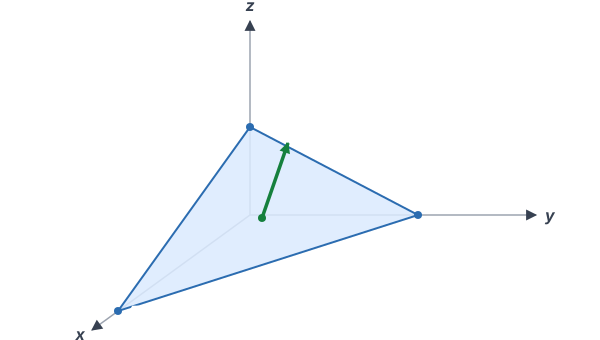
A line in space is set by a point and a direction. A plane is set by a point and a normal vector, a vector that sticks straight out of the plane, perpendicular to it.
Here is why that works. If P₀ is a fixed point in the plane and P is any other point in it, the arrow from P₀ to P lies flat in the plane. So it is perpendicular to n, and their dot product is 0. Writing that dot product out in coordinates gives the equation of the plane.
The coefficients of x, y and z in ax + by + cz = d are the components of a normal vector. So you can read n = ⟨a, b, c⟩ straight from the equation.
Equation of a plane formulas
\mathbf{n} \cdot (\mathbf{r} - \mathbf{r}_0) = 0a(x - x_0) + b(y - y_0) + c(z - z_0) = 0
ax + by + cz = d, \quad \text{where } d = ax_0 + by_0 + cz_0D = \dfrac{|ax_1 + by_1 + cz_1 - d|}{\sqrt{a^2 + b^2 + c^2}} \quad \text{(distance from } (x_1, y_1, z_1) \text{ to the plane)}- Point-normal form a(x − x₀) + b(y − y₀) + c(z − z₀) = 0 needs one point and a normal vector.
- For three points A, B and C, use n = AB × AC.
- Two planes are parallel when their normal vectors are parallel. The angle between two planes is the angle between their normals.
- The intercepts of ax + by + cz = d are found by setting two of the variables equal to 0.
Equation of a plane examples
Example 1: Point and normal vector
Find the equation of the plane through P(1, −2, 4) with normal vector n = ⟨3, 1, −2⟩.
3(x - 1) + 1(y + 2) - 2(z - 4) = 0
Substitute into point-normal form; y − (−2) = y + 2.
3x - 3 + y + 2 - 2z + 8 = 0
Distribute (see distributive property).
3x + y - 2z + 7 = 0
Combine the constants: −3 + 2 + 8 = 7.
3x + y - 2z = -7
Subtract 7 from both sides.
3 \cdot 1 + (-2) - 2 \cdot 4 = 3 - 2 - 8 = -7
Check: P satisfies the equation.
Answer: 3x + y − 2z = −7.
Example 2: Plane through three points
Find the equation of the plane through P(1, 0, 2), Q(3, 1, 0) and R(0, 2, 3).
\overrightarrow{PQ} = \langle 2, 1, -2 \rangle, \quad \overrightarrow{PR} = \langle -1, 2, 1 \rangleSubtract P from Q and from R.
\overrightarrow{PQ} \times \overrightarrow{PR} = \langle 5, 0, 5 \rangleTake the cross product (see cross product).
\mathbf{n} = \langle 1, 0, 1 \rangleDivide by 5; any nonzero multiple of a normal is still a normal.
1(x - 1) + 0(y - 0) + 1(z - 2) = 0
Substitute P and n into point-normal form.
x - 1 + z - 2 = 0
Distribute; the y-term is 0.
x + z = 3
Add 3 to both sides.
3 + 0 = 3, \quad 0 + 3 = 3
Check Q(3, 1, 0) and R(0, 2, 3).
Answer: x + z = 3. The plane contains every value of y, so it is parallel to the y-axis.
Example 3: Intercepts
Find the x-, y- and z-intercepts of the plane 2x + 3y + 6z = 12, and sketch it.
2x = 12
Set y = 0 and z = 0.
x = 6
Divide both sides by 2.
3y = 12
Set x = 0 and z = 0.
y = 4
Divide both sides by 3.
6z = 12
Set x = 0 and y = 0.
z = 2
Divide both sides by 6.
Answer: the intercepts are (6, 0, 0), (0, 4, 0) and (0, 0, 2). Connecting them gives the triangle in the diagram, the part of the plane in the first octant.
Example 4: Where a line meets a plane
Find where the line x = 2 + t, y = 1 − t, z = 2t meets the plane 2x + y + z = 11.
2(2 + t) + (1 - t) + 2t = 11
Substitute the line’s x, y and z into the plane.
4 + 2t + 1 - t + 2t = 11
Distribute.
5 + 3t = 11
Combine like terms.
3t = 6
Subtract 5 from both sides.
t = 2
Divide both sides by 3.
(2 + 2, \; 1 - 2, \; 2 \cdot 2) = (4, -1, 4)
Substitute t = 2 into the line (see equations of lines in 3D).
2 \cdot 4 + (-1) + 4 = 11
Check the point in the plane.
Answer: the line meets the plane at (4, −1, 4).
Example 5: Camera distance from a roof (word problem)
A sloped roof lies in the plane x + 2y + 2z = 10, measured in meters. How far is a security camera at (4, 6, 9) from the plane of the roof?
1 \cdot 4 + 2 \cdot 6 + 2 \cdot 9 - 10 = 4 + 12 + 18 - 10
Substitute the camera’s coordinates into ax + by + cz − d. Multiply.
= 24
Add and subtract.
\sqrt{1^2 + 2^2 + 2^2} = \sqrt{9} = 3Find the length of n = ⟨1, 2, 2⟩.
D = \dfrac{|24|}{3} = 8Divide the absolute value by the length of n.
Answer: the camera is 8 m from the plane of the roof, measured along the perpendicular.
Common mistakes
| Mistake | Example of the error | Fix |
|---|---|---|
| Using a point as the normal | Plane through (1, −2, 4) with normal ⟨1, −2, 4⟩ | The normal must be given or found with a cross product. |
| Sign slips when distributing | −2(z − 4) = −2z − 8 | −2 times −4 is +8: −2(z − 4) = −2z + 8. |
| Using a direction in the plane as the normal | Using PQ = ⟨2, 1, −2⟩ as n in Example 2 | Cross two directions in the plane to get n. |
| Dropping the absolute value | Distance = (2 − 6)/3 = −4/3 | Distance is never negative: |−4|/3 = 4/3. |
| Thinking parallel planes have equal d | x + 2y = 3 and 2x + 4y = 6 are “parallel” | These are the same plane. Parallel planes have proportional normals, but their equations are not multiples of each other. |
Related methods
Angle between two planes
The angle between two planes is the angle between their normals. For x + z = 3 and y + z = 1, the normals are ⟨1, 0, 1⟩ and ⟨0, 1, 1⟩:
1 \cdot 0 + 0 \cdot 1 + 1 \cdot 1 = 1
Find the dot product of the normals.
\cos\theta = \dfrac{1}{\sqrt{2} \cdot \sqrt{2}} = \dfrac{1}{2}Divide by the product of their lengths.
\theta = \cos^{-1}\left(\dfrac{1}{2}\right) = 60^\circTake the inverse cosine.
Line of intersection of two planes
Two planes that aren’t parallel meet in a line. Its direction is n₁ × n₂, since that vector is perpendicular to both normals. Find one point on both planes (for example, by setting z = 0 and solving), then write the line as in equations of lines in 3D. The distance formula above is a vector projection onto n in disguise.
Practice problems
- Find the equation of the plane through (2, 1, −3) with normal ⟨4, −1, 5⟩.
- Give a normal vector to the plane 3x − 7y + z = 4.
- Find the equation of the plane through A(1, 1, 0), B(2, 0, 1) and C(0, 3, 1).
- Find the intercepts of 4x + 2y + 5z = 20.
- Is the point (1, 3, −2) on the plane 2x − y + 4z = −9?
- Find the plane through (3, −1, 2) parallel to 2x + 5y − z = 7.
- Where does the line x = 1 + t, y = 2t, z = 4 − t meet the plane x + y + z = 11?
- Find the distance from (1, −2, 3) to the plane 2x − y + 2z = 4.
- Are the planes x − 2y + 3z = 1 and −2x + 4y − 6z = 5 parallel? Are they the same plane?
- Find the angle between the planes x + y = 3 and y + z = 1.
Show answers
1.
4(x - 2) - 1(y - 1) + 5(z + 3) = 0
Substitute into point-normal form.
4x - 8 - y + 1 + 5z + 15 = 0
Distribute.
4x - y + 5z + 8 = 0
Combine the constants: −8 + 1 + 15 = 8.
4x - y + 5z = -8
Subtract 8 from both sides.
Answer: 4x − y + 5z = −8
2.
Answer: ⟨3, −7, 1⟩, read from the coefficients (any nonzero multiple also works).
3.
\overrightarrow{AB} = \langle 1, -1, 1 \rangle, \quad \overrightarrow{AC} = \langle -1, 2, 1 \rangleSubtract A from B and from C.
(-1) \cdot 1 - 1 \cdot 2 = -3
i-component of AB × AC.
-(1 \cdot 1 - 1 \cdot (-1)) = -2
j-component.
1 \cdot 2 - (-1) \cdot (-1) = 1
k-component.
-3(x - 1) - 2(y - 1) + 1(z - 0) = 0
Use n = ⟨−3, −2, 1⟩ and point A.
-3x + 3 - 2y + 2 + z = 0
Distribute.
-3x - 2y + z = -5
Subtract 5 from both sides.
3x + 2y - z = 5
Multiply both sides by −1.
Answer: 3x + 2y − z = 5
4.
4x = 20
Set y = 0 and z = 0.
x = 5
Divide both sides by 4.
2y = 20
Set x = 0 and z = 0.
y = 10
Divide both sides by 2.
5z = 20
Set x = 0 and y = 0.
z = 4
Divide both sides by 5.
Answer: (5, 0, 0), (0, 10, 0) and (0, 0, 4)
5.
2 \cdot 1 - 3 + 4 \cdot (-2) = 2 - 3 - 8
Substitute the point. Multiply.
= -9
Add.
Answer: yes, because the left side equals −9.
6.
2(x - 3) + 5(y + 1) - 1(z - 2) = 0
Parallel planes share the normal ⟨2, 5, −1⟩.
2x - 6 + 5y + 5 - z + 2 = 0
Distribute.
2x + 5y - z + 1 = 0
Combine the constants: −6 + 5 + 2 = 1.
2x + 5y - z = -1
Subtract 1 from both sides.
Answer: 2x + 5y − z = −1
7.
(1 + t) + 2t + (4 - t) = 11
Substitute the line into the plane.
5 + 2t = 11
Combine like terms.
2t = 6
Subtract 5 from both sides.
t = 3
Divide both sides by 2.
(1 + 3, \; 2 \cdot 3, \; 4 - 3) = (4, 6, 1)
Substitute t = 3.
Answer: (4, 6, 1)
8.
2 \cdot 1 - (-2) + 2 \cdot 3 - 4 = 2 + 2 + 6 - 4
Substitute into ax + by + cz − d. Multiply.
= 6
Add and subtract.
\sqrt{4 + 1 + 4} = 3Find the length of ⟨2, −1, 2⟩.
D = \dfrac{|6|}{3} = 2Divide.
Answer: 2
9.
\langle -2, 4, -6 \rangle = -2 \langle 1, -2, 3 \rangle
The normals are multiples, so the planes are parallel.
-2x + 4y - 6z = -2
Multiply the first equation by −2.
-2 \ne 5
Compare with the second equation’s right side.
Answer: parallel but not the same plane
10.
1 \cdot 0 + 1 \cdot 1 + 0 \cdot 1 = 1
Dot the normals ⟨1, 1, 0⟩ and ⟨0, 1, 1⟩.
\cos\theta = \dfrac{1}{\sqrt{2} \cdot \sqrt{2}} = \dfrac{1}{2}Divide by the product of the lengths.
\theta = 60^\circ
Take the inverse cosine.
Answer: 60°
Equation of a plane FAQ
How do you find the equation of a plane from three points?
Subtract one point from the other two to get two vectors in the plane. Their cross product is a normal vector n. Then use n and any of the three points in a(x − x₀) + b(y − y₀) + c(z − z₀) = 0.
What is a normal vector to a plane?
It is a nonzero vector perpendicular to the plane. In ax + by + cz = d, the vector ⟨a, b, c⟩ is normal to the plane.
How do you find the distance from a point to a plane?
Substitute the point into ax + by + cz − d, take the absolute value, and divide by √(a² + b² + c²).
How can you tell if two planes are parallel?
Compare their normal vectors. If one is a scalar multiple of the other, the planes are parallel (or the same plane, if the whole equations are multiples).
Summary
- A plane is set by a point (x₀, y₀, z₀) and a normal vector n = ⟨a, b, c⟩.
- Point-normal form: a(x − x₀) + b(y − y₀) + c(z − z₀) = 0, or ax + by + cz = d.
- For three points, n = AB × AC.
- Distance from a point to a plane: |ax₁ + by₁ + cz₁ − d| ÷ √(a² + b² + c²).
- Parallel planes have parallel normals; the angle between planes is the angle between normals.
Previous lesson: Equations of Lines in 3D
Next lesson: Quadric Surfaces
Back to the Calculus 3 Index