
Quadric Surfaces
Quadric surfaces are the 3D graphs of second-degree equations in x, y and z, such as x²/a² + y²/b² + z²/c² = 1. The six main types are the ellipsoid, the elliptic paraboloid, the hyperbolic paraboloid, the elliptic cone, and the hyperboloids of one and two sheets. You identify and sketch them with traces.
Before this lesson: 3D Coordinate System, Ellipses, Hyperbolas and Identifying Conic Sections
How to see a surface through its traces
A surface in space is hard to picture all at once. So we slice it. A trace is the curve where the surface meets a plane, usually a plane parallel to a coordinate plane, like z = k.
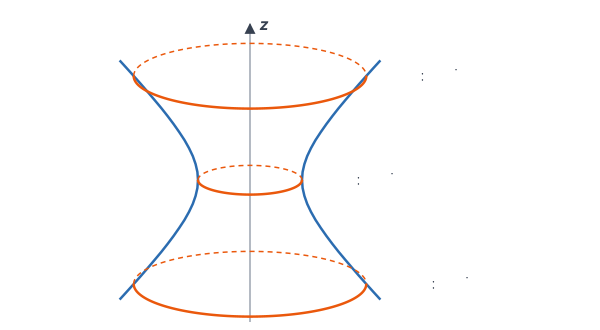
For a quadric surface, every trace is a conic section: an ellipse, a parabola or a hyperbola (or a single point or a pair of lines). Stacking the traces shows the shape. For example, the traces of x² + y² − z² = 1 in the planes z = k are circles that grow as |k| grows, so the surface looks like an hourglass with no pinch point: a hyperboloid of one sheet.
If one variable is missing from the equation, the surface is a cylinder: the same curve repeated along that variable’s axis. For example, x² + z² = 9 is a circular cylinder of radius 3 around the y-axis.
Standard forms of quadric surfaces
| Surface | Standard equation | How to recognize it |
|---|---|---|
| Ellipsoid | \dfrac{x^2}{a^2} + \dfrac{y^2}{b^2} + \dfrac{z^2}{c^2} = 1 | All squared, all plus signs, equals 1. Every trace is an ellipse. |
| Elliptic paraboloid | z = \dfrac{x^2}{a^2} + \dfrac{y^2}{b^2} | One variable to the first power; the squares have the same sign. Bowl shape. |
| Hyperbolic paraboloid | z = \dfrac{y^2}{b^2} - \dfrac{x^2}{a^2} | One variable to the first power; the squares have opposite signs. Saddle shape. |
| Elliptic cone | \dfrac{x^2}{a^2} + \dfrac{y^2}{b^2} = \dfrac{z^2}{c^2} | All squared, equals 0 when moved to one side. Two cones meeting at a point. |
| Hyperboloid of one sheet | \dfrac{x^2}{a^2} + \dfrac{y^2}{b^2} - \dfrac{z^2}{c^2} = 1 | All squared, one minus sign, equals 1. Hourglass in one piece. |
| Hyperboloid of two sheets | -\dfrac{x^2}{a^2} - \dfrac{y^2}{b^2} + \dfrac{z^2}{c^2} = 1 | All squared, two minus signs, equals 1. Two separate bowls. |
- The axis of a paraboloid is the variable that is not squared. The axis of a cone or hyperboloid is the variable whose sign differs from the other two.
- When a = b, the ellipses become circles, and the surface is called circular (for example, a circular cone).
- To identify a messy equation, move everything to one side, complete the square, and divide so the constant is 1.
Quadric surfaces examples
Example 1: Identifying an ellipsoid
Identify the surface 4x² + 9y² + z² = 36, and find its intercepts and its trace in the xy-plane.
\dfrac{4x^2}{36} + \dfrac{9y^2}{36} + \dfrac{z^2}{36} = 1Divide both sides by 36.
\dfrac{x^2}{9} + \dfrac{y^2}{4} + \dfrac{z^2}{36} = 1Reduce each fraction.
a = 3, \quad b = 2, \quad c = 6
Take the square roots of 9, 4 and 36.
\dfrac{x^2}{9} + \dfrac{y^2}{4} = 1Set z = 0 for the trace in the xy-plane.
Answer: an ellipsoid (all squares, all plus, equal to 1). It crosses the axes at (±3, 0, 0), (0, ±2, 0) and (0, 0, ±6), and its trace in the xy-plane is the ellipse x²/9 + y²/4 = 1.
Example 2: Traces of a paraboloid
Identify z = x² + y²/4 and describe its traces in the planes z = 4, x = 0 and y = 0.
x^2 + \dfrac{y^2}{4} = 4Set z = 4.
\dfrac{x^2}{4} + \dfrac{y^2}{16} = 1Divide both sides by 4.
z = \dfrac{y^2}{4}Set x = 0: a parabola in the yz-plane.
z = x^2
Set y = 0: a parabola in the xz-plane.
Answer: an elliptic paraboloid, a bowl opening upward along the z-axis (z is the variable that isn’t squared). Horizontal traces are ellipses, such as x²/4 + y²/16 = 1 at height 4, and vertical traces are parabolas.
Example 3: A hyperboloid of one sheet
Identify x² + y² − z² = 1, and find its traces in the planes z = 2 and x = 0.
x^2 + y^2 - 2^2 = 1
Set z = 2.
x^2 + y^2 - 4 = 1
Square 2.
x^2 + y^2 = 5
Add 4 to both sides.
y^2 - z^2 = 1
Set x = 0.
Answer: a hyperboloid of one sheet with axis along z (z has the minus sign). The trace at z = 2 is a circle of radius √5, and the trace in the plane x = 0 is the hyperbola y² − z² = 1, as in the diagram.
Example 4: Completing the square
Identify the surface x² + 2y² − z² − 4x + 4 = 0.
(x^2 - 4x) + 2y^2 - z^2 + 4 = 0
Group the x-terms.
(x^2 - 4x + 4) - 4 + 2y^2 - z^2 + 4 = 0
Add and subtract 4 to complete the square (see completing the square).
(x - 2)^2 - 4 + 2y^2 - z^2 + 4 = 0
Factor the perfect square trinomial.
(x - 2)^2 + 2y^2 - z^2 = 0
Combine −4 + 4 = 0.
(x - 2)^2 + 2y^2 = z^2
Add z² to both sides.
Answer: an elliptic cone with vertex (2, 0, 0) and axis parallel to the z-axis. Its horizontal traces z = k are ellipses (x − 2)² + 2y² = k², which shrink to the single point (2, 0, 0) at k = 0.
Example 5: A cooling tower (word problem)
A power plant’s cooling tower has the shape x²/900 + y²/900 − z²/2500 = 1, in meters, with z = 0 at its narrowest point. Find the radius at the narrowest point and at a height of 50 m above it.
\dfrac{x^2}{900} + \dfrac{y^2}{900} = 1Set z = 0.
x^2 + y^2 = 900
Multiply both sides by 900.
r = \sqrt{900} = 30Take the square root to get the radius.
\dfrac{x^2}{900} + \dfrac{y^2}{900} - \dfrac{50^2}{2500} = 1Set z = 50.
\dfrac{x^2}{900} + \dfrac{y^2}{900} - 1 = 150² = 2500, so the fraction is 1.
\dfrac{x^2}{900} + \dfrac{y^2}{900} = 2Add 1 to both sides.
x^2 + y^2 = 1800
Multiply both sides by 900.
r = \sqrt{1800} = 30\sqrt{2} \approx 42.43Take the square root (see simplifying square roots).
Answer: the tower is a hyperboloid of one sheet. Its radius is 30 m at the narrowest point and about 42.43 m at 50 m above it.
Common mistakes
| Mistake | Example of the error | Fix |
|---|---|---|
| Mixing up one and two sheets | Calling x² − y² − z² = 1 one sheet | Count the minus signs on the squares: one minus = one sheet, two minuses = two sheets. |
| Not getting 1 on the right | Reading 4x² + 9y² + z² = 36 as a = 4 | Divide by 36 first: x²/9 + …, so a = 3. |
| Calling a cylinder a curve | “x² + z² = 9 is a circle” | In space, a missing variable means a cylinder along that axis. |
| Mixing up the two paraboloids | Calling z = y² − x² a bowl | Opposite signs on the squares give a saddle (hyperbolic paraboloid). |
| Picking the wrong axis | Axis of y = x² + z² taken as z | The axis is the variable that isn’t squared: the y-axis. |
Related methods
Cylinders and spheres
A sphere is an ellipsoid with a = b = c, like the spheres in the 3D coordinate system lesson. A parabolic cylinder such as y = x² repeats the parabola along the z-axis. Planes from the equation of a plane lesson are first-degree surfaces, so they are not quadrics.
Connection to conic sections
Each quadric surface is built from conics. If you can identify a conic in two variables, as in identifying conic sections, you can identify its traces, and the traces tell you the surface.
Practice problems
- Identify x²/4 + y²/9 + z²/16 = 1.
- Identify z² = x² + y².
- Identify x² − y² − z² = 1 and give its axis.
- Identify z = y² − x².
- Identify y = x² + z² and give its axis.
- Write 9x² + 36y² + 4z² = 36 in standard form and give the intercepts.
- Find the trace of z = x² + y²/4 in the plane z = 1.
- Find the trace of x² + y² − z² = 4 in the plane z = 3.
- Identify x² + y² − 6y − z = −9 by completing the square.
- Describe the surface x² + z² = 9.
Show answers
1.
Answer: an ellipsoid (all squares, all plus signs, equal to 1), with intercepts ±2, ±3 and ±4 on the x-, y- and z-axes.
2.
Answer: a circular cone with axis along the z-axis and vertex at the origin.
3.
Answer: a hyperboloid of two sheets (two minus signs). Its axis is the x-axis, the variable with the different sign.
4.
Answer: a hyperbolic paraboloid (saddle), since the squares have opposite signs.
5.
Answer: a circular paraboloid opening in the positive y-direction. Its axis is the y-axis, the variable that isn’t squared.
6.
\dfrac{9x^2}{36} + \dfrac{36y^2}{36} + \dfrac{4z^2}{36} = 1Divide both sides by 36.
\dfrac{x^2}{4} + y^2 + \dfrac{z^2}{9} = 1Reduce each fraction.
Answer: an ellipsoid with intercepts (±2, 0, 0), (0, ±1, 0) and (0, 0, ±3).
7.
x^2 + \dfrac{y^2}{4} = 1Set z = 1.
Answer: the ellipse x² + y²/4 = 1 at height 1.
8.
x^2 + y^2 - 3^2 = 4
Set z = 3.
x^2 + y^2 - 9 = 4
Square 3.
x^2 + y^2 = 13
Add 9 to both sides.
Answer: a circle of radius √13 at height 3.
9.
x^2 + (y^2 - 6y + 9) - 9 - z = -9
Add and subtract 9 to complete the square in y.
x^2 + (y - 3)^2 - 9 - z = -9
Factor the trinomial.
x^2 + (y - 3)^2 - z = 0
Add 9 to both sides.
z = x^2 + (y - 3)^2
Add z to both sides.
Answer: a circular paraboloid opening upward with vertex (0, 3, 0).
10.
Answer: a circular cylinder of radius 3 whose axis is the y-axis. The variable y is missing, so the circle x² + z² = 9 repeats for every y.
Quadric surfaces FAQ
What are the six quadric surfaces?
The ellipsoid, the elliptic paraboloid, the hyperbolic paraboloid, the elliptic cone, the hyperboloid of one sheet and the hyperboloid of two sheets. Cylinders and spheres are special cases.
How do you identify a quadric surface from its equation?
Check which variables are squared and the signs. One variable to the first power means a paraboloid. If all are squared, use the constant and the minus signs: equals 0 is a cone; equals 1 with zero, one or two minus signs is an ellipsoid or a hyperboloid of one or two sheets.
What is a trace of a surface?
A trace is the curve where a surface meets a plane. Setting x, y or z equal to a constant gives a trace, and for a quadric surface each trace is a conic section.
What is the difference between a hyperboloid of one sheet and two sheets?
A hyperboloid of one sheet (one minus sign) is a single connected hourglass shape. A hyperboloid of two sheets (two minus signs) is two separate bowl-shaped pieces with a gap between them.
Summary
- Quadric surfaces are graphs of second-degree equations in x, y and z.
- Traces, found by setting one variable equal to a constant, are conic sections.
- One unsquared variable: paraboloid (same signs = bowl, opposite signs = saddle).
- All squared and equal to 0: cone. Equal to 1: ellipsoid (no minus), one sheet (one minus), two sheets (two minuses).
- A missing variable gives a cylinder along that axis.
Previous lesson: Equation of a Plane
Next lesson: Vector Functions and Space Curves
Back to the Calculus 3 Index