
Vector Functions and Space Curves
Vector functions and space curves go together: a vector function r(t) = ⟨f(t), g(t), h(t)⟩ assigns a 3D vector to each value of t, and the tips of those vectors trace a curve in space. You find limits, derivatives and integrals of r(t) one component at a time, and the derivative r′(t) points along the curve.
Before this lesson: Vector-Valued Functions, Equations of Lines in 3D and Derivatives of Trig Functions
What a space curve is
In Calculus 2, a vector function ⟨x(t), y(t)⟩ traced a path in the plane. Adding a third component lets the path leave the plane. Think of t as time and r(t) as the position of a particle: as t changes, the particle moves and leaves a trail, the space curve.
The classic example is the helix r(t) = ⟨2 cos t, 2 sin t, 3t⟩. The first two components go around a circle of radius 2, while the third keeps climbing. The result is a spring shape wrapped around a cylinder.
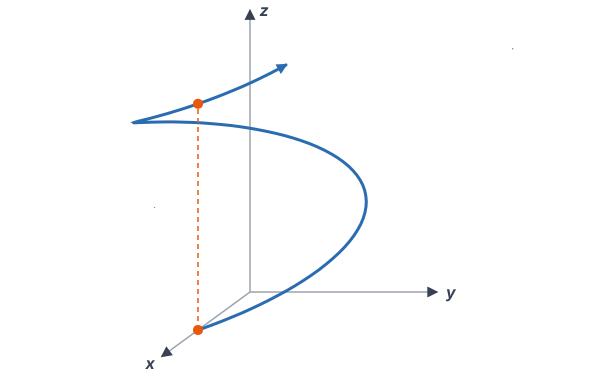
The domain of r(t) is every t where all three components are defined. The derivative r′(t) is the velocity of the moving point: it is tangent to the curve and points in the direction of motion.
Calculus of vector functions
\lim_{t \to a} \mathbf{r}(t) = \left\langle \lim_{t \to a} f(t), \; \lim_{t \to a} g(t), \; \lim_{t \to a} h(t) \right\rangle\mathbf{r}'(t) = \langle f'(t), \; g'(t), \; h'(t) \rangle\int_a^b \mathbf{r}(t)\,dt = \left\langle \int_a^b f(t)\,dt, \; \int_a^b g(t)\,dt, \; \int_a^b h(t)\,dt \right\rangle- The tangent line at t = t₀ passes through r(t₀) with direction r′(t₀), provided r′(t₀) ≠ 0.
- An indefinite integral gets a constant vector C = ⟨C₁, C₂, C₃⟩, one constant per component.
- The product rules still hold: (u · v)′ = u′ · v + u · v′ and (u × v)′ = u′ × v + u × v′.
Vector functions and space curves examples
Example 1: Recognizing a helix
Show that the curve r(t) = ⟨2 cos t, 2 sin t, 3t⟩ lies on a cylinder, and find how much it rises in one turn.
x^2 + y^2 = (2\cos t)^2 + (2\sin t)^2
Substitute x = 2 cos t and y = 2 sin t.
= 4\cos^2 t + 4\sin^2 t
Square each term.
= 4(\cos^2 t + \sin^2 t)
Factor out 4.
= 4
Use cos² t + sin² t = 1 (see fundamental trig identities).
3(2\pi) - 3(0) = 6\pi
One turn runs from t = 0 to t = 2π; subtract the z-values.
Answer: every point satisfies x² + y² = 4, so the curve lies on the cylinder of radius 2 around the z-axis. It is a helix that rises 6π ≈ 18.85 units per turn.
Example 2: Limit of a vector function
Find the limit as t → 0 of r(t) = ⟨(sin t)/t, e²ᵗ, (t² − t)/t⟩.
\lim_{t \to 0} \dfrac{\sin t}{t} = 1x-component: a standard limit (see squeeze theorem).
\lim_{t \to 0} e^{2t} = e^0 = 1y-component: substitute t = 0.
\dfrac{t^2 - t}{t} = t - 1z-component: divide each term by t (for t ≠ 0).
\lim_{t \to 0} (t - 1) = -1Substitute t = 0.
Answer: the limit is ⟨1, 1, −1⟩.
Example 3: Derivative and tangent line
Find r′(t) for r(t) = ⟨t², 3t − 1, eᵗ⁻¹⟩ and the tangent line at t = 1.
\mathbf{r}'(t) = \langle 2t, \; 3, \; e^{t-1} \rangleDifferentiate each component (see power rule and derivatives of exponential functions).
\mathbf{r}(1) = \langle 1^2, \; 3(1) - 1, \; e^0 \rangle = \langle 1, 2, 1 \rangleFind the point at t = 1.
\mathbf{r}'(1) = \langle 2(1), \; 3, \; e^0 \rangle = \langle 2, 3, 1 \rangleFind the tangent direction at t = 1.
x = 1 + 2s, \quad y = 2 + 3s, \quad z = 1 + s
Write the line through the point with that direction (see equations of lines in 3D).
Answer: r′(t) = ⟨2t, 3, eᵗ⁻¹⟩, and the tangent line at t = 1 is x = 1 + 2s, y = 2 + 3s, z = 1 + s.
Example 4: Definite integral of a vector function
Evaluate the integral of r(t) = ⟨cos t, 2t, sin 2t⟩ from t = 0 to t = π/2.
\int_0^{\pi/2} \cos t\,dt = \sin\dfrac{\pi}{2} - \sin 0 = 1x-component: antiderivative sin t, then subtract (see Fundamental Theorem of Calculus).
\int_0^{\pi/2} 2t\,dt = \left(\dfrac{\pi}{2}\right)^2 - 0^2 = \dfrac{\pi^2}{4}y-component: antiderivative t².
\int_0^{\pi/2} \sin 2t\,dt = -\dfrac{\cos \pi}{2} + \dfrac{\cos 0}{2}z-component: antiderivative −(cos 2t)/2 (see u-substitution).
= \dfrac{1}{2} + \dfrac{1}{2}Use cos π = −1 and cos 0 = 1.
= 1
Add.
Answer: ⟨1, π²/4, 1⟩ ≈ ⟨1, 2.47, 1⟩.
Example 5: Position of a drone (word problem)
A drone’s velocity is v(t) = ⟨4, 6t, 3t²⟩ meters per second, and at t = 0 it is at r(0) = ⟨1, 0, 2⟩. Find its position r(t), where it is at t = 2, and its speed then.
\mathbf{r}(t) = \langle 4t + C_1, \; 3t^2 + C_2, \; t^3 + C_3 \rangleIntegrate each component of v(t).
\langle C_1, C_2, C_3 \rangle = \langle 1, 0, 2 \rangle
Set t = 0 and match r(0).
\mathbf{r}(t) = \langle 4t + 1, \; 3t^2, \; t^3 + 2 \rangleSubstitute the constants.
\mathbf{r}(2) = \langle 9, 12, 10 \rangleSubstitute t = 2: 4(2) + 1, 3(4), 8 + 2.
\mathbf{v}(2) = \langle 4, 12, 12 \rangleSubstitute t = 2 into v(t).
\sqrt{16 + 144 + 144} = \sqrt{304} = 4\sqrt{19} \approx 17.44Speed is the magnitude of velocity.
Answer: r(t) = ⟨4t + 1, 3t², t³ + 2⟩. At t = 2 the drone is at (9, 12, 10) and moving at about 17.44 m/s.
Common mistakes
| Mistake | Example of the error | Fix |
|---|---|---|
| Using one component’s domain | Domain of ⟨√(t − 1), 1/(5 − t), t⟩ given as t ≥ 1 | Every component must be defined: t ≥ 1 and t ≠ 5. |
| Forgetting the chain rule | (sin 3t)′ = cos 3t | (sin 3t)′ = 3 cos 3t. |
| Using a single number as the constant | ∫⟨6t, 2, 1⟩ dt = ⟨3t², 2t, t⟩ + C with C a number | Use a constant vector ⟨C₁, C₂, C₃⟩. |
| Mixing up the point and the direction | Tangent line in Example 3 through ⟨2, 3, 1⟩ | The line passes through r(1) = ⟨1, 2, 1⟩ and points along r′(1) = ⟨2, 3, 1⟩. |
| Differentiating the magnitude | r′(t) taken as the derivative of ‖r(t)‖ | Differentiate each component; speed ‖r′(t)‖ comes after. |
Related methods
Vector functions in the plane
With two components, the same rules give velocity, speed and acceleration for motion in the plane, as in vector-valued functions. In space, the next lessons find the length of a curve, the unit tangent and normal vectors, and curvature.
Curves of intersection
Where two surfaces meet, you can often write the curve as a vector function. For example, the cylinder x² + y² = 1 and the plane z = 2 − y meet along r(t) = ⟨cos t, sin t, 2 − sin t⟩: the first two components stay on the cylinder, and the third makes z = 2 − y.
Practice problems
- Find the domain of r(t) = ⟨√(t − 1), 1/(5 − t), t⟩.
- Find r(2) for r(t) = ⟨t, t², t³⟩.
- Find the limit as t → 2 of ⟨t², (t² − 4)/(t − 2), 3t⟩.
- Find r′(t) for r(t) = ⟨sin 3t, t⁴, e⁻ᵗ⟩.
- Find the tangent line to r(t) = ⟨t, t², t³⟩ at t = 1.
- Show that r(t) = ⟨3 cos t, 3 sin t, 4t⟩ lies on the cylinder x² + y² = 9.
- Evaluate the integral of ⟨3t², 4, 2t⟩ from t = 0 to t = 2.
- Find the indefinite integral of ⟨e²ᵗ, 6t, cos t⟩.
- Find r(t) if r′(t) = ⟨2t, 1, 3t²⟩ and r(0) = ⟨1, −1, 0⟩.
- A particle has velocity v(t) = ⟨1, 2t, 2⟩ and starts at r(0) = ⟨0, 0, 5⟩. Find its position and speed at t = 3.
Show answers
1.
t - 1 \ge 0 \Rightarrow t \ge 1
The square root needs t − 1 ≥ 0.
5 - t \ne 0 \Rightarrow t \ne 5
The fraction needs a nonzero denominator.
Answer: t ≥ 1 and t ≠ 5, that is, [1, 5) ∪ (5, ∞)
2.
\langle 2, \; 2^2, \; 2^3 \rangle = \langle 2, 4, 8 \rangle
Substitute t = 2 into each component.
Answer: ⟨2, 4, 8⟩
3.
\lim_{t \to 2} t^2 = 4x-component: substitute.
\dfrac{t^2 - 4}{t - 2} = \dfrac{(t - 2)(t + 2)}{t - 2} = t + 2y-component: factor and cancel (see difference of squares).
\lim_{t \to 2} (t + 2) = 4Substitute t = 2.
\lim_{t \to 2} 3t = 6z-component: substitute.
Answer: ⟨4, 4, 6⟩
4.
(\sin 3t)' = 3\cos 3t
Chain rule (see chain rule).
(t^4)' = 4t^3
Power rule.
(e^{-t})' = -e^{-t}Chain rule with inner derivative −1.
Answer: r′(t) = ⟨3 cos 3t, 4t³, −e⁻ᵗ⟩
5.
\mathbf{r}(1) = \langle 1, 1, 1 \rangleFind the point.
\mathbf{r}'(t) = \langle 1, 2t, 3t^2 \rangleDifferentiate each component.
\mathbf{r}'(1) = \langle 1, 2, 3 \rangleSubstitute t = 1.
x = 1 + s, \quad y = 1 + 2s, \quad z = 1 + 3s
Write the tangent line.
Answer: x = 1 + s, y = 1 + 2s, z = 1 + 3s
6.
(3\cos t)^2 + (3\sin t)^2 = 9\cos^2 t + 9\sin^2 t
Square each term.
= 9(\cos^2 t + \sin^2 t)
Factor out 9.
= 9
Use cos² t + sin² t = 1.
Answer: x² + y² = 9 for every t, so the curve (a helix) lies on the cylinder.
7.
\int_0^2 3t^2\,dt = 2^3 - 0^3 = 8
x-component: antiderivative t³.
\int_0^2 4\,dt = 4(2) - 4(0) = 8
y-component: antiderivative 4t.
\int_0^2 2t\,dt = 2^2 - 0^2 = 4
z-component: antiderivative t².
Answer: ⟨8, 8, 4⟩
8.
\int e^{2t}\,dt = \dfrac{e^{2t}}{2}x-component.
\int 6t\,dt = 3t^2
y-component.
\int \cos t\,dt = \sin t
z-component.
Answer: ⟨e²ᵗ/2, 3t², sin t⟩ + C, where C is a constant vector
9.
\mathbf{r}(t) = \langle t^2 + C_1, \; t + C_2, \; t^3 + C_3 \rangleIntegrate each component.
\langle C_1, C_2, C_3 \rangle = \langle 1, -1, 0 \rangle
Set t = 0 and match r(0).
Answer: r(t) = ⟨t² + 1, t − 1, t³⟩
10.
\mathbf{r}(t) = \langle t + C_1, \; t^2 + C_2, \; 2t + C_3 \rangleIntegrate each component of v(t).
\langle C_1, C_2, C_3 \rangle = \langle 0, 0, 5 \rangle
Set t = 0 and match r(0).
\mathbf{r}(t) = \langle t, \; t^2, \; 2t + 5 \rangleSubstitute the constants.
\mathbf{r}(3) = \langle 3, 9, 11 \rangleSubstitute t = 3.
\mathbf{v}(3) = \langle 1, 6, 2 \rangleSubstitute t = 3 into v(t).
\sqrt{1 + 36 + 4} = \sqrt{41} \approx 6.40Find the speed.
Answer: at (3, 9, 11), moving at √41 ≈ 6.40 units per second
Vector functions and space curves FAQ
What is a vector function?
A vector function r(t) = ⟨f(t), g(t), h(t)⟩ takes a number t and returns a vector. As t varies, the tip of r(t) traces a curve.
How do you differentiate a vector function?
Differentiate each component separately: r′(t) = ⟨f′(t), g′(t), h′(t)⟩. The result is a tangent vector to the curve.
What is a space curve?
A space curve is the path in three dimensions traced by the tip of a vector function, such as the helix ⟨cos t, sin t, t⟩.
How do you integrate a vector function?
Integrate each component. For an indefinite integral, add a constant vector C; for a definite integral, the result is a vector of three numbers.
Summary
- A vector function r(t) = ⟨f(t), g(t), h(t)⟩ traces a space curve as t varies.
- Its domain is where all three components are defined.
- Limits, derivatives and integrals work one component at a time.
- r′(t) is tangent to the curve; the tangent line at t₀ is r(t₀) + s r′(t₀).
- Indefinite integrals need a constant vector C, found from an initial condition.
Previous lesson: Quadric Surfaces
Next lesson: Arc Length of a Space Curve
Back to the Calculus 3 Index