
Arc Length of a Space Curve
The arc length of a space curve r(t) = ⟨x(t), y(t), z(t)⟩ from t = a to t = b is L = ∫ ‖r′(t)‖ dt, where ‖r′(t)‖ = √(x′² + y′² + z′²) is the speed. You add up speed times time along the curve. It is the 2D arc length formula with one more term for z.
Before this lesson: Vector Functions and Space Curves, Arc Length of Parametric Curves and Vectors in 3D
What arc length means in space
Picture a point moving along a curve in space, with position r(t) at time t. Its velocity is r′(t), and its speed is the length of that vector, ‖r′(t)‖. Distance traveled is speed times time, so over a tiny time step dt the point moves about ‖r′(t)‖ dt.
Adding up these tiny distances from t = a to t = b gives the length of the curve. It is like walking a winding mountain trail with a step counter: the counter adds every short step, even when the trail doubles back or climbs.
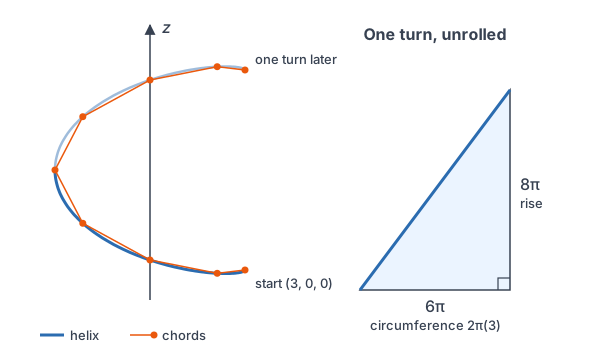
You can also think of the curve as a chain of short straight pieces, called chords. Each chord has a length from the 3D distance formula. As the pieces get shorter, the total of the chord lengths approaches the arc length.
Arc length formula for a space curve
L = \int_a^b \|\mathbf{r}'(t)\|\,dt = \int_a^b \sqrt{\left(\dfrac{dx}{dt}\right)^2 + \left(\dfrac{dy}{dt}\right)^2 + \left(\dfrac{dz}{dt}\right)^2}\,dt- The formula assumes r′(t) is continuous and the curve is traced exactly once as t runs from a to b.
- The arc length function measures length from a starting time t = a up to time t: s(t) = \int_a^t \|\mathbf{r}'(u)\|\,du, so ds/dt = \|\mathbf{r}'(t)\|.
- To parametrize by arc length, solve s = s(t) for t and substitute into r(t). The new curve r(s) has speed 1, so the parameter s measures distance along the curve.
Arc length of a space curve examples
Example 1: A line segment
Find the length of r(t) = ⟨1 + 2t, 3 − t, 2t⟩ for 0 ≤ t ≤ 3.
\mathbf{r}'(t) = \langle 2, -1, 2 \rangleDifferentiate each component.
\|\mathbf{r}'(t)\| = \sqrt{2^2 + (-1)^2 + 2^2}Write the magnitude of r′(t).
= \sqrt{4 + 1 + 4}Square each component.
= \sqrt{9}Add.
= 3
Take the square root.
L = \int_0^3 3\,dt
Set up the arc length integral.
= 3(3) - 3(0)
Use the antiderivative 3t and subtract (see Fundamental Theorem of Calculus).
= 9
Multiply and subtract.
\mathbf{r}(0) = \langle 1, 3, 0 \rangle, \; \mathbf{r}(3) = \langle 7, 0, 6 \rangleCheck: find the endpoints.
\sqrt{6^2 + (-3)^2 + 6^2} = \sqrt{81} = 9The distance between the endpoints is also 9, as it must be for a straight segment.
Answer: the segment has length 9.
Example 2: One turn of a helix
Find the length of the helix r(t) = ⟨3 cos t, 3 sin t, 4t⟩ for 0 ≤ t ≤ 2π.
\mathbf{r}'(t) = \langle -3\sin t, \; 3\cos t, \; 4 \rangleDifferentiate each component (see derivatives of trig functions).
\|\mathbf{r}'(t)\|^2 = 9\sin^2 t + 9\cos^2 t + 16Square each component and add.
= 9(\sin^2 t + \cos^2 t) + 16
Factor 9 from the first two terms.
= 9 + 16
Use sin² t + cos² t = 1 (see fundamental trig identities).
= 25
Add.
\|\mathbf{r}'(t)\| = 5Take the square root.
L = \int_0^{2\pi} 5\,dt = 5(2\pi) - 5(0)Integrate the constant speed.
= 10\pi \approx 31.42
Simplify.
Answer: one turn of the helix has length 10π ≈ 31.42. The picture above shows why: unrolled, one turn is the hypotenuse of a right triangle with legs 6π and 8π.
Example 3: A curve with a perfect-square speed
Find the length of r(t) = ⟨t³, 3t², 6t⟩ for 0 ≤ t ≤ 1.
\mathbf{r}'(t) = \langle 3t^2, \; 6t, \; 6 \rangleDifferentiate each component (see power rule).
\|\mathbf{r}'(t)\|^2 = 9t^4 + 36t^2 + 36Square each component and add.
= 9(t^4 + 4t^2 + 4)
Factor out 9.
= 9(t^2 + 2)^2
Factor the trinomial as a square (see perfect square trinomials).
\|\mathbf{r}'(t)\| = 3(t^2 + 2) = 3t^2 + 6Take the square root; t² + 2 is positive.
L = \int_0^1 (3t^2 + 6)\,dt
Set up the integral.
= \left[ t^3 + 6t \right]_0^1
Find the antiderivative.
= (1 + 6) - (0 + 0)
Substitute the limits.
= 7
Subtract.
Answer: the length is 7. As a check, the straight-line distance from (0, 0, 0) to (1, 3, 6) is √46 ≈ 6.78, a little less than 7.
Example 4: Arc length function and reparametrizing
For the helix r(t) = ⟨3 cos t, 3 sin t, 4t⟩, find the arc length function s(t) starting at t = 0. Then parametrize the helix by arc length, and find the point 5π units along the curve from (3, 0, 0).
s(t) = \int_0^t \|\mathbf{r}'(u)\|\,du = \int_0^t 5\,duUse the speed 5 from Example 2.
= 5t
Integrate the constant.
t = \dfrac{s}{5}Solve s = 5t for t.
\mathbf{r}(s) = \left\langle 3\cos\dfrac{s}{5}, \; 3\sin\dfrac{s}{5}, \; \dfrac{4s}{5} \right\rangleSubstitute t = s/5 into r(t).
\mathbf{r}'(s) = \left\langle -\dfrac{3}{5}\sin\dfrac{s}{5}, \; \dfrac{3}{5}\cos\dfrac{s}{5}, \; \dfrac{4}{5} \right\rangleCheck: differentiate with the chain rule.
\|\mathbf{r}'(s)\|^2 = \dfrac{9}{25} + \dfrac{16}{25} = 1The speed is 1, as it should be for an arc length parametrization.
\mathbf{r}(5\pi) = \langle 3\cos\pi, \; 3\sin\pi, \; 4\pi \rangleSubstitute s = 5π.
= \langle -3, \; 0, \; 4\pi \rangle
Use cos π = −1 and sin π = 0.
Answer: s(t) = 5t, r(s) = ⟨3 cos(s/5), 3 sin(s/5), 4s/5⟩, and the point 5π units along is (−3, 0, 4π), half a turn up the helix.
Example 5: Length of a stair handrail (word problem)
A spiral staircase has a handrail shaped like the helix r(t) = ⟨1.2 cos t, 1.2 sin t, 3t/(2π)⟩ in meters. It makes 2 full turns (0 ≤ t ≤ 4π) and rises 3 m per turn. How long is the handrail?
\mathbf{r}'(t) = \left\langle -1.2\sin t, \; 1.2\cos t, \; \dfrac{3}{2\pi} \right\rangleDifferentiate each component.
\|\mathbf{r}'(t)\|^2 = 1.44(\sin^2 t + \cos^2 t) + \dfrac{9}{4\pi^2}Square each component, add, and factor 1.44.
= 1.44 + \dfrac{9}{4\pi^2}Use sin² t + cos² t = 1.
\approx 1.44 + 0.2280 = 1.6680
Divide 9 by 4π².
\|\mathbf{r}'(t)\| \approx 1.2915Take the square root.
L = \int_0^{4\pi} 1.2915\,dt \approx 1.2915(4\pi)Integrate the constant speed.
\approx 16.23
Multiply.
Answer: the handrail is about 16.23 m long. Check by unrolling one turn: the legs are 2π(1.2) ≈ 7.54 m and 3 m, so one turn is √(7.54² + 3²) ≈ 8.11 m, and two turns are about 16.23 m.
Common mistakes
| Mistake | Example of the error | Fix |
|---|---|---|
| Leaving out the z-term | Using √(x′² + y′²) for ⟨3 cos t, 3 sin t, 4t⟩ and getting 6π | Include all three components: √(9 + 16) = 5, so L = 10π. |
| Integrating the position instead of the speed | Writing L = ∫ ‖r(t)‖ dt | Differentiate first: L = ∫ ‖r′(t)‖ dt. |
| Taking a square root term by term | √(9t⁴ + 36t² + 36) = 3t² + 6t + 6 | Factor first: 9(t² + 2)², so the root is 3t² + 6. |
| Using the points as limits | Integrating from (0, 0, 0) to (1, 3, 6) | The limits are parameter values, here t = 0 to t = 1. |
| Forgetting to check the speed after reparametrizing | Writing r(s) with t = s, not t = s/5 | After substituting, ‖r′(s)‖ must equal 1. |
Related methods
Arc length in the plane
For a plane curve, drop the z-term: L = ∫ √(x′² + y′²) dt, as in arc length of parametric curves. For a graph y = f(x), it becomes ∫ √(1 + f′(x)²) dx, from arc length of a curve.
When the integral has no nice antiderivative
Most speeds do not simplify, so most arc length integrals must be estimated. For example, ⟨t, t², t³⟩ on 0 ≤ t ≤ 1 has speed √(1 + 4t² + 9t⁴), and its length is about 1.863. Use a calculator’s numerical integration or Simpson’s rule.
Why the arc length parameter matters
With a curve written in terms of s, the speed is 1, so the derivative is already a unit vector. The next lessons use this idea to find the unit tangent vector and to measure curvature.
Practice problems
- Find the length of r(t) = ⟨2t, 3t, 6t⟩ for 0 ≤ t ≤ 2.
- Find the length of r(t) = ⟨cos t, sin t, t⟩ for 0 ≤ t ≤ 2π.
- Find the length of r(t) = ⟨5 sin t, 5 cos t, 12t⟩ for 0 ≤ t ≤ π.
- Find the length of r(t) = ⟨t, t², (2/3)t³⟩ for 0 ≤ t ≤ 1.
- Find the length of r(t) = ⟨t², 2t, ln t⟩ for 1 ≤ t ≤ e.
- Find the length of r(t) = ⟨eᵗ cos t, eᵗ sin t, eᵗ⟩ for 0 ≤ t ≤ ln 2.
- Find the arc length function s(t), starting at t = 0, for r(t) = ⟨4 cos t, 4 sin t, 3t⟩.
- Parametrize r(t) = ⟨4 cos t, 4 sin t, 3t⟩ by arc length, measured from t = 0.
- On the helix in Problem 7, find the point 10π units along the curve from (4, 0, 0), moving in the direction of increasing t.
- A drone’s position after t seconds is r(t) = ⟨6t, 3t², t³⟩ meters. How far does it fly in the first 2 seconds?
Show answers
1.
\mathbf{r}'(t) = \langle 2, 3, 6 \rangleDifferentiate each component.
\|\mathbf{r}'(t)\| = \sqrt{4 + 9 + 36}Square each component.
= \sqrt{49} = 7Add, then take the square root.
L = \int_0^2 7\,dt = 7(2) - 7(0) = 14
Integrate the constant speed.
Answer: 14
2.
\mathbf{r}'(t) = \langle -\sin t, \; \cos t, \; 1 \rangleDifferentiate each component.
\|\mathbf{r}'(t)\|^2 = \sin^2 t + \cos^2 t + 1Square each component and add.
= 1 + 1 = 2
Use sin² t + cos² t = 1.
\|\mathbf{r}'(t)\| = \sqrt{2}Take the square root.
L = \int_0^{2\pi} \sqrt{2}\,dt = 2\pi\sqrt{2} \approx 8.89Integrate the constant speed.
Answer: 2π√2 ≈ 8.89
3.
\mathbf{r}'(t) = \langle 5\cos t, \; -5\sin t, \; 12 \rangleDifferentiate each component.
\|\mathbf{r}'(t)\|^2 = 25\cos^2 t + 25\sin^2 t + 144Square each component and add.
= 25 + 144 = 169
Factor 25 and use cos² t + sin² t = 1.
\|\mathbf{r}'(t)\| = 13Take the square root.
L = \int_0^{\pi} 13\,dt = 13\pi \approx 40.84Integrate the constant speed.
Answer: 13π ≈ 40.84
4.
\mathbf{r}'(t) = \langle 1, \; 2t, \; 2t^2 \rangleDifferentiate each component.
\|\mathbf{r}'(t)\|^2 = 1 + 4t^2 + 4t^4Square each component and add.
= (1 + 2t^2)^2
Factor as a perfect square.
\|\mathbf{r}'(t)\| = 1 + 2t^2Take the square root; 1 + 2t² is positive.
L = \left[ t + \dfrac{2t^3}{3} \right]_0^1Integrate.
= 1 + \dfrac{2}{3} - 0 = \dfrac{5}{3}Substitute the limits and subtract.
Answer: 5/3 ≈ 1.67
5.
\mathbf{r}'(t) = \left\langle 2t, \; 2, \; \dfrac{1}{t} \right\rangleDifferentiate each component (see derivatives of logarithmic functions).
\|\mathbf{r}'(t)\|^2 = 4t^2 + 4 + \dfrac{1}{t^2}Square each component and add.
= \left(2t + \dfrac{1}{t}\right)^2Factor as a perfect square: the middle term is 2(2t)(1/t) = 4.
\|\mathbf{r}'(t)\| = 2t + \dfrac{1}{t}Take the square root; 2t + 1/t is positive for t ≥ 1.
L = \left[ t^2 + \ln t \right]_1^e
Integrate.
= (e^2 + 1) - (1 + 0)
Substitute the limits; ln e = 1 and ln 1 = 0.
= e^2 \approx 7.39
Subtract.
Answer: e² ≈ 7.39
6.
x' = e^t(\cos t - \sin t)
Differentiate x with the product rule.
y' = e^t(\sin t + \cos t)
Differentiate y with the product rule.
z' = e^t
Differentiate z.
(\cos t - \sin t)^2 + (\sin t + \cos t)^2 = 2
Expand both squares; the ±2 sin t cos t terms cancel and sin² t + cos² t = 1 twice.
\|\mathbf{r}'(t)\|^2 = e^{2t}(2 + 1) = 3e^{2t}Add the three squared components.
\|\mathbf{r}'(t)\| = \sqrt{3}\,e^tTake the square root.
L = \left[ \sqrt{3}\,e^t \right]_0^{\ln 2} = \sqrt{3}(2 - 1)Integrate; e^(ln 2) = 2 and e⁰ = 1.
= \sqrt{3} \approx 1.73Simplify.
Answer: √3 ≈ 1.73
7.
\mathbf{r}'(t) = \langle -4\sin t, \; 4\cos t, \; 3 \rangleDifferentiate each component.
\|\mathbf{r}'(t)\| = \sqrt{16 + 9} = 5Use 16 sin² t + 16 cos² t = 16, add 9, take the root.
s(t) = \int_0^t 5\,du = 5t
Integrate the speed from 0 to t.
Answer: s(t) = 5t
8.
t = \dfrac{s}{5}Solve s = 5t for t.
\mathbf{r}(s) = \left\langle 4\cos\dfrac{s}{5}, \; 4\sin\dfrac{s}{5}, \; \dfrac{3s}{5} \right\rangleSubstitute into r(t).
\|\mathbf{r}'(s)\|^2 = \dfrac{16}{25} + \dfrac{9}{25} = 1Check that the speed is 1.
Answer: r(s) = ⟨4 cos(s/5), 4 sin(s/5), 3s/5⟩
9.
5t = 10\pi
Set the arc length function equal to 10π.
t = 2\pi
Divide both sides by 5.
\mathbf{r}(2\pi) = \langle 4\cos 2\pi, \; 4\sin 2\pi, \; 6\pi \rangle = \langle 4, 0, 6\pi \rangleSubstitute t = 2π.
Answer: (4, 0, 6π), one full turn directly above the start
10.
\mathbf{r}'(t) = \langle 6, \; 6t, \; 3t^2 \rangleDifferentiate each component.
\|\mathbf{r}'(t)\|^2 = 36 + 36t^2 + 9t^4Square each component and add.
= 9(t^2 + 2)^2
Factor out 9; t⁴ + 4t² + 4 is a perfect square.
\|\mathbf{r}'(t)\| = 3t^2 + 6Take the square root.
L = \left[ t^3 + 6t \right]_0^2 = 8 + 12
Integrate and substitute the limits.
= 20
Add.
Answer: 20 m (the straight-line distance to (12, 12, 8) is only √352 ≈ 18.76 m)
Arc length of a space curve FAQ
What is the formula for the arc length of a space curve?
For r(t) = ⟨x(t), y(t), z(t)⟩ with a ≤ t ≤ b, the length is L = ∫ from a to b of √(x′(t)² + y′(t)² + z′(t)²) dt, the integral of the speed ‖r′(t)‖.
How is arc length in 3D different from arc length in 2D?
Only by one term. In 3D you add (dz/dt)² under the square root. Everything else, including the idea of integrating speed, stays the same.
What does it mean to parametrize a curve by arc length?
It means rewriting r in terms of s, the distance traveled along the curve. Then ‖r′(s)‖ = 1, and the point r(s) is exactly s units from the start.
Why do so many arc length integrals have no exact answer?
The square root of a sum of squares rarely simplifies. Textbook problems are chosen so that it does, often as a perfect square or a constant; in real work you estimate the integral numerically.
Summary
- Arc length of a space curve: L = ∫ from a to b of ‖r′(t)‖ dt, the integral of speed.
- ‖r′(t)‖ = √(x′² + y′² + z′²); in 2D the z-term drops out.
- Look for a constant speed (helices) or a perfect square under the root.
- The arc length function is s(t) = ∫ from a to t of ‖r′(u)‖ du, and ds/dt = ‖r′(t)‖.
- Parametrizing by arc length gives a curve with speed 1.
Previous lesson: Vector Functions and Space Curves
Next lesson: Unit Tangent and Unit Normal Vectors
Back to the Calculus 3 Index