
Curvature
Curvature, written κ (kappa), measures how sharply a curve bends. It is the rate at which the unit tangent vector turns per unit of distance: κ = ‖T′(t)‖/‖r′(t)‖ = ‖r′ × r″‖/‖r′‖³. A straight line has curvature 0, and a circle of radius R has curvature 1/R.
Before this lesson: Unit Tangent and Unit Normal Vectors, Arc Length of a Space Curve and Cross Product
What curvature measures
Drive along a road at a steady speed. On a gentle curve, the direction you face changes slowly; on a hairpin turn, it changes fast. Curvature puts a number on that: how much the direction turns for each meter you travel.
The direction is the unit tangent vector T. So curvature is the length of dT/ds, the rate of change of T with respect to arc length s. Measuring per unit of distance, not per unit of time, means the answer depends only on the shape of the curve, not on how fast you move along it.
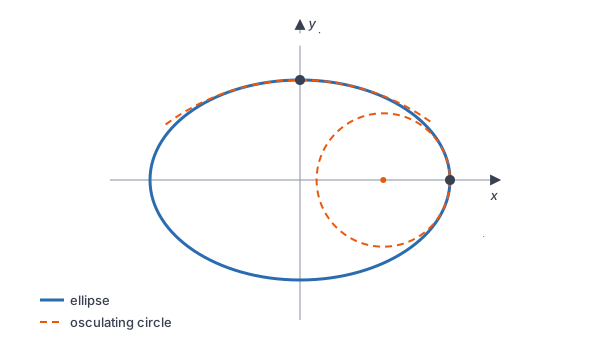
Every point with κ ≠ 0 has a best-fitting circle, called the osculating circle (from the Latin for “kissing”). Its radius, ρ = 1/κ, is the radius of curvature. A large κ means a small, tight circle.
Curvature formulas
\kappa = \left\| \dfrac{d\mathbf{T}}{ds} \right\| = \dfrac{\|\mathbf{T}'(t)\|}{\|\mathbf{r}'(t)\|} = \dfrac{\|\mathbf{r}'(t) \times \mathbf{r}''(t)\|}{\|\mathbf{r}'(t)\|^3}\kappa(x) = \dfrac{|f''(x)|}{\left(1 + [f'(x)]^2\right)^{3/2}} \quad \text{for a graph } y = f(x)- The middle formula follows from the chain rule: dT/dt = (dT/ds)(ds/dt), and ds/dt = ‖r′(t)‖.
- The cross product formula is usually fastest, because it needs only r′ and r″, not T′. For a plane curve, write it as ⟨x(t), y(t), 0⟩.
- The radius of curvature is ρ = 1/κ. Curvature is never negative.
Curvature examples
Example 1: Curvature of a circle
Find the curvature of the circle r(t) = ⟨4 cos t, 4 sin t⟩ of radius 4.
\mathbf{r}'(t) = \langle -4\sin t, \; 4\cos t \rangleDifferentiate each component (see derivatives of trig functions).
\|\mathbf{r}'(t)\| = \sqrt{16\sin^2 t + 16\cos^2 t} = 4Use sin² t + cos² t = 1 (see fundamental trig identities).
\mathbf{T}(t) = \langle -\sin t, \; \cos t \rangleDivide r′(t) by 4.
\mathbf{T}'(t) = \langle -\cos t, \; -\sin t \rangleDifferentiate T.
\|\mathbf{T}'(t)\| = 1Use cos² t + sin² t = 1.
\kappa = \dfrac{1}{4}Divide ‖T′(t)‖ by ‖r′(t)‖.
Answer: κ = 1/4 at every point, so the radius of curvature is 4, the radius of the circle itself.
Example 2: Curvature of a helix
Find the curvature of the helix r(t) = ⟨3 cos t, 3 sin t, 4t⟩.
\|\mathbf{r}'(t)\| = 5Speed from the arc length of a space curve lesson, Example 2.
\|\mathbf{T}'(t)\| = \dfrac{3}{5}From the unit tangent lesson, Example 2.
\kappa = \dfrac{3/5}{5} = \dfrac{3}{25} = 0.12Divide ‖T′(t)‖ by ‖r′(t)‖.
\rho = \dfrac{25}{3} \approx 8.33Radius of curvature: take the reciprocal.
Answer: κ = 3/25 everywhere on the helix. That is less than the 1/3 of a flat circle of radius 3, because climbing stretches the bend out.
Example 3: The cross product formula on an ellipse
Find the curvature of the ellipse r(t) = ⟨3 cos t, 2 sin t, 0⟩ at the end (3, 0, 0), where t = 0, and at the top (0, 2, 0), where t = π/2.
\mathbf{r}'(t) = \langle -3\sin t, \; 2\cos t, \; 0 \rangleDifferentiate each component.
\mathbf{r}''(t) = \langle -3\cos t, \; -2\sin t, \; 0 \rangleDifferentiate again.
\mathbf{r}' \times \mathbf{r}'' = \langle 0, \; 0, \; (-3\sin t)(-2\sin t) - (2\cos t)(-3\cos t) \rangleCross product: only the z-component can be nonzero (see cross product).
= \langle 0, \; 0, \; 6\sin^2 t + 6\cos^2 t \rangle = \langle 0, 0, 6 \rangle
Multiply, then use sin² t + cos² t = 1.
\|\mathbf{r}'(t)\| = \sqrt{9\sin^2 t + 4\cos^2 t}Find the speed.
\kappa(t) = \dfrac{6}{(9\sin^2 t + 4\cos^2 t)^{3/2}}Divide by the speed cubed.
\kappa(0) = \dfrac{6}{4^{3/2}} = \dfrac{6}{8} = \dfrac{3}{4}At t = 0: sin 0 = 0, cos 0 = 1, and 4^(3/2) = 8 (see rational exponents).
\kappa\left(\dfrac{\pi}{2}\right) = \dfrac{6}{9^{3/2}} = \dfrac{6}{27} = \dfrac{2}{9}At t = π/2: sin = 1, cos = 0, and 9^(3/2) = 27.
Answer: κ = 3/4 at (3, 0, 0) and κ = 2/9 at (0, 2, 0). The ends of the long axis bend more sharply, as the picture shows.
Example 4: Curvature of a graph
Find the curvature of y = x² as a function of x. Where is it largest, and what are κ and ρ at x = 0 and x = 1?
f'(x) = 2x, \quad f''(x) = 2
Differentiate twice (see power rule).
\kappa(x) = \dfrac{|2|}{\left(1 + (2x)^2\right)^{3/2}} = \dfrac{2}{(1 + 4x^2)^{3/2}}Substitute into the graph formula.
\kappa(0) = \dfrac{2}{1^{3/2}} = 2, \quad \rho = \dfrac{1}{2}Substitute x = 0, then take the reciprocal.
\kappa(1) = \dfrac{2}{5^{3/2}} = \dfrac{2}{5\sqrt{5}} \approx 0.179Substitute x = 1; 5^(3/2) = 5√5.
\rho = \dfrac{5\sqrt{5}}{2} \approx 5.59Take the reciprocal.
Answer: κ(x) = 2/(1 + 4x²)^(3/2). The denominator is smallest at x = 0, so the curvature is largest at the vertex: κ = 2, ρ = 1/2. At x = 1, κ ≈ 0.179 and ρ ≈ 5.59.
Example 5: Sharpest point of an exit ramp (word problem)
An exit ramp near its sharpest point follows y = 0.02x², with x and y in meters. Find the radius of curvature at the vertex (x = 0) and at x = 10. Where must drivers slow down most?
f'(x) = 0.04x, \quad f''(x) = 0.04
Differentiate twice.
\kappa(0) = \dfrac{0.04}{(1 + 0)^{3/2}} = 0.04Substitute x = 0.
\rho(0) = \dfrac{1}{0.04} = 25Take the reciprocal.
f'(10) = 0.4, \quad 1 + 0.4^2 = 1.16
Find the slope at x = 10 and the base of the denominator.
1.16^{3/2} \approx 1.2494Raise to the 3/2 power.
\kappa(10) \approx \dfrac{0.04}{1.2494} \approx 0.0320Divide.
\rho(10) \approx \dfrac{1}{0.0320} \approx 31.2Take the reciprocal.
Answer: the radius of curvature is 25 m at the vertex and about 31.2 m at x = 10. The vertex has the smallest radius (the sharpest turn), so that is where drivers must slow down most.
Common mistakes
| Mistake | Example of the error | Fix |
|---|---|---|
| Forgetting to divide by the speed | κ = ‖T′‖ = 3/5 for the helix in Example 2 | κ = ‖T′‖/‖r′‖ = (3/5)/5 = 3/25. |
| Dividing by the speed, not its cube | κ = ‖r′ × r″‖/‖r′‖ = 6/2 = 3 for the ellipse at t = 0 | Cube the speed: 6/2³ = 3/4. |
| Dropping the absolute value | κ = −2 at the vertex of y = −x² | Use |f″(x)|: κ = 2. Curvature is never negative. |
| Using f′ in the numerator | For y = x³ at x = 1, writing κ = 3/10^(3/2) with f′(1) = 3 on top | The numerator is |f″(1)| = 6: κ = 6/10^(3/2) ≈ 0.190. |
| Mixing up κ and ρ | “A circle of radius 4 has curvature 4” | κ = 1/R = 1/4; the radius of curvature ρ = 1/κ is 4. |
Related methods
Osculating circle
At a point where κ ≠ 0, the osculating circle has radius ρ = 1/κ and its center is ρ units from the point in the direction of the unit normal N. For y = x² at the vertex, N = ⟨0, 1⟩ and ρ = 1/2, so the circle is centered at (0, 1/2).
Curvature and concavity
For a graph, the sign of f″ tells you which way the curve bends (concavity), and the size of κ tells you how sharply. At an inflection point f″ = 0, so κ = 0 there for a moment.
Torsion
Curvature measures bending within a plane. A space curve can also twist out of its plane; that twisting is measured by torsion, using the binormal vector B = T × N.
Practice problems
- Find the curvature of the circle r(t) = ⟨5 cos t, 5 sin t⟩.
- Find the curvature of the helix r(t) = ⟨cos t, sin t, t⟩.
- Find the curvature of the line r(t) = ⟨1 + t, 2 − t, 3t⟩.
- Find the curvature of r(t) = ⟨t, t², t³⟩ at t = 0.
- Find the curvature of r(t) = ⟨t, cos 2t, sin 2t⟩.
- Find the curvature of y = x³ at x = 1.
- Find the curvature and the radius of curvature of y = sin x at x = π/2.
- Find the curvature of y = ln x at x = 1.
- Use the cross product formula to find the curvature of r(t) = ⟨2t, t², t³/3⟩ at t = 1.
- A roller coaster dip follows y = x²/40 near its lowest point, in meters. Find the radius of curvature at the bottom (x = 0).
Show answers
1.
\mathbf{T}(t) = \langle -\sin t, \; \cos t \rangle, \; \|\mathbf{r}'(t)\| = 5r′(t) = ⟨−5 sin t, 5 cos t⟩ has length 5; divide to get T.
\|\mathbf{T}'(t)\| = \|\langle -\cos t, \; -\sin t \rangle\| = 1Differentiate T and find its length.
\kappa = \dfrac{1}{5}Divide.
Answer: κ = 1/5
2.
\mathbf{r}'(t) = \langle -\sin t, \; \cos t, \; 1 \rangle, \; \|\mathbf{r}'(t)\| = \sqrt{2}Differentiate and find the speed.
\mathbf{r}''(t) = \langle -\cos t, \; -\sin t, \; 0 \rangleDifferentiate again.
\mathbf{r}' \times \mathbf{r}'' = \langle \sin t, \; -\cos t, \; 1 \rangleCross product: x = 0 + sin t, y = −cos t − 0, z = sin² t + cos² t.
\|\mathbf{r}' \times \mathbf{r}''\| = \sqrt{2}Find its length.
\kappa = \dfrac{\sqrt{2}}{(\sqrt{2})^3} = \dfrac{\sqrt{2}}{2\sqrt{2}} = \dfrac{1}{2}Divide by the speed cubed.
Answer: κ = 1/2
3.
\mathbf{r}''(t) = \langle 0, 0, 0 \rangler′(t) = ⟨1, −1, 3⟩ is constant, so r″ = 0.
\kappa = \dfrac{\|\mathbf{r}' \times \mathbf{0}\|}{\|\mathbf{r}'\|^3} = 0The cross product with the zero vector is 0.
Answer: κ = 0 (a line does not bend)
4.
\mathbf{r}'(0) = \langle 1, 0, 0 \rangle, \; \mathbf{r}''(0) = \langle 0, 2, 0 \rangler′ = ⟨1, 2t, 3t²⟩ and r″ = ⟨0, 2, 6t⟩; substitute t = 0.
\mathbf{r}'(0) \times \mathbf{r}''(0) = \langle 0, 0, 2 \rangleCross product.
\kappa(0) = \dfrac{2}{1^3} = 2Divide by the speed cubed.
Answer: κ(0) = 2
5.
\|\mathbf{r}'(t)\| = \sqrt{5}, \quad \|\mathbf{T}'(t)\| = \dfrac{4}{\sqrt{5}}From r′ = ⟨1, −2 sin 2t, 2 cos 2t⟩ and T = r′/√5.
\kappa = \dfrac{4/\sqrt{5}}{\sqrt{5}} = \dfrac{4}{5}Divide.
Answer: κ = 4/5 everywhere
6.
f'(1) = 3, \quad f''(1) = 6
f′(x) = 3x² and f″(x) = 6x; substitute x = 1.
\kappa(1) = \dfrac{6}{(1 + 9)^{3/2}} = \dfrac{6}{10\sqrt{10}}Substitute into the graph formula.
\approx 0.190
Evaluate.
Answer: κ(1) = 3/(5√10) ≈ 0.190
7.
f'\left(\dfrac{\pi}{2}\right) = \cos\dfrac{\pi}{2} = 0, \quad f''\left(\dfrac{\pi}{2}\right) = -\sin\dfrac{\pi}{2} = -1Differentiate twice and substitute.
\kappa = \dfrac{|-1|}{(1 + 0)^{3/2}} = 1Substitute into the graph formula.
\rho = \dfrac{1}{1} = 1Take the reciprocal.
Answer: κ = 1 and ρ = 1 at the top of the sine wave
8.
f'(x) = \dfrac{1}{x}, \quad f''(x) = -\dfrac{1}{x^2}Differentiate twice (see derivatives of logarithmic functions).
\kappa(1) = \dfrac{|-1|}{(1 + 1)^{3/2}} = \dfrac{1}{2\sqrt{2}}Substitute x = 1.
\approx 0.354
Evaluate.
Answer: κ(1) = 1/(2√2) = √2/4 ≈ 0.354
9.
\mathbf{r}'(1) = \langle 2, 2, 1 \rangle, \; \mathbf{r}''(1) = \langle 0, 2, 2 \rangler′ = ⟨2, 2t, t²⟩ and r″ = ⟨0, 2, 2t⟩; substitute t = 1.
\mathbf{r}' \times \mathbf{r}'' = \langle 2(2) - 1(2), \; 1(0) - 2(2), \; 2(2) - 2(0) \rangle = \langle 2, -4, 4 \rangleCross product.
\|\langle 2, -4, 4 \rangle\| = \sqrt{4 + 16 + 16} = 6Find its length.
\|\mathbf{r}'(1)\|^3 = 3^3 = 27The speed is √(4 + 4 + 1) = 3; cube it.
\kappa(1) = \dfrac{6}{27} = \dfrac{2}{9}Divide.
Answer: κ(1) = 2/9
10.
f'(x) = \dfrac{x}{20}, \quad f''(x) = \dfrac{1}{20}Differentiate twice.
\kappa(0) = \dfrac{1/20}{(1 + 0)^{3/2}} = \dfrac{1}{20}Substitute x = 0.
\rho = 20
Take the reciprocal.
Answer: the radius of curvature at the bottom is 20 m
Curvature FAQ
What is the formula for curvature?
For r(t), κ = ‖r′(t) × r″(t)‖/‖r′(t)‖³, or equivalently ‖T′(t)‖/‖r′(t)‖. For a graph y = f(x), κ = |f″(x)|/(1 + f′(x)²)^(3/2).
What is the curvature of a circle?
A circle of radius R has curvature 1/R at every point. Smaller circles bend more sharply, so they have larger curvature.
What is the radius of curvature?
The radius of curvature is ρ = 1/κ. It is the radius of the osculating circle, the circle that best fits the curve at that point.
Can curvature be negative?
No. Curvature is a length, ‖dT/ds‖, so it is always 0 or positive. The direction of the bend is shown by the unit normal N, or for a graph by the sign of f″.
Summary
- Curvature κ = ‖dT/ds‖ measures how fast the direction of a curve turns per unit of distance.
- Formulas: κ = ‖T′‖/‖r′‖ = ‖r′ × r″‖/‖r′‖³; for y = f(x), κ = |f″|/(1 + f′²)^(3/2).
- A line has κ = 0; a circle of radius R has κ = 1/R.
- The radius of curvature is ρ = 1/κ, the radius of the osculating circle.
- Curvature never depends on the speed along the curve, only on its shape.
Previous lesson: Unit Tangent and Unit Normal Vectors
Next lesson: Motion in Space
Back to the Calculus 3 Index