
Unit Tangent and Unit Normal Vectors
The unit tangent vector T(t) = r′(t)/‖r′(t)‖ points in the direction a curve is moving, and the unit normal vector N(t) = T′(t)/‖T′(t)‖ points in the direction the curve is bending. Both have length 1, and N is always perpendicular to T.
Before this lesson: Vector Functions and Space Curves, Arc Length of a Space Curve and Quotient Rule
Direction of motion and direction of bending
The velocity r′(t) points along the curve, but its length is the speed, which can change. Dividing by the speed keeps only the direction. That direction is the unit tangent vector T(t).
As you move along a curve, T(t) turns. Its derivative T′(t) shows which way it is turning. Because T always has length 1, T′ is perpendicular to T, so it points sideways, toward the inside of the bend. Scaling T′ to length 1 gives the unit normal vector N(t).
Think of driving a car. T is the way the car points. N is the way you turn the steering wheel: toward the center of the curve you are driving around.
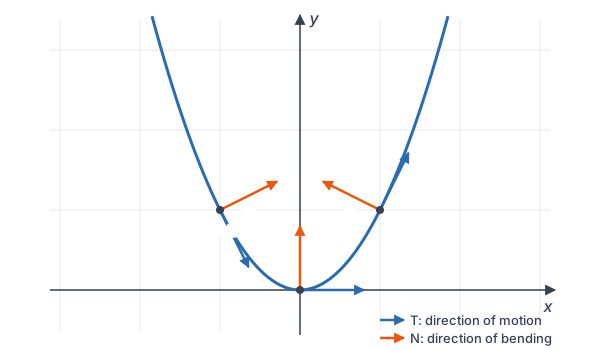
Unit tangent and unit normal vector formulas
\mathbf{T}(t) = \dfrac{\mathbf{r}'(t)}{\|\mathbf{r}'(t)\|} \qquad \mathbf{N}(t) = \dfrac{\mathbf{T}'(t)}{\|\mathbf{T}'(t)\|}- T(t) needs r′(t) ≠ 0. N(t) needs T′(t) ≠ 0; on a straight line T never changes, so N is not defined.
- T · N = 0 at every point, because T · T = 1 for all t and differentiating gives 2T · T′ = 0.
- N points toward the concave side of the curve (the inside of the bend).
- To find N at one point, differentiate T first, then substitute the value of t. Substituting first turns T into a constant, whose derivative is 0.
Unit tangent and unit normal vector examples
Example 1: Unit tangent of a line
Find T(t) for the line r(t) = ⟨1 + 2t, 3t, 2 − 6t⟩. Does N(t) exist?
\mathbf{r}'(t) = \langle 2, 3, -6 \rangleDifferentiate each component.
\|\mathbf{r}'(t)\| = \sqrt{4 + 9 + 36}Square each component (see vectors in 3D for magnitude).
= \sqrt{49} = 7Add, then take the square root.
\mathbf{T}(t) = \left\langle \dfrac{2}{7}, \; \dfrac{3}{7}, \; -\dfrac{6}{7} \right\rangleDivide each component by 7.
\mathbf{T}'(t) = \langle 0, 0, 0 \rangleT is constant, so its derivative is the zero vector.
Answer: T(t) = ⟨2/7, 3/7, −6/7⟩ for every t. A line does not bend, so T′ = 0 and N(t) is not defined.
Example 2: T and N for a helix
Find T(t) and N(t) for the helix r(t) = ⟨3 cos t, 3 sin t, 4t⟩.
\mathbf{r}'(t) = \langle -3\sin t, \; 3\cos t, \; 4 \rangleDifferentiate each component (see derivatives of trig functions).
\|\mathbf{r}'(t)\| = \sqrt{9\sin^2 t + 9\cos^2 t + 16}Square each component and add.
= \sqrt{9 + 16} = 5Use sin² t + cos² t = 1 (see fundamental trig identities), then take the root.
\mathbf{T}(t) = \left\langle -\dfrac{3}{5}\sin t, \; \dfrac{3}{5}\cos t, \; \dfrac{4}{5} \right\rangleDivide r′(t) by 5.
\mathbf{T}'(t) = \left\langle -\dfrac{3}{5}\cos t, \; -\dfrac{3}{5}\sin t, \; 0 \right\rangleDifferentiate each component of T.
\|\mathbf{T}'(t)\| = \sqrt{\dfrac{9}{25}\cos^2 t + \dfrac{9}{25}\sin^2 t} = \dfrac{3}{5}Find the magnitude of T′(t).
\mathbf{N}(t) = \langle -\cos t, \; -\sin t, \; 0 \rangleDivide T′(t) by 3/5.
Answer: T(t) = ⟨−(3/5) sin t, (3/5) cos t, 4/5⟩ and N(t) = ⟨−cos t, −sin t, 0⟩. N is horizontal and points from the curve straight toward the z-axis, the center of the bend.
Example 3: Unit tangent at a point
Find T(t) for r(t) = ⟨eᵗ, e⁻ᵗ, √2 t⟩, and then T(0).
\mathbf{r}'(t) = \langle e^t, \; -e^{-t}, \; \sqrt{2} \rangleDifferentiate each component (see derivatives of exponential functions).
\|\mathbf{r}'(t)\|^2 = e^{2t} + e^{-2t} + 2Square each component and add.
= (e^t + e^{-t})^2Factor as a perfect square: the middle term is 2eᵗe⁻ᵗ = 2.
\|\mathbf{r}'(t)\| = e^t + e^{-t}Take the square root; eᵗ + e⁻ᵗ is positive.
\mathbf{T}(t) = \dfrac{\langle e^t, \; -e^{-t}, \; \sqrt{2} \rangle}{e^t + e^{-t}}Divide r′(t) by its length.
\mathbf{T}(0) = \dfrac{\langle 1, \; -1, \; \sqrt{2} \rangle}{2}Substitute t = 0: e⁰ = 1, so the denominator is 2.
\|\mathbf{T}(0)\| = \dfrac{\sqrt{1 + 1 + 2}}{2} = 1Check: T has length 1.
Answer: T(0) = ⟨1/2, −1/2, √2/2⟩.
Example 4: T and N at a point when the speed changes
Find T(1) and N(1) for r(t) = ⟨t², 2t, ln t⟩.
\mathbf{r}'(t) = \left\langle 2t, \; 2, \; \dfrac{1}{t} \right\rangleDifferentiate each component.
\|\mathbf{r}'(t)\| = 2t + \dfrac{1}{t} = \dfrac{2t^2 + 1}{t}Use the perfect-square speed from the arc length lesson, then write it as one fraction.
\mathbf{T}(t) = \left\langle 2t, \; 2, \; \dfrac{1}{t} \right\rangle \cdot \dfrac{t}{2t^2 + 1}Divide by the speed: multiply by its reciprocal.
= \dfrac{\langle 2t^2, \; 2t, \; 1 \rangle}{2t^2 + 1}Multiply each component by t.
\mathbf{T}(1) = \dfrac{\langle 2, 2, 1 \rangle}{3}Substitute t = 1.
\left( \dfrac{2t^2}{2t^2 + 1} \right)' = \dfrac{4t(2t^2 + 1) - 2t^2(4t)}{(2t^2 + 1)^2} = \dfrac{4t}{(2t^2 + 1)^2}First component of T′: use the quotient rule and simplify.
\left( \dfrac{2t}{2t^2 + 1} \right)' = \dfrac{2(2t^2 + 1) - 2t(4t)}{(2t^2 + 1)^2} = \dfrac{2 - 4t^2}{(2t^2 + 1)^2}Second component: quotient rule.
\left( \dfrac{1}{2t^2 + 1} \right)' = \dfrac{-4t}{(2t^2 + 1)^2}Third component: quotient rule (or the chain rule).
\mathbf{T}'(1) = \dfrac{\langle 4, \; -2, \; -4 \rangle}{9}Substitute t = 1; the denominator is 3² = 9.
\|\mathbf{T}'(1)\| = \dfrac{\sqrt{16 + 4 + 16}}{9} = \dfrac{6}{9} = \dfrac{2}{3}Find the magnitude.
\mathbf{N}(1) = \dfrac{\langle 4, -2, -4 \rangle}{9} \cdot \dfrac{3}{2} = \dfrac{\langle 2, -1, -2 \rangle}{3}Divide T′(1) by 2/3.
\mathbf{T}(1) \cdot \mathbf{N}(1) = \dfrac{4 - 2 - 2}{9} = 0Check: the dot product is 0, so T and N are perpendicular.
Answer: T(1) = ⟨2/3, 2/3, 1/3⟩ and N(1) = ⟨2/3, −1/3, −2/3⟩.
Example 5: Driving up a spiral ramp (word problem)
A car drives up a spiral parking-garage ramp along r(t) = ⟨12 cos t, 12 sin t, 5t⟩, in meters. Find T and N at t = π/2, and describe which way the car is heading and which way it is turning.
\mathbf{r}'(t) = \langle -12\sin t, \; 12\cos t, \; 5 \rangleDifferentiate each component.
\|\mathbf{r}'(t)\| = \sqrt{144 + 25} = 13Use 144 sin² t + 144 cos² t = 144, add 25, take the root.
\mathbf{T}(t) = \dfrac{\langle -12\sin t, \; 12\cos t, \; 5 \rangle}{13}Divide by the speed.
\mathbf{T}'(t) = \dfrac{\langle -12\cos t, \; -12\sin t, \; 0 \rangle}{13}Differentiate T.
\|\mathbf{T}'(t)\| = \dfrac{12}{13}Use cos² t + sin² t = 1.
\mathbf{N}(t) = \langle -\cos t, \; -\sin t, \; 0 \rangleDivide T′(t) by 12/13.
\mathbf{r}\left(\dfrac{\pi}{2}\right) = \left\langle 0, \; 12, \; \dfrac{5\pi}{2} \right\rangleFind the car’s position.
\mathbf{T}\left(\dfrac{\pi}{2}\right) = \left\langle -\dfrac{12}{13}, \; 0, \; \dfrac{5}{13} \right\rangleSubstitute t = π/2: sin = 1, cos = 0.
\mathbf{N}\left(\dfrac{\pi}{2}\right) = \langle 0, \; -1, \; 0 \rangleSubstitute t = π/2.
Answer: at (0, 12, 5π/2) the car heads in the direction ⟨−12/13, 0, 5/13⟩: mostly in the −x direction while climbing. N = ⟨0, −1, 0⟩ points from the car straight toward the ramp’s center post on the z-axis, so the car is turning left, toward the center.
Common mistakes
| Mistake | Example of the error | Fix |
|---|---|---|
| Not dividing by the length | T(t) = ⟨2, 3, −6⟩ for the line in Example 1 | Divide by ‖r′‖ = 7: T = ⟨2/7, 3/7, −6/7⟩. |
| Substituting before differentiating | T(1) = ⟨2/3, 2/3, 1/3⟩, so T′(1) = 0 | Find T′(t) first, then substitute t = 1. |
| Using r″(t) for the direction of N | For ⟨t², 2t, ln t⟩, r″(1) = ⟨2, 0, −1⟩, which is not perpendicular to T(1) | When the speed changes, use T′, not r″. |
| Writing N = 0 for a line | N(t) = ⟨0, 0, 0⟩ for r(t) = ⟨1 + 2t, 3t, 2 − 6t⟩ | N is not defined when T′ = 0; a unit vector cannot be 0. |
| Getting the wrong side | N pointing away from the center of a circle | N always points toward the inside of the bend. |
Related methods
The binormal vector
The binormal vector B = T × N is a third unit vector, perpendicular to both T and N. Together, T, N and B form a moving set of axes called the TNB (or Frenet) frame. For the helix in Example 2, the cross product gives B = ⟨(4/5) sin t, −(4/5) cos t, 3/5⟩.
A shortcut in the plane
For a curve in the xy-plane with T = ⟨a, b⟩, the normal is one of the two perpendicular unit vectors ⟨−b, a⟩ or ⟨b, −a⟩. Choose the one that points toward the inside of the bend, which for a graph y = f(x) is upward where it is concave up.
What comes next
How fast T turns, compared with distance traveled, is the curvature of the curve. Later in this unit, T and N also split acceleration into a part along the path and a part toward the center of the bend.
Practice problems
- Find T(t) for the line r(t) = ⟨3 − t, 2 + 2t, 4 + 2t⟩.
- Find T(t) for the helix r(t) = ⟨cos t, sin t, t⟩.
- Find N(t) for the helix in Problem 2.
- Find T(1) for r(t) = ⟨t, t², t³⟩.
- Find T(t) and N(t) for r(t) = ⟨t, cos 2t, sin 2t⟩.
- For the parabola r(t) = ⟨t, t²⟩, find T(1), then use the shortcut in the plane to find N(1).
- Show that T(t) · N(t) = 0 for the helix in Problems 2 and 3.
- A drone flies along r(t) = ⟨6t, 3t², t³⟩. Find T(1) and N(1).
- Find the binormal vector B(t) = T(t) × N(t) for the helix in Problems 2 and 3.
- A rider on a carousel moves along r(t) = ⟨4 cos 3t, 4 sin 3t, 2⟩ (meters, seconds). Find T and N at t = π/6, and show that N points from the rider to the center of the carousel at (0, 0, 2).
Show answers
1.
\mathbf{r}'(t) = \langle -1, 2, 2 \rangleDifferentiate each component.
\|\mathbf{r}'(t)\| = \sqrt{1 + 4 + 4} = 3Find the magnitude.
\mathbf{T}(t) = \left\langle -\dfrac{1}{3}, \; \dfrac{2}{3}, \; \dfrac{2}{3} \right\rangleDivide by 3.
Answer: T(t) = ⟨−1/3, 2/3, 2/3⟩ for every t
2.
\mathbf{r}'(t) = \langle -\sin t, \; \cos t, \; 1 \rangleDifferentiate each component.
\|\mathbf{r}'(t)\| = \sqrt{\sin^2 t + \cos^2 t + 1} = \sqrt{2}Use sin² t + cos² t = 1.
\mathbf{T}(t) = \dfrac{\langle -\sin t, \; \cos t, \; 1 \rangle}{\sqrt{2}}Divide by √2.
Answer: T(t) = ⟨−sin t, cos t, 1⟩/√2
3.
\mathbf{T}'(t) = \dfrac{\langle -\cos t, \; -\sin t, \; 0 \rangle}{\sqrt{2}}Differentiate T(t) from Problem 2.
\|\mathbf{T}'(t)\| = \dfrac{1}{\sqrt{2}}Use cos² t + sin² t = 1.
\mathbf{N}(t) = \langle -\cos t, \; -\sin t, \; 0 \rangleDivide T′(t) by 1/√2.
Answer: N(t) = ⟨−cos t, −sin t, 0⟩
4.
\mathbf{r}'(t) = \langle 1, \; 2t, \; 3t^2 \rangleDifferentiate each component.
\mathbf{r}'(1) = \langle 1, 2, 3 \rangleSubstitute t = 1.
\|\mathbf{r}'(1)\| = \sqrt{1 + 4 + 9} = \sqrt{14}Find the magnitude.
\mathbf{T}(1) = \dfrac{\langle 1, 2, 3 \rangle}{\sqrt{14}}Divide by √14.
Answer: T(1) = ⟨1, 2, 3⟩/√14 ≈ ⟨0.27, 0.53, 0.80⟩
5.
\mathbf{r}'(t) = \langle 1, \; -2\sin 2t, \; 2\cos 2t \rangleDifferentiate with the chain rule.
\|\mathbf{r}'(t)\| = \sqrt{1 + 4\sin^2 2t + 4\cos^2 2t} = \sqrt{5}Use sin² 2t + cos² 2t = 1.
\mathbf{T}(t) = \dfrac{\langle 1, \; -2\sin 2t, \; 2\cos 2t \rangle}{\sqrt{5}}Divide by √5.
\mathbf{T}'(t) = \dfrac{\langle 0, \; -4\cos 2t, \; -4\sin 2t \rangle}{\sqrt{5}}Differentiate T.
\|\mathbf{T}'(t)\| = \dfrac{4}{\sqrt{5}}Use cos² 2t + sin² 2t = 1.
\mathbf{N}(t) = \langle 0, \; -\cos 2t, \; -\sin 2t \rangleDivide T′(t) by 4/√5.
Answer: T(t) = ⟨1, −2 sin 2t, 2 cos 2t⟩/√5 and N(t) = ⟨0, −cos 2t, −sin 2t⟩
6.
\mathbf{r}'(1) = \langle 1, 2 \rangleDifferentiate ⟨t, t²⟩ to get ⟨1, 2t⟩, then substitute t = 1.
\mathbf{T}(1) = \dfrac{\langle 1, 2 \rangle}{\sqrt{5}}Divide by √(1 + 4) = √5.
\dfrac{\langle -2, 1 \rangle}{\sqrt{5}} \text{ or } \dfrac{\langle 2, -1 \rangle}{\sqrt{5}}Write the two unit vectors perpendicular to T(1).
\mathbf{N}(1) = \dfrac{\langle -2, 1 \rangle}{\sqrt{5}}The parabola is concave up, so N must point upward (positive y-component).
Answer: T(1) = ⟨1, 2⟩/√5 and N(1) = ⟨−2, 1⟩/√5
7.
\mathbf{T} \cdot \mathbf{N} = \dfrac{(-\sin t)(-\cos t) + (\cos t)(-\sin t) + (1)(0)}{\sqrt{2}}Multiply matching components and add.
= \dfrac{\sin t\cos t - \sin t\cos t + 0}{\sqrt{2}}Simplify each product.
= 0
The terms cancel.
Answer: T · N = 0 for every t
8.
\mathbf{T}(t) = \dfrac{\langle 6, \; 6t, \; 3t^2 \rangle}{3t^2 + 6} = \dfrac{\langle 2, \; 2t, \; t^2 \rangle}{t^2 + 2}Divide r′(t) by the speed 3t² + 6, then cancel 3.
\mathbf{T}(1) = \dfrac{\langle 2, 2, 1 \rangle}{3}Substitute t = 1.
\mathbf{T}'(t) = \dfrac{\langle -4t, \; 4 - 2t^2, \; 4t \rangle}{(t^2 + 2)^2}Differentiate each component with the quotient rule.
\mathbf{T}'(1) = \dfrac{\langle -4, \; 2, \; 4 \rangle}{9}Substitute t = 1.
\|\mathbf{T}'(1)\| = \dfrac{\sqrt{16 + 4 + 16}}{9} = \dfrac{2}{3}Find the magnitude.
\mathbf{N}(1) = \dfrac{\langle -2, 1, 2 \rangle}{3}Divide T′(1) by 2/3.
Answer: T(1) = ⟨2/3, 2/3, 1/3⟩ and N(1) = ⟨−2/3, 1/3, 2/3⟩
9.
\mathbf{T} \times \mathbf{N} = \dfrac{1}{\sqrt{2}} \langle -\sin t, \; \cos t, \; 1 \rangle \times \langle -\cos t, \; -\sin t, \; 0 \rangleWrite the cross product.
x: \; (\cos t)(0) - (1)(-\sin t) = \sin t
First component.
y: \; (1)(-\cos t) - (-\sin t)(0) = -\cos t
Second component.
z: \; (-\sin t)(-\sin t) - (\cos t)(-\cos t) = 1
Third component; sin² t + cos² t = 1.
Answer: B(t) = ⟨sin t, −cos t, 1⟩/√2
10.
\mathbf{r}'(t) = \langle -12\sin 3t, \; 12\cos 3t, \; 0 \rangleDifferentiate with the chain rule.
\mathbf{T}(t) = \langle -\sin 3t, \; \cos 3t, \; 0 \rangleDivide by the speed 12.
\mathbf{T}'(t) = \langle -3\cos 3t, \; -3\sin 3t, \; 0 \rangleDifferentiate T.
\mathbf{N}(t) = \langle -\cos 3t, \; -\sin 3t, \; 0 \rangleDivide by ‖T′(t)‖ = 3.
\mathbf{T}\left(\dfrac{\pi}{6}\right) = \langle -1, 0, 0 \rangle, \; \mathbf{N}\left(\dfrac{\pi}{6}\right) = \langle 0, -1, 0 \rangleSubstitute t = π/6, so 3t = π/2.
\langle 0, 0, 2 \rangle - \langle 0, 4, 2 \rangle = \langle 0, -4, 0 \rangle
The rider is at r(π/6) = (0, 4, 2); subtract to get the direction to the center.
Answer: T = ⟨−1, 0, 0⟩ and N = ⟨0, −1, 0⟩; the vector to the center, ⟨0, −4, 0⟩, is 4N, so N points at the center.
Unit tangent and unit normal vectors FAQ
How do you find the unit tangent vector?
Differentiate the position to get r′(t), find its length, and divide: T(t) = r′(t)/‖r′(t)‖. The result points the way the curve moves and has length 1.
How do you find the unit normal vector?
Differentiate the unit tangent vector and divide by its length: N(t) = T′(t)/‖T′(t)‖. It points toward the inside of the bend.
Why is the unit normal vector perpendicular to the unit tangent vector?
T always has length 1, so T · T = 1. Differentiating both sides gives 2T · T′ = 0, so T′, and therefore N, is perpendicular to T.
What is the binormal vector?
The binormal vector is B = T × N. It is a unit vector perpendicular to both T and N, and it completes the TNB frame.
Summary
- Unit tangent vector: T(t) = r′(t)/‖r′(t)‖, the direction of motion.
- Unit normal vector: N(t) = T′(t)/‖T′(t)‖, the direction of bending, toward the inside of the curve.
- T · N = 0, and both have length 1.
- Differentiate before you substitute a value of t.
- A straight line has a constant T and no N; the binormal is B = T × N.
Previous lesson: Arc Length of a Space Curve
Next lesson: Curvature
Back to the Calculus 3 Index