
Motion in Space
Motion in space describes a moving object with vectors: position r(t), velocity v(t) = r′(t), speed ‖v(t)‖ and acceleration a(t) = r″(t). Acceleration splits into a tangential part a_T = (v · a)/‖v‖ that changes the speed and a normal part a_N = ‖v × a‖/‖v‖ that changes the direction.
Before this lesson: Curvature, Unit Tangent and Unit Normal Vectors and Position, Velocity and Acceleration
Velocity, speed and acceleration in 3D
In Calculus 1, an object moved along a number line, and velocity and acceleration were single numbers. In space they are vectors. The velocity v(t) points the way the object moves, and its length is the speed. The acceleration a(t) shows how the velocity is changing.
Acceleration can change velocity in two ways. Pressing the gas pedal changes your speed: that part of a points along T. Turning the steering wheel changes your direction: that part points along N, toward the inside of the turn. Every acceleration is a mix of the two.
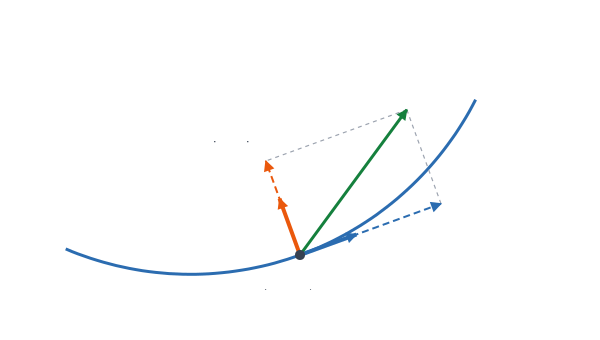
Motion in space formulas
\mathbf{v}(t) = \mathbf{r}'(t), \qquad \text{speed} = \|\mathbf{v}(t)\|, \qquad \mathbf{a}(t) = \mathbf{v}'(t) = \mathbf{r}''(t)\mathbf{a} = a_T\,\mathbf{T} + a_N\,\mathbf{N}, \qquad a_T = \dfrac{\mathbf{v} \cdot \mathbf{a}}{\|\mathbf{v}\|} = \dfrac{d}{dt}\|\mathbf{v}\|, \qquad a_N = \dfrac{\|\mathbf{v} \times \mathbf{a}\|}{\|\mathbf{v}\|} = \kappa\,\|\mathbf{v}\|^2- a_T is positive when the object speeds up, negative when it slows down, and 0 at constant speed.
- a_N is never negative. It is 0 on a straight path and large on a tight turn at high speed.
- The two parts satisfy ‖a‖² = a_T^2 + a_N^2, a useful check.
- Going backward, integrate a(t) to get v(t), then integrate v(t) to get r(t), using an initial condition each time.
Motion in space examples
Example 1: Velocity, speed and acceleration
An object moves along r(t) = ⟨2t, t², t³/3⟩. Find v(t), the speed, and a(t), and evaluate them at t = 1.
\mathbf{v}(t) = \langle 2, \; 2t, \; t^2 \rangleDifferentiate each component of r(t) (see power rule).
\|\mathbf{v}(t)\| = \sqrt{4 + 4t^2 + t^4}Write the speed as the length of v.
= \sqrt{(t^2 + 2)^2} = t^2 + 2Factor the perfect square, then take the root.
\mathbf{a}(t) = \langle 0, \; 2, \; 2t \rangleDifferentiate each component of v(t).
\mathbf{v}(1) = \langle 2, 2, 1 \rangle, \quad \|\mathbf{v}(1)\| = 3, \quad \mathbf{a}(1) = \langle 0, 2, 2 \rangleSubstitute t = 1.
Answer: v(t) = ⟨2, 2t, t²⟩, speed t² + 2, and a(t) = ⟨0, 2, 2t⟩. At t = 1 the velocity is ⟨2, 2, 1⟩, the speed is 3, and the acceleration is ⟨0, 2, 2⟩.
Example 2: Tangential and normal components
For the object in Example 1, find a_T and a_N at t = 1, and check that a_T^2 + a_N^2 = ‖a‖².
\mathbf{v} \cdot \mathbf{a} = (2)(0) + (2)(2) + (1)(2)Multiply matching components (see dot product).
= 0 + 4 + 2 = 6
Add.
a_T = \dfrac{6}{3} = 2Divide by the speed 3.
\mathbf{v} \times \mathbf{a} = \langle 2(2) - 1(2), \; 1(0) - 2(2), \; 2(2) - 2(0) \rangleCross product of ⟨2, 2, 1⟩ and ⟨0, 2, 2⟩ (see cross product).
= \langle 2, \; -4, \; 4 \rangle
Simplify each component.
\|\mathbf{v} \times \mathbf{a}\| = \sqrt{4 + 16 + 16} = 6Find its length.
a_N = \dfrac{6}{3} = 2Divide by the speed.
a_T^2 + a_N^2 = 4 + 4 = 8
Check: add the squares.
\|\mathbf{a}\|^2 = 0 + 4 + 4 = 8The squared length of ⟨0, 2, 2⟩ matches.
Answer: a_T = 2 and a_N = 2. As a second check, the speed is t² + 2, whose derivative 2t equals 2 at t = 1, matching a_T.
Example 3: Constant speed on a helix
A particle moves along the helix r(t) = ⟨3 cos t, 3 sin t, 4t⟩. Find a_T and a_N.
\mathbf{v}(t) = \langle -3\sin t, \; 3\cos t, \; 4 \rangle, \quad \|\mathbf{v}(t)\| = 5Differentiate; the speed is 5, as in the arc length lesson.
\mathbf{a}(t) = \langle -3\cos t, \; -3\sin t, \; 0 \rangleDifferentiate again.
\mathbf{v} \cdot \mathbf{a} = 9\sin t\cos t - 9\sin t\cos t + 0 = 0Dot product: the first two terms cancel.
a_T = \dfrac{0}{5} = 0Divide by the speed.
\|\mathbf{a}\| = \sqrt{9\cos^2 t + 9\sin^2 t} = 3Find the length of a (see fundamental trig identities).
a_N = \sqrt{\|\mathbf{a}\|^2 - a_T^2} = \sqrt{9 - 0} = 3Use ‖a‖² = a_T^2 + a_N^2.
\kappa\|\mathbf{v}\|^2 = \dfrac{3}{25}(25) = 3Check with the curvature of this helix, 3/25.
Answer: a_T = 0, because the speed never changes, and a_N = 3. All of the acceleration goes into turning.
Example 4: From acceleration to position
An object has acceleration a(t) = ⟨6t, 2, 0⟩, initial velocity v(0) = ⟨1, 0, 3⟩ and initial position r(0) = ⟨0, 1, 0⟩. Find v(t), r(t) and r(2).
\mathbf{v}(t) = \langle 3t^2 + C_1, \; 2t + C_2, \; C_3 \rangleIntegrate each component of a(t) (see antiderivatives).
\langle C_1, C_2, C_3 \rangle = \langle 1, 0, 3 \rangle
Set t = 0 and match v(0).
\mathbf{v}(t) = \langle 3t^2 + 1, \; 2t, \; 3 \rangleSubstitute the constants.
\mathbf{r}(t) = \langle t^3 + t + D_1, \; t^2 + D_2, \; 3t + D_3 \rangleIntegrate each component of v(t).
\langle D_1, D_2, D_3 \rangle = \langle 0, 1, 0 \rangle
Set t = 0 and match r(0).
\mathbf{r}(t) = \langle t^3 + t, \; t^2 + 1, \; 3t \rangleSubstitute the constants.
\mathbf{r}(2) = \langle 8 + 2, \; 4 + 1, \; 6 \rangle = \langle 10, 5, 6 \rangleSubstitute t = 2.
Answer: v(t) = ⟨3t² + 1, 2t, 3⟩, r(t) = ⟨t³ + t, t² + 1, 3t⟩, and at t = 2 the object is at (10, 5, 6).
Example 5: A kicked ball (word problem)
A soccer ball is kicked from the origin on level ground with initial velocity ⟨8, 6, 14.7⟩ m/s, where z is height. Gravity gives a = ⟨0, 0, −9.8⟩ m/s². Find where it lands, how far it travels along the ground, its maximum height, and its speed when it lands.
\mathbf{v}(t) = \langle 8, \; 6, \; 14.7 - 9.8t \rangleIntegrate a(t) and add v(0).
\mathbf{r}(t) = \langle 8t, \; 6t, \; 14.7t - 4.9t^2 \rangleIntegrate v(t); r(0) = 0.
14.7t - 4.9t^2 = 0
It lands when the height is 0.
4.9t(3 - t) = 0
Factor out 4.9t (see solving quadratic equations by factoring).
t = 3
Take the nonzero solution.
\mathbf{r}(3) = \langle 24, \; 18, \; 0 \rangleSubstitute t = 3.
\sqrt{24^2 + 18^2} = \sqrt{576 + 324} = \sqrt{900} = 30Ground distance from the origin.
14.7 - 9.8t = 0 \Rightarrow t = 1.5
Maximum height: the vertical velocity is 0.
z(1.5) = 14.7(1.5) - 4.9(1.5)^2 = 22.05 - 11.025 = 11.025
Substitute t = 1.5.
\mathbf{v}(3) = \langle 8, \; 6, \; -14.7 \rangleVelocity at landing: 14.7 − 9.8(3) = −14.7.
\|\mathbf{v}(3)\| = \sqrt{64 + 36 + 216.09} = \sqrt{316.09} \approx 17.78Speed at landing.
Answer: the ball lands at (24, 18, 0) after 3 s, 30 m from the kick. It reaches about 11.0 m high at t = 1.5 s and lands at about 17.78 m/s, the same speed it was kicked with.
Common mistakes
| Mistake | Example of the error | Fix |
|---|---|---|
| Using ‖a‖ as a_T | a_T = ‖⟨0, 2, 2⟩‖ = 2√2 in Example 2 | a_T = (v · a)/‖v‖ = 6/3 = 2; only part of a changes the speed. |
| Taking the absolute value of a_T | a_T = 3 when v · a = −6 and ‖v‖ = 2 | Keep the sign: a_T = −3 means the object is slowing down. |
| Forgetting the initial conditions | v(t) = ⟨3t², 2t, 0⟩ from a(t) = ⟨6t, 2, 0⟩ | Add a constant vector and match v(0): ⟨3t² + 1, 2t, 3⟩. |
| Using +g for gravity | a = ⟨0, 0, 9.8⟩ with z as height | Gravity pulls down: a = ⟨0, 0, −9.8⟩ m/s². |
| Dividing by ‖v‖² instead of ‖v‖ | a_N = ‖v × a‖/‖v‖² = 6/9 | a_N = ‖v × a‖/‖v‖ = 6/3 = 2. |
Related methods
Projectile motion in the plane
When a projectile moves in one vertical plane, you can use two components, as in projectile motion with parametric equations. The 3D version in Example 5 is the same, with one more horizontal direction.
Normal acceleration and curvature
For circular motion of radius R at speed v, a_N = κv² = v²/R. This is the centripetal acceleration from physics. On a curve with curvature κ, the same formula a_N = κ‖v‖² holds at each point.
Motion in the plane
For motion in the xy-plane, write the vectors with a third component of 0 so the cross product formula for a_N still works, or use the two-component tools in vector-valued functions.
Practice problems
- Find the velocity, speed and acceleration of r(t) = ⟨t, t², t³⟩ at t = 1.
- Find the speed and the acceleration of r(t) = ⟨cos t, sin t, t⟩.
- Find a_T and a_N for the helix in Problem 2.
- Find a_T and a_N for r(t) = ⟨t, t², t³⟩ at t = 1.
- An object has a(t) = ⟨0, 0, −10⟩, v(0) = ⟨3, 4, 20⟩ and r(0) = ⟨0, 0, 0⟩. Find v(t) and r(t).
- When and where does the object in Problem 5 return to the ground (z = 0)?
- Find the maximum height of the object in Problem 5.
- Find r(t) if a(t) = ⟨2, 6t, 0⟩, v(0) = ⟨0, 0, 1⟩ and r(0) = ⟨1, 0, 0⟩.
- A car drives around a circular track of radius 50 m at a constant 20 m/s. Find a_T and a_N.
- At the moment the car in Problem 9 is going 20 m/s, it starts speeding up at 2 m/s². Find a_T, a_N and the size of the total acceleration.
Show answers
1.
\mathbf{v}(t) = \langle 1, \; 2t, \; 3t^2 \rangle, \quad \mathbf{v}(1) = \langle 1, 2, 3 \rangleDifferentiate, then substitute t = 1.
\|\mathbf{v}(1)\| = \sqrt{1 + 4 + 9} = \sqrt{14} \approx 3.74Find the speed.
\mathbf{a}(t) = \langle 0, \; 2, \; 6t \rangle, \quad \mathbf{a}(1) = \langle 0, 2, 6 \rangleDifferentiate v, then substitute t = 1.
Answer: v(1) = ⟨1, 2, 3⟩, speed √14 ≈ 3.74, a(1) = ⟨0, 2, 6⟩
2.
\mathbf{v}(t) = \langle -\sin t, \; \cos t, \; 1 \rangleDifferentiate.
\|\mathbf{v}(t)\| = \sqrt{\sin^2 t + \cos^2 t + 1} = \sqrt{2}Find the speed.
\mathbf{a}(t) = \langle -\cos t, \; -\sin t, \; 0 \rangleDifferentiate again.
Answer: speed √2 (constant), a(t) = ⟨−cos t, −sin t, 0⟩
3.
\mathbf{v} \cdot \mathbf{a} = \sin t\cos t - \sin t\cos t + 0 = 0Dot product.
a_T = 0
Divide 0 by the speed √2.
\|\mathbf{a}\| = 1, \quad a_N = \sqrt{1 - 0} = 1Use ‖a‖² = a_T^2 + a_N^2.
Answer: a_T = 0 and a_N = 1
4.
\mathbf{v} \cdot \mathbf{a} = (1)(0) + (2)(2) + (3)(6) = 22Dot product of ⟨1, 2, 3⟩ and ⟨0, 2, 6⟩.
a_T = \dfrac{22}{\sqrt{14}} \approx 5.880Divide by the speed √14.
\mathbf{v} \times \mathbf{a} = \langle 2(6) - 3(2), \; 3(0) - 1(6), \; 1(2) - 2(0) \rangle = \langle 6, -6, 2 \rangleCross product.
\|\mathbf{v} \times \mathbf{a}\| = \sqrt{36 + 36 + 4} = \sqrt{76}Find its length.
a_N = \dfrac{\sqrt{76}}{\sqrt{14}} \approx 2.330Divide by the speed.
a_T^2 + a_N^2 = \dfrac{484}{14} + \dfrac{76}{14} = 40 = \|\mathbf{a}\|^2Check: ‖⟨0, 2, 6⟩‖² = 4 + 36 = 40.
Answer: a_T = 22/√14 ≈ 5.88 and a_N = √(76/14) ≈ 2.33
5.
\mathbf{v}(t) = \langle 3, \; 4, \; 20 - 10t \rangleIntegrate a(t) and add v(0).
\mathbf{r}(t) = \langle 3t, \; 4t, \; 20t - 5t^2 \rangleIntegrate v(t); r(0) = 0.
Answer: v(t) = ⟨3, 4, 20 − 10t⟩ and r(t) = ⟨3t, 4t, 20t − 5t²⟩
6.
20t - 5t^2 = 0
Set the height equal to 0.
5t(4 - t) = 0
Factor out 5t.
t = 4
Take the nonzero solution.
\mathbf{r}(4) = \langle 12, \; 16, \; 0 \rangleSubstitute t = 4.
Answer: at t = 4, at the point (12, 16, 0)
7.
20 - 10t = 0
At the top, the vertical velocity is 0.
t = 2
Solve for t.
z(2) = 20(2) - 5(2)^2 = 40 - 20 = 20
Substitute t = 2 into the height.
Answer: the maximum height is 20
8.
\mathbf{v}(t) = \langle 2t, \; 3t^2, \; 1 \rangleIntegrate a(t) and match v(0) = ⟨0, 0, 1⟩.
\mathbf{r}(t) = \langle t^2 + 1, \; t^3, \; t \rangleIntegrate v(t) and match r(0) = ⟨1, 0, 0⟩.
Answer: r(t) = ⟨t² + 1, t³, t⟩
9.
a_T = 0
The speed is constant.
a_N = \kappa v^2 = \dfrac{1}{50}(20)^2A circle of radius 50 has κ = 1/50.
= \dfrac{400}{50} = 8Simplify.
Answer: a_T = 0 and a_N = 8 m/s², pointing toward the center
10.
a_T = 2, \quad a_N = 8
a_T is the rate of change of speed; a_N = v²/R is still 400/50 = 8.
\|\mathbf{a}\| = \sqrt{2^2 + 8^2} = \sqrt{68} \approx 8.25Combine with ‖a‖² = a_T^2 + a_N^2.
Answer: a_T = 2 m/s², a_N = 8 m/s², and the total acceleration is about 8.25 m/s²
Motion in space FAQ
How do you find velocity and acceleration from a position vector?
Differentiate once for velocity, v(t) = r′(t), and again for acceleration, a(t) = r″(t). The speed is the length of the velocity, ‖v(t)‖.
What are the tangential and normal components of acceleration?
They are the parts of a along T and N: a_T = (v · a)/‖v‖ changes the speed, and a_N = ‖v × a‖/‖v‖ changes the direction. Together, a = a_T T + a_N N.
Why is the tangential component 0 at constant speed?
a_T is the derivative of the speed, d‖v‖/dt. If the speed does not change, that derivative is 0, and all of the acceleration is normal.
How do you find position from acceleration?
Integrate a(t) to get v(t) plus a constant vector, use v(0) to find it, then integrate v(t) and use r(0). Each integration needs its own initial condition.
Summary
- Velocity v = r′, speed ‖v‖, acceleration a = v′ = r″.
- a = a_T T + a_N N, with a_T = (v · a)/‖v‖ and a_N = ‖v × a‖/‖v‖ = κ‖v‖².
- a_T changes the speed (it can be negative); a_N changes the direction and is never negative.
- Check with ‖a‖² = a_T^2 + a_N^2.
- Integrate a, then v, with initial conditions, to recover the path; for gravity, a = ⟨0, 0, −9.8⟩ m/s².
Previous lesson: Curvature
Next lesson: Functions of Several Variables
Back to the Calculus 3 Index