
Parametric Surfaces
A parametric surface is a surface traced out by a vector function of two parameters, r(u, v) = ⟨x(u, v), y(u, v), z(u, v)⟩, as (u, v) moves over a region D. Its tangent vectors r_u and r_v give a normal vector r_u × r_v, and its surface area is the double integral of |r_u × r_v| over D.
Before this lesson: Vector Functions and Space Curves, Partial Derivatives, Cross Product and Double Integrals in Polar Coordinates
What a parametric surface is
A curve in space needs one parameter: r(t) traces a path as t changes. A surface needs two. Each point (u, v) in a flat region D is sent to a point r(u, v) in space, so the whole region D bends into a surface.
Hold v fixed and let u change, and r traces a u-curve on the surface. Hold u fixed instead and you get a v-curve. Together these curves form a curved grid, like lines of latitude and longitude on a globe.
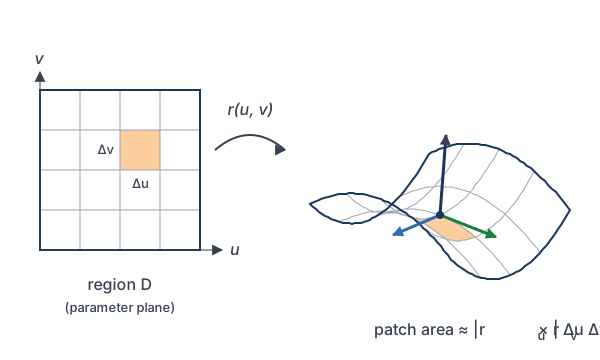
Tangent vectors, normal vector and surface area formula
The partial derivatives r_u and r_v are tangent to the u-curve and the v-curve through a point. Both lie in the tangent plane, so their cross product is a normal vector.
\mathbf{r}_u = \left\langle \dfrac{\partial x}{\partial u}, \dfrac{\partial y}{\partial u}, \dfrac{\partial z}{\partial u} \right\rangle, \qquad \mathbf{r}_v = \left\langle \dfrac{\partial x}{\partial v}, \dfrac{\partial y}{\partial v}, \dfrac{\partial z}{\partial v} \right\rangle, \qquad \mathbf{n} = \mathbf{r}_u \times \mathbf{r}_vA small Δu by Δv cell of D maps to a patch that is almost a parallelogram with sides r_u Δu and r_v Δv. Its area is about |r_u × r_v| Δu Δv. Adding up the patches gives the surface area. The surface should be smooth, meaning r_u × r_v ≠ 0 inside D.
A(S) = \iint_D \left| \mathbf{r}_u \times \mathbf{r}_v \right| \, dACommon parametrizations
| Surface | r(u, v) | |r_u × r_v| |
|---|---|---|
| Graph z = f(x, y) | ⟨x, y, f(x, y)⟩ | √(1 + f_x² + f_y²) |
| Cylinder x² + y² = a² | ⟨a cos θ, a sin θ, z⟩ | a |
| Sphere x² + y² + z² = a² | ⟨a sin φ cos θ, a sin φ sin θ, a cos φ⟩ | a² sin φ |
| Cone z = √(x² + y²) | ⟨r cos θ, r sin θ, r⟩ | r√2 |
| Plane through P₀ with direction vectors a and b | P₀ + u a + v b | |a × b| |
The sphere uses the angles of spherical coordinates with ρ = a fixed, and the cylinder uses cylindrical coordinates with r = a fixed. For a graph, the formula matches the one in applications of double integrals.
Parametric surface examples
Example 1: Identify a parametric surface
Describe the surface r(u, v) = ⟨2 cos u, 2 sin u, v⟩ for 0 ≤ u ≤ 2π and 0 ≤ v ≤ 5.
x^2 + y^2 = (2\cos u)^2 + (2\sin u)^2
Square x and y and add.
= 4\cos^2 u + 4\sin^2 u
Square each term.
= 4(\cos^2 u + \sin^2 u)
Factor out 4.
= 4
Use cos² u + sin² u = 1 (see fundamental trig identities).
z = v, \quad 0 \le v \le 5
The height z runs from 0 to 5.
Answer: every point satisfies x² + y² = 4, so the surface is the circular cylinder of radius 2 around the z-axis, from z = 0 to z = 5. The u-curves are circles and the v-curves are vertical lines.
Example 2: Tangent plane to a parametric surface
Find the tangent plane to r(u, v) = ⟨u², v², u + 2v⟩ at the point where u = 1 and v = 1.
\mathbf{r}(1, 1) = \langle 1, 1, 3 \rangleFind the point: x = 1², y = 1², z = 1 + 2(1).
\mathbf{r}_u = \langle 2u, 0, 1 \rangle = \langle 2, 0, 1 \rangleDifferentiate each component with respect to u, then set u = 1.
\mathbf{r}_v = \langle 0, 2v, 2 \rangle = \langle 0, 2, 2 \rangleDifferentiate with respect to v, then set v = 1.
\mathbf{n} = \langle 0 \cdot 2 - 1 \cdot 2,\; 1 \cdot 0 - 2 \cdot 2,\; 2 \cdot 2 - 0 \cdot 0 \rangleTake r_u × r_v (see cross product).
= \langle -2, -4, 4 \rangle
Simplify each component.
-2(x - 1) - 4(y - 1) + 4(z - 3) = 0
Write the plane through (1, 1, 3) with this normal (see equation of a plane).
(x - 1) + 2(y - 1) - 2(z - 3) = 0
Divide both sides by −2.
x - 1 + 2y - 2 - 2z + 6 = 0
Distribute.
x + 2y - 2z + 3 = 0
Combine the constants: −1 − 2 + 6 = 3.
Answer: x + 2y − 2z + 3 = 0. Check: 1 + 2(1) − 2(3) + 3 = 0, so the point is on the plane.
Example 3: Area of a spherical cap
Find the area of the part of the sphere x² + y² + z² = 16 that lies above the plane z = 2.
\mathbf{r}(\varphi, \theta) = \langle 4\sin\varphi\cos\theta, 4\sin\varphi\sin\theta, 4\cos\varphi \rangleParametrize the sphere of radius 4.
4\cos\varphi = 2 \Rightarrow \cos\varphi = \tfrac{1}{2} \Rightarrow \varphi = \tfrac{\pi}{3}Find where the sphere meets z = 2. The cap is 0 ≤ φ ≤ π/3 and 0 ≤ θ ≤ 2π.
\mathbf{r}_\varphi = \langle 4\cos\varphi\cos\theta, 4\cos\varphi\sin\theta, -4\sin\varphi \rangleDifferentiate with respect to φ.
\mathbf{r}_\theta = \langle -4\sin\varphi\sin\theta, 4\sin\varphi\cos\theta, 0 \rangleDifferentiate with respect to θ.
\mathbf{r}_\varphi \times \mathbf{r}_\theta = \langle 16\sin^2\varphi\cos\theta, 16\sin^2\varphi\sin\theta, 16\sin\varphi\cos\varphi \rangleTake the cross product. The third component is 16 sin φ cos φ (cos² θ + sin² θ).
|\mathbf{r}_\varphi \times \mathbf{r}_\theta| = \sqrt{256\sin^4\varphi + 256\sin^2\varphi\cos^2\varphi}Take the length. The first two components give 256 sin⁴ φ (cos² θ + sin² θ).
= 16\sin\varphi\sqrt{\sin^2\varphi + \cos^2\varphi} = 16\sin\varphiFactor out 256 sin² φ. Here sin φ ≥ 0 because 0 ≤ φ ≤ π.
A = \int_0^{2\pi} \int_0^{\pi/3} 16\sin\varphi \, d\varphi \, d\thetaSet up the area integral.
\int_0^{\pi/3} 16\sin\varphi \, d\varphi = \big[-16\cos\varphi\big]_0^{\pi/3} = -8 + 16 = 8Inner integral.
A = \int_0^{2\pi} 8 \, d\theta = 16\piOuter integral.
Answer: 16π ≈ 50.27 square units. Check: a cap of height h on a sphere of radius R has area 2πRh = 2π(4)(2) = 16π.
Example 4: Area of part of a paraboloid
Find the area of the part of the paraboloid z = x² + y² that lies below the plane z = 4.
\mathbf{r}(r, \theta) = \langle r\cos\theta, r\sin\theta, r^2 \rangle, \quad 0 \le r \le 2,\; 0 \le \theta \le 2\piUse polar parameters. The condition z = r² ≤ 4 means r ≤ 2.
\mathbf{r}_r = \langle \cos\theta, \sin\theta, 2r \rangle, \quad \mathbf{r}_\theta = \langle -r\sin\theta, r\cos\theta, 0 \rangleTake the partial derivatives.
\mathbf{r}_r \times \mathbf{r}_\theta = \langle -2r^2\cos\theta, -2r^2\sin\theta, r \rangleTake the cross product. The third component is r cos² θ + r sin² θ = r.
|\mathbf{r}_r \times \mathbf{r}_\theta| = \sqrt{4r^4 + r^2} = r\sqrt{4r^2 + 1}Take the length and factor out r² (r ≥ 0).
A = \int_0^{2\pi} \int_0^2 r\sqrt{4r^2 + 1} \, dr \, d\thetaSet up the area integral.
\int_0^2 r\sqrt{4r^2 + 1} \, dr = \dfrac{1}{8}\int_1^{17} \sqrt{w} \, dwSubstitute w = 4r² + 1, so dw = 8r dr; r = 0 gives w = 1 and r = 2 gives w = 17 (see u-substitution with definite integrals).
= \dfrac{1}{8} \cdot \dfrac{2}{3} \big[w^{3/2}\big]_1^{17} = \dfrac{17\sqrt{17} - 1}{12}Integrate the power w^(1/2) and evaluate.
A = 2\pi \cdot \dfrac{17\sqrt{17} - 1}{12} = \dfrac{\pi(17\sqrt{17} - 1)}{6}Outer integral. The integrand does not depend on θ.
Answer: π(17√17 − 1)/6 ≈ 36.18 square units.
Example 5: Sheet metal for a funnel
A funnel is shaped like the part of the cone z = √(x² + y²) between z = 1 and z = 3, with lengths in inches. How much sheet metal covers its side?
\mathbf{r}(r, \theta) = \langle r\cos\theta, r\sin\theta, r \rangle, \quad 1 \le r \le 3,\; 0 \le \theta \le 2\piOn the cone z = r, so 1 ≤ z ≤ 3 means 1 ≤ r ≤ 3.
\mathbf{r}_r = \langle \cos\theta, \sin\theta, 1 \rangle, \quad \mathbf{r}_\theta = \langle -r\sin\theta, r\cos\theta, 0 \rangleTake the partial derivatives.
\mathbf{r}_r \times \mathbf{r}_\theta = \langle -r\cos\theta, -r\sin\theta, r \rangleTake the cross product.
|\mathbf{r}_r \times \mathbf{r}_\theta| = \sqrt{r^2\cos^2\theta + r^2\sin^2\theta + r^2} = r\sqrt{2}Take the length: r² + r² = 2r².
A = \int_0^{2\pi} \int_1^3 \sqrt{2}\, r \, dr \, d\thetaSet up the area integral.
\int_1^3 \sqrt{2}\, r \, dr = \sqrt{2} \cdot \dfrac{9 - 1}{2} = 4\sqrt{2}Inner integral: r²/2 from 1 to 3.
A = 2\pi \cdot 4\sqrt{2} = 8\sqrt{2}\,\pi \approx 35.54Outer integral.
Answer: about 35.5 square inches of sheet metal. Check: the frustum formula π(r₁ + r₂)s with slant height s = √(2² + 2²) = 2√2 gives π(4)(2√2) = 8√2 π.
Common mistakes
| Mistake | Example of the error | Fix |
|---|---|---|
| Leaving out the area factor | Writing the cap area in Example 3 as the integral of 1 dφ dθ | The area element is |r_u × r_v| dA, here 16 sin φ dφ dθ. |
| Using the wrong parameter limits | Taking 0 ≤ r ≤ 4 for z = x² + y² below z = 4 | Translate the condition: z = r² ≤ 4 gives r ≤ 2. |
| Covering part of the surface twice | Letting φ run from 0 to 2π on a sphere | Use 0 ≤ φ ≤ π and 0 ≤ θ ≤ 2π, so each point is traced once. |
| Using a dot product for the normal | Computing ⟨2, 0, 1⟩ · ⟨0, 2, 2⟩ = 2 as the normal | A normal vector needs the cross product r_u × r_v, which is a vector. |
| Integrating the vector instead of its length | Integrating ⟨−r cos θ, −r sin θ, r⟩ for the cone’s area | Surface area needs the scalar |r_u × r_v| = r√2. |
Related methods
Surfaces of revolution
Rotating y = f(x), a ≤ x ≤ b, about the x-axis gives r(x, θ) = ⟨x, f(x) cos θ, f(x) sin θ⟩. Then |r_x × r_θ| = f(x)√(1 + f′(x)²) when f(x) ≥ 0, and the area formula becomes the one from surface area of revolution.
Surface integrals and flux
The same area element |r_u × r_v| dA is used to integrate a function over a surface, and the normal r_u × r_v is used to find the flux of a vector field through it. That is the next lesson, on surface integrals.
Practice problems
- Describe the surface r(u, v) = ⟨u, v, 4 − u − v⟩.
- Describe the surface r(u, v) = ⟨3 cos v, u, 3 sin v⟩.
- Write a parametrization of the plane through (1, 2, 0) with direction vectors ⟨1, 0, 2⟩ and ⟨0, 1, −1⟩.
- For r(u, v) = ⟨u, v, uv⟩, find r_u, r_v and r_u × r_v at (u, v) = (1, 2).
- Find the tangent plane to r(u, v) = ⟨u + v, u − v, u²⟩ at the point where u = 1 and v = 0.
- Find the area of the part of the plane z = 1 + 2x + 2y above the rectangle 0 ≤ x ≤ 1, 0 ≤ y ≤ 2.
- Use r(θ, z) = ⟨2 cos θ, 2 sin θ, z⟩ to find the area of the cylinder x² + y² = 4 for 0 ≤ z ≤ 6.
- Use the sphere parametrization to show that a sphere of radius 3 has area 36π.
- Find the area of the helicoid r(u, v) = ⟨u cos v, u sin v, v⟩ for 0 ≤ u ≤ 1 and 0 ≤ v ≤ 2π.
- A dome is the part of the sphere x² + y² + z² = 100 above the plane z = 6, with lengths in meters. How much area needs paint?
Show answers
1.
x + y + z = u + v + (4 - u - v)
Add the three components.
= 4
The u and v terms cancel.
Answer: the plane x + y + z = 4.
2.
x^2 + z^2 = 9\cos^2 v + 9\sin^2 v
Square x and z and add.
= 9
Factor out 9 and use cos² v + sin² v = 1.
Answer: the circular cylinder x² + z² = 9 of radius 3 around the y-axis (y = u can be any number).
3.
\mathbf{r}(u, v) = \langle 1, 2, 0 \rangle + u\langle 1, 0, 2 \rangle + v\langle 0, 1, -1 \rangleStart at the point and add multiples of each direction vector.
= \langle 1 + u, 2 + v, 2u - v \rangle
Add the components.
Answer: r(u, v) = ⟨1 + u, 2 + v, 2u − v⟩
4.
\mathbf{r}_u = \langle 1, 0, v \rangle = \langle 1, 0, 2 \rangleDifferentiate with respect to u, then set v = 2.
\mathbf{r}_v = \langle 0, 1, u \rangle = \langle 0, 1, 1 \rangleDifferentiate with respect to v, then set u = 1.
\mathbf{r}_u \times \mathbf{r}_v = \langle 0 \cdot 1 - 2 \cdot 1,\; 2 \cdot 0 - 1 \cdot 1,\; 1 \cdot 1 - 0 \cdot 0 \rangle = \langle -2, -1, 1 \rangleTake the cross product.
Answer: r_u = ⟨1, 0, 2⟩, r_v = ⟨0, 1, 1⟩ and r_u × r_v = ⟨−2, −1, 1⟩
5.
\mathbf{r}(1, 0) = \langle 1, 1, 1 \rangleFind the point.
\mathbf{r}_u = \langle 1, 1, 2u \rangle = \langle 1, 1, 2 \rangle, \quad \mathbf{r}_v = \langle 1, -1, 0 \rangleTake the partial derivatives at u = 1.
\mathbf{n} = \langle 1 \cdot 0 - 2(-1),\; 2 \cdot 1 - 1 \cdot 0,\; 1(-1) - 1 \cdot 1 \rangle = \langle 2, 2, -2 \rangleTake the cross product.
2(x - 1) + 2(y - 1) - 2(z - 1) = 0
Write the plane through (1, 1, 1).
(x - 1) + (y - 1) - (z - 1) = 0
Divide both sides by 2.
x + y - z = 1
Distribute and move the constant: −1 − 1 + 1 = −1.
Answer: x + y − z = 1
6.
\sqrt{1 + f_x^2 + f_y^2} = \sqrt{1 + 2^2 + 2^2} = \sqrt{9} = 3Use the graph formula with f_x = 2 and f_y = 2.
A = \int_0^2 \int_0^1 3 \, dx \, dy = 3 \cdot 1 \cdot 2 = 6
The integrand is constant, so multiply by the area of the rectangle.
Answer: 6 square units
7.
\mathbf{r}_\theta \times \mathbf{r}_z = \langle 2\cos\theta, 2\sin\theta, 0 \rangleUse r_θ = ⟨−2 sin θ, 2 cos θ, 0⟩ and r_z = ⟨0, 0, 1⟩.
|\mathbf{r}_\theta \times \mathbf{r}_z| = \sqrt{4\cos^2\theta + 4\sin^2\theta} = 2Take the length.
A = \int_0^6 \int_0^{2\pi} 2 \, d\theta \, dz = 2 \cdot 2\pi \cdot 6 = 24\piIntegrate the constant over the parameter rectangle.
Answer: 24π ≈ 75.40 square units, the same as circumference times height.
8.
|\mathbf{r}_\varphi \times \mathbf{r}_\theta| = 9\sin\varphiSame steps as Example 3 with radius 3: the length is a² sin φ.
A = \int_0^{2\pi} \int_0^{\pi} 9\sin\varphi \, d\varphi \, d\thetaThe whole sphere has 0 ≤ φ ≤ π.
\int_0^{\pi} 9\sin\varphi \, d\varphi = \big[-9\cos\varphi\big]_0^{\pi} = 9 + 9 = 18Inner integral.
A = 18 \cdot 2\pi = 36\pi
Outer integral.
Answer: 36π, which matches 4πa² with a = 3.
9.
\mathbf{r}_u = \langle \cos v, \sin v, 0 \rangle, \quad \mathbf{r}_v = \langle -u\sin v, u\cos v, 1 \rangleTake the partial derivatives.
\mathbf{r}_u \times \mathbf{r}_v = \langle \sin v, -\cos v, u \rangleTake the cross product. The third component is u cos² v + u sin² v = u.
|\mathbf{r}_u \times \mathbf{r}_v| = \sqrt{\sin^2 v + \cos^2 v + u^2} = \sqrt{1 + u^2}Take the length.
A = \int_0^{2\pi} \int_0^1 \sqrt{1 + u^2} \, du \, dvSet up the area integral.
\int_0^1 \sqrt{1 + u^2} \, du = \tfrac{1}{2}\Big[u\sqrt{1 + u^2} + \ln\big(u + \sqrt{1 + u^2}\big)\Big]_0^1Use the antiderivative from the substitution u = tan t (see trigonometric substitution).
= \tfrac{1}{2}\big(\sqrt{2} + \ln(1 + \sqrt{2})\big)Evaluate. The lower limit gives 0.
A = \pi\big(\sqrt{2} + \ln(1 + \sqrt{2})\big) \approx 7.21Multiply by 2π for the outer integral.
Answer: π(√2 + ln(1 + √2)) ≈ 7.21 square units
10.
\cos\varphi_0 = \dfrac{6}{10} = 0.6The sphere meets z = 6 where 10 cos φ = 6.
A = \int_0^{2\pi} \int_0^{\varphi_0} 100\sin\varphi \, d\varphi \, d\thetaOn a sphere of radius 10 the area element is 100 sin φ.
\int_0^{\varphi_0} 100\sin\varphi \, d\varphi = 100(1 - \cos\varphi_0) = 100(0.4) = 40Inner integral: −100 cos φ from 0 to φ₀.
A = 40 \cdot 2\pi = 80\pi \approx 251.3
Outer integral.
Answer: 80π ≈ 251 square meters.
Parametric surfaces FAQ
What is a parametric surface?
It is a surface given by a vector function r(u, v) of two parameters. As (u, v) moves over a region D in the plane, the point r(u, v) traces out the surface in space.
How do you find the surface area of a parametric surface?
Find r_u and r_v, take the length of their cross product, and integrate it over the parameter region: A = ∬ |r_u × r_v| dA over D.
How do you find a normal vector to a parametric surface?
The cross product r_u × r_v at a point is normal to the surface there. Use it with the point r(u₀, v₀) to write the tangent plane.
How do you parametrize a sphere?
Use spherical angles with a fixed radius a: r(φ, θ) = ⟨a sin φ cos θ, a sin φ sin θ, a cos φ⟩ for 0 ≤ φ ≤ π and 0 ≤ θ ≤ 2π. Then |r_φ × r_θ| = a² sin φ.
Summary
- A parametric surface is r(u, v) = ⟨x(u, v), y(u, v), z(u, v)⟩ for (u, v) in a region D.
- r_u and r_v are tangent vectors, and r_u × r_v is a normal vector.
- Surface area: A = ∬ |r_u × r_v| dA over D.
- For a graph z = f(x, y), |r_x × r_y| = √(1 + f_x² + f_y²).
- Sphere: a² sin φ. Cylinder: a. Cone z = √(x² + y²): r√2.
Previous lesson: Curl and Divergence
Next lesson: Surface Integrals
Back to the Calculus 3 Index