
Surface Integrals
A surface integral adds up the values of a function over a surface S, as a line integral does along a curve. With a parametrization r(u, v), the piece of area is dS = |r_u × r_v| dA. For a vector field F, the surface integral of F · n is the flux: how much F flows through S.
Before this lesson: Parametric Surfaces, Line Integrals and Double Integrals in Polar Coordinates
What a surface integral measures
Think of S as a thin metal sheet whose density at each point is f(x, y, z). Cut S into small patches of area ΔS. Each patch has mass about f ΔS, and adding them up gives the surface integral of f. If f = 1, the surface integral is just the area of S.
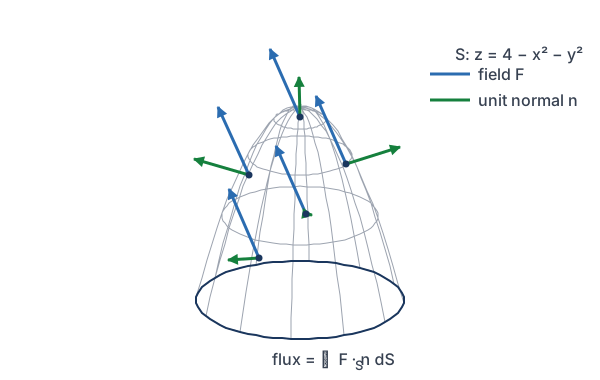
Now think of F as the velocity of a fluid, and let n be a unit normal vector on S. Only the part of F along n carries fluid through a patch, so the fluid crossing a patch per second is about (F · n) ΔS. Adding these gives the flux. Flux is positive where F points the same way as n and negative where it points the other way.
Surface integral formulas
Surface integral of a function
\iint_S f(x, y, z) \, dS = \iint_D f(\mathbf{r}(u, v)) \, \left| \mathbf{r}_u \times \mathbf{r}_v \right| \, dAFor a graph z = g(x, y) over a region D in the xy-plane, |r_x × r_y| = √(1 + g_x² + g_y²), so dS = √(1 + g_x² + g_y²) dA.
Flux of a vector field
An oriented surface has a chosen unit normal n at each point that changes smoothly. A closed surface, such as a sphere, is usually oriented outward. The flux of F through S is
\iint_S \mathbf{F} \cdot d\mathbf{S} = \iint_S \mathbf{F} \cdot \mathbf{n} \, dS = \iint_D \mathbf{F}(\mathbf{r}(u, v)) \cdot (\mathbf{r}_u \times \mathbf{r}_v) \, dAThe last form works when r_u × r_v points the way S is oriented. If it points the other way, use r_v × r_u, which flips the sign. The length |r_u × r_v| cancels, because n = (r_u × r_v)/|r_u × r_v|.
For a graph z = g(x, y) with the upward normal, r_x × r_y = ⟨−g_x, −g_y, 1⟩. For F = ⟨P, Q, R⟩ this gives
\iint_S \mathbf{F} \cdot d\mathbf{S} = \iint_D \left( -P g_x - Q g_y + R \right) dASurface integral examples
Example 1: Surface integral over a plane
Find the surface integral of f(x, y, z) = z over the part S of the plane x + y + z = 1 in the first octant.
z = g(x, y) = 1 - x - y
Solve the plane for z.
dS = \sqrt{1 + (-1)^2 + (-1)^2} \, dA = \sqrt{3} \, dAUse g_x = −1 and g_y = −1.
\iint_S z \, dS = \sqrt{3} \int_0^1 \int_0^{1-x} (1 - x - y) \, dy \, dxD is the triangle with x ≥ 0, y ≥ 0 and x + y ≤ 1. Replace z with 1 − x − y.
\int_0^{1-x} (1 - x - y) \, dy = (1 - x)^2 - \dfrac{(1 - x)^2}{2} = \dfrac{(1 - x)^2}{2}Inner integral: (1 − x)y − y²/2 from 0 to 1 − x.
\int_0^1 \dfrac{(1 - x)^2}{2} \, dx = \dfrac{1}{6}Outer integral: −(1 − x)³/6 from 0 to 1.
\iint_S z \, dS = \dfrac{\sqrt{3}}{6}Multiply by √3.
Answer: √3/6 ≈ 0.289.
Example 2: Surface integral over a sphere
Find the surface integral of z² over the sphere x² + y² + z² = 4.
dS = 4\sin\varphi \, d\varphi \, d\theta
On a sphere of radius a, |r_φ × r_θ| = a² sin φ (see parametric surfaces).
z^2 = 4\cos^2\varphi
On the sphere, z = 2 cos φ.
\iint_S z^2 \, dS = \int_0^{2\pi} \int_0^{\pi} 16\cos^2\varphi\sin\varphi \, d\varphi \, d\thetaMultiply 4 cos² φ by 4 sin φ.
\int_0^{\pi} 16\cos^2\varphi\sin\varphi \, d\varphi = 16\Big[-\dfrac{\cos^3\varphi}{3}\Big]_0^{\pi} = 16 \cdot \dfrac{2}{3} = \dfrac{32}{3}Inner integral with w = cos φ (see u-substitution).
\int_0^{2\pi} \dfrac{32}{3} \, d\theta = \dfrac{64\pi}{3}Outer integral.
Answer: 64π/3 ≈ 67.02. Check by symmetry: the integrals of x², y² and z² are equal and add to the integral of 4, which is 4(16π) = 64π. One third of that is 64π/3.
Example 3: Flux through a paraboloid
Find the upward flux of F = ⟨y, x, z⟩ through the part of z = 4 − x² − y² above the xy-plane.
g_x = -2x, \quad g_y = -2y
Differentiate g = 4 − x² − y².
-P g_x - Q g_y + R = -y(-2x) - x(-2y) + (4 - x^2 - y^2)
Substitute P = y, Q = x and R = z = g.
= 4xy + 4 - x^2 - y^2
Simplify.
\iint_S \mathbf{F} \cdot d\mathbf{S} = \int_0^{2\pi} \int_0^2 \left(4r^2\cos\theta\sin\theta + 4 - r^2\right) r \, dr \, d\thetaD is the disk x² + y² ≤ 4. Switch to polar: x = r cos θ, y = r sin θ, dA = r dr dθ.
\int_0^2 \left(4r^3\cos\theta\sin\theta + 4r - r^3\right) dr = 16\cos\theta\sin\theta + 8 - 4
Inner integral: r⁴ cos θ sin θ + 2r² − r⁴/4 from 0 to 2.
\int_0^{2\pi} \left(16\cos\theta\sin\theta + 4\right) d\theta = 0 + 8\piOuter integral. The cos θ sin θ term integrates to 0 over a full turn.
Answer: the upward flux is 8π ≈ 25.13.
Example 4: Outward flux through a sphere
Find the outward flux of F = ⟨x, y, z⟩ through the sphere x² + y² + z² = 9.
\mathbf{r}_\varphi \times \mathbf{r}_\theta = 9\sin\varphi \langle \sin\varphi\cos\theta, \sin\varphi\sin\theta, \cos\varphi \rangleFor radius 3. This points outward: at the top (φ near 0) its z-component is positive.
\mathbf{F}(\mathbf{r}) = 3\langle \sin\varphi\cos\theta, \sin\varphi\sin\theta, \cos\varphi \rangleOn the sphere, F = r(φ, θ).
\mathbf{F} \cdot (\mathbf{r}_\varphi \times \mathbf{r}_\theta) = 27\sin\varphi\left(\sin^2\varphi\cos^2\theta + \sin^2\varphi\sin^2\theta + \cos^2\varphi\right)Take the dot product.
= 27\sin\varphi
The sum in parentheses is sin² φ + cos² φ = 1.
\int_0^{\pi} 27\sin\varphi \, d\varphi = 27 \cdot 2 = 54Inner integral: −27 cos φ from 0 to π.
\int_0^{2\pi} 54 \, d\theta = 108\piOuter integral.
Answer: 108π ≈ 339.29. Check: on the sphere, F · n = (x² + y² + z²)/3 = 3, so the flux is 3 times the area 36π.
Example 5: Water flow through a pipe
Water flows along a pipe of radius 3 cm. Its velocity is v = ⟨0, 0, 9 − x² − y²⟩ cm/s, fastest at the center and 0 at the wall. How much water passes through the cross-section x² + y² ≤ 9 at z = 0 each second?
\mathbf{n} = \langle 0, 0, 1 \rangle, \quad dS = dAThe cross-section is a flat disk with the upward normal.
\mathbf{v} \cdot \mathbf{n} = 9 - x^2 - y^2 = 9 - r^2Only the z-component counts. Write it in polar form.
\iint_S \mathbf{v} \cdot \mathbf{n} \, dS = \int_0^{2\pi} \int_0^3 (9 - r^2) r \, dr \, d\thetaSet up the flux in polar coordinates.
\int_0^3 (9r - r^3) \, dr = \dfrac{81}{2} - \dfrac{81}{4} = \dfrac{81}{4}Inner integral: 9r²/2 − r⁴/4 from 0 to 3.
\int_0^{2\pi} \dfrac{81}{4} \, d\theta = \dfrac{81\pi}{2} \approx 127.2Outer integral.
Answer: about 127 cubic centimeters of water per second.
Common mistakes
| Mistake | Example of the error | Fix |
|---|---|---|
| Forgetting the dS factor | Writing the integral of z over the plane in Example 1 as 1/6 | Include dS = √3 dA, which gives √3/6. |
| Using the length of r_u × r_v in a flux integral | Computing F · n with |r_u × r_v| left in | For flux, use the vector r_u × r_v. Its length cancels with the one in n. |
| Using the wrong orientation | Using r_θ × r_φ on a sphere and getting −108π for the outward flux | Check one point. At the top of a sphere, the outward normal must point up. |
| Using the downward normal for a graph | Using ⟨g_x, g_y, −1⟩ for the upward flux | The upward normal ⟨−g_x, −g_y, 1⟩ has a positive z-component. |
| Not substituting the surface into f or F | Integrating z² in dφ dθ without writing z = 2 cos φ | Write every x, y and z in terms of the parameters before integrating. |
Related methods
Mass and center of mass of a thin shell
If a thin shell S has density δ(x, y, z), its mass is the surface integral of δ over S. The moments use the same idea as in applications of double integrals, with dS in place of dA.
Flux through a closed surface
Example 4 found the flux out of a closed surface by integrating over the surface itself. The divergence theorem, at the end of this unit, gets the same answer from a triple integral of div F over the solid inside. Stokes’ theorem, the next lesson, turns the flux of curl F through a surface into a line integral around its edge.
Practice problems
- Find the surface integral of x over the part of the plane z = 2x with 0 ≤ x ≤ 1 and 0 ≤ y ≤ 3.
- Find the surface integral of x² + y² over the cylinder x² + y² = 4 with 0 ≤ z ≤ 3.
- Find the surface integral of z over the upper half of the sphere x² + y² + z² = 1.
- Find the surface integral of z over the cone z = √(x² + y²) with 0 ≤ z ≤ 2.
- Find the upward flux of F = ⟨x, y, z⟩ through the part of the plane z = 6 − 2x − 3y in the first octant.
- Find the outward flux of F = ⟨0, 0, z⟩ through the sphere x² + y² + z² = 4.
- Find the outward flux of F = ⟨x, y, 0⟩ through the side of the cylinder x² + y² = 1 with 0 ≤ z ≤ 5.
- Find the upward flux of F = ⟨y, −x, 2⟩ through the part of z = x² + y² below z = 1.
- A thin dome is the upper half of the sphere x² + y² + z² = 4, with density δ = z. Find its mass.
- Air rises through a vent with velocity v = ⟨0, 0, 4 − x² − y²⟩ m/s. A net covers the vent in the shape of the upper half of the sphere x² + y² + z² = 4. How much air passes outward through the net each second?
Show answers
1.
dS = \sqrt{1 + 2^2 + 0^2} \, dA = \sqrt{5} \, dAUse g = 2x, so g_x = 2 and g_y = 0.
\sqrt{5}\int_0^3 \int_0^1 x \, dx \, dy = \sqrt{5} \cdot \dfrac{1}{2} \cdot 3The inner integral is 1/2, and the outer one multiplies by 3.
= \dfrac{3\sqrt{5}}{2}Simplify.
Answer: 3√5/2 ≈ 3.354
2.
x^2 + y^2 = 4, \quad dS = 2 \, d\theta \, dz
On the cylinder of radius 2, f = 4 and |r_θ × r_z| = 2.
\int_0^3 \int_0^{2\pi} 4 \cdot 2 \, d\theta \, dz = 8 \cdot 2\pi \cdot 3 = 48\piIntegrate the constant 8.
Answer: 48π ≈ 150.80
3.
\iint_S z \, dS = \int_0^{2\pi} \int_0^{\pi/2} \cos\varphi\sin\varphi \, d\varphi \, d\thetaRadius 1: z = cos φ and dS = sin φ dφ dθ. The upper half is 0 ≤ φ ≤ π/2.
\int_0^{\pi/2} \cos\varphi\sin\varphi \, d\varphi = \Big[\dfrac{\sin^2\varphi}{2}\Big]_0^{\pi/2} = \dfrac{1}{2}Inner integral.
\dfrac{1}{2} \cdot 2\pi = \piOuter integral.
Answer: π
4.
z = r, \quad dS = r\sqrt{2} \, dr \, d\thetaUse the cone parametrization ⟨r cos θ, r sin θ, r⟩ with 0 ≤ r ≤ 2.
\int_0^2 r \cdot r\sqrt{2} \, dr = \sqrt{2} \cdot \dfrac{8}{3}Inner integral: √2 r³/3 from 0 to 2.
\dfrac{8\sqrt{2}}{3} \cdot 2\pi = \dfrac{16\sqrt{2}\,\pi}{3}Outer integral.
Answer: 16√2 π/3 ≈ 23.70
5.
-P g_x - Q g_y + R = -x(-2) - y(-3) + (6 - 2x - 3y)
Use g_x = −2, g_y = −3 and R = z = g.
= 6
The x and y terms cancel.
6 \cdot \text{area}(D) = 6 \cdot \tfrac{1}{2}(3)(2) = 18D is the triangle with vertices (0, 0), (3, 0) and (0, 2).
Answer: 18
6.
\mathbf{F} \cdot (\mathbf{r}_\varphi \times \mathbf{r}_\theta) = 2\cos\varphi \cdot 4\sin\varphi\cos\varphiF = ⟨0, 0, 2 cos φ⟩, and the outward normal has z-component 4 sin φ cos φ.
= 8\cos^2\varphi\sin\varphi
Multiply.
\int_0^{\pi} 8\cos^2\varphi\sin\varphi \, d\varphi = \dfrac{16}{3}Inner integral: −8 cos³ φ/3 from 0 to π.
\dfrac{16}{3} \cdot 2\pi = \dfrac{32\pi}{3}Outer integral.
Answer: 32π/3 ≈ 33.51
7.
\mathbf{r}_\theta \times \mathbf{r}_z = \langle \cos\theta, \sin\theta, 0 \rangleFor ⟨cos θ, sin θ, z⟩. This points outward.
\mathbf{F} \cdot (\mathbf{r}_\theta \times \mathbf{r}_z) = \cos^2\theta + \sin^2\theta = 1On the cylinder, F = ⟨cos θ, sin θ, 0⟩.
\int_0^5 \int_0^{2\pi} 1 \, d\theta \, dz = 10\piIntegrate the constant.
Answer: 10π ≈ 31.42
8.
-P g_x - Q g_y + R = -y(2x) - (-x)(2y) + 2
Use g = x² + y², so g_x = 2x and g_y = 2y.
= 2
The xy terms cancel.
2 \cdot \pi(1)^2 = 2\pi
D is the unit disk, with area π.
Answer: 2π ≈ 6.28
9.
\delta \, dS = 2\cos\varphi \cdot 4\sin\varphi \, d\varphi \, d\theta
Radius 2: z = 2 cos φ and dS = 4 sin φ dφ dθ.
\int_0^{\pi/2} 8\cos\varphi\sin\varphi \, d\varphi = 4Inner integral: 4 sin² φ from 0 to π/2.
4 \cdot 2\pi = 8\pi
Outer integral.
Answer: 8π ≈ 25.13
10.
\mathbf{v} \cdot (\mathbf{r}_\varphi \times \mathbf{r}_\theta) = (4 - 4\sin^2\varphi) \cdot 4\sin\varphi\cos\varphiOn the sphere, x² + y² = 4 sin² φ. The outward normal has z-component 4 sin φ cos φ.
= 16\cos^3\varphi\sin\varphi
Use 4 − 4 sin² φ = 4 cos² φ.
\int_0^{\pi/2} 16\cos^3\varphi\sin\varphi \, d\varphi = \Big[-4\cos^4\varphi\Big]_0^{\pi/2} = 4Inner integral.
4 \cdot 2\pi = 8\pi \approx 25.13
Outer integral.
Answer: about 25.1 cubic meters per second. This equals the flux through the flat opening x² + y² ≤ 4, because div v = 0.
Surface integrals FAQ
What is a surface integral?
It adds up a function over a surface, using small pieces of area dS. With a parametrization, dS = |r_u × r_v| dA, so the surface integral becomes a double integral over the parameter region.
What is the difference between a surface integral and a flux integral?
A surface integral of a function f adds f dS and needs no orientation. A flux integral is the surface integral of F · n for a vector field F, and its sign depends on which way n points.
How do you choose the orientation of a surface?
Pick the unit normal the problem asks for, such as upward or outward. Then check that r_u × r_v points that way at one easy point, and switch the order of the cross product if it does not.
What does dS mean in a surface integral?
dS is a small piece of surface area. For a parametrized surface, dS = |r_u × r_v| du dv; for a graph z = g(x, y), dS = √(1 + g_x² + g_y²) dA.
Summary
- Surface integral of a function: ∬ f dS = ∬ f(r(u, v)) |r_u × r_v| dA over D.
- For a graph z = g(x, y): dS = √(1 + g_x² + g_y²) dA.
- Flux: ∬ F · n dS = ∬ F(r(u, v)) · (r_u × r_v) dA, with r_u × r_v pointing the chosen way.
- Upward flux through z = g(x, y): ∬ (−P g_x − Q g_y + R) dA.
- Closed surfaces are oriented outward; reversing the orientation changes the sign of the flux.
Previous lesson: Parametric Surfaces
Next lesson: Stokes’ Theorem
Back to the Calculus 3 Index