
Parametric Vector Form
Parametric vector form writes every solution of a linear system as x = p + t₁v₁ + ⋯ + tₖvₖ, with one vector for each free variable. To find it, reduce the system, solve for the pivot variables, and split x by free variable. For Ax = b, p is one particular solution; for Ax = 0, p = 0.
Before this lesson: Homogeneous Systems and Reduced Row Echelon Form
Why use parametric vector form?
When a system has free variables, it has infinitely many solutions, so you cannot list them. Parametric vector form describes all of them at once. The free variables act as parameters: each choice of their values gives one solution.
It also shows the shape of the solution set, which for Ax = 0 is a span. One free variable gives a line, two give a plane, and the vector p tells you where that line or plane sits.
How to write the solution in parametric vector form
- Row reduce the augmented matrix [A | b] to reduced row echelon form.
- Write each pivot variable in terms of the free variables. Watch the signs when you move terms across the equals sign.
- Write x as a column vector, using those expressions for the pivot variables and the free variables themselves in their own entries.
- Split the column into a constant vector p plus one vector for each free variable, with that free variable factored out.
\mathbf{x} = \mathbf{p} + x_3\mathbf{v}_1 + x_4\mathbf{v}_2 \qquad (\text{free variables } x_3, x_4)You can rename the free variables as parameters such as s and t; the solution set is the same.
Solutions of Ax = b and Ax = 0
The vectors that multiply the free variables solve the homogeneous equation Ax = 0. The constant vector p solves the matrix equation Ax = b. This gives a key fact about every consistent system:
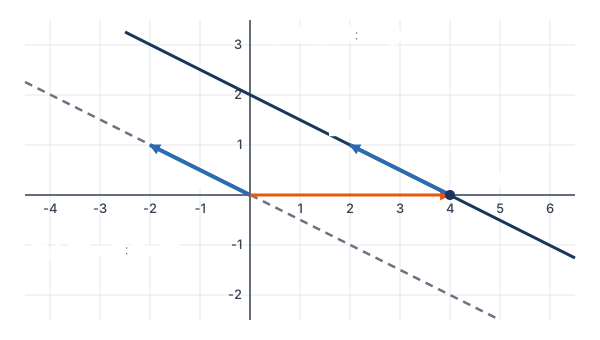
\{\text{solutions of } A\mathbf{x} = \mathbf{b}\} = \mathbf{p} + \{\text{solutions of } A\mathbf{x} = \mathbf{0}\}So the solution set of Ax = b is the solution set of Ax = 0 shifted by p. In the picture below, the line for x₁ + 2x₂ = 4 is the line for x₁ + 2x₂ = 0 moved over by p = (4, 0).
Parametric vector form examples
Example 1: One homogeneous equation in ℝ³
Write the solutions of 2x₁ − 4x₂ + 6x₃ = 0 in parametric vector form.
x_1 - 2x_2 + 3x_3 = 0
Divide both sides by 2 so the pivot is 1.
x_1 = 2x_2 - 3x_3
Subtract −2x₂ + 3x₃ from both sides; x₂ and x₃ are free.
\mathbf{x} = \begin{bmatrix} 2x_2 - 3x_3 \\ x_2 \\ x_3 \end{bmatrix}Write x as a column.
\mathbf{x} = x_2\begin{bmatrix} 2 \\ 1 \\ 0 \end{bmatrix} + x_3\begin{bmatrix} -3 \\ 0 \\ 1 \end{bmatrix}Split by free variable.
2(2) - 4(1) + 6(0) = 0
Check (2, 1, 0).
2(-3) - 4(0) + 6(1) = 0
Check (−3, 0, 1).
Answer: x = x₂(2, 1, 0) + x₃(−3, 0, 1), a plane through the origin. Here p = 0 because the equation is homogeneous.
Example 2: One equation with a nonzero right side
Write the solutions of x₁ + 2x₂ = 4 in parametric vector form. This is the navy line in the graph.
x_1 = 4 - 2x_2
Subtract 2x₂ from both sides; x₂ is free.
\mathbf{x} = \begin{bmatrix} 4 - 2x_2 \\ x_2 \end{bmatrix}Write x as a column.
\mathbf{x} = \begin{bmatrix} 4 \\ 0 \end{bmatrix} + x_2\begin{bmatrix} -2 \\ 1 \end{bmatrix}Split into the constant part and the x₂ part.
Answer: x = (4, 0) + x₂(−2, 1). The point p = (4, 0) solves x₁ + 2x₂ = 4, and v = (−2, 1) solves x₁ + 2x₂ = 0, since −2 + 2 = 0.
Example 3: A line of solutions in ℝ³
Solve the system with augmented matrix below and write the solution in parametric vector form.
\left[\begin{array}{rrr|r} 1 & 2 & -1 & 1 \\ 2 & 5 & 1 & 4 \\ 1 & 3 & 2 & 3 \end{array}\right]Augmented matrix [A | b].
\left[\begin{array}{rrr|r} 1 & 2 & -1 & 1 \\ 0 & 1 & 3 & 2 \\ 1 & 3 & 2 & 3 \end{array}\right]R₂ − 2R₁ → R₂: 5 − 4 = 1, 1 + 2 = 3 and 4 − 2 = 2.
\left[\begin{array}{rrr|r} 1 & 2 & -1 & 1 \\ 0 & 1 & 3 & 2 \\ 0 & 1 & 3 & 2 \end{array}\right]R₃ − R₁ → R₃: 3 − 2 = 1, 2 + 1 = 3 and 3 − 1 = 2.
\left[\begin{array}{rrr|r} 1 & 2 & -1 & 1 \\ 0 & 1 & 3 & 2 \\ 0 & 0 & 0 & 0 \end{array}\right]R₃ − R₂ → R₃.
\left[\begin{array}{rrr|r} 1 & 0 & -7 & -3 \\ 0 & 1 & 3 & 2 \\ 0 & 0 & 0 & 0 \end{array}\right]R₁ − 2R₂ → R₁: −1 − 6 = −7 and 1 − 4 = −3.
x_1 = -3 + 7x_3
Row 1: x₁ − 7x₃ = −3, so add 7x₃ to both sides.
x_2 = 2 - 3x_3
Row 2: x₂ + 3x₃ = 2, so subtract 3x₃ from both sides.
\mathbf{x} = \begin{bmatrix} -3 + 7x_3 \\ 2 - 3x_3 \\ x_3 \end{bmatrix} = \begin{bmatrix} -3 \\ 2 \\ 0 \end{bmatrix} + x_3\begin{bmatrix} 7 \\ -3 \\ 1 \end{bmatrix}Write x as a column and split it.
A\mathbf{p} = \begin{bmatrix} -3 + 4 + 0 \\ -6 + 10 + 0 \\ -3 + 6 + 0 \end{bmatrix} = \begin{bmatrix} 1 \\ 4 \\ 3 \end{bmatrix}Check: p = (−3, 2, 0) solves Ax = b.
A\mathbf{v} = \begin{bmatrix} 7 - 6 - 1 \\ 14 - 15 + 1 \\ 7 - 9 + 2 \end{bmatrix} = \begin{bmatrix} 0 \\ 0 \\ 0 \end{bmatrix}Check: v = (7, −3, 1) solves Ax = 0.
Answer: x = (−3, 2, 0) + x₃(7, −3, 1), a line through (−3, 2, 0) in the direction (7, −3, 1).
Example 4: Two free variables
Solve x₁ − x₂ + 2x₃ + x₄ = 3 and 2x₁ − 2x₂ + 5x₃ + 4x₄ = 8 in parametric vector form.
\left[\begin{array}{rrrr|r} 1 & -1 & 2 & 1 & 3 \\ 2 & -2 & 5 & 4 & 8 \end{array}\right]Augmented matrix.
\left[\begin{array}{rrrr|r} 1 & -1 & 2 & 1 & 3 \\ 0 & 0 & 1 & 2 & 2 \end{array}\right]R₂ − 2R₁ → R₂: 5 − 4 = 1, 4 − 2 = 2 and 8 − 6 = 2.
\left[\begin{array}{rrrr|r} 1 & -1 & 0 & -3 & -1 \\ 0 & 0 & 1 & 2 & 2 \end{array}\right]R₁ − 2R₂ → R₁: 1 − 4 = −3 and 3 − 4 = −1.
The pivots are in columns 1 and 3, so x₂ and x₄ are free.
x_1 = -1 + x_2 + 3x_4
Row 1: x₁ − x₂ − 3x₄ = −1, so add x₂ + 3x₄ to both sides.
x_3 = 2 - 2x_4
Row 2: x₃ + 2x₄ = 2, so subtract 2x₄ from both sides.
\mathbf{x} = \begin{bmatrix} -1 \\ 0 \\ 2 \\ 0 \end{bmatrix} + x_2\begin{bmatrix} 1 \\ 1 \\ 0 \\ 0 \end{bmatrix} + x_4\begin{bmatrix} 3 \\ 0 \\ -2 \\ 1 \end{bmatrix}Split into the constant part, the x₂ part and the x₄ part.
-1 - 0 + 2(2) + 0 = 3
Check p = (−1, 0, 2, 0) in equation 1.
2(-1) - 2(0) + 5(2) + 4(0) = 8
Check p in equation 2.
3 - 0 + 2(-2) + 1 = 0
Check (3, 0, −2, 1) in the homogeneous equation 1; equation 2 gives 6 − 10 + 4 = 0, and (1, 1, 0, 0) gives 1 − 1 = 0 and 2 − 2 = 0.
Answer: x = (−1, 0, 2, 0) + x₂(1, 1, 0, 0) + x₄(3, 0, −2, 1), a plane in ℝ⁴ that does not pass through the origin.
Example 5: Every possible snack mix
A snack mix uses peanuts at $3 per cup, raisins at $2 per cup and pretzels at $1 per cup. A batch must have exactly 10 cups and cost exactly $20. Find every possible batch, using x₁, x₂ and x₃ cups.
\left[\begin{array}{rrr|r} 1 & 1 & 1 & 10 \\ 3 & 2 & 1 & 20 \end{array}\right]Total cups x₁ + x₂ + x₃ = 10 and total cost 3x₁ + 2x₂ + x₃ = 20.
\left[\begin{array}{rrr|r} 1 & 1 & 1 & 10 \\ 0 & -1 & -2 & -10 \end{array}\right]R₂ − 3R₁ → R₂: 2 − 3 = −1, 1 − 3 = −2 and 20 − 30 = −10.
\left[\begin{array}{rrr|r} 1 & 1 & 1 & 10 \\ 0 & 1 & 2 & 10 \end{array}\right]−R₂ → R₂.
\left[\begin{array}{rrr|r} 1 & 0 & -1 & 0 \\ 0 & 1 & 2 & 10 \end{array}\right]R₁ − R₂ → R₁: 1 − 2 = −1 and 10 − 10 = 0.
x_1 = x_3
Row 1: x₁ − x₃ = 0.
x_2 = 10 - 2x_3
Row 2: x₂ + 2x₃ = 10.
\mathbf{x} = \begin{bmatrix} 0 \\ 10 \\ 0 \end{bmatrix} + x_3\begin{bmatrix} 1 \\ -2 \\ 1 \end{bmatrix}Parametric vector form.
0 \le 10 - 2x_3
Amounts cannot be negative, so x₂ ≥ 0.
x_3 \le 5
Add 2x₃ to both sides, then divide by 2.
Answer: x = (0, 10, 0) + x₃(1, −2, 1) with 0 ≤ x₃ ≤ 5. For example, x₃ = 2 gives 2 cups of peanuts, 6 of raisins and 2 of pretzels: 2 + 6 + 2 = 10 cups and 6 + 12 + 2 = $20.
Common mistakes
| Mistake | Example of the error | Fix |
|---|---|---|
| Leaving out p for Ax = b | Writing x = x₃(7, −3, 1) in Example 3 | Ax = b with b ≠ 0 needs the constant vector: x = (−3, 2, 0) + x₃(7, −3, 1). |
| Dropping the free variable’s own entry | Writing x = x₃(7, −3) with no third entry | x₃ = x₃ goes in its own slot, so the vector ends in 1. |
| Sign errors when moving terms | From x₁ − 7x₃ = −3, writing x₁ = −3 − 7x₃ | Adding 7x₃ to both sides gives x₁ = −3 + 7x₃. |
| Solving from echelon form without back-substitution | Reading x₁ = 1 + x₃ from row 1 of [1 2 −1 | 1] | Reduce to reduced row echelon form first, so each row has one pivot variable. |
| Thinking the form is unique | Marking (4, 2, 4) + t(1, −2, 1) wrong in Example 5 | Any particular solution works as p, and any nonzero multiple of v works as a direction. |
Related ideas
Lines and planes in space. A solution set x = p + tv is the vector equation of a line, the same form used for equations of lines in 3D.
Independence of the direction vectors. The vectors that multiply the free variables never repeat a direction. The next lesson, Linear Independence, makes that idea precise.
Null space. The solution set of Ax = 0 is called the null space of A. It gets its own lesson, Null Space and Column Space (coming soon), in Unit 6.
Practice problems
- Write the solutions of x₁ − 3x₂ = 0 in parametric vector form.
- Write the solutions of x₁ + x₂ − x₃ = 0 in parametric vector form.
- Write the solutions of x₁ − 3x₂ = 6 in parametric vector form.
- An augmented matrix reduces to rows [1 0 2 | 5] and [0 1 −1 | −2]. Write the solution in parametric vector form.
- A homogeneous system reduces to rows [1 4 0 −1] and [0 0 1 3] in the variables x₁, …, x₄. Write the solution in parametric vector form.
- Solve x₁ + 2x₂ + x₃ = 4 and 2x₁ + 4x₂ + 3x₃ = 9 in parametric vector form.
- Solve the system with augmented rows [1 −1 1 | 2], [2 −1 4 | 7] and [3 −2 5 | 9] in parametric vector form.
- A solution set is x = (1, 2) + t(3, −1). Is (7, 0) a solution? Is (4, 2)?
- Write the solutions of Ax = 0 for the matrix A in Problem 7.
- A $30 gift basket holds 12 pieces of fruit: apples at $2, oranges at $3 and pears at $4. Find every possible basket.
Show answers
1.
x_1 = 3x_2
Add 3x₂ to both sides; x₂ is free.
\mathbf{x} = x_2\begin{bmatrix} 3 \\ 1 \end{bmatrix}Write x as a column and factor out x₂.
Answer: x = x₂(3, 1).
2.
x_1 = -x_2 + x_3
Solve for x₁; x₂ and x₃ are free.
\mathbf{x} = x_2\begin{bmatrix} -1 \\ 1 \\ 0 \end{bmatrix} + x_3\begin{bmatrix} 1 \\ 0 \\ 1 \end{bmatrix}Split by free variable.
Answer: x = x₂(−1, 1, 0) + x₃(1, 0, 1). Check: −1 + 1 − 0 = 0 and 1 + 0 − 1 = 0.
3.
x_1 = 6 + 3x_2
Add 3x₂ to both sides.
\mathbf{x} = \begin{bmatrix} 6 \\ 0 \end{bmatrix} + x_2\begin{bmatrix} 3 \\ 1 \end{bmatrix}Split into the constant part and the x₂ part.
Answer: x = (6, 0) + x₂(3, 1), the line from Problem 1 shifted by (6, 0).
4.
x_1 = 5 - 2x_3
Row 1: x₁ + 2x₃ = 5.
x_2 = -2 + x_3
Row 2: x₂ − x₃ = −2.
\mathbf{x} = \begin{bmatrix} 5 \\ -2 \\ 0 \end{bmatrix} + x_3\begin{bmatrix} -2 \\ 1 \\ 1 \end{bmatrix}Split by free variable.
Answer: x = (5, −2, 0) + x₃(−2, 1, 1).
5.
x_1 = -4x_2 + x_4
Row 1: x₁ + 4x₂ − x₄ = 0.
x_3 = -3x_4
Row 2: x₃ + 3x₄ = 0.
\mathbf{x} = x_2\begin{bmatrix} -4 \\ 1 \\ 0 \\ 0 \end{bmatrix} + x_4\begin{bmatrix} 1 \\ 0 \\ -3 \\ 1 \end{bmatrix}Split by the free variables x₂ and x₄.
Answer: x = x₂(−4, 1, 0, 0) + x₄(1, 0, −3, 1).
6.
\left[\begin{array}{rrr|r} 1 & 2 & 1 & 4 \\ 2 & 4 & 3 & 9 \end{array}\right]Augmented matrix.
\left[\begin{array}{rrr|r} 1 & 2 & 1 & 4 \\ 0 & 0 & 1 & 1 \end{array}\right]R₂ − 2R₁ → R₂: 3 − 2 = 1 and 9 − 8 = 1.
\left[\begin{array}{rrr|r} 1 & 2 & 0 & 3 \\ 0 & 0 & 1 & 1 \end{array}\right]R₁ − R₂ → R₁.
x_1 = 3 - 2x_2
Row 1: x₁ + 2x₂ = 3; x₂ is free.
x_3 = 1
Row 2.
Answer: x = (3, 0, 1) + x₂(−2, 1, 0). Check p: 3 + 0 + 1 = 4 and 6 + 0 + 3 = 9.
7.
\left[\begin{array}{rrr|r} 1 & -1 & 1 & 2 \\ 2 & -1 & 4 & 7 \\ 3 & -2 & 5 & 9 \end{array}\right]Augmented matrix.
\left[\begin{array}{rrr|r} 1 & -1 & 1 & 2 \\ 0 & 1 & 2 & 3 \\ 3 & -2 & 5 & 9 \end{array}\right]R₂ − 2R₁ → R₂: −1 + 2 = 1, 4 − 2 = 2 and 7 − 4 = 3.
\left[\begin{array}{rrr|r} 1 & -1 & 1 & 2 \\ 0 & 1 & 2 & 3 \\ 0 & 1 & 2 & 3 \end{array}\right]R₃ − 3R₁ → R₃: −2 + 3 = 1, 5 − 3 = 2 and 9 − 6 = 3.
\left[\begin{array}{rrr|r} 1 & -1 & 1 & 2 \\ 0 & 1 & 2 & 3 \\ 0 & 0 & 0 & 0 \end{array}\right]R₃ − R₂ → R₃.
\left[\begin{array}{rrr|r} 1 & 0 & 3 & 5 \\ 0 & 1 & 2 & 3 \\ 0 & 0 & 0 & 0 \end{array}\right]R₁ + R₂ → R₁.
x_1 = 5 - 3x_3
Row 1: x₁ + 3x₃ = 5.
x_2 = 3 - 2x_3
Row 2: x₂ + 2x₃ = 3.
Answer: x = (5, 3, 0) + x₃(−3, −2, 1). Check p: 5 − 3 + 0 = 2, 10 − 3 + 0 = 7 and 15 − 6 + 0 = 9.
8.
(1, 2) + 2(3, -1) = (7, 0)
For (7, 0), the first entry needs 1 + 3t = 7, so t = 2; the second entry checks: 2 − 2 = 0.
(1, 2) + 1(3, -1) = (4, 1)
For (4, 2), the first entry needs t = 1, but then the second entry is 1, not 2.
Answer: (7, 0) is a solution (t = 2); (4, 2) is not.
9.
The homogeneous solutions are the free-variable part of Problem 7, with p removed.
Answer: x = x₃(−3, −2, 1). Check: −3 + 2 + 1 = 0, −6 + 2 + 4 = 0 and −9 + 4 + 5 = 0.
10.
\left[\begin{array}{rrr|r} 1 & 1 & 1 & 12 \\ 2 & 3 & 4 & 30 \end{array}\right]Total pieces x₁ + x₂ + x₃ = 12 and cost 2x₁ + 3x₂ + 4x₃ = 30.
\left[\begin{array}{rrr|r} 1 & 1 & 1 & 12 \\ 0 & 1 & 2 & 6 \end{array}\right]R₂ − 2R₁ → R₂: 3 − 2 = 1, 4 − 2 = 2 and 30 − 24 = 6.
\left[\begin{array}{rrr|r} 1 & 0 & -1 & 6 \\ 0 & 1 & 2 & 6 \end{array}\right]R₁ − R₂ → R₁.
\mathbf{x} = \begin{bmatrix} 6 \\ 6 \\ 0 \end{bmatrix} + x_3\begin{bmatrix} 1 \\ -2 \\ 1 \end{bmatrix}x₁ = 6 + x₃ and x₂ = 6 − 2x₃.
Answer: whole fruit needs x₃ = 0, 1, 2 or 3 (x₂ = 6 − 2x₃ ≥ 0), so the baskets are (6, 6, 0), (7, 4, 1), (8, 2, 2) and (9, 0, 3).
Parametric vector form FAQ
What is parametric vector form?
It writes the solution set of a linear system as x = p + t₁v₁ + ⋯ + tₖvₖ, where the free variables t₁, …, tₖ can be any real numbers.
How do you find the parametric vector form of a solution?
Reduce [A | b] to reduced row echelon form, solve for the pivot variables, write x as a column and split it by free variable.
What is the particular solution p?
It is one solution of Ax = b, found by setting every free variable to 0. For a homogeneous system, p = 0.
Why is the solution set of Ax = b parallel to that of Ax = 0?
Both use the same direction vectors. The solutions of Ax = b are the solutions of Ax = 0 shifted by p.
Summary
- Parametric vector form is x = p + t₁v₁ + ⋯ + tₖvₖ, with one vector per free variable.
- Reduce to reduced row echelon form, solve for the pivot variables, write x as a column and split it.
- Each free variable’s own entry is 1 in its vector and 0 in the others.
- p solves Ax = b; the vectors vᵢ solve Ax = 0.
- The solution set of Ax = b is the solution set of Ax = 0 shifted by p.
Previous lesson: Homogeneous Systems
Next lesson: Linear Independence
Back to the Linear Algebra Index