
Homogeneous Systems
A homogeneous system is a linear system Ax = 0, where every constant on the right side is 0. It always has the trivial solution x = 0. It has a nontrivial solution, one with some entry not 0, exactly when the system has at least one free variable. That always happens when there are more unknowns than equations.
Before this lesson: Matrix Equation Ax = b and Gaussian Elimination
What makes a system homogeneous
A linear system is homogeneous when all of its constants are zero, as in 2x₁ − x₂ = 0 and x₁ + 3x₂ = 0. In matrix form it is Ax = 0, where 0 is the zero vector.
A homogeneous system can never be inconsistent. Setting every variable to 0 makes every equation read 0 = 0, so x = 0 is always a solution. It is called the trivial solution. The real question is whether there are any other solutions, called nontrivial solutions.
The right side stays 0 under every row operation, so you can row reduce A alone and remember that the last column of [A | 0] is all zeros.
When does Ax = 0 have a nontrivial solution?
Row reduce A and look for a free variable, a variable whose column has no pivot. A free variable can be set to any number, including a nonzero one, and that gives a nontrivial solution.
A\mathbf{x} = \mathbf{0} \text{ has a nontrivial solution} \iff \text{the system has at least one free variable}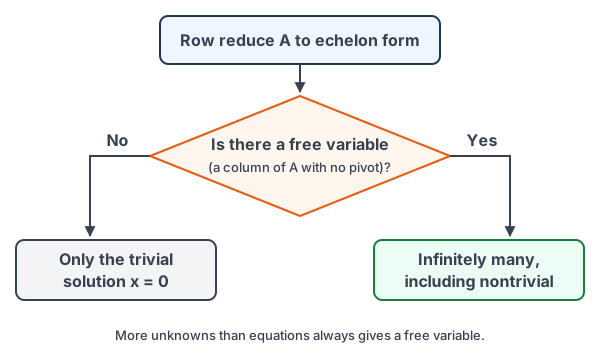
If A is m × n with n > m, there are more columns than rows. Each row holds at most one pivot, so at least one column has no pivot, and Ax = 0 must have nontrivial solutions. When n ≤ m you have to row reduce to find out.
When there are nontrivial solutions, write each pivot variable in terms of the free variables. The solutions are then all the combinations of a few fixed vectors, one for each free variable, so the solution set is a span: a line or plane through the origin, or a larger span.
Homogeneous system examples
Example 1: Only the trivial solution
Does Ax = 0 have a nontrivial solution when A has rows (1, 2, −1), (2, 5, 0) and (−1, 0, 4)?
\begin{bmatrix} 1 & 2 & -1 \\ 2 & 5 & 0 \\ -1 & 0 & 4 \end{bmatrix}Row reduce A; the zero right side never changes.
\begin{bmatrix} 1 & 2 & -1 \\ 0 & 1 & 2 \\ -1 & 0 & 4 \end{bmatrix}R₂ − 2R₁ → R₂: 5 − 4 = 1 and 0 + 2 = 2.
\begin{bmatrix} 1 & 2 & -1 \\ 0 & 1 & 2 \\ 0 & 2 & 3 \end{bmatrix}R₃ + R₁ → R₃: 0 + 2 = 2 and 4 − 1 = 3.
\begin{bmatrix} 1 & 2 & -1 \\ 0 & 1 & 2 \\ 0 & 0 & -1 \end{bmatrix}R₃ − 2R₂ → R₃: 3 − 4 = −1.
Answer: no. Every column has a pivot, so there is no free variable. The only solution is the trivial one, x = 0.
Example 2: A line of solutions
Solve Ax = 0 when A has rows (1, −1, 2), (2, −1, 7) and (−1, 3, 4).
\begin{bmatrix} 1 & -1 & 2 \\ 2 & -1 & 7 \\ -1 & 3 & 4 \end{bmatrix}Row reduce A.
\begin{bmatrix} 1 & -1 & 2 \\ 0 & 1 & 3 \\ -1 & 3 & 4 \end{bmatrix}R₂ − 2R₁ → R₂: −1 + 2 = 1 and 7 − 4 = 3.
\begin{bmatrix} 1 & -1 & 2 \\ 0 & 1 & 3 \\ 0 & 2 & 6 \end{bmatrix}R₃ + R₁ → R₃: 3 − 1 = 2 and 4 + 2 = 6.
\begin{bmatrix} 1 & -1 & 2 \\ 0 & 1 & 3 \\ 0 & 0 & 0 \end{bmatrix}R₃ − 2R₂ → R₃.
\begin{bmatrix} 1 & 0 & 5 \\ 0 & 1 & 3 \\ 0 & 0 & 0 \end{bmatrix}R₁ + R₂ → R₁, giving reduced row echelon form.
Column 3 has no pivot, so x₃ is free and there are nontrivial solutions.
x_1 + 5x_3 = 0
Row 1 of the reduced matrix.
x_1 = -5x_3
Subtract 5x₃ from both sides.
x_2 + 3x_3 = 0
Row 2.
x_2 = -3x_3
Subtract 3x₃ from both sides.
\mathbf{x} = \begin{bmatrix} -5x_3 \\ -3x_3 \\ x_3 \end{bmatrix} = x_3\begin{bmatrix} -5 \\ -3 \\ 1 \end{bmatrix}Factor out the free variable.
A\begin{bmatrix} -5 \\ -3 \\ 1 \end{bmatrix} = \begin{bmatrix} -5 + 3 + 2 \\ -10 + 3 + 7 \\ 5 - 9 + 4 \end{bmatrix} = \begin{bmatrix} 0 \\ 0 \\ 0 \end{bmatrix}Check with the row-vector rule.
Answer: x = x₃(−5, −3, 1) for any x₃. The solutions form the line Span{(−5, −3, 1)} through the origin; x₃ = 1 gives the nontrivial solution (−5, −3, 1).
Example 3: More unknowns than equations
Solve x₁ + 2x₂ − x₃ + x₄ = 0 and 2x₁ + 4x₂ + x₃ + 5x₄ = 0.
There are 4 unknowns and only 2 equations, so nontrivial solutions must exist. Row reduce to find them.
\begin{bmatrix} 1 & 2 & -1 & 1 \\ 2 & 4 & 1 & 5 \end{bmatrix}Coefficient matrix A.
\begin{bmatrix} 1 & 2 & -1 & 1 \\ 0 & 0 & 3 & 3 \end{bmatrix}R₂ − 2R₁ → R₂: 4 − 4 = 0, 1 + 2 = 3 and 5 − 2 = 3.
\begin{bmatrix} 1 & 2 & -1 & 1 \\ 0 & 0 & 1 & 1 \end{bmatrix}(1/3)R₂ → R₂.
\begin{bmatrix} 1 & 2 & 0 & 2 \\ 0 & 0 & 1 & 1 \end{bmatrix}R₁ + R₂ → R₁: −1 + 1 = 0 and 1 + 1 = 2.
The pivots are in columns 1 and 3, so x₂ and x₄ are free.
x_1 = -2x_2 - 2x_4
Row 1: x₁ + 2x₂ + 2x₄ = 0, so subtract 2x₂ + 2x₄.
x_3 = -x_4
Row 2: x₃ + x₄ = 0, so subtract x₄.
\mathbf{x} = x_2\begin{bmatrix} -2 \\ 1 \\ 0 \\ 0 \end{bmatrix} + x_4\begin{bmatrix} -2 \\ 0 \\ -1 \\ 1 \end{bmatrix}Split the solution by free variable.
(-2) + 2(0) - (-1) + 1 = 0
Check (−2, 0, −1, 1) in equation 1.
2(-2) + 4(0) + (-1) + 5(1) = 0
Check it in equation 2. The vector (−2, 1, 0, 0) checks the same way: −2 + 2 = 0 and −4 + 4 = 0.
Answer: the solution set is Span{(−2, 1, 0, 0), (−2, 0, −1, 1)}, a plane through the origin in ℝ⁴.
Example 4: Find k for nontrivial solutions
For which k does the system x₁ + 2x₂ = 0 and 3x₁ + kx₂ = 0 have a nontrivial solution?
\begin{bmatrix} 1 & 2 \\ 3 & k \end{bmatrix}Coefficient matrix A.
\begin{bmatrix} 1 & 2 \\ 0 & k - 6 \end{bmatrix}R₂ − 3R₁ → R₂: k − 3(2) = k − 6.
If k − 6 ≠ 0, both columns have pivots and only x = 0 works. If k − 6 = 0, column 2 has no pivot and x₂ is free.
k - 6 = 0
The condition for a free variable.
k = 6
Add 6 to both sides.
x_1 = -2x_2
With k = 6, row 1 gives x₁ + 2x₂ = 0.
1(-2) + 2(1) = 0 \quad\text{and}\quad 3(-2) + 6(1) = 0Check x = (−2, 1) in both equations.
Answer: k = 6. Then the solutions are x = x₂(−2, 1).
Example 5: Water circulating in a closed system
A closed cooling system has four junctions A, B, C and D joined by one-way pipes: x₁ runs from A to B, x₂ from B to C, x₃ from C to D, x₄ from D to A, and x₅ from A to C. No water enters or leaves, so at each junction the flow in equals the flow out. Find every possible set of flows.
x_1 - x_4 + x_5 = 0
Junction A: in x₄, out x₁ + x₅.
x_1 - x_2 = 0
Junction B: in x₁, out x₂.
x_2 - x_3 + x_5 = 0
Junction C: in x₂ + x₅, out x₃.
x_3 - x_4 = 0
Junction D: in x₃, out x₄.
\begin{bmatrix} 1 & 0 & 0 & -1 & 1 \\ 1 & -1 & 0 & 0 & 0 \\ 0 & 1 & -1 & 0 & 1 \\ 0 & 0 & 1 & -1 & 0 \end{bmatrix}Coefficient matrix of this homogeneous system: 4 equations, 5 unknowns.
\begin{bmatrix} 1 & 0 & 0 & -1 & 1 \\ 0 & -1 & 0 & 1 & -1 \\ 0 & 1 & -1 & 0 & 1 \\ 0 & 0 & 1 & -1 & 0 \end{bmatrix}R₂ − R₁ → R₂.
\begin{bmatrix} 1 & 0 & 0 & -1 & 1 \\ 0 & -1 & 0 & 1 & -1 \\ 0 & 0 & -1 & 1 & 0 \\ 0 & 0 & 1 & -1 & 0 \end{bmatrix}R₃ + R₂ → R₃: 1 − 1 = 0 and 1 − 1 = 0.
\begin{bmatrix} 1 & 0 & 0 & -1 & 1 \\ 0 & -1 & 0 & 1 & -1 \\ 0 & 0 & -1 & 1 & 0 \\ 0 & 0 & 0 & 0 & 0 \end{bmatrix}R₄ + R₃ → R₄.
The pivots are in columns 1, 2 and 3, so x₄ and x₅ are free.
x_3 = x_4
Row 3: −x₃ + x₄ = 0, so add x₃ to both sides.
x_2 = x_4 - x_5
Row 2: −x₂ + x₄ − x₅ = 0, so add x₂ to both sides.
x_1 = x_4 - x_5
Row 1: x₁ − x₄ + x₅ = 0, so add x₄ − x₅ to both sides.
\mathbf{x} = x_4\begin{bmatrix} 1 \\ 1 \\ 1 \\ 1 \\ 0 \end{bmatrix} + x_5\begin{bmatrix} -1 \\ -1 \\ 0 \\ 0 \\ 1 \end{bmatrix}Split the solution by free variable.
Answer: the flows are x = x₄(1, 1, 1, 1, 0) + x₅(−1, −1, 0, 0, 1). For example, x₄ = 5 and x₅ = 2 give flows (3, 3, 5, 5, 2) liters per minute. Check: at A, in 5 = out 3 + 2; at C, in 3 + 2 = out 5. The pipes are one-way, so x₅ ≤ x₄ keeps every flow at 0 or more.
Common mistakes
| Mistake | Example of the error | Fix |
|---|---|---|
| Saying Ax = 0 has no solution | “The system is inconsistent” | x = 0 always works, so a homogeneous system is always consistent. |
| Treating a zero row as “only the trivial solution” | Seeing [0 0 0] and stopping | A zero row often means a column lacks a pivot. Count the free variables. |
| Deciding from the shape alone when n ≤ m | “3 equations and 3 unknowns, so only x = 0” | Square systems can go either way; Example 2 has a free variable. Row reduce. |
| Calling x = 0 a nontrivial solution | Listing (0, 0, 0) as the answer to “find a nontrivial solution” | Set a free variable to a nonzero value, such as x₃ = 1. |
| Solving for the free variable | Writing x₃ = −x₁/5 in Example 2 | Write the pivot variables in terms of the free ones, then factor the free ones out. |
Related ideas
Parametric vector form. Writing x as x₃(−5, −3, 1) is an example of parametric vector form. The next lesson, Parametric Vector Form, uses it for every solution set, including Ax = b with b ≠ 0.
Square matrices. When A is square, Ax = 0 has only the trivial solution exactly when A is invertible, which happens exactly when its determinant is not 0. In Example 4 the determinant k − 6 is 0 when k = 6.
Balancing chemical equations. Balancing an equation leads to a homogeneous system whose nontrivial solutions give the coefficients. See applications of linear systems.
Practice problems
- Does x₁ − 3x₂ = 0, 2x₁ + x₂ = 0 have a nontrivial solution?
- A homogeneous system has 3 equations and 5 unknowns. Must it have a nontrivial solution?
- Solve x₁ + 2x₂ − 3x₃ = 0 and 2x₁ + 5x₂ − 4x₃ = 0.
- Solve Ax = 0 for A with rows (1, −2) and (−3, 6).
- Does Ax = 0 have a nontrivial solution when A has rows (1, 1, 1), (1, 2, 3) and (1, 3, 6)?
- For which k does x₁ − x₂ = 0, kx₁ + 4x₂ = 0 have a nontrivial solution?
- Solve Ax = 0 for A with rows (1, 0, −2), (0, 1, 3) and (2, 1, −1).
- Solve the single equation x₁ − 4x₂ + 2x₃ = 0 and write the solutions with two vectors.
- True or false: if A is 4 × 3, then Ax = 0 must have a nontrivial solution.
- Three one-way pipes form a closed loop: x₁ from A to B, x₂ from B to C and x₃ from C to A, with no water entering or leaving. Find all possible flows.
Show answers
1.
\begin{bmatrix} 1 & -3 \\ 2 & 1 \end{bmatrix}Coefficient matrix.
\begin{bmatrix} 1 & -3 \\ 0 & 7 \end{bmatrix}R₂ − 2R₁ → R₂: 1 + 6 = 7.
Answer: no. Both columns have pivots, so only x = 0 works.
2.
Yes. A is 3 × 5, so at most 3 of the 5 columns have pivots and at least 2 variables are free.
3.
\begin{bmatrix} 1 & 2 & -3 \\ 2 & 5 & -4 \end{bmatrix}Coefficient matrix.
\begin{bmatrix} 1 & 2 & -3 \\ 0 & 1 & 2 \end{bmatrix}R₂ − 2R₁ → R₂: 5 − 4 = 1 and −4 + 6 = 2.
\begin{bmatrix} 1 & 0 & -7 \\ 0 & 1 & 2 \end{bmatrix}R₁ − 2R₂ → R₁: −3 − 4 = −7.
x_1 = 7x_3
Row 1: x₁ − 7x₃ = 0.
x_2 = -2x_3
Row 2: x₂ + 2x₃ = 0.
Answer: x = x₃(7, −2, 1). Check: 7 − 4 − 3 = 0 and 14 − 10 − 4 = 0.
4.
\begin{bmatrix} 1 & -2 \\ -3 & 6 \end{bmatrix}Coefficient matrix.
\begin{bmatrix} 1 & -2 \\ 0 & 0 \end{bmatrix}R₂ + 3R₁ → R₂: −3 + 3 = 0 and 6 − 6 = 0.
x_1 = 2x_2
Row 1: x₁ − 2x₂ = 0, and x₂ is free.
Answer: x = x₂(2, 1).
5.
\begin{bmatrix} 1 & 1 & 1 \\ 1 & 2 & 3 \\ 1 & 3 & 6 \end{bmatrix}Coefficient matrix.
\begin{bmatrix} 1 & 1 & 1 \\ 0 & 1 & 2 \\ 1 & 3 & 6 \end{bmatrix}R₂ − R₁ → R₂.
\begin{bmatrix} 1 & 1 & 1 \\ 0 & 1 & 2 \\ 0 & 2 & 5 \end{bmatrix}R₃ − R₁ → R₃.
\begin{bmatrix} 1 & 1 & 1 \\ 0 & 1 & 2 \\ 0 & 0 & 1 \end{bmatrix}R₃ − 2R₂ → R₃: 5 − 4 = 1.
Answer: no. There is a pivot in every column, so only the trivial solution.
6.
\begin{bmatrix} 1 & -1 \\ k & 4 \end{bmatrix}Coefficient matrix.
\begin{bmatrix} 1 & -1 \\ 0 & 4 + k \end{bmatrix}R₂ − kR₁ → R₂: 4 − k(−1) = 4 + k.
4 + k = 0
Column 2 needs no pivot.
k = -4
Subtract 4 from both sides.
Answer: k = −4. Then x = x₂(1, 1); check: 1 − 1 = 0 and −4 + 4 = 0.
7.
\begin{bmatrix} 1 & 0 & -2 \\ 0 & 1 & 3 \\ 2 & 1 & -1 \end{bmatrix}Coefficient matrix.
\begin{bmatrix} 1 & 0 & -2 \\ 0 & 1 & 3 \\ 0 & 1 & 3 \end{bmatrix}R₃ − 2R₁ → R₃: −1 + 4 = 3.
\begin{bmatrix} 1 & 0 & -2 \\ 0 & 1 & 3 \\ 0 & 0 & 0 \end{bmatrix}R₃ − R₂ → R₃.
x_1 = 2x_3
Row 1: x₁ − 2x₃ = 0.
x_2 = -3x_3
Row 2: x₂ + 3x₃ = 0.
Answer: x = x₃(2, −3, 1). Check row 3: 4 − 3 − 1 = 0.
8.
x_1 = 4x_2 - 2x_3
Solve for the pivot variable; x₂ and x₃ are free.
\mathbf{x} = x_2\begin{bmatrix} 4 \\ 1 \\ 0 \end{bmatrix} + x_3\begin{bmatrix} -2 \\ 0 \\ 1 \end{bmatrix}Split by free variable.
Answer: a plane through the origin, Span{(4, 1, 0), (−2, 0, 1)}. Check: 4 − 4 + 0 = 0 and −2 − 0 + 2 = 0.
9.
False. With 3 columns, A can have a pivot in every column. For example, if A has rows (1, 0, 0), (0, 1, 0), (0, 0, 1) and (0, 0, 0), then Ax = 0 forces x = 0.
10.
x_3 - x_1 = 0
Junction A: in x₃, out x₁.
x_1 - x_2 = 0
Junction B: in x₁, out x₂.
x_2 - x_3 = 0
Junction C: in x₂, out x₃.
x_1 = x_2 = x_3
Combine the equations; x₃ is free.
Answer: x = x₃(1, 1, 1). The water can circulate at any rate, as long as all three pipes carry the same flow.
Homogeneous systems FAQ
What is a homogeneous system of linear equations?
It is a system where every constant on the right side is 0, so it can be written Ax = 0.
Does a homogeneous system always have a solution?
Yes. The trivial solution x = 0 always works, so a homogeneous system is never inconsistent.
How do you know if Ax = 0 has a nontrivial solution?
Row reduce A. There is a nontrivial solution exactly when some column has no pivot, which gives a free variable.
What is the trivial solution?
It is the solution where every variable equals 0. Any other solution is called nontrivial.
Summary
- A homogeneous system is Ax = 0; it always has the trivial solution x = 0.
- It has nontrivial solutions exactly when there is at least one free variable.
- More unknowns than equations always means a free variable, so nontrivial solutions exist.
- Row reduce A alone; the zero right side never changes.
- The solution set is a span: write the pivot variables in terms of the free ones and factor them out.
Previous lesson: Matrix Equation Ax = b
Next lesson: Parametric Vector Form
Back to the Linear Algebra Index