
Logical Equivalence
Two statements are logically equivalent when they have the same truth value in every row of their truth tables, written P ≡ Q. Logical equivalence can be proved with a truth table or with a chain of known laws, such as De Morgan’s laws, ¬(p ∧ q) ≡ ¬p ∨ ¬q and ¬(p ∨ q) ≡ ¬p ∧ ¬q.
Before this lesson: Propositional Logic and Truth Tables
What does logically equivalent mean?
Two compound propositions P and Q are logically equivalent if their final columns in a truth table match row for row. In other words, P ≡ Q exactly when the biconditional P ↔ Q is a tautology. Equivalent statements can replace each other anywhere, the way equal expressions can in algebra.
The symbol ≡ is not a connective. P ↔ Q is a statement that can be true or false, while P ≡ Q is a claim about two statements: that they always have the same truth value.
Laws of logical equivalence
Each law below can be checked with a truth table. Here T stands for any tautology and F for any contradiction.
| Law | Equivalence | Partner form |
|---|---|---|
| Identity | p \land \text{T} \equiv p | p \lor \text{F} \equiv p |
| Domination | p \lor \text{T} \equiv \text{T} | p \land \text{F} \equiv \text{F} |
| Idempotent | p \land p \equiv p | p \lor p \equiv p |
| Double negation | \lnot(\lnot p) \equiv p | |
| Commutative | p \land q \equiv q \land p | p \lor q \equiv q \lor p |
| Associative | (p \land q) \land r \equiv p \land (q \land r) | (p \lor q) \lor r \equiv p \lor (q \lor r) |
| Distributive | p \land (q \lor r) \equiv (p \land q) \lor (p \land r) | p \lor (q \land r) \equiv (p \lor q) \land (p \lor r) |
| De Morgan’s | \lnot(p \land q) \equiv \lnot p \lor \lnot q | \lnot(p \lor q) \equiv \lnot p \land \lnot q |
| Absorption | p \lor (p \land q) \equiv p | p \land (p \lor q) \equiv p |
| Negation | p \lor \lnot p \equiv \text{T} | p \land \lnot p \equiv \text{F} |
| Conditional | p \to q \equiv \lnot p \lor q | \lnot(p \to q) \equiv p \land \lnot q |
| Contrapositive | p \to q \equiv \lnot q \to \lnot p | |
| Biconditional | p \leftrightarrow q \equiv (p \to q) \land (q \to p) |
De Morgan’s laws
De Morgan’s laws tell you how to negate an “and” or an “or”: negate each part and switch the connective. “Not (p and q)” becomes “not p or not q,” and “not (p or q)” becomes “not p and not q.” The shaded regions in the diagram show why.
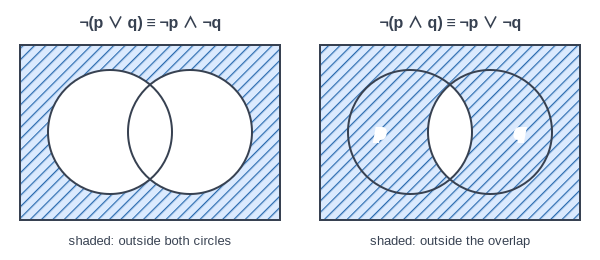
How to prove two statements are equivalent
- Truth table method: build one table with a column for each statement. If the two final columns match in every row, the statements are equivalent. If even one row differs, they are not.
- Laws method: start from one statement and rewrite it one law at a time until it becomes the other. Name the law used at every step, as in a two-column proof.
To show that two statements are not equivalent, one row is enough: give truth values that make one statement true and the other false.
Logical equivalence examples
Example 1: Proving De Morgan’s law with a truth table
Show that ¬(p ∧ q) ≡ ¬p ∨ ¬q.
| p | q | p \land q | \lnot(p \land q) | \lnot p | \lnot q | \lnot p \lor \lnot q |
|---|---|---|---|---|---|---|
| T | T | T | F | F | F | F |
| T | F | F | T | F | T | T |
| F | T | F | T | T | F | T |
| F | F | F | T | T | T | T |
\lnot(p \land q):\ \text{F, T, T, T}Negate the p ∧ q column (T, F, F, F).
\lnot p \lor \lnot q:\ \text{F, T, T, T}False only in row 1, where ¬p and ¬q are both false.
Answer: the two final columns are both F, T, T, T, so ¬(p ∧ q) ≡ ¬p ∨ ¬q.
Example 2: Negating a conditional
Use the laws to show that ¬(p → q) ≡ p ∧ ¬q. Then write the negation of “If it rains, then the game is canceled.”
\lnot(p \to q) \equiv \lnot(\lnot p \lor q)
Conditional law: p → q ≡ ¬p ∨ q.
\equiv \lnot(\lnot p) \land \lnot q
De Morgan’s law: negate each part and switch ∨ to ∧.
\equiv p \land \lnot q
Double negation law.
Answer: ¬(p → q) ≡ p ∧ ¬q. The negation of the sentence is “It rains and the game is not canceled.” It is not “If it rains, then the game is not canceled.”
Example 3: Simplifying with a chain of laws
Show that ¬(p ∨ (¬p ∧ q)) ≡ ¬p ∧ ¬q.
\lnot(p \lor (\lnot p \land q)) \equiv \lnot p \land \lnot(\lnot p \land q)
De Morgan’s law on the outer “or.”
\equiv \lnot p \land (\lnot(\lnot p) \lor \lnot q)
De Morgan’s law on the inner “and.”
\equiv \lnot p \land (p \lor \lnot q)
Double negation law.
\equiv (\lnot p \land p) \lor (\lnot p \land \lnot q)
Distributive law.
\equiv \text{F} \lor (\lnot p \land \lnot q)Negation law: ¬p ∧ p is a contradiction.
\equiv \lnot p \land \lnot q
Identity law (with the commutative law).
Answer: each step uses one law, so ¬(p ∨ (¬p ∧ q)) ≡ ¬p ∧ ¬q.
Example 4: Proving a tautology with the laws
Show that (p ∧ q) → (p ∨ q) is a tautology without a truth table.
(p \land q) \to (p \lor q) \equiv \lnot(p \land q) \lor (p \lor q)
Conditional law.
\equiv (\lnot p \lor \lnot q) \lor (p \lor q)
De Morgan’s law.
\equiv (\lnot p \lor p) \lor (\lnot q \lor q)
Commutative and associative laws: regroup the four parts.
\equiv \text{T} \lor \text{T}Negation law, used twice.
\equiv \text{T}Domination law.
Answer: the statement is equivalent to T, so it is a tautology.
Example 5: Rewriting a store policy (word problem)
A store’s policy says: “It is not true that a customer is under 18 or lacks an ID.” Let u be “the customer is under 18” and i be “the customer has an ID.” Rewrite the policy without a negated “or.” Then check whether it is equivalent to “the customer is not under 18 or has an ID.”
\lnot(u \lor \lnot i)
“lacks an ID” is ¬i.
\equiv \lnot u \land \lnot(\lnot i)
De Morgan’s law.
\equiv \lnot u \land i
Double negation law.
u = \text{T},\quad i = \text{T}Test a customer who is 16 and has an ID.
\lnot u \land i = \text{F} \land \text{T} = \text{F}The policy is not met.
\lnot u \lor i = \text{F} \lor \text{T} = \text{T}The “or” version is met.
Answer: the policy means “the customer is 18 or older and has an ID,” ¬u ∧ i. It is not equivalent to ¬u ∨ i, because the two disagree for a 16-year-old with an ID.
Common mistakes
| Mistake | Example of the error | Fix |
|---|---|---|
| Negating each part but not switching the connective | Writing ¬(p ∧ q) ≡ ¬p ∧ ¬q | De Morgan’s laws switch ∧ and ∨: ¬(p ∧ q) ≡ ¬p ∨ ¬q. |
| Negating a conditional as another conditional | Writing ¬(p → q) ≡ ¬p → ¬q | ¬(p → q) ≡ p ∧ ¬q; it is an “and,” not an “if … then.” |
| Treating the converse as equivalent | Saying p → q ≡ q → p | Only the contrapositive ¬q → ¬p is equivalent; the row p = F, q = T separates the converse. |
| Distributing ¬ over → | Writing ¬(p → q) ≡ ¬p → q | Rewrite p → q as ¬p ∨ q first, then use De Morgan’s law. |
| Checking only some rows | Comparing rows 1 and 2 and calling the statements equivalent | Equivalence needs every row to match. |
| Using two laws in one unlabeled step | Jumping from ¬(p ∨ ¬q) straight to ¬p ∧ q with no reasons | Write De Morgan’s law, then double negation, on separate lines. |
Related ideas
Equivalences are the tools for negating quantified statements in the next lesson, Predicates and Quantifiers. The contrapositive law p → q ≡ ¬q → ¬p, first met with conditional statements in geometry, is the reason a proof by contrapositive works. The same laws, written with 0 and 1, are used to simplify digital circuits in Boolean algebra.
Practice problems
- Use a truth table to show that p → q ≡ ¬q → ¬p.
- Is p → q equivalent to its converse q → p? Give a row that settles it.
- Use De Morgan’s law to negate “x is even and x is prime.”
- Use De Morgan’s law to negate “I study or I fail the test.”
- Simplify ¬(¬p ∧ q) with the laws.
- Simplify ¬(p → ¬q) with the laws.
- Use a truth table to show the absorption law p ∨ (p ∧ q) ≡ p.
- Use the laws to show that (p → q) ∧ (p → r) ≡ p → (q ∧ r).
- Use the laws to show that ¬p → (q ∧ ¬q) ≡ p.
- A game ends when it is not true that the player has lives left (l) and time left (t). Rewrite the condition ¬(l ∧ t) without a negated “and,” in symbols and in words.
Show answers
1.
\lnot q \to \lnot p:\ \text{T, F, T, T}Rows TT, TF, FT, FF: false only in row 2, where ¬q is T and ¬p is F.
p \to q:\ \text{T, F, T, T}False only in row 2, where p is T and q is F.
Answer: the columns match in every row, so p → q ≡ ¬q → ¬p
2.
p = \text{F},\quad q = \text{T}Try the row with a false p and a true q.
p \to q = \text{F} \to \text{T} = \text{T}A false hypothesis makes the conditional true.
q \to p = \text{T} \to \text{F} = \text{F}True hypothesis, false conclusion.
Answer: no; the row p = F, q = T makes p → q true and q → p false
3.
\lnot(e \land r) \equiv \lnot e \lor \lnot r
De Morgan’s law, with e: x is even and r: x is prime.
Answer: x is not even or x is not prime
4.
\lnot(s \lor f) \equiv \lnot s \land \lnot f
De Morgan’s law, with s: I study and f: I fail the test.
Answer: I do not study and I do not fail the test
5.
\lnot(\lnot p \land q) \equiv \lnot(\lnot p) \lor \lnot q
De Morgan’s law.
\equiv p \lor \lnot q
Double negation law.
Answer: p ∨ ¬q
6.
\lnot(p \to \lnot q) \equiv \lnot(\lnot p \lor \lnot q)
Conditional law.
\equiv \lnot(\lnot p) \land \lnot(\lnot q)
De Morgan’s law.
\equiv p \land q
Double negation law, used twice.
Answer: p ∧ q
7.
p \land q:\ \text{T, F, F, F}Both parts are true only in row 1.
p \lor (p \land q):\ \text{T, T, F, F}True in rows 1 and 2, where p is true.
p:\ \text{T, T, F, F}The p column.
Answer: the columns match, so p ∨ (p ∧ q) ≡ p
8.
(p \to q) \land (p \to r) \equiv (\lnot p \lor q) \land (\lnot p \lor r)
Conditional law, used twice.
\equiv \lnot p \lor (q \land r)
Distributive law, read from right to left.
\equiv p \to (q \land r)
Conditional law.
Answer: the chain ends at p → (q ∧ r), so the statements are equivalent
9.
\lnot p \to (q \land \lnot q) \equiv \lnot p \to \text{F}Negation law: q ∧ ¬q is a contradiction.
\equiv \lnot(\lnot p) \lor \text{F}Conditional law.
\equiv p \lor \text{F}Double negation law.
\equiv p
Identity law.
Answer: ¬p → (q ∧ ¬q) ≡ p
10.
\lnot(l \land t) \equiv \lnot l \lor \lnot t
De Morgan’s law.
Answer: ¬l ∨ ¬t: the game ends when the player is out of lives or out of time
Logical equivalence FAQ
How do you prove logical equivalence?
Build a truth table and check that the two final columns match in every row, or rewrite one statement into the other with a chain of laws. The laws method is shorter when there are many variables.
What are De Morgan’s laws?
They say ¬(p ∧ q) ≡ ¬p ∨ ¬q and ¬(p ∨ q) ≡ ¬p ∧ ¬q. To negate an “and” or an “or,” negate each part and switch the connective.
What is the difference between ≡ and ↔?
p ↔ q is a compound statement that is true in some rows and false in others. P ≡ Q says that P ↔ Q is true in every row, that is, a tautology.
Is a conditional equivalent to its contrapositive?
Yes. p → q ≡ ¬q → ¬p, because both are false only when p is true and q is false. The converse q → p and the inverse ¬p → ¬q are equivalent to each other, but not to p → q.
Summary
- Two statements are logically equivalent when their truth tables match in every row.
- P ≡ Q exactly when P ↔ Q is a tautology.
- De Morgan’s laws: ¬(p ∧ q) ≡ ¬p ∨ ¬q and ¬(p ∨ q) ≡ ¬p ∧ ¬q.
- p → q ≡ ¬p ∨ q, and ¬(p → q) ≡ p ∧ ¬q.
- Prove equivalence with a truth table or a chain of laws, one law per step; disprove it with one row.
Previous lesson: Truth Tables
Next lesson: Predicates and Quantifiers
Back to the Discrete Math Index