
Mean, Median, Mode and Range
The mean, median, mode and range describe a set of numbers. The mean is the average: add the values and divide by how many there are. The median is the middle value when the data is in order. The mode is the value that appears most often. The range is the largest value minus the smallest.
Before this lesson: You should know how to divide decimals, work with negative numbers and use the order of operations.
What Mean, Median, Mode and Range Tell You
Suppose you timed your bus wait for a week. You got 4, 6, 7, 7, 8, 9 and 15 minutes. Mean, median and mode each give a “typical” wait. Range tells how spread out the waits are.
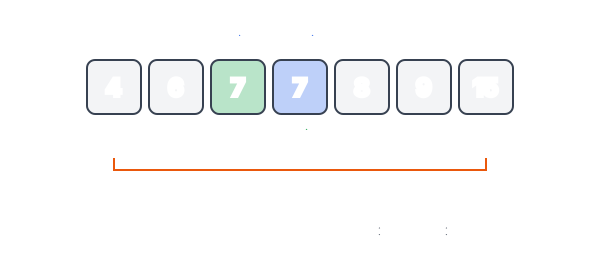
The mean, median and mode are called measures of center. The range is a measure of spread. A set of numbers like this is called a data set.
How to Find Each One
| Measure | How to find it | Bus wait example |
|---|---|---|
| Mean | Add all the values. Divide by how many values there are. | 56 \div 7 = 8 min |
| Median | Put the values in order. Find the middle one. With an even number of values, find the mean of the two middle ones. | 7 min |
| Mode | Find the value that appears most often. There can be more than one mode, or none. | 7 min |
| Range | Subtract the smallest value from the largest. | 15 - 4 = 11 min |
\text{mean} = \frac{\text{sum of the values}}{\text{number of values}}Worked Examples
Example 1: Find all four
Find the mean, median, mode and range of the bus waits: 4, 6, 7, 7, 8, 9, 15.
Step 1. Mean: 4 + 6 + 7 + 7 + 8 + 9 + 15 = 56, and 56 \div 7 = 8.
Step 2. Median: the values are already in order. There are 7 values, so the middle one is the 4th: 7.
Step 3. Mode: 7 appears twice. Every other value appears once. The mode is 7.
Step 4. Range: 15 - 4 = 11.
Answer: mean 8, median 7, mode 7, range 11 (all in minutes)
Example 2: Median with an even number of values
The high temperatures for 6 days were 68, 72, 75, 71, 69 and 77 °F. Find the median, mean and range.
Step 1. Put them in order: 68, 69, 71, 72, 75, 77.
Step 2. There are 6 values, so there are two middle ones: 71 and 72. Their mean is \frac{71 + 72}{2} = 71.5.
Step 3. Mean: 432 \div 6 = 72. Range: 77 - 68 = 9.
Answer: median 71.5 °F, mean 72 °F, range 9 °F. There is no mode, because no value repeats.
Example 3: An outlier changes the mean
Five friends get weekly allowances of $10, $12, $12, $15 and $100. Which better describes a typical allowance, the mean or the median?
Step 1. Mean: 10 + 12 + 12 + 15 + 100 = 149, and 149 \div 5 = 29.8.
Step 2. Median: the middle of 10, 12, 12, 15, 100 is 12.
Step 3. The $100 is an outlier, a value far from the rest. It pulls the mean up to $29.80, more than four of the five friends get.
Answer: The median, $12, better describes a typical allowance.
Example 4: Find a missing value
Maya has test scores of 80, 92 and 78. What does she need on the 4th test to have a mean of 85?
Step 1. A mean of 85 on 4 tests means the total must be 4 \times 85 = 340.
Step 2. Her current total is 80 + 92 + 78 = 250.
Step 3. Subtract: 340 - 250 = 90.
Answer: She needs a 90.
Example 5: Word problem with basketball points
A player scored 12, 18, 9, 15, 18, 21, 10 and 17 points in 8 games. Find the mean, median, mode and range.
Step 1. Order the data: 9, 10, 12, 15, 17, 18, 18, 21.
Step 2. Mean: the sum is 120, and 120 \div 8 = 15.
Step 3. Median: the two middle values are 15 and 17, so the median is \frac{15 + 17}{2} = 16.
Step 4. Mode: 18 appears twice. Range: 21 - 9 = 12.
Answer: mean 15, median 16, mode 18, range 12 points
Common Mistakes with Mean, Median, Mode and Range
| Mistake | Example of the error | Fix |
|---|---|---|
| Finding the median without ordering | The middle of 68, 72, 75, 71, 69, 77 is “75 and 71” | Sort first: 68, 69, 71, 72, 75, 77. The median is 71.5. |
| Dividing by the wrong count | For 7 values, dividing the sum by 6 | Count every value, including repeats. Divide by 7. |
| Saying the mode is how many times it appears | “The mode is 2” because 7 appears 2 times | The mode is the value itself: 7. |
| Giving the range as two numbers | “The range is 4 to 15” | The range is one number: 15 - 4 = 11. |
| Forgetting negative values | Range of −4, 2, 7 as 7 - 2 = 5 | The smallest value is −4: 7 - (-4) = 11. |
Which Measure of Center to Use
| Use this | When | Example |
|---|---|---|
| Mean | The data has no outliers. | Test scores that are all close together |
| Median | The data has outliers or is lopsided. | House prices, allowances, incomes |
| Mode | The data is categories or you want the most common value. | The most popular shoe size or pizza topping |
Practice Problems
- Find the mean, median, mode and range of 3, 8, 5, 8, 6.
- Find the median of 12, 4, 9, 15, 7, 10.
- Find the mode of 2, 3, 3, 5, 5, 7.
- Find the range of −4, 2, 7, −1, 5.
- Find the mean of 2.5, 3.0, 4.5 and 6.0.
- The mean of five numbers is 12. Four of them are 10, 14, 9 and 13. Find the fifth number.
- Add 50 to the data set 4, 5, 6. Which changes more, the mean or the median?
- Jordan worked 15, 20, 18, 22 and 25 hours over 5 weeks. Find the mean, median and range.
Show answers
- In order: 3, 5, 6, 8, 8. Mean 30 \div 5 = 6, median 6, mode 8, range 8 - 3 = 5.
- In order: 4, 7, 9, 10, 12, 15. Median \frac{9 + 10}{2} = 9.5.
- 3 and 5 both appear twice, so there are two modes: 3 and 5.
- 7 - (-4) = 11
- 16 \div 4 = 4
- The total must be 5 \times 12 = 60. 60 - (10 + 14 + 9 + 13) = 60 - 46 = 14.
- The mean goes from 5 to 65 \div 4 = 16.25. The median goes from 5 to 5.5. The mean changes more.
- Mean 100 \div 5 = 20 hours, median 20 hours, range 25 - 15 = 10 hours.
Mean, Median, Mode and Range FAQ
Is the mean the same as the average?
Yes. When people say “average,” they usually mean the mean: the sum divided by the number of values.
How do you find the median with an even number of values?
Put the values in order and find the two middle ones. The median is the mean of those two numbers.
Can there be no mode?
Yes. If every value appears the same number of times, the data set has no mode. A data set can also have two or more modes.
What is an outlier?
An outlier is a value much bigger or smaller than the rest. It can pull the mean far away from the typical values, but it barely moves the median.
Summary
- Mean: add the values and divide by how many there are.
- Median: the middle value once the data is in order.
- Mode: the value that appears most often.
- Range: the largest value minus the smallest.
- Outliers pull the mean, so the median is better for lopsided data.
Previous lesson: Area of Composite Figures
Next lesson: Dot Plots and Histograms
Back to the Pre-Algebra (Math Basics) Index