
Area of Composite Figures
A composite figure is a shape made of simpler shapes, like rectangles, triangles and half circles. To find the area of composite figures, split the shape into pieces you know. Find the area of each piece. Then add the pieces, or subtract any part that is cut out. The answer is in square units.
Before this lesson: You should know the area of a rectangle, the area of a triangle, the area of a trapezoid and the area of a circle.
What Composite Figures Are
Many real shapes aren’t simple. A house outline is a rectangle with a triangle on top. An L-shaped room is two rectangles joined together. A running track is a rectangle with a half circle on each end.
There is no single formula for these shapes. Instead, you break them into shapes that do have formulas.
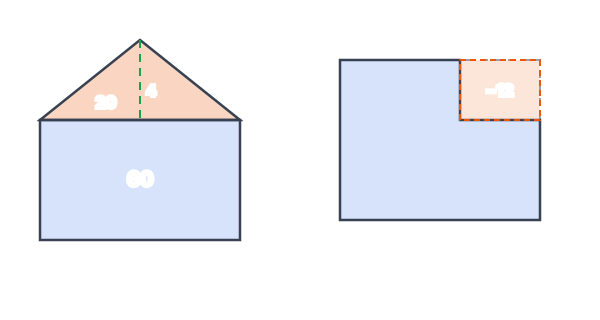
How to Find the Area of Composite Figures
- Split the figure into simple shapes, or see it as a big shape with a piece cut out.
- Find any missing lengths you need.
- Find the area of each simple shape.
- Add the areas of the pieces. Subtract the area of any piece that is cut out.
- Write the answer in square units.
There is often more than one way to split a shape. Every correct way gives the same total.
Worked Examples
Example 1: An L-shape two ways
An L-shape is 10 m wide and 8 m tall, with a 4 m by 3 m corner missing. Find its area.
Step 1 (subtract). The full rectangle is 10 \times 8 = 80 m². The missing corner is 4 \times 3 = 12 m². So the area is 80 - 12 = 68 m².
Step 2 (add, to check). Split it into a left piece 6 \times 8 = 48 and a lower right piece 4 \times 5 = 20. Then 48 + 20 = 68 m².
Answer: The area is 68 m². This is the same shape as in the perimeter lesson.
Example 2: A rectangle with a triangle on top
A house outline is a rectangle 10 ft wide and 6 ft tall. A triangle on top has a base of 10 ft and a height of 4 ft. Find the total area.
Step 1. Rectangle: 10 \times 6 = 60 ft².
Step 2. Triangle: \frac{1}{2} \times 10 \times 4 = 20 ft².
Step 3. Add: 60 + 20 = 80 ft².
Answer: The area is 80 ft².
Example 3: A rectangle with a half circle
A window is a rectangle 8 in long and 4 in tall, with a half circle on top. The half circle’s diameter is 4 in. Find the area. Use 3.14 for pi.
Step 1. Rectangle: 8 \times 4 = 32 in².
Step 2. The half circle has a radius of 2 in. Its area is half a circle: \frac{1}{2} \times \pi \times 2^2 = 2\pi \approx 6.28 in².
Step 3. Add: 32 + 6.28 = 38.28 in².
Answer: The area is about 38.28 in².
Example 4: A shape with a hole
A square tile is 10 cm on each side. A circle with a radius of 3 cm is cut out of the middle. Find the area that is left.
Step 1. Square: 10 \times 10 = 100 cm².
Step 2. Circle: \pi \times 3^2 = 9\pi \approx 28.26 cm².
Step 3. Subtract the hole: 100 - 28.26 = 71.74 cm².
Answer: About 71.74 cm² is left.
Example 5: Word problem with grass seed
A yard is 20 m by 15 m. It has a 5 m by 4 m patio and a triangular flower bed with a base of 6 m and a height of 3 m. The rest is grass. One bag of seed covers 50 m². How many bags are needed?
Step 1. Yard: 20 \times 15 = 300 m².
Step 2. Patio: 5 \times 4 = 20 m². Flower bed: \frac{1}{2} \times 6 \times 3 = 9 m².
Step 3. Grass: 300 - 20 - 9 = 271 m².
Step 4. Bags: 271 \div 50 = 5.42. Five bags aren’t enough, so round up.
Answer: You need 6 bags of seed.
Common Mistakes with Composite Figures
| Mistake | Example of the error | Fix |
|---|---|---|
| Overlapping pieces | Counting the corner of an L-shape in both rectangles | Make the pieces touch without overlapping, or use the subtract method. |
| Using the wrong length for a piece | Using 8 as the height of the lower right piece of the L-shape | Find the missing length: 8 - 3 = 5. |
| Using a full circle for a half circle | Adding \pi \times 2^2 for a half-circle window top | Take half: \frac{1}{2} \times \pi \times 2^2. |
| Using the diameter as the radius | A half circle on a 4 in side with r = 4 | The 4 in side is the diameter, so r = 2. |
| Adding a hole instead of subtracting | 100 + 28.26 for a tile with a hole | A cut-out piece is subtracted: 100 - 28.26. |
Perimeter of Composite Figures
Perimeter works differently. Only count the outside edges. Don’t count the lines you drew inside to split the shape.
For a half circle on the end of a rectangle, the curved part is half the circumference, \frac{1}{2}\pi d. The straight side under it is not part of the perimeter.
Practice Problems
- Two rectangles, 5 cm by 3 cm and 4 cm by 2 cm, are joined without overlapping. Find the total area.
- An L-shape is 12 ft by 9 ft with a 5 ft by 4 ft corner missing. Find its area.
- A rectangle 6 m by 4 m has a triangle on top with base 6 m and height 3 m. Find the total area.
- A rectangle 10 in by 6 in has a half circle on one 6 in side. Find the total area. Use 3.14 for pi.
- A square 8 cm on a side has a circle of radius 2 cm cut out. Find the area left.
- A rectangle 8 m by 5 m has a trapezoid on top with bases 8 m and 4 m and height 3 m. Find the total area.
- A picture frame is 12 in by 10 in on the outside. The opening is 8 in by 6 in. Find the area of the frame.
- A track field is a rectangle 20 m by 10 m with a half circle on each 10 m end. Find the total area.
- A rectangle 9 ft by 7 ft has a triangle with base 4 ft and height 3 ft cut out. Find the area left.
- A wall is 14 ft by 9 ft, with a 3 ft by 7 ft door and a 4 ft by 3 ft window. Paint costs $0.50 per square foot. How much does it cost to paint the wall?
Show answers
- 15 + 8 = 23 cm²
- 12 \times 9 - 5 \times 4 = 108 - 20 = 88 ft²
- 24 + \frac{1}{2} \times 6 \times 3 = 24 + 9 = 33 m²
- r = 3. 60 + \frac{1}{2} \times \pi \times 3^2 = 60 + 4.5\pi \approx 60 + 14.13 = 74.13 in²
- 64 - \pi \times 2^2 = 64 - 4\pi \approx 64 - 12.56 = 51.44 cm²
- 40 + \frac{1}{2}(8 + 4) \times 3 = 40 + 18 = 58 m²
- 120 - 48 = 72 in²
- The two half circles make one whole circle with r = 5: 200 + 25\pi \approx 200 + 78.5 = 278.5 m²
- 63 - \frac{1}{2} \times 4 \times 3 = 63 - 6 = 57 ft²
- 126 - 21 - 12 = 93 ft², and 93 \times 0.50 = 46.50. It costs $46.50.
Area of Composite Figures FAQ
How do you find the area of a composite shape?
Split it into rectangles, triangles, circles or other simple shapes. Find each area, then add them. Subtract any part that is cut out.
Can you split a composite figure in different ways?
Yes. Any split that covers the shape exactly once gives the same total area. Choose the split that needs the fewest missing lengths.
What is the area of a half circle?
A half circle is half of a circle, so its area is \frac{1}{2}\pi r^2. Use the radius, which is half the straight side.
Summary
- A composite figure is made of simpler shapes.
- Split it into pieces, find each area, and add them.
- Or start with a big shape and subtract the part that is missing.
- Find missing lengths first, and don’t let pieces overlap.
- A half circle’s area is \frac{1}{2}\pi r^2.
Previous lesson: Circumference and Area of Circles
Next lesson: Mean, Median, Mode and Range
Back to the Pre-Algebra (Math Basics) Index