
Partial Orders
A partial order is a relation that is reflexive, antisymmetric and transitive, such as ≤ on numbers or “divides” on positive integers. A set with a partial order is a partially ordered set, or poset. A Hasse diagram draws a finite poset with only its essential links, placing larger elements higher.
Before this lesson: Properties of Relations, Equivalence Relations and Sets and Subsets
The idea
An order tells you which of two things comes first. For ≤ on numbers, every two numbers can be compared. Many useful orders are not like that. Under “divides,” 2 | 6 and 3 | 6, but neither of 2 and 3 divides the other. Under ⊆, the sets {a} and {b} are not subsets of each other.
A partial order allows such gaps. Some pairs are comparable (one comes before the other) and some are incomparable. The word “partial” means the order compares only some pairs, not necessarily all of them.
Partial order definition and Hasse diagrams
A relation ≼ on a set A is a partial order if it is
- reflexive: a \preceq a for every a;
- antisymmetric: a \preceq b and b \preceq a imply a = b;
- transitive: a \preceq b and b \preceq c imply a \preceq c.
The pair (A, ≼) is a poset. If every two elements are comparable, ≼ is a total order (or linear order); ≤ on the real numbers is the standard example. We write a \prec b when a \preceq b and a ≠ b.
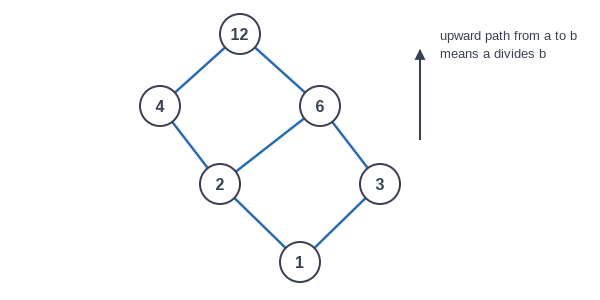
We say b covers a if a \prec b and no element c fits between them with a \prec c \prec b. A Hasse diagram draws one dot per element and one line for each covering pair, with the larger element higher. Loops are left out because every element relates to itself, and links implied by transitivity are left out because a path upward shows them.
Special elements
| Term | Meaning | In the Hasse diagram |
|---|---|---|
| Maximal element | nothing is strictly above it | a dot with no line going up |
| Minimal element | nothing is strictly below it | a dot with no line going down |
| Greatest element | above every element | the single top dot, if there is one |
| Least element | below every element | the single bottom dot, if there is one |
| Upper bound of a set S | above every element of S | reachable upward from every element of S |
| Least upper bound | the smallest upper bound | the lowest common point above S |
A greatest element is always maximal, but a maximal element need not be greatest: a poset can have several maximal elements and no greatest one. The greatest lower bound is defined the same way, looking downward.
How to draw a Hasse diagram
- Check that the relation is reflexive, antisymmetric and transitive.
- Put the minimal elements on the bottom row.
- For each element, find the elements that cover it, and place them higher.
- Draw a line for each covering pair only. Skip loops and any link that a path upward already shows.
Partial order examples
Example 1: The divisors of 12
Show that “divides” is a partial order on A = {1, 2, 3, 4, 6, 12}, and find the covering pairs for its Hasse diagram.
a = a \cdot 1
Reflexive: every number divides itself.
a \mid b,\ b \mid a \Rightarrow a = b
Antisymmetric for positive integers (proved in Properties of Relations, Example 2).
a \mid b,\ b \mid c \Rightarrow a \mid c
Transitive: if b = am and c = bk, then c = a(mk).
1 \prec 2,\ 1 \prec 3
2 and 3 cover 1: nothing in A lies strictly between.
2 \prec 4,\ 2 \prec 6,\ 3 \prec 6
4 covers 2, and 6 covers both 2 and 3.
4 \prec 12,\ 6 \prec 12
12 covers 4 and 6.
1 \mid 4 \text{ via } 1 \prec 2 \prec 4Pairs such as 1 | 4 and 2 | 12 are not covers, because a path shows them.
Answer: “divides” is a partial order on A, with 7 covering pairs, as in the diagram above. It is not a total order: 4 ∤ 6 and 6 ∤ 4, so 4 and 6 are incomparable.
Example 2: Subsets ordered by inclusion
Order the power set of {a, b, c} by ⊆. Is this a total order? How many lines does its Hasse diagram have?
\{a\} \not\subseteq \{b\},\ \{b\} \not\subseteq \{a\}{a} and {b} are incomparable, so ⊆ is not a total order.
S \subset S \cup \{x\}T covers S exactly when T is S plus one more element.
1 \cdot 3 = 3
The empty set: 3 elements can be added.
3 \cdot 2 = 6
Each of the 3 one-element sets: 2 elements can be added.
3 \cdot 1 = 3
Each of the 3 two-element sets: 1 element can be added.
3 + 6 + 3 = 12
Add the covering pairs ({a, b, c} covers nothing above it).
Answer: ⊆ is a partial order but not a total order, and its Hasse diagram has 12 lines. Drawn with ∅ at the bottom and {a, b, c} at the top, it looks like a cube standing on a corner.
Example 3: Maximal, minimal, greatest and least
Find the maximal, minimal, greatest and least elements of A = {2, 3, 4, 6, 8, 12} under “divides.”
2 \mid 4,\ 2 \mid 6,\ 2 \mid 8,\ 2 \mid 12
Nothing else in A divides 2, so 2 is minimal.
3 \mid 6,\ 3 \mid 12
Nothing else in A divides 3, so 3 is minimal.
4 \mid 8,\ 4 \mid 12,\ 6 \mid 12
4 and 6 each divide something larger, so they are not maximal.
8 \nmid 12,\ 12 \nmid 8
8 and 12 divide no other element, so both are maximal.
2 \nmid 3,\ 8 \nmid 12
Two minimal and two maximal elements that are incomparable.
Answer: the minimal elements are 2 and 3, the maximal elements are 8 and 12, and there is no least or greatest element.
Example 4: Bounds
In the divisors of 12 (Example 1), find the upper bounds, lower bounds, least upper bound and greatest lower bound of {4, 6}.
4 \mid u,\ 6 \mid u
An upper bound u must be a multiple of both 4 and 6.
u = 12
Only 12 in A qualifies, so it is the least upper bound.
\ell \mid 4,\ \ell \mid 6
A lower bound ℓ must divide both 4 and 6.
\ell \in \{1, 2\}Check the divisors of 4 against 6: 1 and 2 work; 4 does not.
1 \mid 2
2 is above 1, so 2 is the greatest lower bound.
Answer: the least upper bound is 12 = lcm(4, 6) and the greatest lower bound is 2 = gcd(4, 6). Under “divides,” these bounds are always the least common multiple and the greatest common factor, when they lie in the set.
Example 5: Scheduling courses (word problem)
A student plans six courses: Algebra 2 (A), Precalculus (P), Calculus 1 (C1), Calculus 2 (C2), Linear Algebra (LA) and Differential Equations (DE). The prerequisites are A before P, P before C1 and LA, C1 before C2, and both C2 and LA before DE. Find a valid order to take them, one per term, and count the valid orders.
A \prec P \prec C1 \prec C2 \prec DE,\ P \prec LA \prec DE
“X must come before Y” (plus X = Y) is a partial order on the courses.
A
A is the only minimal element, so it goes first.
A,\ P
Remove A; now P is the only minimal element.
A,\ P,\ C1
Remove P; C1 and LA are both minimal. Choose C1.
A,\ P,\ C1,\ LA,\ C2,\ DE
Keep removing a minimal element until none are left.
\text{LA before C1, between C1 and C2, or after C2}Count orders: A and P are fixed, DE is last, and LA can go in 3 places among C1 and C2.
Answer: one valid order is A, P, C1, LA, C2, DE, and there are 3 valid orders in all. A total order that respects a partial order is a topological sort (or linear extension).
Common mistakes
| Mistake | Example of the error | Fix |
|---|---|---|
| Drawing every pair in a Hasse diagram | A line from 1 to 12 in the divisors of 12 | Draw covers only; the path 1–2–4–12 already shows 1 | 12. |
| Confusing maximal with greatest | “8 is the greatest element of {2, 3, 4, 6, 8, 12}” | 8 is maximal, but 8 ∤ 12, so it is not above everything. |
| Assuming every pair is comparable | “Either 4 | 6 or 6 | 4” | A partial order can leave pairs incomparable. |
| Assuming a greatest element always exists | “Every finite poset has a top element” | {2, 3, 4, 6, 8, 12} has two maximal elements and no greatest one. |
| Using divides on all integers | “Divides is a partial order on ℤ” | 2 | −2 and −2 | 2 with 2 ≠ −2: not antisymmetric. Use positive integers. |
| Calling < a partial order | “< is reflexive” | < is not reflexive; it is a strict partial order. ≤ is the partial order. |
Related methods
Lattices
A poset in which every pair has a least upper bound and a greatest lower bound is a lattice. The divisors of 12 form a lattice (lcm and gcd), and so does any power set under ⊆ (union and intersection).
Strict orders and the matrix test
A strict partial order such as < or ⊂ is irreflexive and transitive. It matches a partial order one to one: remove or add the loops. In a relation’s matrix, a partial order has 1s on the diagonal and never has 1s in both mirror positions off the diagonal.
Equivalence relations versus partial orders
Both are reflexive and transitive. An equivalence relation adds symmetry and groups equal-like elements; a partial order adds antisymmetry and ranks elements. The relation = is the only relation that is both.
Practice problems
- Is ≥ a partial order on the integers? Is it a total order?
- Is R = {(1, 1), (2, 2), (3, 3), (1, 2), (2, 3), (1, 3)} a partial order on {1, 2, 3}?
- Is “divides” a partial order on the nonzero integers?
- List the covering pairs of the divisors of 18 under “divides.”
- Find the minimal and maximal elements of {2, 4, 5, 10, 12, 20, 25} under “divides.”
- Find the greatest and least elements of the divisors of 18 under “divides,” if they exist.
- In the divisors of 18 under “divides,” find the least upper bound and greatest lower bound of 6 and 9.
- In the power set of {a, b, c} under ⊆, find the least upper bound and greatest lower bound of {a} and {b}.
- Laundry tasks: buy detergent (B) before washing (W), washing before drying (D), and drying before both folding (F) and ironing (I). Give a valid order of the five tasks and count the valid orders.
- On pairs of integers, let (a, b) \preceq (c, d) mean a ≤ c and b ≤ d. Is this a partial order? Is it a total order?
Show answers
1.
a \ge a
Reflexive: yes.
a \ge b \wedge b \ge a \Rightarrow a = b
Antisymmetric: yes.
a \ge b \wedge b \ge c \Rightarrow a \ge c
Transitive: yes.
a \ge b \vee b \ge a
Any two integers are comparable.
Answer: yes, and it is a total order
2.
(1, 1), (2, 2), (3, 3) \in R
Reflexive: yes.
\text{no pair and its reverse}Antisymmetric: yes.
(1, 2), (2, 3) \Rightarrow (1, 3) \in R
Transitive: the only chain closes.
Answer: yes; it is the total order 1 ≼ 2 ≼ 3
3.
2 \mid -2,\ -2 \mid 2
−2 = 2(−1) and 2 = (−2)(−1).
2 \ne -2
Antisymmetry fails.
Answer: no
4.
\{1, 2, 3, 6, 9, 18\}List the divisors of 18.
1 \prec 2,\ 1 \prec 3
Covers of 1.
2 \prec 6,\ 3 \prec 6,\ 3 \prec 9
Covers of 2 and 3.
6 \prec 18,\ 9 \prec 18
Covers of 6 and 9.
Answer: 7 covering pairs: 1–2, 1–3, 2–6, 3–6, 3–9, 6–18, 9–18
5.
2 \mid 4, 10, 12, 20;\ 5 \mid 10, 20, 25
Nothing else in the set divides 2 or 5.
4 \mid 12, 20;\ 10 \mid 20
4 and 10 are not maximal.
12, 20, 25
These divide no other element.
Answer: minimal 2 and 5; maximal 12, 20 and 25
6.
1 \mid d \text{ for every divisor } d1 is below everything.
d \mid 18 \text{ for every divisor } d18 is above everything.
Answer: least 1, greatest 18
7.
\operatorname{lcm}(6, 9) = 18The upper bounds are multiples of 6 and 9 in the set: only 18.
\gcd(6, 9) = 3
The lower bounds are 1 and 3; 3 is the larger.
Answer: least upper bound 18, greatest lower bound 3
8.
\{a\} \cup \{b\} = \{a, b\}The smallest set containing both.
\{a\} \cap \{b\} = \emptysetThe largest set inside both.
Answer: least upper bound {a, b}, greatest lower bound ∅
9.
B,\ W,\ D
B is the only minimal task, then W, then D.
B,\ W,\ D,\ F,\ I
After D, both F and I are minimal; choose F first.
2
F and I can go in either order; everything else is fixed.
Answer: B, W, D, F, I is valid; there are 2 valid orders
10.
a \le a,\ b \le b
Reflexive.
a \le c \le a,\ b \le d \le b \Rightarrow (a, b) = (c, d)
Antisymmetric.
a \le c \le e,\ b \le d \le f
Transitive, coordinate by coordinate.
(1, 2),\ (2, 1)
1 ≤ 2 but 2 > 1, so neither pair is below the other.
Answer: a partial order, but not a total order
Partial orders FAQ
What is the difference between a partial order and a total order?
In a total order every two elements are comparable. A partial order can have incomparable pairs, such as 4 and 6 under “divides.”
What is a Hasse diagram?
It is a drawing of a finite poset with a dot for each element and a line for each covering pair, with larger elements higher. Loops and links implied by transitivity are left out.
What is the difference between a maximal and a greatest element?
A maximal element has nothing above it. A greatest element is above every element. A poset can have several maximal elements and no greatest one.
Is ⊆ a partial order?
Yes. Inclusion is reflexive, antisymmetric and transitive on any collection of sets, but it is usually not total, because two sets need not contain one another.
Summary
- A partial order is reflexive, antisymmetric and transitive; a set with one is a poset.
- A total order makes every pair comparable; a partial order may not.
- A Hasse diagram shows only covering pairs, with larger elements higher.
- Maximal and minimal elements can be several; a greatest or least element, if it exists, is unique.
- Under “divides,” the least upper bound is the lcm and the greatest lower bound is the gcd.
- A topological sort lists the elements in an order that respects the partial order.
Previous lesson: Equivalence Relations
Next lesson: Graph Theory Basics
Back to the Discrete Math Index