
Properties of Relations
The four properties of relations describe how a relation R on a set A behaves. R is reflexive if every element relates to itself, symmetric if a R b forces b R a, antisymmetric if a R b and b R a force a = b, and transitive if a R b and b R c force a R c.
Before this lesson: Power Sets and Cartesian Products, Predicates and Quantifiers and Relations and Functions
The idea
A relation records which pairs of things are connected. “Divides” connects 3 to 12, “is less than or equal to” connects 2 to 5, and “has the same birthday as” connects two people. Formally, a relation on a set A is any subset R of the Cartesian product A \times A. We write a \, R \, b when (a, b) \in R.
A small relation is easiest to see as a directed graph: draw a dot for each element and an arrow from a to b for each pair (a, b). A pair (a, a) is a loop. The four properties then become questions about loops, return arrows and shortcuts.
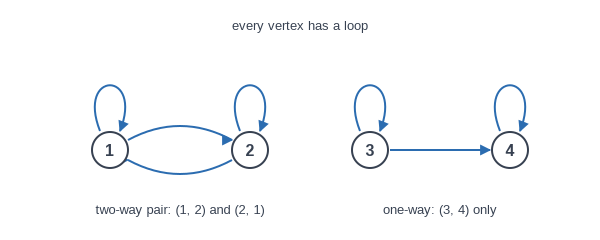
The four properties of relations
Let R be a relation on a set A. Each property is a “for all” statement, written with quantifiers:
| Property | Definition | In the directed graph |
|---|---|---|
| Reflexive | \forall a \in A,\ (a, a) \in R | a loop at every vertex |
| Symmetric | (a, b) \in R \Rightarrow (b, a) \in R | every arrow has a return arrow |
| Antisymmetric | (a, b) \in R \wedge (b, a) \in R \Rightarrow a = b | no two-way pair between different vertices |
| Transitive | (a, b) \in R \wedge (b, c) \in R \Rightarrow (a, c) \in R | every two-step path has a one-step shortcut |
Three points trip people up.
- Symmetric and antisymmetric are not opposites. The equality relation is both, and the relation in the diagram is neither.
- Antisymmetric allows loops. It only forbids a two-way pair between two different elements.
- A property with nothing to check holds. If no two pairs chain together, then R is transitive automatically. This is a vacuous truth: the “if” part is never true.
How to test a relation
- Reflexive: check that (a, a) \in R for every a in A. One missing loop makes R not reflexive.
- Symmetric: for each pair (a, b), look for (b, a). One missing return arrow is a counterexample.
- Antisymmetric: look for two different elements a ≠ b with both (a, b) and (b, a) in R. Finding one such pair is a counterexample.
- Transitive: for every chain (a, b), (b, c), check that (a, c) \in R. Include chains that return to the start, such as (1, 2), (2, 1), which require (1, 1).
For a relation on an infinite set such as the integers, a single counterexample disproves a property, but showing that a property holds needs a general argument, like a direct proof.
Properties of relations examples
Example 1: A relation on a small set
Let A = {1, 2, 3, 4} and R = {(1, 1), (1, 2), (2, 1), (2, 2), (3, 3), (3, 4), (4, 4)}, the relation in the diagram above. Which properties does R have?
(1, 1), (2, 2), (3, 3), (4, 4) \in R
Reflexive: every element of A has a loop. Yes.
(3, 4) \in R,\ (4, 3) \notin R
Symmetric: the arrow from 3 to 4 has no return arrow. No.
(1, 2) \in R,\ (2, 1) \in R,\ 1 \ne 2
Antisymmetric: 1 and 2 form a two-way pair. No.
(1, 2), (2, 1) \Rightarrow (1, 1) \in R
Transitive: check each chain. This one closes with a loop.
(2, 1), (1, 2) \Rightarrow (2, 2) \in R
The reverse chain also closes.
(3, 4), (4, 4) \Rightarrow (3, 4) \in R
A chain through a loop always closes.
(3, 3), (3, 4) \Rightarrow (3, 4) \in R
So does a chain that starts with a loop.
(1, 1), (1, 2) \Rightarrow (1, 2) \in R
The remaining chains each use a loop, so they close too. Transitive: yes.
Answer: R is reflexive and transitive, but neither symmetric nor antisymmetric.
Example 2: The divides relation
On the positive integers, let a \, R \, b mean a \mid b (a divides b). Prove which properties hold.
a = a \cdot 1
Reflexive: a divides a, because a is a times an integer. Yes.
2 \mid 4,\ 4 \nmid 2
Symmetric: a counterexample. No.
b = am,\ a = bn
Antisymmetric: suppose a | b and b | a, for integers m and n.
a = (am)n = a(mn)
Substitute b = am into a = bn.
mn = 1
Divide both sides by a, which is positive.
m = n = 1
m and n are positive integers, so both equal 1.
b = a
Substitute m = 1 into b = am. Antisymmetric: yes.
b = am,\ c = bk
Transitive: suppose a | b and b | c.
c = (am)k = a(mk)
Substitute b = am, then regroup.
a \mid c
mk is an integer. Transitive: yes.
Answer: divides is reflexive, antisymmetric and transitive, but not symmetric. (See divisibility for the definition of a | b.) The lesson on partial orders studies relations with exactly these three properties.
Example 3: Same parity
On the integers, let a \, R \, b mean that a − b is even. Which properties hold?
a - a = 0 = 2 \cdot 0
Reflexive: 0 is even. Yes.
b - a = -(a - b) = 2(-k)
Symmetric: if a − b = 2k, then b − a is also even. Yes.
1 - 3 = -2,\ 3 - 1 = 2
Antisymmetric: 1 R 3 and 3 R 1, but 1 ≠ 3. No.
a - c = (a - b) + (b - c)
Transitive: add and subtract b.
a - c = 2k + 2j = 2(k + j)
Substitute a − b = 2k and b − c = 2j, then factor out 2. Yes.
Answer: R is reflexive, symmetric and transitive, but not antisymmetric. A relation with these three properties is an equivalence relation, the topic of the next lesson. In the language of modular arithmetic, this R is a \equiv b \pmod{2}.
Example 4: A “close to” relation
On the real numbers, let a \, R \, b mean |a - b| \le 1. Which properties hold?
|a - a| = 0 \le 1
Reflexive: every number is close to itself. Yes.
|b - a| = |a - b|
Symmetric: absolute value ignores order. Yes.
|0 - 1| = 1 \le 1
Antisymmetric: 0 R 1 …
|1 - 0| = 1 \le 1
… and 1 R 0, but 0 ≠ 1. No.
|0 - 1| \le 1,\ |1 - 2| \le 1
Transitive: 0 R 1 and 1 R 2 …
|0 - 2| = 2 \gt 1
… but 0 is not related to 2. No.
Answer: R is reflexive and symmetric only. Small steps of “close” can add up to “far,” which is why closeness is not transitive.
Example 5: A round-robin tournament (word problem)
Four teams, A, B, C and D, each play every other team once, with no ties. A beat B, B beat C, C beat A, and each of A, B and C beat D. Let x \, R \, y mean “x beat y.” Which properties does R have?
R = \{(A, B), (B, C), (C, A), (A, D), (B, D), (C, D)\}List the six games as ordered pairs (winner, loser).
(A, A) \notin R
Reflexive: no team plays itself. No.
(A, B) \in R,\ (B, A) \notin R
Symmetric: A beat B, but B did not beat A. No.
\text{each pair of teams appears once}Antisymmetric: two teams played once, so no two-way pair exists. Yes.
(A, B), (B, C) \in R,\ (A, C) \notin R
Transitive: A beat B and B beat C, but C beat A. No.
Answer: “beat” is antisymmetric only. The cycle A → B → C → A is why tournaments can have no clear ranking even when every game has a winner.
Common mistakes
| Mistake | Example of the error | Fix |
|---|---|---|
| Treating symmetric and antisymmetric as opposites | “R is not symmetric, so it must be antisymmetric” | Check each separately: Example 1 is neither, and equality is both. |
| Calling a relation reflexive when some loops are missing | R = {(1, 1), (2, 2)} on A = {1, 2, 3} called reflexive | Every element of A needs a loop: (3, 3) is missing. |
| Saying a relation is not transitive because nothing chains | R = {(1, 2)} called not transitive | With no chains to check, R is transitive (vacuously). |
| Skipping chains that return to the start | R = {(1, 2), (2, 1)} called transitive | The chain (1, 2), (2, 1) requires (1, 1), which is missing. |
| Thinking loops break antisymmetry | “(1, 1) ∈ R, so R is not antisymmetric” | Antisymmetry only restricts pairs with a ≠ b. |
| Proving a “for all” property with one example | “2 R 4 and 4 R 6 give 2 R 6, so R is transitive” | One example only disproves. Proving needs a general argument. |
Related methods
The matrix of a relation
For A = {1, …, n}, the matrix of R has a 1 in row i, column j when (i, j) \in R and a 0 otherwise. For Example 1:
M_R = \begin{bmatrix} 1 & 1 & 0 & 0 \\ 1 & 1 & 0 & 0 \\ 0 & 0 & 1 & 1 \\ 0 & 0 & 0 & 1 \end{bmatrix}R is reflexive when the main diagonal is all 1s, and symmetric when the matrix equals its transpose. R is antisymmetric when no 1 off the diagonal has a 1 in its mirror position.
Closures
The reflexive, symmetric or transitive closure of R is the smallest relation that contains R and has that property. To get the transitive closure, keep adding (a, c) for every chain (a, b), (b, c) until nothing new appears. For example, the transitive closure of {(1, 2), (2, 3)} is {(1, 2), (2, 3), (1, 3)}.
Counting relations
A set with n elements has n^2 ordered pairs, and each pair is either in R or not, so there are 2^{n^2} relations on it. Reflexive relations must contain the n loops and may include or leave out each of the other n^2 - n pairs, so there are 2^{n^2 - n} of them (by the product rule for counting).
Practice problems
- Let A = {1, 2, 3} and R = {(1, 1), (2, 2), (3, 3), (1, 3), (3, 1)}. Which of the four properties does R have?
- Let A = {1, 2, 3} and R = {(1, 2), (2, 3)}. Which of the four properties does R have?
- Let A = {a, b, c} and R = {(a, b)}. Is R transitive? Is it antisymmetric?
- Which properties does ≤ have on the real numbers?
- Which properties does < have on the real numbers?
- On the integers, let a R b mean that a + b is even. Is R transitive? Prove your answer.
- On the integers, let a R b mean ab \ge 0. Is R transitive?
- How many reflexive relations are there on a set with 3 elements?
- Find the transitive closure of R = {(1, 2), (2, 3), (3, 4)} on {1, 2, 3, 4}.
- The relation R on {1, 2, 3} has matrix \begin{bmatrix} 1 & 1 & 0 \\ 0 & 1 & 1 \\ 0 & 0 & 1 \end{bmatrix}. Which properties does R have?
Show answers
1.
(1, 1), (2, 2), (3, 3) \in R
Reflexive: every loop is present. Yes.
(1, 3), (3, 1) \in R
Symmetric: the only non-loop pair has its return. Yes.
1 \ne 3
Antisymmetric: 1 and 3 form a two-way pair. No.
(1, 3), (3, 1) \Rightarrow (1, 1) \in R
Transitive: this chain closes.
(3, 1), (1, 3) \Rightarrow (3, 3) \in R
So does the reverse; chains through loops always close. Yes.
Answer: reflexive, symmetric and transitive, but not antisymmetric
2.
(1, 1) \notin R
Reflexive: no loops. No.
(1, 2) \in R,\ (2, 1) \notin R
Symmetric: no return arrow. No.
\text{no two-way pairs}Antisymmetric: yes.
(1, 2), (2, 3) \in R,\ (1, 3) \notin R
Transitive: the chain has no shortcut. No.
Answer: antisymmetric only
3.
\text{no chain } (x, y), (y, z)(a, b) is the only pair, and nothing starts at b.
R \text{ is transitive}The condition is never tested, so it holds vacuously.
(b, a) \notin R
No two-way pair exists, so R is antisymmetric.
Answer: yes, R is transitive and antisymmetric
4.
a \le a
Reflexive: yes.
2 \le 5,\ 5 \not\le 2
Symmetric: no.
a \le b \wedge b \le a \Rightarrow a = b
Antisymmetric: yes.
a \le b \wedge b \le c \Rightarrow a \le c
Transitive: yes.
Answer: reflexive, antisymmetric and transitive
5.
1 \lt 1 \text{ is false}Reflexive: no.
1 \lt 2,\ 2 \not\lt 1
Symmetric: no.
a \lt b \wedge b \lt a \text{ never happens}Antisymmetric: yes, vacuously.
a \lt b \wedge b \lt c \Rightarrow a \lt c
Transitive: yes.
Answer: antisymmetric and transitive only
6.
a + c = (a + b) + (b + c) - 2b
Suppose a + b and b + c are even. Add them and subtract 2b.
a + c = 2k + 2j - 2b
Substitute a + b = 2k and b + c = 2j.
a + c = 2(k + j - b)
Factor out 2.
Answer: yes, R is transitive, because a + c is even
7.
1 \cdot 0 = 0 \ge 0
1 R 0.
0 \cdot (-1) = 0 \ge 0
0 R −1.
1 \cdot (-1) = -1 \lt 0
But 1 is not related to −1.
Answer: no; 1 R 0 and 0 R −1, but not 1 R −1
8.
3^2 - 3 = 6
Count the pairs that are not loops.
2^6 = 64
Each of the 6 pairs is in or out; the 3 loops must be in.
Answer: 64
9.
(1, 2), (2, 3) \Rightarrow (1, 3)
Add the shortcut for the first chain.
(2, 3), (3, 4) \Rightarrow (2, 4)
Add the shortcut for the second chain.
(1, 3), (3, 4) \Rightarrow (1, 4)
A new chain appears; add its shortcut.
\text{no new pairs}Every chain now closes.
Answer: {(1, 2), (2, 3), (3, 4), (1, 3), (2, 4), (1, 4)}
10.
m_{11} = m_{22} = m_{33} = 1Reflexive: the diagonal is all 1s. Yes.
m_{12} = 1,\ m_{21} = 0Symmetric: the matrix is not its transpose. No.
m_{12}, m_{23} = 1;\ m_{21}, m_{32} = 0Antisymmetric: no 1 off the diagonal has a mirror 1. Yes.
(1, 2), (2, 3) \in R,\ m_{13} = 0Transitive: the chain has no shortcut. No.
Answer: reflexive and antisymmetric, but not symmetric or transitive
Properties of relations FAQ
What is the difference between symmetric and antisymmetric relations?
Symmetric means every pair (a, b) comes with its reverse (b, a). Antisymmetric means a pair and its reverse never both appear unless a = b. A relation can be both, such as equality, or neither, such as Example 1.
Can a relation be both reflexive and irreflexive?
Only on the empty set. An irreflexive relation has no loops, and a reflexive relation has a loop at every element, so both can hold only when there are no elements.
How do you prove a relation is transitive?
Assume a R b and b R c for arbitrary a, b and c, and use the definition of R to show a R c. To show a relation is not transitive, give one chain whose shortcut is missing.
What do you call a relation that is reflexive, symmetric and transitive?
An equivalence relation. A relation that is reflexive, antisymmetric and transitive is a partial order.
Summary
- A relation on A is a subset of A × A; write a R b when (a, b) is in R.
- Reflexive: every element is related to itself (a loop at every vertex).
- Symmetric: every pair has its reverse. Antisymmetric: no two-way pair between different elements.
- Transitive: every chain a R b, b R c has the shortcut a R c; vacuous cases count.
- One counterexample disproves a property; proving one needs a general argument.
Previous lesson: Generating Functions
Next lesson: Equivalence Relations
Back to the Discrete Math Index