
Generating Functions
A generating function stores a sequence as the coefficients of a power series: the sequence a_0, a_1, a_2, \ldots becomes G(x) = a_0 + a_1 x + a_2 x^2 + \cdots. Generating functions turn counting problems into polynomial multiplication, and they turn recurrence relations into algebra that you can solve for G(x) to get a closed formula.
Before this lesson: Solving Linear Recurrence Relations, Combinations with Repetition, Infinite Geometric Series and Partial Fraction Decomposition
The idea
A sequence is an infinite list of numbers, which is awkward to work with as a whole. A generating function packs the whole list into one expression: the term a_n becomes the coefficient of x^n. The powers of x act only as labels that keep the terms in order, so you never plug in a number for x.
For example, the sequence 1, 3, 9, 27, … has generating function 1 + 3x + 9x^2 + 27x^3 + \cdots. This is a geometric series with ratio 3x, so it equals \dfrac{1}{1 - 3x}. One short fraction now carries every term of the sequence.
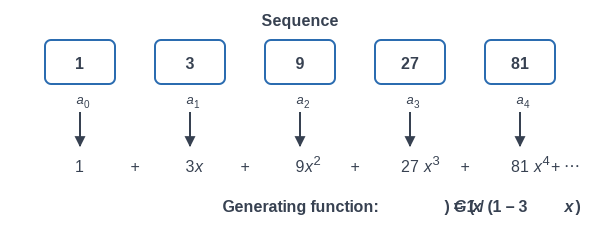
Two facts make this useful. Multiplying generating functions matches the way choices combine when you count, and shifting a sequence matches multiplying by x, which turns a recurrence into an equation for G(x).
Generating function rules
The ordinary generating function of a sequence (a_n) is
G(x) = \sum_{n=0}^{\infty} a_n x^n = a_0 + a_1 x + a_2 x^2 + \cdotsWe treat it as a formal power series: an algebraic object whose coefficients we track, with no question of convergence. The table lists the generating functions used most often. Each comes from the geometric series \frac{1}{1 - r} = 1 + r + r^2 + \cdots or from the binomial theorem.
| Sequence a_n | First terms | Generating function |
|---|---|---|
| 1 | 1, 1, 1, 1, … | \dfrac{1}{1 - x} |
| c^n | 1, c, c², c³, … | \dfrac{1}{1 - cx} |
| n + 1 | 1, 2, 3, 4, … | \dfrac{1}{(1 - x)^2} |
| \binom{n + k - 1}{k - 1} | 1, k, … | \dfrac{1}{(1 - x)^k} |
| \binom{m}{n} | 1, m, …, 1, 0, 0, … | (1 + x)^m |
| 1 for n ≤ m, then 0 | 1, 1, …, 1, 0, 0, … | 1 + x + \cdots + x^m = \dfrac{1 - x^{m+1}}{1 - x} |
Three operations do most of the work.
- Shift: if G(x) generates a_n, then x^k G(x) generates the sequence moved k places to the right, with k zeros in front.
- Sum: adding generating functions adds the sequences term by term.
- Product: if A(x) generates a_n and B(x) generates b_n, then A(x)B(x) generates c_n = a_0 b_n + a_1 b_{n-1} + \cdots + a_n b_0, called the convolution.
The product rule is what makes counting work. If one choice can contribute i to a total and a second choice can contribute j, then x^i \cdot x^j = x^{i+j}, so the coefficient of x^n in the product counts the ways the two choices add to n.
How to use generating functions
To count selections:
- Write one factor for each type of item. Its terms are x^k for each amount k that type can contribute.
- Multiply the factors.
- The coefficient of x^n is the number of ways to reach a total of n.
To solve a recurrence relation:
- Let G(x) = \sum a_n x^n. Multiply the recurrence by x^n and add over every n where it holds.
- Rewrite each sum in terms of G(x), subtracting the initial terms that each sum leaves out.
- Solve the result for G(x).
- Split G(x) into partial fractions of the form \frac{A}{1 - rx}.
- Read off a_n: each \frac{A}{1 - rx} contributes A r^n.
Generating function examples
Example 1: From a generating function to its sequence
Find a formula for a_n if the generating function is G(x) = \dfrac{2}{1 - 3x} + \dfrac{5}{1 + x}, and list the first four terms.
\frac{1}{1 - 3x} = \sum_{n=0}^{\infty} 3^n x^nUse \frac{1}{1 - cx} with c = 3 (see infinite geometric series).
\frac{1}{1 + x} = \sum_{n=0}^{\infty} (-1)^n x^nWrite 1 + x as 1 − (−1)x, so c = −1.
G(x) = \sum_{n=0}^{\infty} \left(2 \cdot 3^n + 5(-1)^n\right) x^nMultiply by the constants and add the two series term by term.
a_n = 2 \cdot 3^n + 5(-1)^n
Read off the coefficient of x^n.
a_0 = 2 + 5 = 7
Substitute n = 0.
a_1 = 6 - 5 = 1
Substitute n = 1.
a_2 = 18 + 5 = 23
Substitute n = 2.
a_3 = 54 - 5 = 49
Substitute n = 3.
Answer: a_n = 2 \cdot 3^n + 5(-1)^n, so the sequence starts 7, 1, 23, 49.
Example 2: Choosing fruit (word problem)
A student packs 6 pieces of fruit. She takes at most 2 apples and at most 3 bananas, and oranges come only in bags of 2. In how many ways can she choose the fruit?
A(x) = 1 + x + x^2
Apples: 0, 1 or 2.
B(x) = 1 + x + x^2 + x^3
Bananas: 0 to 3.
C(x) = 1 + x^2 + x^4 + x^6
Oranges: 0, 2, 4 or 6 (more than 6 cannot fit).
A(x)B(x) = 1 + 2x + 3x^2 + 3x^3 + 2x^4 + x^5
Multiply the first two factors (see multiplying polynomials).
[x^6]\,A B C = [x^6]AB + [x^4]AB + [x^2]AB + [x^0]AB
Pair each power of x in C(x) with the power of x in AB that makes 6.
= 0 + 2 + 3 + 1
Read the coefficients from A(x)B(x); it has no x^6 term.
= 6
Add.
Answer: there are 6 ways. (The notation [x^n]\,F(x) means the coefficient of x^n in F(x).) The six choices of (apples, bananas, oranges) are (0, 0, 6), (1, 1, 4), (0, 2, 4), (2, 0, 4), (1, 3, 2) and (2, 2, 2).
Example 3: Selections with repetition
A shop sells 3 flavors of donut. How many ways are there to choose 7 donuts if you take at least one of each flavor?
x + x^2 + x^3 + \cdots = \frac{x}{1 - x}One flavor, with at least 1: factor out x from the geometric series.
G(x) = \left(\frac{x}{1 - x}\right)^3 = \frac{x^3}{(1 - x)^3}Multiply one factor for each of the 3 flavors.
[x^7]\,\frac{x^3}{(1 - x)^3} = [x^4]\,\frac{1}{(1 - x)^3}The factor x^3 shifts the coefficients by 3, and 7 − 3 = 4.
\frac{1}{(1 - x)^3} = \sum_{n=0}^{\infty} \binom{n + 2}{2} x^nUse the table row \frac{1}{(1 - x)^k} with k = 3.
[x^4] = \binom{6}{2}Substitute n = 4.
\binom{6}{2} = \frac{6 \cdot 5}{2} = 15Evaluate the binomial coefficient (see permutations and combinations).
Answer: 15 ways. This matches stars and bars: give each flavor one donut first, then choose the other 4 from 3 flavors in \binom{4 + 2}{2} = 15 ways.
Example 4: A first-order recurrence
Use a generating function to solve a_n = 2a_{n-1} + 3 for n ≥ 1, with a_0 = 1.
\sum_{n \ge 1} a_n x^n = 2\sum_{n \ge 1} a_{n-1} x^n + 3\sum_{n \ge 1} x^nMultiply the recurrence by x^n and add for n ≥ 1.
G(x) - 1 = 2xG(x) + \frac{3x}{1 - x}The left sum misses a_0 = 1; the middle sum is x times G(x); the last is a geometric series that starts at x.
G(x) - 2xG(x) = 1 + \frac{3x}{1 - x}Move 2xG(x) to the left and 1 to the right.
G(x)(1 - 2x) = \frac{1 + 2x}{1 - x}Factor out G(x); on the right, 1 − x + 3x = 1 + 2x.
G(x) = \frac{1 + 2x}{(1 - x)(1 - 2x)}Divide both sides by 1 − 2x.
1 + 2x = A(1 - 2x) + B(1 - x)
Set up partial fractions \frac{A}{1 - x} + \frac{B}{1 - 2x} (see partial fraction decomposition).
3 = -A
Substitute x = 1.
A = -3
Multiply both sides by −1.
2 = \tfrac{1}{2}BSubstitute x = 1/2.
B = 4
Multiply both sides by 2.
G(x) = \frac{4}{1 - 2x} - \frac{3}{1 - x}Write the partial fractions.
a_n = 4 \cdot 2^n - 3
Read off coefficients: 4 \cdot 2^n and -3 \cdot 1^n.
a_1 = 2(1) + 3 = 5
Check with the recurrence.
4 \cdot 2 - 3 = 5
The formula gives the same value.
Answer: a_n = 4 \cdot 2^n - 3, giving 1, 5, 13, 29, ….
Example 5: A second-order recurrence
Use a generating function to solve a_n = a_{n-1} + 6a_{n-2} for n ≥ 2, with a_0 = 1 and a_1 = 8.
\sum_{n \ge 2} a_n x^n = \sum_{n \ge 2} a_{n-1} x^n + 6\sum_{n \ge 2} a_{n-2} x^nMultiply by x^n and add for n ≥ 2.
G(x) - 1 - 8x = x\left(G(x) - 1\right) + 6x^2 G(x)
Restore the missing terms: the left misses a_0 + a_1 x, the middle misses a_0.
G(x) - xG(x) - 6x^2 G(x) = 1 + 8x - x
Collect the G(x) terms on the left and the rest on the right.
G(x)(1 - x - 6x^2) = 1 + 7x
Factor out G(x) and combine like terms.
1 - x - 6x^2 = (1 - 3x)(1 + 2x)
Factor the trinomial (see factoring trinomials).
G(x) = \frac{1 + 7x}{(1 - 3x)(1 + 2x)}Divide both sides by the factored trinomial.
1 + 7x = A(1 + 2x) + B(1 - 3x)
Set up partial fractions \frac{A}{1 - 3x} + \frac{B}{1 + 2x}.
\tfrac{10}{3} = \tfrac{5}{3}ASubstitute x = 1/3.
A = 2
Divide both sides by 5/3.
-\tfrac{5}{2} = \tfrac{5}{2}BSubstitute x = −1/2.
B = -1
Divide both sides by 5/2.
G(x) = \frac{2}{1 - 3x} - \frac{1}{1 + 2x}Write the partial fractions.
a_n = 2 \cdot 3^n - (-2)^n
Read off coefficients with c = 3 and c = −2.
a_2 = 8 + 6(1) = 14
Check with the recurrence.
2 \cdot 9 - 4 = 14
The formula gives the same value.
Answer: a_n = 2 \cdot 3^n - (-2)^n. The denominator 1 - x - 6x^2 holds the characteristic roots 3 and −2, the same roots the characteristic equation r^2 - r - 6 = 0 gives.
Common mistakes
| Mistake | Example of the error | Fix |
|---|---|---|
| Dropping the initial terms when shifting a sum | Writing \sum_{n \ge 1} a_n x^n = G(x) | The sum misses a_0: it equals G(x) - a_0. |
| Starting a geometric series at the wrong power | \sum_{n \ge 1} 3x^n = \frac{3}{1 - x} | It starts at x, so it is \frac{3x}{1 - x}. |
| Losing the sign in \frac{1}{1 + cx} | Reading \frac{1}{1 + 2x} as \sum 2^n x^n | Write it as \frac{1}{1 - (-2)x}, so the coefficients are (-2)^n. |
| Adding factors for “and” choices | A(x) + B(x) for apples and bananas together | Choices made together multiply: use A(x)B(x). |
| Using an infinite factor for a limited supply | \frac{1}{1 - x} for “at most 2 apples” | A limit of 2 means 1 + x + x^2. |
| Forgetting the shift from a factor x^k | [x^7]\frac{x^3}{(1 - x)^3} taken as \binom{9}{2} | Subtract the shift first: [x^4]\frac{1}{(1 - x)^3} = \binom{6}{2}. |
Related methods
Exponential generating functions
The exponential generating function of a_n is \sum a_n \frac{x^n}{n!}. It suits counts of arrangements, where order matters. For example, the sequence 1, 1, 1, … has exponential generating function e^x, a series from the lesson on Maclaurin series.
Connections to calculus
If a generating function converges near x = 0, it is an ordinary power series, and calculus applies. Differentiating \frac{1}{1 - x} = \sum x^n gives \frac{1}{(1 - x)^2} = \sum (n + 1)x^n, which is the third row of the table. The method of solving a recurrence through G(x) is the discrete version of solving differential equations with Laplace transforms: transform, solve with algebra, then transform back.
Practice problems
- Find the generating function of 1, 5, 25, 125, … in closed form.
- Find a_n if G(x) = \dfrac{3}{1 - 2x} - \dfrac{1}{1 + x}.
- Find the generating function of the sequence 0, 1, 1, 1, … in closed form.
- Find the coefficient of x^4 in (1 + x)^6.
- How many ways are there to choose 5 coins from pennies, nickels and dimes, with any number of each type?
- Use the generating function (x + x^2 + \cdots + x^6)^2 to find the number of ways to roll a sum of 5 with two dice.
- Use a generating function to solve a_n = 3a_{n-1} for n ≥ 1 with a_0 = 2.
- Use a generating function to solve a_n = a_{n-1} + 2 for n ≥ 1 with a_0 = 1.
- Use a generating function to solve a_n = 4a_{n-1} - 3a_{n-2} for n ≥ 2 with a_0 = 2 and a_1 = 4.
- In how many ways can you make 15 cents with pennies, nickels and dimes? Use the generating function \frac{1}{(1 - x)(1 - x^5)(1 - x^{10})}.
Show answers
1.
a_n = 5^n
Each term is 5 times the one before.
G(x) = \sum_{n=0}^{\infty} 5^n x^nWrite the generating function.
G(x) = \frac{1}{1 - 5x}Use \frac{1}{1 - cx} with c = 5.
Answer: \dfrac{1}{1 - 5x}
2.
\frac{3}{1 - 2x} = \sum 3 \cdot 2^n x^nUse \frac{1}{1 - cx} with c = 2.
\frac{1}{1 + x} = \sum (-1)^n x^nUse c = −1.
a_n = 3 \cdot 2^n - (-1)^n
Subtract the coefficients.
Answer: a_n = 3 \cdot 2^n - (-1)^n (2, 7, 11, 25, …)
3.
G(x) = x + x^2 + x^3 + \cdots
The terms with n ≥ 1 are 1, and a_0 = 0.
G(x) = x(1 + x + x^2 + \cdots)
Factor out x.
G(x) = \frac{x}{1 - x}Use \frac{1}{1 - x}.
Answer: \dfrac{x}{1 - x}
4.
[x^4]\,(1 + x)^6 = \binom{6}{4}Use the binomial theorem.
\binom{6}{4} = \frac{6 \cdot 5 \cdot 4 \cdot 3}{4 \cdot 3 \cdot 2 \cdot 1}Write out the binomial coefficient.
= \frac{360}{24} = 15Multiply, then divide.
Answer: 15
5.
G(x) = \frac{1}{(1 - x)^3}One factor \frac{1}{1 - x} for each of the 3 coin types.
[x^5] = \binom{5 + 2}{2} = \binom{7}{2}Use the table row with k = 3 and n = 5.
\binom{7}{2} = \frac{7 \cdot 6}{2} = 21Evaluate.
Answer: 21 ways
6.
[x^5]\,(x + \cdots + x^6)^2
Each die contributes x^i for a roll of i.
x^1 x^4,\ x^2 x^3,\ x^3 x^2,\ x^4 x^1
List the products of two terms with exponents adding to 5.
[x^5] = 4
Count them.
Answer: 4 ways: (1, 4), (2, 3), (3, 2) and (4, 1)
7.
G(x) - 2 = 3xG(x)
Multiply by x^n, add for n ≥ 1 and restore a_0 = 2.
G(x)(1 - 3x) = 2
Move 3xG(x) to the left and 2 to the right, then factor.
G(x) = \frac{2}{1 - 3x}Divide by 1 − 3x.
Answer: a_n = 2 \cdot 3^n
8.
G(x) - 1 = xG(x) + \frac{2x}{1 - x}Multiply by x^n, add for n ≥ 1 and restore a_0 = 1.
G(x)(1 - x) = 1 + \frac{2x}{1 - x}Move xG(x) to the left and 1 to the right, then factor.
G(x) = \frac{1}{1 - x} + \frac{2x}{(1 - x)^2}Divide by 1 − x.
\frac{x}{(1 - x)^2} = \sum n x^nShift \frac{1}{(1 - x)^2} = \sum (n + 1)x^n by one place.
a_n = 1 + 2n
Add the coefficients.
Answer: a_n = 2n + 1 (1, 3, 5, 7, …)
9.
G(x) - 2 - 4x = 4x(G(x) - 2) - 3x^2 G(x)
Multiply by x^n, add for n ≥ 2 and restore the missing terms.
G(x)(1 - 4x + 3x^2) = 2 + 4x - 8x
Collect the G(x) terms on the left and the rest on the right.
G(x) = \frac{2 - 4x}{(1 - x)(1 - 3x)}Combine 4x − 8x = −4x, factor and divide.
2 - 4x = A(1 - 3x) + B(1 - x)
Set up partial fractions \frac{A}{1 - x} + \frac{B}{1 - 3x}.
-2 = -2A,\ A = 1
Substitute x = 1, then divide by −2.
\tfrac{2}{3} = \tfrac{2}{3}B,\ B = 1Substitute x = 1/3, then divide by 2/3.
G(x) = \frac{1}{1 - x} + \frac{1}{1 - 3x}Write the partial fractions.
Answer: a_n = 1 + 3^n (2, 4, 10, 28, …)
10.
[x^{15}] = \#\{(n, d) : 5n + 10d \le 15\}Pennies fill whatever nickels n and dimes d leave, in exactly one way.
d = 0:\ n = 0, 1, 2, 3
With no dime, 5n ≤ 15 gives 4 choices.
d = 1:\ n = 0, 1
With one dime, 5n ≤ 5 gives 2 choices.
4 + 2 = 6
Add the cases (see sum and product rules for counting).
Answer: 6 ways
Generating functions FAQ
What is a generating function in discrete math?
It is a power series a_0 + a_1 x + a_2 x^2 + \cdots whose coefficients are the terms of a sequence. The powers of x only mark positions, so the series is used as an algebraic object rather than a function to evaluate.
How do you find the generating function of a sequence?
Write \sum a_n x^n and match it to a known series, such as \frac{1}{1 - cx} for c^n or (1 + x)^m for \binom{m}{n}. Use shifts, sums and products to build more complicated sequences from these.
How do you solve a recurrence relation with generating functions?
Multiply the recurrence by x^n, add over all n where it holds and rewrite each sum with G(x). Solve for G(x), split it into partial fractions and read off the coefficient of x^n.
What is the difference between ordinary and exponential generating functions?
An ordinary generating function uses a_n x^n and fits selections where order does not matter. An exponential generating function uses a_n x^n / n! and fits arrangements where order matters.
Summary
- A generating function G(x) = \sum a_n x^n stores a sequence as coefficients.
- Key pairs: \frac{1}{1 - cx} ↔ c^n, \frac{1}{(1 - x)^k} ↔ \binom{n + k - 1}{k - 1} and (1 + x)^m ↔ \binom{m}{n}.
- For counting, multiply one factor per item type; the coefficient of x^n counts the ways to reach n.
- For a recurrence, multiply by x^n, add, solve for G(x), use partial fractions and read off a_n.
- Multiplying by x shifts a sequence; the product of two generating functions gives a convolution.
Previous lesson: Solving Linear Recurrence Relations
Next lesson: Properties of Relations
Back to the Discrete Math Index