
Direct Proof
A direct proof shows that a statement “if P, then Q” is true by assuming P and reaching Q through definitions, algebra and facts already proved, one justified step at a time. Most direct proofs about integers write an even number as 2k, an odd number as 2k + 1 and a multiple of d as dk.
Before this lesson: Rules of Inference and Predicates and Quantifiers
Definitions used in direct proofs
A proof can only use what words mean, so every proof about integers starts from exact definitions. In each one, k is an integer.
| Term | Definition | Examples |
|---|---|---|
| Even integer | n = 2k for some integer k | 8 = 2 · 4, −6 = 2 · (−3), 0 = 2 · 0 |
| Odd integer | n = 2k + 1 for some integer k | 7 = 2 · 3 + 1, −5 = 2 · (−3) + 1 |
| a divides b, written a | b | b = ak for some integer k (with a ≠ 0) | 3 | 12 because 12 = 3 · 4 |
| Rational number | r = p/q for integers p and q with q ≠ 0 | 0.75 = 3/4, −2 = −2/1 |
Two facts do most of the work: the sum, difference and product of integers are integers, and every integer is either even or odd but not both.
How to write a direct proof
A direct proof follows the shape of modus ponens: assume the hypothesis is true, then show the conclusion must follow.
- Write the claim as “for every …, if P, then Q,” and pick an arbitrary element (one with no special properties).
- Assume P is true and write it with its definition, such as n = 2k + 1.
- Use algebra to rewrite the expression in the conclusion.
- Rearrange it into the exact form the definition of Q needs, such as 2(integer) + 1.
- Say why the new multiplier is an integer, and state the conclusion.
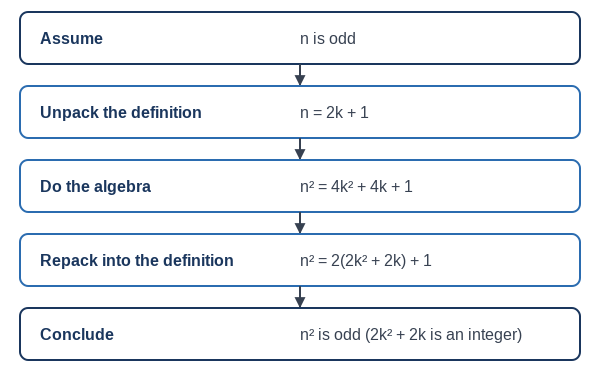
Because the element was arbitrary, the proof covers every case at once. That step is universal generalization.
When the statement is false
If a “for all” statement is false, don’t try to prove it. One counterexample disproves it, and checking examples can never prove it.
Direct proof examples
Example 1: The square of an odd integer is odd
Prove: if n is an odd integer, then n2 is odd.
n = 2k + 1
Assume n is odd, so n = 2k + 1 for some integer k.
n^2 = (2k + 1)^2
Square both sides.
n^2 = 4k^2 + 4k + 1
Expand the square of a binomial.
n^2 = 2(2k^2 + 2k) + 1
Factor 2 out of the first two terms (factoring out the GCF).
m = 2k^2 + 2k
Name the multiplier m; it is an integer because k is an integer.
n^2 = 2m + 1
This is the definition of odd.
Answer: n2 = 2m + 1 with m an integer, so n2 is odd.
Example 2: The sum of two odd integers is even
Prove: if m and n are odd integers, then m + n is even.
m = 2a + 1,\quad n = 2b + 1
Assume both are odd. Use different letters a and b, since m and n can be different numbers.
m + n = (2a + 1) + (2b + 1)
Add the two expressions.
m + n = 2a + 2b + 2
Combine like terms.
m + n = 2(a + b + 1)
Factor out 2.
m + n = 2c,\quad c = a + b + 1
c is an integer because a and b are integers.
Answer: m + n = 2c with c an integer, so m + n is even.
Example 3: Divisibility
Prove: if 3 | a and 3 | b, then 3 | (5a − 2b).
a = 3j,\quad b = 3k
Assume 3 | a and 3 | b, so a = 3j and b = 3k for some integers j and k.
5a - 2b = 5(3j) - 2(3k)
Substitute.
5a - 2b = 15j - 6k
Multiply.
5a - 2b = 3(5j - 2k)
Factor out 3.
5a - 2b = 3t,\quad t = 5j - 2k
t is an integer because j and k are integers.
Answer: 5a − 2b = 3t with t an integer, so 3 | (5a − 2b).
Example 4: The sum of two rational numbers is rational
Prove: if r and s are rational numbers, then r + s is rational.
r = \dfrac{a}{b},\quad s = \dfrac{c}{d}Assume r and s are rational: a, b, c, d are integers with b ≠ 0 and d ≠ 0.
r + s = \dfrac{ad}{bd} + \dfrac{bc}{bd}Rewrite both fractions over the common denominator bd (adding fractions).
r + s = \dfrac{ad + bc}{bd}Add the numerators.
bd \ne 0
The product of two nonzero numbers is not zero.
ad + bc \text{ and } bd \text{ are integers}Sums and products of integers are integers.
Answer: r + s is an integer over a nonzero integer, so r + s is rational. This is why the sum in rational and irrational numbers stays rational.
Example 5: Ticket packs (word problem)
A school sells raffle tickets only in packs of 6 and packs of 9. Prove that any number of tickets a person can buy is divisible by 3. Then decide whether someone can buy exactly 50 tickets.
T = 6x + 9y
Let x be the number of packs of 6 and y the number of packs of 9, both whole numbers.
T = 3(2x + 3y)
Factor out 3.
T = 3s,\quad s = 2x + 3y
s is an integer because x and y are integers, so 3 | T.
50 = 3 \cdot 16 + 2
Divide 50 by 3: the remainder is 2, so 3 does not divide 50.
Answer: every possible total is a multiple of 3, so buying exactly 50 tickets is impossible.
Common mistakes
| Mistake | Example of the error | Fix |
|---|---|---|
| Proving with examples | “3² = 9 and 5² = 25 are odd, so odd squares are odd.” | Examples can’t cover every integer. Use n = 2k + 1 for an arbitrary odd n. |
| Using the same letter for two numbers | Writing m = 2k + 1 and n = 2k + 1 | That forces m = n. Use different letters: m = 2a + 1, n = 2b + 1. |
| Starting from the conclusion | Beginning with “n² is odd” and working backward | Start from the hypothesis and end at the conclusion. |
| Forgetting the multiplier is an integer | Stopping at n² = 2(2k² + 2k) + 1 | Say that 2k² + 2k is an integer, so the form matches the definition. |
| Dividing in a divisibility proof | Writing a/3 as if it were an integer before you know 3 | a | Write a = 3j and work with multiplication. |
| Not saying what k is | Writing “n = 2k” with no explanation | Write “n = 2k for some integer k.” |
Related ideas
The next lesson, Proof by Contrapositive, proves “if P, then Q” when a direct proof gets stuck. Geometry’s algebraic proofs and two-column proofs are direct proofs too, and mathematical induction proves statements for every positive integer n.
Practice problems
- Write 14 and −9 in the form 2k or 2k + 1 with k an integer.
- Prove that the sum of two even integers is even.
- Prove: if n is even, then n2 is even.
- Prove that the product of two odd integers is odd.
- Prove: if n is odd, then 3n + 5 is even.
- Prove: if 4 | a, then 2 | a.
- Prove: if 5 | a and 5 | b, then 5 | (a + b).
- Prove: if a | b and b | c, then a | c.
- Disprove: “The sum of two even integers is always divisible by 4.”
- Prove that the product of two rational numbers is rational.
Show answers
1.
14 = 2 \cdot 7
14 is even with k = 7.
-9 = 2(-5) + 1
−9 is odd with k = −5, since 2(−5) = −10 (multiplying integers).
Answer: 14 = 2 · 7 and −9 = 2(−5) + 1
2.
m = 2a,\quad n = 2b
Assume m and n are even, with a and b integers.
m + n = 2a + 2b
Add.
m + n = 2(a + b)
Factor out 2; a + b is an integer.
Answer: m + n is even
3.
n = 2k
Assume n is even, with k an integer.
n^2 = (2k)^2
Square both sides.
n^2 = 4k^2
Square each factor.
n^2 = 2(2k^2)
Write 4 as 2 · 2; 2k² is an integer.
Answer: n² is even
4.
m = 2a + 1,\quad n = 2b + 1
Assume m and n are odd, with a and b integers.
mn = (2a + 1)(2b + 1)
Multiply.
mn = 4ab + 2a + 2b + 1
Expand (multiplying binomials).
mn = 2(2ab + a + b) + 1
Factor 2 out of the first three terms; 2ab + a + b is an integer.
Answer: mn is odd
5.
n = 2k + 1
Assume n is odd, with k an integer.
3n + 5 = 3(2k + 1) + 5
Substitute.
3n + 5 = 6k + 3 + 5
Use the distributive property.
3n + 5 = 6k + 8
Add 3 and 5.
3n + 5 = 2(3k + 4)
Factor out 2; 3k + 4 is an integer.
Answer: 3n + 5 is even
6.
a = 4k
Assume 4 | a, with k an integer.
a = 2(2k)
Write 4 as 2 · 2; 2k is an integer.
Answer: 2 | a
7.
a = 5j,\quad b = 5k
Assume 5 | a and 5 | b, with j and k integers.
a + b = 5j + 5k
Add.
a + b = 5(j + k)
Factor out 5; j + k is an integer.
Answer: 5 | (a + b)
8.
b = aj,\quad c = bk
Assume a | b and b | c, with j and k integers.
c = (aj)k
Substitute b = aj into c = bk.
c = a(jk)
Regroup the product; jk is an integer.
Answer: a | c
9.
2 + 4 = 6
Try the even integers 2 and 4.
6 = 4 \cdot 1 + 2
Divide 6 by 4: the remainder is 2, so 4 does not divide 6.
Answer: false; 2 + 4 = 6 is a counterexample
10.
r = \dfrac{a}{b},\quad s = \dfrac{c}{d}Assume r and s are rational, with b ≠ 0 and d ≠ 0.
rs = \dfrac{ac}{bd}Multiply numerators and denominators (multiplying fractions).
bd \ne 0
A product of nonzero numbers is nonzero; ac and bd are integers.
Answer: rs is rational
Direct proof FAQ
What is a direct proof?
It is a proof of “if P, then Q” that assumes P and uses definitions, algebra and known facts to reach Q. Nothing is assumed about Q along the way.
How do you start a direct proof?
Write down the hypothesis and replace each word with its definition. For example, “n is odd” becomes “n = 2k + 1 for some integer k.”
Can examples prove a statement?
Examples can’t prove a statement about every integer, because there are infinitely many cases. One counterexample can disprove it, though.
What is the difference between a direct proof and a proof by contrapositive?
A direct proof goes from P to Q. A proof by contrapositive proves the equivalent statement “if not Q, then not P” directly instead.
Summary
- A direct proof assumes the hypothesis and reaches the conclusion through justified steps.
- Even means n = 2k, odd means n = 2k + 1, and a | b means b = ak, each for some integer k.
- Use different letters for different numbers, and say why each new multiplier is an integer.
- End by matching the exact form of the definition you need.
- A single counterexample disproves a “for all” statement; examples never prove one.
Previous lesson: Rules of Inference
Next lesson: Proof by Contrapositive
Back to the Discrete Math Index