
Rules of Inference
Rules of inference are short argument forms, such as modus ponens and modus tollens, that are always valid. An argument is valid when its conclusion must be true whenever all of its premises are true. You prove an argument valid by chaining rules of inference, one justified step at a time, from the premises to the conclusion.
Before this lesson: Propositional Logic, Truth Tables, Logical Equivalence and Predicates and Quantifiers
What makes an argument valid?
An argument is a list of statements called premises, followed by a conclusion. The symbol ∴ means “therefore” and marks the conclusion.
The argument is valid if there is no way to make every premise true and the conclusion false. In symbols, the premises p₁, p₂, …, pₙ and conclusion q form a valid argument exactly when (p₁ ∧ p₂ ∧ … ∧ pₙ) → q is a tautology.
Validity is about form, not facts. “If the moon is cheese, then 2 + 2 = 5. The moon is cheese. ∴ 2 + 2 = 5” is valid but has a false premise. An argument that is valid and has all true premises is called sound, and only a sound argument guarantees a true conclusion.
A truth table can always test validity, but with n variables it has 2ⁿ rows. Rules of inference are the shortcut: each rule is a small valid argument you can reuse without building a table.
The rules of inference
Each rule below is valid because the matching conditional is a tautology. The letters p, q and r can stand for any statements, even long ones.
| Rule | Premises | Conclusion | Tautology behind it |
|---|---|---|---|
| Modus ponens | p \to q, p | q | (p \land (p \to q)) \to q |
| Modus tollens | p \to q, \lnot q | \lnot p | (\lnot q \land (p \to q)) \to \lnot p |
| Hypothetical syllogism | p \to q, q \to r | p \to r | ((p \to q) \land (q \to r)) \to (p \to r) |
| Disjunctive syllogism | p \lor q, \lnot p | q | ((p \lor q) \land \lnot p) \to q |
| Addition | p | p \lor q | p \to (p \lor q) |
| Simplification | p \land q | p | (p \land q) \to p |
| Conjunction | p, q | p \land q | (p \land q) \to (p \land q) |
| Resolution | p \lor q, \lnot p \lor r | q \lor r | ((p \lor q) \land (\lnot p \lor r)) \to (q \lor r) |
Geometry uses other names for two of these: modus ponens is the law of detachment and hypothetical syllogism is the law of syllogism, as in inductive and deductive reasoning.
Two fallacies that look like rules
A fallacy is an argument form that is not valid. Both common ones start from a conditional statement p → q and use the wrong second premise.
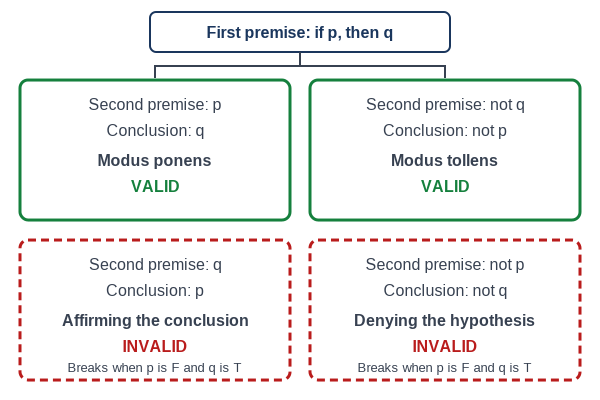
Affirming the conclusion (also called affirming the consequent) argues p → q, q ∴ p. Denying the hypothesis (denying the antecedent) argues p → q, ¬p ∴ ¬q. In both, the row with p false and q true makes every premise true and the conclusion false.
Rules for quantified statements
Four more rules handle the quantifiers ∀ and ∃. Here c stands for one element of the domain.
| Rule | Premise | Conclusion | When you may use it |
|---|---|---|---|
| Universal instantiation | \forall x\, P(x) | P(c) | for any element c of the domain |
| Universal generalization | P(c) for an arbitrary c | \forall x\, P(x) | only if c was not chosen in any special way |
| Existential instantiation | \exists x\, P(x) | P(c) | for a new name c that has not been used yet |
| Existential generalization | P(c) | \exists x\, P(x) | for any element c you have |
Universal instantiation followed by modus ponens is used so often that it has its own name, universal modus ponens: from ∀x (P(x) → Q(x)) and P(a), conclude Q(a).
How to prove an argument is valid
- Write each premise on its own numbered line.
- Look for a rule whose premises match lines you already have. Write its conclusion on a new line and name the rule and the lines it uses.
- Use a logical equivalence (such as De Morgan’s laws or the contrapositive) to rewrite a line when no rule fits it yet.
- Stop when the conclusion appears. If you can’t reach it, look for a row of the truth table that makes every premise true and the conclusion false. That row proves the argument is invalid.
Rules of inference examples
Example 1: Naming the rule
Name the rule used in each argument.
- If the store is open, the lights are on. The lights are not on. ∴ The store is not open.
- Ana is taking chemistry or biology. Ana is not taking chemistry. ∴ Ana is taking biology.
p \to q,\ \lnot q \ \therefore\ \lnot p
Argument 1: let p be “the store is open” and q be “the lights are on.”
\text{modus tollens}A conditional plus the negation of its conclusion gives the negation of its hypothesis.
p \lor q,\ \lnot p \ \therefore\ q
Argument 2: let p be “Ana takes chemistry” and q be “Ana takes biology.”
\text{disjunctive syllogism}An “or” statement with one part ruled out leaves the other part.
Answer: (1) modus tollens; (2) disjunctive syllogism. Both arguments are valid.
Example 2: Testing an argument with a truth table
Decide whether p → q, q ∴ p is valid.
| p | q | p \to q (premise) | q (premise) | p (conclusion) |
|---|---|---|---|---|
| T | T | T | T | T |
| T | F | F | F | T |
| F | T | T | T | F |
| F | F | T | F | F |
p = \text{T},\ q = \text{T}Row 1: both premises are true and the conclusion is true.
p = \text{T},\ q = \text{F}Row 2: the premise p → q is false, so this row cannot break the argument.
p = \text{F},\ q = \text{T}Row 3: both premises are true, but the conclusion p is false.
p = \text{F},\ q = \text{F}Row 4: the premise q is false, so this row cannot break the argument.
Answer: invalid. Row 3 (p false, q true) makes both premises true and the conclusion false. This is the fallacy of affirming the conclusion.
Example 3: A chain of conditionals (word problem)
A detective knows three facts. If the alarm was set, then the door was locked. If the door was locked, then the key was used. The key was not used. Show that the alarm was not set.
Let a be “the alarm was set,” d be “the door was locked” and k be “the key was used.”
a \to d
(1) Premise.
d \to k
(2) Premise.
\lnot k
(3) Premise.
a \to k
(4) Hypothetical syllogism on (1) and (2).
\lnot a
(5) Modus tollens on (4) and (3).
Answer: ¬a, so the alarm was not set. The argument is valid.
Example 4: Using an equivalence inside a proof
Show that the premises (p ∧ q) → r, p and ¬r lead to the conclusion ¬q.
(p \land q) \to r
(1) Premise.
p
(2) Premise.
\lnot r
(3) Premise.
\lnot (p \land q)
(4) Modus tollens on (1) and (3), with p ∧ q as the hypothesis.
\lnot p \lor \lnot q
(5) De Morgan’s law on (4).
\lnot q
(6) Disjunctive syllogism on (5) and (2): ¬p is false because p is true.
Answer: ¬q follows, so the argument is valid. Line (5) is an equivalence, not a rule of inference, but any equivalent statement may replace a line.
Example 5: Reasoning with quantifiers (word problem)
The domain is the students at a school. Every member of the robotics club takes physics. Every student who takes physics owns a graphing calculator. Jordan is a member of the robotics club. Show that Jordan owns a graphing calculator, and then that some student owns a graphing calculator.
Let R(x) be “x is in the robotics club,” P(x) be “x takes physics” and G(x) be “x owns a graphing calculator.” Let j stand for Jordan.
\forall x\, (R(x) \to P(x))
(1) Premise.
\forall x\, (P(x) \to G(x))
(2) Premise.
R(j)
(3) Premise.
R(j) \to P(j)
(4) Universal instantiation on (1) with x = j.
P(j)
(5) Modus ponens on (4) and (3).
P(j) \to G(j)
(6) Universal instantiation on (2) with x = j.
G(j)
(7) Modus ponens on (6) and (5).
\exists x\, G(x)
(8) Existential generalization on (7).
Answer: G(j), so Jordan owns a graphing calculator, and therefore ∃x G(x): some student owns one. Lines (4)–(5) and (6)–(7) are each one use of universal modus ponens.
Common mistakes
| Mistake | Example of the error | Fix |
|---|---|---|
| Affirming the conclusion | p → q and q, so p | Invalid: p false and q true is a counterexample. Use modus ponens (needs p) instead. |
| Denying the hypothesis | p → q and ¬p, so ¬q | Invalid for the same row. Use modus tollens (needs ¬q) instead. |
| Disjunctive syllogism without a negation | p ∨ q and p, so ¬q | “Or” allows both to be true. You need ¬p to conclude q. |
| Applying a rule to part of a line | Using modus ponens with p on the line (p → q) ∨ r | A rule applies to a whole line. The line is an “or,” not a conditional. |
| Reusing a name in existential instantiation | From ∃x P(x) and ∃x Q(x), concluding P(c) and Q(c) | Use a new name each time: P(c) and Q(d). |
| Thinking valid means true | Calling a conclusion true because the argument is valid | The conclusion is guaranteed only when the premises are also true (a sound argument). |
Related ideas
Rules of inference are the steps of every proof. The next lesson, Direct Proof, uses them to prove facts about even, odd and divisible numbers. Geometry’s two-column proofs have the same shape: a statement on each line and a reason beside it.
Practice problems
- Name the rule: p → q, p ∴ q.
- Name the rule: p ∨ q, ¬q ∴ p.
- Name the rule: p ∧ q ∴ p.
- Is this argument valid? “If a number is divisible by 6, then it is even. The number 14 is even. ∴ 14 is divisible by 6.”
- Is p → q, ¬p ∴ ¬q valid? Use a truth table row.
- Show that p → q, q → r and p lead to r.
- Show that p ∨ q, ¬p and q → r lead to r.
- Show that ¬q ∧ r and p → q lead to ¬p.
- Show that resolution, p ∨ q, ¬q ∨ r ∴ p ∨ r, is valid by looking for a row that breaks it.
- The domain is the integers. Every integer divisible by 4 is even, and 7 is not even. Show that 7 is not divisible by 4.
Show answers
1.
p \to q,\ p \ \therefore\ q
A conditional and its hypothesis give its conclusion.
Answer: modus ponens
2.
p \lor q,\ \lnot q \ \therefore\ p
An “or” statement with q ruled out leaves p.
Answer: disjunctive syllogism
3.
p \land q \ \therefore\ p
Keep one part of an “and” statement.
Answer: simplification
4.
s \to e,\ e \ \therefore\ s
Let s be “14 is divisible by 6” and e be “14 is even.”
14 = 6 \cdot 2 + 2
Divide 14 by 6: the remainder is 2, so s is false.
14 = 2 \cdot 7
14 is even, so e is true.
Answer: invalid (affirming the conclusion); both premises are true but the conclusion is false
5.
p = \text{F},\ q = \text{T}Try the row that breaks the fallacies.
p \to q = \text{T}A conditional with a false hypothesis is true.
\lnot p = \text{T}The second premise is true.
\lnot q = \text{F}The conclusion is false.
Answer: invalid (denying the hypothesis)
6.
p \to q
(1) Premise.
q \to r
(2) Premise.
p
(3) Premise.
q
(4) Modus ponens on (1) and (3).
r
(5) Modus ponens on (2) and (4).
Answer: r follows, so the argument is valid
7.
p \lor q
(1) Premise.
\lnot p
(2) Premise.
q \to r
(3) Premise.
q
(4) Disjunctive syllogism on (1) and (2).
r
(5) Modus ponens on (3) and (4).
Answer: r follows, so the argument is valid
8.
\lnot q \land r
(1) Premise.
p \to q
(2) Premise.
\lnot q
(3) Simplification on (1).
\lnot p
(4) Modus tollens on (2) and (3).
Answer: ¬p follows, so the argument is valid
9.
p = \text{F},\ r = \text{F}For the conclusion p ∨ r to be false, both p and r must be false.
p \lor q = \text{T} \Rightarrow q = \text{T}The first premise is true only if q is true, since p is false.
\lnot q \lor r = \text{T} \Rightarrow q = \text{F}The second premise is true only if ¬q is true, since r is false.
q = \text{T} \text{ and } q = \text{F}No row can do both, so no row makes the premises true and the conclusion false.
Answer: valid; no row breaks the argument
10.
\forall x\, (D(x) \to E(x))
(1) Premise, with D(x): “x is divisible by 4” and E(x): “x is even.”
\lnot E(7)
(2) Premise.
D(7) \to E(7)
(3) Universal instantiation on (1) with x = 7.
\lnot D(7)
(4) Modus tollens on (3) and (2).
Answer: 7 is not divisible by 4
Rules of inference FAQ
What are the rules of inference?
They are short valid argument forms used to build proofs. The main ones are modus ponens, modus tollens, hypothetical syllogism, disjunctive syllogism, addition, simplification, conjunction and resolution, plus four rules for quantifiers.
What is the difference between modus ponens and modus tollens?
Both start with p → q. Modus ponens adds p and concludes q; modus tollens adds ¬q and concludes ¬p.
What is the difference between a valid argument and a sound argument?
A valid argument has a form where true premises always give a true conclusion. A sound argument is valid and also has premises that really are true.
How do you show an argument is invalid?
Find one row of the truth table, or one example, that makes every premise true and the conclusion false. One such row is enough.
Summary
- An argument is valid when no row makes every premise true and the conclusion false.
- Modus ponens: p → q and p give q. Modus tollens: p → q and ¬q give ¬p.
- Hypothetical syllogism chains conditionals; disjunctive syllogism rules out one part of an “or.”
- Affirming the conclusion and denying the hypothesis are fallacies, not rules.
- With quantifiers, instantiate to a specific element, apply the rules, then generalize if needed.
Previous lesson: Predicates and Quantifiers
Next lesson: Direct Proof
Back to the Discrete Math Index