
Probability with Combinations
To find a probability with combinations, count with C(n, k) = n!/(k!(n − k)!). When every selection is equally likely, P(A) = (number of selections in A)/(total number of selections). Card hands, lottery tickets and committees are unordered selections, so you count both the event and the sample space with combinations.
Before this lesson: Axioms of Probability, Permutations and Combinations and Sum and Product Rules for Counting
Why counting gives probabilities
Shuffle a deck and deal 5 cards. Each of the possible 5-card hands is as likely as any other. When all outcomes in a finite sample space S are equally likely, each one has probability 1/|S|, where |S| is the number of outcomes. By finite additivity, an event A then has probability |A|/|S|.
So a probability question turns into two counting questions: how many outcomes are there in total, and how many of them are in A? A hand of cards doesn’t depend on the order the cards arrive, so both counts are numbers of combinations, unordered selections.
Most events say how many items come from each group, such as “2 women and 2 men” or “3 kings and 2 queens.” Choose from each group separately, then multiply the counts by the product rule.
Probability with combinations formula
If every k-item selection from n items is equally likely, then
P(A) = \dfrac{|A|}{|S|}, \qquad |S| = \binom{n}{k} = \dfrac{n!}{k!\,(n-k)!}The symbol C(n, k), also written as n choose k, counts the ways to choose k items from n when order doesn’t matter. When the n items split into a group of a items and a group of b items, the chance of getting exactly i items from the first group is
P(\text{exactly } i \text{ from the first group}) = \dfrac{\binom{a}{i}\binom{b}{k-i}}{\binom{a+b}{k}}Steps
- Check that the selection is unordered and that every selection is equally likely.
- Count the sample space: |S| = C(n, k).
- Count the event. Choose from each group with a combination, and multiply the group counts.
- Divide |A| by |S| and simplify.
- For “at least one,” count the complement instead, and subtract from 1.
Probability with combinations examples
Example 1: A committee (word problem)
A club has 6 women and 5 men. It picks a 4-person committee at random. Find the probability that the committee has exactly 2 women.
|S| = \binom{11}{4} = \dfrac{11 \cdot 10 \cdot 9 \cdot 8}{4 \cdot 3 \cdot 2 \cdot 1} = \dfrac{7920}{24} = 330Count all committees: choose 4 of the 11 people.
\binom{6}{2} = \dfrac{6 \cdot 5}{2} = 15Choose the 2 women.
\binom{5}{2} = \dfrac{5 \cdot 4}{2} = 10Choose the 2 men.
|A| = 15 \cdot 10 = 150
Product rule: each pair of women can go with each pair of men.
P(A) = \dfrac{150}{330}Divide the event count by the total.
P(A) = \dfrac{5}{11}Divide the numerator and denominator by 30.
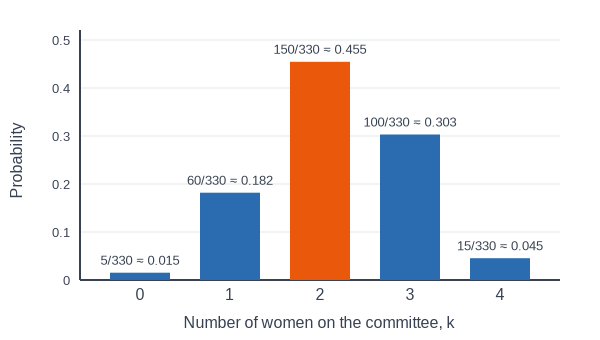
Answer: 5/11 ≈ 0.455. The graph shows the probability of every possible number of women. The five probabilities add to 330/330 = 1, as Axiom 2 requires.
Example 2: A full house in poker
A 5-card hand is dealt from a standard 52-card deck. A full house is three cards of one rank and two cards of another rank, such as three kings and two 7s. Find the probability of a full house.
|S| = \binom{52}{5} = 2{,}598{,}960Count all 5-card hands.
13 \cdot \binom{4}{3} = 13 \cdot 4 = 52Choose the rank for the three of a kind, then 3 of its 4 suits.
12 \cdot \binom{4}{2} = 12 \cdot 6 = 72Choose a different rank for the pair, then 2 of its 4 suits.
|A| = 52 \cdot 72 = 3744
Product rule.
P(A) = \dfrac{3744}{2{,}598{,}960} \approx 0.00144Divide.
Answer: about 0.00144, or roughly 1 hand in 694. The ranks are chosen with 13 and then 12, not C(13, 2), because the two ranks play different roles: kings over 7s is a different hand from 7s over kings.
Example 3: Matching numbers in a lottery
A lottery draws 6 numbers from 1 to 49, and you pick 6 numbers. Find the probability that you match all 6, and the probability that you match exactly 3.
|S| = \binom{49}{6} = 13{,}983{,}816Count all possible draws.
P(\text{all 6}) = \dfrac{1}{13{,}983{,}816}Only one draw matches your ticket.
\binom{6}{3} = 20Choose which 3 of your 6 numbers are drawn.
\binom{43}{3} = \dfrac{43 \cdot 42 \cdot 41}{6} = 12{,}341The other 3 drawn numbers come from the 43 numbers you didn’t pick.
|A| = 20 \cdot 12{,}341 = 246{,}820Product rule.
P(\text{exactly 3}) = \dfrac{246{,}820}{13{,}983{,}816} \approx 0.0177Divide.
Answer: 1 in 13,983,816 for the jackpot, and about 0.0177 (roughly 1 in 57) for exactly 3 matches. Here the two groups are your 6 numbers and the 43 others.
Example 4: At least one dead battery
A box of 20 batteries has 4 dead ones. You take 3 batteries at random. Find the probability that at least one of them is dead.
|S| = \binom{20}{3} = \dfrac{20 \cdot 19 \cdot 18}{6} = 1140Count all ways to take 3 batteries.
\binom{16}{3} = \dfrac{16 \cdot 15 \cdot 14}{6} = 560Count the complement: all 3 come from the 16 good batteries.
P(\text{no dead}) = \dfrac{560}{1140} = \dfrac{28}{57}Divide, then divide the numerator and denominator by 20.
P(\text{at least one dead}) = 1 - \dfrac{28}{57} = \dfrac{29}{57}Complement rule (see axioms of probability).
Answer: 29/57 ≈ 0.509. Counting “at least one” directly would need three cases (1, 2 or 3 dead), so the complement is faster.
Example 5: One pair in poker
Find the probability that a 5-card hand has exactly one pair, such as 9, 9, K, 5, 2, with the other three cards of three different ranks.
13 \cdot \binom{4}{2} = 13 \cdot 6 = 78Choose the rank of the pair and 2 of its 4 suits.
\binom{12}{3} = \dfrac{12 \cdot 11 \cdot 10}{6} = 220Choose 3 different ranks for the other cards. Their order doesn’t matter, so use a combination.
4^3 = 64
Choose a suit for each of those 3 cards.
|A| = 78 \cdot 220 \cdot 64 = 1{,}098{,}240Product rule.
P(A) = \dfrac{1{,}098{,}240}{2{,}598{,}960} \approx 0.4226Divide by the number of hands from Example 2.
Answer: about 0.4226, so a little over 42% of hands have exactly one pair. A common wrong count uses 12 · 11 · 10 for the other ranks. That treats the hand 9, 9, K, 5, 2 and the hand 9, 9, 5, K, 2 as different and counts each hand 6 times.
Common mistakes
| Mistake | Example of the error | Fix |
|---|---|---|
| Counting order in one count but not the other | Using 4 · 3 = 12 ordered pairs of aces over C(52, 2) = 1326 hands | Count both the event and the sample space the same way: both unordered or both ordered. |
| Adding group counts instead of multiplying | C(6, 2) + C(5, 2) = 25 committees with 2 women and 2 men | Every choice of women pairs with every choice of men, so multiply: 15 · 10 = 150. |
| Counting “at least one” as one fixed item times the rest | C(4, 1) · C(19, 2) = 684 for at least one dead battery | This counts hands with 2 or 3 dead batteries more than once. Use the complement: 1140 − 560 = 580. |
| Using permutations for the other ranks | Using 12 · 11 · 10 in the one-pair count | The leftover ranks are unordered, so use C(12, 3) = 220. |
| Assuming outcomes are equally likely when they aren’t | Saying the number of women is 0, 1, 2, 3 or 4, so each has probability 1/5 | Count equally likely committees instead. The five values are not equally likely (see the graph). |
Related methods
Ordered counting gives the same answer
You can count ordered selections instead, as long as you do it for both the event and the sample space. For two cards that are both aces:
\dfrac{\binom{4}{2}}{\binom{52}{2}} = \dfrac{6}{1326} = \dfrac{1}{221}Unordered: pairs of aces over pairs of cards.
\dfrac{4 \cdot 3}{52 \cdot 51} = \dfrac{12}{2652} = \dfrac{1}{221}Ordered: first card then second card, for both counts.
The hypergeometric pattern
Examples 1, 3 and 4 all choose from two groups without replacement. The probability of getting exactly i items from the first group follows the formula above for every possible i. That pattern is the Hypergeometric Distribution. If the items are put back after each draw, the binomial distribution applies instead.
Conditional probability by counting
Counting also gives conditional probabilities. Given that a 5-card hand has at least one ace, the condition shrinks the sample space to the hands with an ace, and you count inside that smaller set.
Practice problems
- A group has 4 juniors and 6 seniors. Three people are chosen at random. Find the probability that all three are seniors.
- Find the probability that a 5-card hand is a flush (all 5 cards of one suit, including straight flushes).
- Two cards are dealt from a standard deck. Find the probability that both are hearts.
- A lottery draws 5 numbers from 1 to 39. Find the probability that a ticket matches all 5.
- In the lottery from Problem 4, find the probability that a ticket matches exactly 4 numbers.
- A committee of 5 is chosen from 8 Democrats and 7 Republicans. Find the probability that it has at least 4 Democrats.
- A carton of 12 light bulbs has 3 defective bulbs. Four bulbs are chosen at random. Find the probability that at least one is defective.
- Find the probability that a 5-card hand has four of a kind.
- Find the probability that a 5-card hand has two pair (two pairs of different ranks plus a fifth card of a third rank).
- Show that ordered and unordered counting give the same probability that 3 cards dealt from a standard deck are all spades.
Show answers
1.
\binom{6}{3} = 20,\quad \binom{10}{3} = 120Count the all-senior groups and all groups.
P = \dfrac{20}{120} = \dfrac{1}{6}Divide, then simplify.
Answer: 1/6
2.
\binom{13}{5} = 1287Choose 5 of the 13 cards in one suit.
|A| = 4 \cdot 1287 = 5148
Multiply by the 4 possible suits.
P = \dfrac{5148}{2{,}598{,}960} \approx 0.00198Divide by the number of hands.
Answer: about 0.00198
3.
\binom{13}{2} = 78,\quad \binom{52}{2} = 1326Count the pairs of hearts and all pairs.
P = \dfrac{78}{1326} = \dfrac{1}{17}Divide, then divide the numerator and denominator by 78.
Answer: 1/17
4.
\binom{39}{5} = \dfrac{39 \cdot 38 \cdot 37 \cdot 36 \cdot 35}{120} = 575{,}757Count all draws.
Answer: 1/575,757
5.
\binom{5}{4} = 5,\quad \binom{34}{1} = 34Choose 4 of your 5 numbers, and 1 of the 34 numbers you didn’t pick.
|A| = 5 \cdot 34 = 170
Product rule.
P = \dfrac{170}{575{,}757} \approx 0.000295Divide.
Answer: about 0.000295
6.
\binom{8}{4}\binom{7}{1} = 70 \cdot 7 = 490Exactly 4 Democrats and 1 Republican.
\binom{8}{5} = 56Exactly 5 Democrats.
|A| = 490 + 56 = 546
Sum rule: the two cases are disjoint.
\binom{15}{5} = 3003Count all committees.
P = \dfrac{546}{3003} = \dfrac{2}{11}Divide, then divide the numerator and denominator by 273.
Answer: 2/11 ≈ 0.182
7.
\binom{9}{4} = 126,\quad \binom{12}{4} = 495Count the choices with no defective bulb, and all choices.
P(\text{none defective}) = \dfrac{126}{495} = \dfrac{14}{55}Divide, then divide the numerator and denominator by 9.
P(\text{at least one}) = 1 - \dfrac{14}{55} = \dfrac{41}{55}Complement rule.
Answer: 41/55 ≈ 0.745
8.
|A| = 13 \cdot 48 = 624
Choose the rank of the four of a kind, then any 1 of the other 48 cards.
P = \dfrac{624}{2{,}598{,}960} \approx 0.000240Divide.
Answer: about 0.000240
9.
\binom{13}{2} = 78Choose the 2 ranks for the pairs. They play the same role, so use a combination.
\binom{4}{2}^2 = 6^2 = 36Choose 2 suits for each pair.
44
The fifth card: any of the 52 − 8 = 44 cards not of those two ranks.
|A| = 78 \cdot 36 \cdot 44 = 123{,}552Product rule.
P = \dfrac{123{,}552}{2{,}598{,}960} \approx 0.0475Divide.
Answer: about 0.0475
10.
\dfrac{\binom{13}{3}}{\binom{52}{3}} = \dfrac{286}{22{,}100} = \dfrac{11}{850}Unordered counts. Divide the numerator and denominator by 26.
\dfrac{13 \cdot 12 \cdot 11}{52 \cdot 51 \cdot 50} = \dfrac{1716}{132{,}600} = \dfrac{11}{850}Ordered counts. Divide the numerator and denominator by 156.
Answer: both equal 11/850 ≈ 0.0129, because each unordered hand matches 3! = 6 ordered deals in both counts
Probability with combinations FAQ
How do you find a probability with combinations?
Count the outcomes in the event and in the whole sample space with combinations, then divide. This works when every selection is equally likely, such as a well-shuffled deck or a random draw.
When do you use combinations instead of permutations in probability?
Use combinations when order doesn’t matter, as with card hands, lottery numbers and committees. You can also use permutations for both counts; the answer is the same as long as both counts treat order the same way.
What is the probability of getting a full house?
There are 3744 full houses among the 2,598,960 five-card hands, so the probability is about 0.00144, roughly 1 in 694.
What is the probability of winning a 6/49 lottery?
There are C(49, 6) = 13,983,816 ways to draw 6 numbers from 49, and only one matches your ticket. So the probability is 1 in 13,983,816.
Summary
- For equally likely outcomes, P(A) = |A|/|S|.
- For unordered selections, count both |A| and |S| with combinations C(n, k).
- Choose from each group separately, then multiply the counts.
- For “at least one,” count the complement and subtract from 1.
- Ordered counting also works, as long as both counts are ordered.
Previous lesson: Axioms of Probability
Next lesson: Law of Total Probability
Back to the Probability Theory Index