
Green’s Theorem
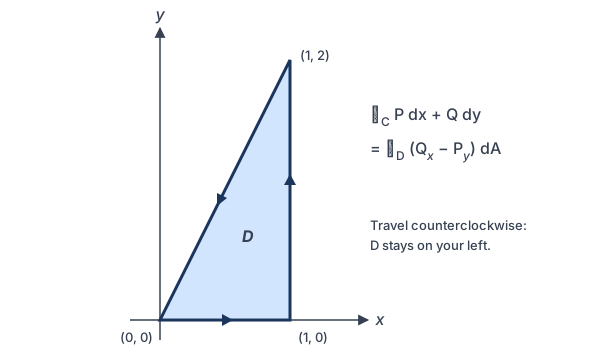
Green’s theorem turns a line integral around a closed curve C into a double integral over the region D inside it: ∮C P dx + Q dy = ∬D (∂Q/∂x − ∂P/∂y) dA. The curve must be traced counterclockwise, with D on the left. It often replaces several line integrals with one easy double integral, and it gives a formula for area.
Before this lesson: Line Integrals, Conservative Vector Fields and Double Integrals over General Regions
What Green’s theorem says
Think of F = ⟨P, Q⟩ as the velocity of a fluid. The line integral ∮C F · dr measures the circulation: how much the fluid flows along the boundary. The quantity Q_x − P_y measures how much the fluid spins at each point inside.
Green’s theorem says the total spin inside D equals the circulation around its edge. Inside D, the spins of neighboring tiny squares cancel along their shared edges, so only the outer boundary is left.
Green’s theorem formula
\oint_C P\,dx + Q\,dy = \iint_D \Big(\dfrac{\partial Q}{\partial x} - \dfrac{\partial P}{\partial y}\Big)\,dAThe conditions: C is a simple closed curve (it doesn’t cross itself), it is piecewise smooth, it is traced counterclockwise (positive orientation), and P and Q have continuous partial derivatives on an open region containing D.
Area with Green’s theorem
\text{Area of } D = \oint_C x\,dy = -\oint_C y\,dx = \dfrac{1}{2}\oint_C x\,dy - y\,dx- Check that C is closed and traced counterclockwise.
- Identify P (the coefficient of dx) and Q (the coefficient of dy).
- Compute Q_x − P_y.
- Set up the double integral over D, using polar coordinates if D is round, and evaluate.
Green’s theorem examples
Example 1: A rectangle
Evaluate \oint_C (x^2 - y)\,dx + (x + y^2)\,dy, where C is the boundary of the rectangle [0, 3] × [0, 2], counterclockwise.
P = x^2 - y, \quad Q = x + y^2
Identify P and Q.
Q_x = 1, \quad P_y = -1
Take the partial derivatives.
Q_x - P_y = 1 - (-1) = 2
Subtract.
\oint_C P\,dx + Q\,dy = \iint_D 2\,dA
Apply Green’s theorem.
= 2 \cdot (3 \cdot 2) = 12
The integral of a constant is the constant times the area 6.
Answer: 12. Doing this directly would take four separate line integrals, one per side.
Example 2: A triangle
Evaluate \oint_C xy\,dx + x^2\,dy, where C is the triangle with vertices (0, 0), (1, 0) and (1, 2), counterclockwise.
Q_x - P_y = 2x - x = x
P = xy gives P_y = x; Q = x² gives Q_x = 2x.
0 \le x \le 1, \quad 0 \le y \le 2x
Describe D: the slanted side is the line y = 2x.
\iint_D x\,dA = \int_0^1 \int_0^{2x} x\,dy\,dxSet up the double integral.
\int_0^{2x} x\,dy = 2x^2Integrate in y.
\int_0^1 2x^2\,dx = \dfrac{2}{3}Integrate in x.
Answer: 2/3. As a check, the three line integrals along the sides give 0, 2 and −4/3, which also add to 2/3.
Example 3: A circle
Evaluate \oint_C -y^3\,dx + x^3\,dy, where C is the circle x² + y² = 4, counterclockwise.
Q_x - P_y = 3x^2 - (-3y^2) = 3x^2 + 3y^2
P = −y³ and Q = x³.
= 3r^2
Switch to polar coordinates: x² + y² = r².
\iint_D 3r^2\,dA = \int_0^{2\pi} \int_0^2 3r^2 \cdot r\,dr\,d\thetaUse double integrals in polar coordinates, dA = r dr dθ.
\int_0^2 3r^3\,dr = \Big[\dfrac{3r^4}{4}\Big]_0^2 = 12Integrate in r.
2\pi \cdot 12 = 24\pi
Integrate in θ.
Answer: 24π ≈ 75.40.
Example 4: Area of an ellipse
Use Green’s theorem to find the area inside the ellipse x²/16 + y²/9 = 1.
x = 4\cos t, \quad y = 3\sin t, \quad 0 \le t \le 2\pi
Parametrize the ellipse counterclockwise.
dx = -4\sin t\,dt, \quad dy = 3\cos t\,dt
Differentiate.
x\,dy - y\,dx = 12\cos^2 t\,dt + 12\sin^2 t\,dt
Substitute: (4 cos t)(3 cos t) − (3 sin t)(−4 sin t).
= 12\,dt
Use cos² t + sin² t = 1.
A = \dfrac{1}{2}\int_0^{2\pi} 12\,dt = 12\piApply the area formula.
Answer: 12π ≈ 37.70, which matches πab = π(4)(3).
Example 5: Work done on a robot
A garden robot drives once counterclockwise around the edge of a square plot with corners (0, 0), (4, 0), (4, 4) and (0, 4), in meters. Along the way, a force F = ⟨x − y², x² + y⟩ newtons acts on it. Find the work done by F.
Q_x - P_y = 2x - (-2y) = 2x + 2y
P = x − y² and Q = x² + y.
W = \int_0^4 \int_0^4 (2x + 2y)\,dy\,dx
Apply Green’s theorem over the square.
\int_0^4 (2x + 2y)\,dy = 8x + 16
Integrate in y: 2xy + y² from 0 to 4.
\int_0^4 (8x + 16)\,dx = 64 + 64 = 128
Integrate in x: 4x² + 16x from 0 to 4.
Answer: the force does 128 J of work. The field is not conservative (Q_x − P_y is not 0), so a closed trip can do nonzero work.
Common mistakes
| Mistake | Example of the error | Fix |
|---|---|---|
| Subtracting in the wrong order | Using P_y − Q_x in Example 1 and getting −12 | The integrand is Q_x − P_y: the dy coefficient differentiated in x, minus the dx coefficient differentiated in y. |
| Ignoring orientation | Using the formula for a clockwise curve without a sign change | Green’s theorem assumes counterclockwise. A clockwise curve gives the negative. |
| Using it on a curve that is not closed | Applying Green’s theorem to the bottom side of the rectangle alone | C must be closed. For an open path, parametrize, or close it up and subtract the added piece. |
| Swapping P and Q | Taking P = x² in Example 2 | P multiplies dx and Q multiplies dy. |
| Ignoring a hole where the field is undefined | Using Green’s theorem on a disk around the origin for a field undefined at the origin | P and Q must be smooth on all of D. Cut out the bad point and include the inner boundary. |
Related methods
Conservative fields
If Q_x = P_y everywhere on D, Green’s theorem gives ∮C F · dr = 0. That matches the test for conservative vector fields.
Regions with holes
For a ring-shaped region, C has two parts: the outer curve counterclockwise and the inner curve clockwise, so D is always on the left. Green’s theorem then uses both parts.
Curl and flux forms
The integrand Q_x − P_y is the k-component of the curl of F, the topic of the next lesson. Green’s theorem also has a flux form that uses the divergence P_x + Q_y.
Practice problems
- Evaluate \oint_C y\,dx - x\,dy around the unit circle, counterclockwise.
- Evaluate \oint_C 3y\,dx + 5x\,dy around the square [0, 2] × [0, 2], counterclockwise.
- Evaluate \oint_C x^2y\,dx + xy^2\,dy around the rectangle [0, 2] × [0, 1], counterclockwise.
- Use Green’s theorem to find the area of a disk of radius 5.
- Use Area = ∮C x dy to find the area of the triangle with vertices (0, 0), (4, 0) and (0, 3).
- Evaluate \oint_C (e^x + y)\,dx + (3x + \cos y)\,dy around the circle x² + y² = 4, counterclockwise.
- Evaluate \oint_C -y\,dx + x\,dy around the square [0, 1] × [0, 1], traced clockwise.
- Show that \oint_C 2xy\,dx + x^2\,dy = 0 for every simple closed curve C.
- Evaluate \oint_C -x^2y\,dx + xy^2\,dy around the circle x² + y² = 9, counterclockwise.
- A storm’s wind field is F = ⟨−2y, 3x⟩ km/h, with x and y in km. Find the circulation ∮C F · dr around the circle of radius 10 km centered at the origin, counterclockwise.
Show answers
1.
Q_x - P_y = -1 - 1 = -2
P = y and Q = −x.
\iint_D (-2)\,dA = -2\pi
Multiply by the area of the unit disk, π.
Answer: −2π ≈ −6.28
2.
Q_x - P_y = 5 - 3 = 2
P = 3y and Q = 5x.
2 \cdot 4 = 8
Multiply by the area of the square.
Answer: 8
3.
Q_x - P_y = y^2 - x^2
Q = xy² gives y²; P = x²y gives x².
\int_0^2 \int_0^1 y^2\,dy\,dx = 2 \cdot \dfrac{1}{3} = \dfrac{2}{3}Integrate the y² part.
\int_0^2 \int_0^1 x^2\,dy\,dx = \dfrac{8}{3} \cdot 1 = \dfrac{8}{3}Integrate the x² part.
\dfrac{2}{3} - \dfrac{8}{3} = -2Subtract.
Answer: −2
4.
A = \dfrac{1}{2}\int_0^{2\pi} (25\cos^2 t + 25\sin^2 t)\,dtUse x = 5 cos t, y = 5 sin t in (1/2)∮ x dy − y dx.
= \dfrac{1}{2} \cdot 25 \cdot 2\pi = 25\piSimplify and integrate.
Answer: 25π ≈ 78.54
5.
\text{Bottom: } dy = 0Along (0, 0) to (4, 0), y is constant, so x dy = 0.
\text{Slanted side: } \int_0^1 (4 - 4t)(3\,dt) = 12 - 6 = 6Use x = 4 − 4t, y = 3t from (4, 0) to (0, 3).
\text{Left side: } x = 0Along (0, 3) to (0, 0), x dy = 0.
Answer: 6, which matches (1/2)(4)(3).
6.
Q_x - P_y = 3 - 1 = 2
P = eˣ + y gives P_y = 1; Q = 3x + cos y gives Q_x = 3.
2 \cdot \pi(2)^2 = 8\pi
Multiply by the area of the disk.
Answer: 8π ≈ 25.13
7.
Q_x - P_y = 1 - (-1) = 2
P = −y and Q = x.
-\iint_D 2\,dA = -2
Clockwise gives the negative of Green’s theorem; the area is 1.
Answer: −2
8.
Q_x - P_y = 2x - 2x = 0
P = 2xy and Q = x².
\iint_D 0\,dA = 0
Apply Green’s theorem.
Answer: 0 for every simple closed curve (the field is ∇(x²y)).
9.
Q_x - P_y = y^2 - (-x^2) = x^2 + y^2 = r^2
Q = xy² and P = −x²y.
\int_0^{2\pi} \int_0^3 r^2 \cdot r\,dr\,d\theta = 2\pi \cdot \dfrac{81}{4}Use polar coordinates.
= \dfrac{81\pi}{2}Simplify.
Answer: 81π/2 ≈ 127.23
10.
Q_x - P_y = 3 - (-2) = 5
P = −2y and Q = 3x.
5 \cdot \pi(10)^2 = 500\pi \approx 1570.8
Multiply by the area of the disk.
Answer: 500π ≈ 1571 km²/h
Green’s theorem FAQ
When can you use Green’s theorem?
Use it for a line integral around a simple closed curve in the plane, traced counterclockwise, when P and Q have continuous partial derivatives on the region inside.
What does positive orientation mean?
It means counterclockwise for the outer boundary: as you walk along C, the region D stays on your left. Inner boundaries of a region with holes go clockwise.
How do you find area with Green’s theorem?
Use Area = ½ ∮C x dy − y dx, or ∮C x dy alone. Parametrize the boundary and evaluate the line integral.
What is the difference between Green’s theorem and Stokes’ theorem?
Green’s theorem is for flat regions in the xy-plane. Stokes’ theorem extends the same idea to curved surfaces in space.
Summary
- Green’s theorem: ∮C P dx + Q dy = ∬D (Q_x − P_y) dA.
- C must be simple, closed and counterclockwise, with D on the left.
- It turns hard line integrals into easier double integrals, and the reverse.
- Area = ½ ∮ x dy − y dx.
- If Q_x = P_y on D, the integral around C is 0.
Previous lesson: Conservative Vector Fields
Next lesson: Curl and Divergence
Back to the Calculus 3 Index