
Limits of Multivariable Functions
The limit of a multivariable function f(x, y) as (x, y) → (a, b) is L when f(x, y) gets close to L no matter which path (x, y) takes toward (a, b). For a continuous function you can substitute directly. To show a limit does not exist, find two paths that give different values.
Before this lesson: Functions of Several Variables, Evaluating Limits Algebraically and Squeeze Theorem
Why limits in two variables are harder
In one variable, x can approach a only from the left or the right. In the plane, (x, y) can approach (a, b) from any direction: along a line, along a parabola, or spiraling in. For the limit to exist, every one of these paths must lead to the same value.
That gives a quick way to show a limit does not exist: find two paths with different limits. Showing that a limit does exist takes more, because you cannot test every path one at a time. Instead you use substitution, algebra, polar coordinates or a squeeze.
Limit and continuity rules
\lim_{(x, y) \to (a, b)} f(x, y) = L \quad \text{means } f(x, y) \to L \text{ along every path to } (a, b)- Continuity: f is continuous at (a, b) when the limit equals f(a, b). Polynomials are continuous everywhere, and sums, products, quotients (where the denominator is not 0) and compositions of continuous functions are continuous. For these, find the limit by substituting.
- Two-path test: if two paths to (a, b) give different limits, the limit does not exist.
- Polar coordinates: at the origin, set x = r cos θ and y = r sin θ. If f is bounded by something that goes to 0 as r → 0, whatever θ is, the limit is 0.
- Agreement along many paths, even every line through the point, does not prove that a limit exists.
Limits of multivariable functions examples
Example 1: Direct substitution
Find the limit of x²y + 3xy − y² as (x, y) → (1, 2).
1^2(2) + 3(1)(2) - 2^2
The function is a polynomial, so it is continuous; substitute x = 1 and y = 2.
= 2 + 6 - 4
Multiply each term.
= 4
Add and subtract.
Answer: the limit is 4.
Example 2: Factor and cancel
Find the limit of (x² − y²)/(x − y) as (x, y) → (2, 2).
\dfrac{2^2 - 2^2}{2 - 2} = \dfrac{0}{0}Direct substitution gives 0/0, so more work is needed.
\dfrac{(x - y)(x + y)}{x - y}Factor the numerator (see difference of squares).
= x + y
Cancel x − y, which is not 0 for points off the line y = x.
\lim_{(x, y) \to (2, 2)} (x + y) = 4Substitute x = 2 and y = 2.
Answer: the limit is 4. The function is undefined on the whole line y = x, but the limit only cares about nearby points where it is defined.
Example 3: Two paths, two answers
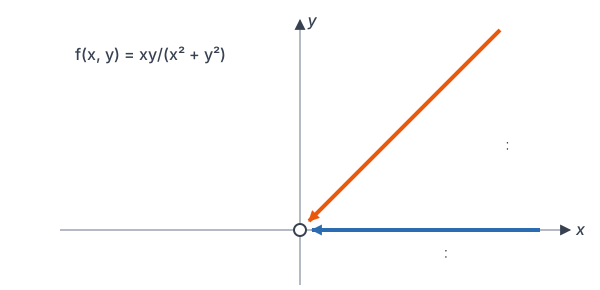
Show that the limit of f(x, y) = xy/(x² + y²) as (x, y) → (0, 0) does not exist.
f(x, 0) = \dfrac{x \cdot 0}{x^2 + 0} = 0Path 1: the x-axis, y = 0 (with x ≠ 0).
\lim_{x \to 0} 0 = 0Along the x-axis, f → 0.
f(x, x) = \dfrac{x \cdot x}{x^2 + x^2} = \dfrac{x^2}{2x^2}Path 2: the line y = x.
= \dfrac{1}{2}Cancel x² (x ≠ 0).
0 \ne \dfrac{1}{2}The two paths give different limits.
Answer: the limit does not exist. In fact, along any line y = mx, f = m/(1 + m²), which changes with the slope m.
Example 4: Polar coordinates show a limit exists
Find the limit of x²y/(x² + y²) as (x, y) → (0, 0).
x = r\cos\theta, \quad y = r\sin\theta, \quad x^2 + y^2 = r^2
Switch to polar coordinates.
\dfrac{x^2 y}{x^2 + y^2} = \dfrac{r^3\cos^2\theta\sin\theta}{r^2}Substitute.
= r\cos^2\theta\sin\theta
Cancel r² (r ≠ 0).
\left| r\cos^2\theta\sin\theta \right| \le r
Bound it: |cos θ| ≤ 1 and |sin θ| ≤ 1.
r \to 0
As (x, y) → (0, 0), r → 0 whatever θ is.
Answer: the expression is squeezed between −r and r, so the limit is 0.
Example 5: A sensor reading near a source (word problem)
A sensor’s reading near a point source at the origin is modeled by S(x, y) = 3(x² + y²)/(√(x² + y² + 1) − 1). The formula is undefined at the source itself. What reading does it approach as the sensor moves to (0, 0)?
u = x^2 + y^2, \quad u \to 0^+
Let u stand for x² + y²; it goes to 0 from above.
\dfrac{3u}{\sqrt{u + 1} - 1} \cdot \dfrac{\sqrt{u + 1} + 1}{\sqrt{u + 1} + 1}Multiply by the conjugate (see rationalizing the denominator).
= \dfrac{3u\left(\sqrt{u + 1} + 1\right)}{(u + 1) - 1}Multiply the denominators: (√(u + 1))² − 1².
= \dfrac{3u\left(\sqrt{u + 1} + 1\right)}{u}Simplify the denominator.
= 3\left(\sqrt{u + 1} + 1\right)Cancel u (u ≠ 0).
\to 3\left(\sqrt{1} + 1\right) = 6Let u → 0.
Answer: the reading approaches 6. Because S depends only on x² + y², every path gives the same result, so the limit really is 6.
Common mistakes
| Mistake | Example of the error | Fix |
|---|---|---|
| Testing only straight lines | x²y/(x⁴ + y²) → 0 along every line y = mx, so “the limit is 0” | Along y = x² it equals 1/2. Lines agreeing does not prove anything. |
| Stopping after two paths agree | xy/(x² + y²) is 0 on both axes, so “the limit is 0” | Try y = x too (it gives 1/2). To prove a limit, use substitution, algebra or a squeeze. |
| Substituting into 0/0 | “(x² − y²)/(x − y) at (2, 2) is 0/0, so the limit is 0” | 0/0 means more work: factor and cancel to get 4. |
| Ignoring θ in polar form | (x² − y²)/(x² + y²) = cos 2θ, so “it goes to 0 as r → 0” | There is no r left: cos 2θ depends on direction, so the limit does not exist. |
| Using polar coordinates away from the origin | Setting x = r cos θ for a limit at (1, 2) | Polar coordinates center at (0, 0). Shift first, or use another method. |
Related methods
One-variable limits
Along a single path, a two-variable limit becomes an ordinary one-variable limit, so the tools of evaluating limits algebraically still apply on each path.
Squeeze theorem in two variables
If |f(x, y) − L| ≤ g(x, y) and g → 0, then f → L. This is the two-variable squeeze theorem, and the polar bound in Example 4 is one way to find g.
Continuity of compositions
A function like e^(xy) or sin(x² + y²) is a continuous one-variable function applied to a polynomial, so it is continuous everywhere. Limits of such functions come from substitution. Continuity is also what the next lesson, on partial derivatives, builds on.
Practice problems
- Find the limit of 3x − 2y + xy as (x, y) → (2, 1).
- Find the limit of e^(xy) cos(x + y) as (x, y) → (0, π).
- Find the limit of (x² − 4y²)/(x − 2y) as (x, y) → (2, 1).
- Show that the limit of (x² − y²)/(x² + y²) as (x, y) → (0, 0) does not exist.
- Show that the limit of 2xy/(x² + 3y²) as (x, y) → (0, 0) does not exist.
- Show that the limit of x²y/(x⁴ + y²) as (x, y) → (0, 0) does not exist, even though every line through the origin gives 0.
- Use polar coordinates to find the limit of (x³ + y³)/(x² + y²) as (x, y) → (0, 0).
- Find the limit of (x² + y²)/(√(x² + y² + 4) − 2) as (x, y) → (0, 0).
- Where is f(x, y) = (x + y)/(x − y) continuous?
- A ripple on a pond has height h(x, y) = sin(x² + y²)/(x² + y²) centimeters, away from the center. What height does it approach at the center (0, 0)?
Show answers
1.
3(2) - 2(1) + (2)(1)
Polynomial: substitute x = 2 and y = 1.
= 6 - 2 + 2 = 6
Multiply, then add and subtract.
Answer: 6
2.
e^{0 \cdot \pi}\cos(0 + \pi) = e^0\cos\piThe function is continuous; substitute x = 0 and y = π.
= (1)(-1) = -1
Use e⁰ = 1 and cos π = −1.
Answer: −1
3.
\dfrac{(x - 2y)(x + 2y)}{x - 2y} = x + 2yFactor the difference of squares and cancel (x ≠ 2y).
2 + 2(1) = 4
Substitute x = 2 and y = 1.
Answer: 4
4.
f(x, 0) = \dfrac{x^2}{x^2} = 1Path 1: y = 0 gives 1.
f(0, y) = \dfrac{-y^2}{y^2} = -1Path 2: x = 0 gives −1.
Answer: 1 ≠ −1, so the limit does not exist.
5.
f(x, 0) = \dfrac{0}{x^2} = 0Path 1: y = 0 gives 0.
f(x, x) = \dfrac{2x^2}{x^2 + 3x^2} = \dfrac{2x^2}{4x^2} = \dfrac{1}{2}Path 2: y = x gives 1/2.
Answer: 0 ≠ 1/2, so the limit does not exist.
6.
f(x, mx) = \dfrac{mx^3}{x^4 + m^2x^2} = \dfrac{mx}{x^2 + m^2} \to 0Any line y = mx (m ≠ 0): cancel x², then let x → 0. The axes also give 0.
f(x, x^2) = \dfrac{x^4}{x^4 + x^4} = \dfrac{1}{2}The parabola y = x² gives 1/2.
Answer: 0 ≠ 1/2, so the limit does not exist.
7.
\dfrac{r^3\cos^3\theta + r^3\sin^3\theta}{r^2} = r(\cos^3\theta + \sin^3\theta)Substitute polar coordinates and cancel r².
\left| r(\cos^3\theta + \sin^3\theta) \right| \le 2r \to 0
Each cube is at most 1 in size.
Answer: 0
8.
\dfrac{u}{\sqrt{u + 4} - 2} \cdot \dfrac{\sqrt{u + 4} + 2}{\sqrt{u + 4} + 2} = \dfrac{u(\sqrt{u + 4} + 2)}{u}Let u = x² + y² and multiply by the conjugate.
= \sqrt{u + 4} + 2 \to \sqrt{4} + 2 = 4Cancel u, then let u → 0.
Answer: 4
9.
x - y \ne 0
A quotient of polynomials is continuous wherever the denominator is not 0.
Answer: continuous at every point not on the line y = x
10.
u = x^2 + y^2 \to 0^+
Let u stand for x² + y².
\lim_{u \to 0} \dfrac{\sin u}{u} = 1Use the standard limit (proved with the squeeze theorem).
Answer: the height approaches 1 cm at the center
Limits of multivariable functions FAQ
How do you show a multivariable limit does not exist?
Find two paths to the point that give different limits, such as the x-axis and the line y = x. If they disagree, the limit does not exist.
How do you prove a multivariable limit exists?
Use direct substitution for continuous functions, algebra such as factoring or conjugates, polar coordinates at the origin, or a squeeze. Checking a few paths is not a proof.
Why use polar coordinates for limits at the origin?
In polar form, (x, y) → (0, 0) becomes r → 0 in every direction at once. If the expression is bounded by something like r that goes to 0 for every θ, the limit is 0.
When is a function of two variables continuous?
When its limit at each point equals its value there. Polynomials are continuous everywhere, and rational functions are continuous wherever their denominators are not 0.
Summary
- The limit L must be the same along every path to (a, b).
- For continuous functions (polynomials, and quotients with a nonzero denominator), substitute.
- For 0/0, try factoring, conjugates or polar coordinates.
- Two paths with different limits prove the limit does not exist.
- Paths agreeing, even all lines, does not prove the limit exists.
Previous lesson: Functions of Several Variables
Next lesson: Partial Derivatives
Back to the Calculus 3 Index