
Orthogonal Sets and Orthonormal Bases
An orthogonal set is a set of vectors in which every pair has dot product 0. An orthonormal basis is an orthogonal basis made of unit vectors. In an orthogonal basis, each coordinate comes from one dot product, with no row reduction. A square matrix with orthonormal columns is an orthogonal matrix, and its inverse is its transpose.
Before this lesson: Dot Product, Basis and Dimension and Transpose of a Matrix
Why orthogonal bases are easier
For most bases, finding the coordinates of a vector means solving a system of equations. When the basis vectors are perpendicular, each coordinate can be found on its own, as if the other basis vectors were not there.
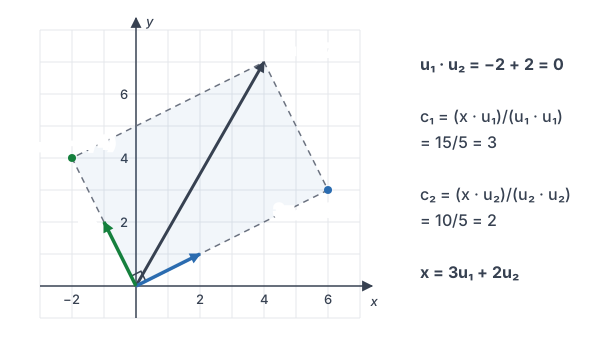
In the picture, u₁ = (2, 1) and u₂ = (−1, 2) are perpendicular because u₁ · u₂ = −2 + 2 = 0. The vector x = (4, 7) splits into 3u₁ + 2u₂, and each weight comes from a single dot product: 3 = (x · u₁)/(u₁ · u₁) = 15/5 and 2 = (x · u₂)/(u₂ · u₂) = 10/5.
Definitions and formulas
For vectors in ℝⁿ, the dot product is u · v = u₁v₁ + u₂v₂ + ⋯ + uₙvₙ, and the length (norm) of v is ‖v‖ = √(v · v).
- Two vectors are orthogonal if u · v = 0.
- A set of vectors is an orthogonal set if every pair of different vectors in it is orthogonal.
- A unit vector has length 1. To normalize a nonzero vector, divide it by its length.
- An orthonormal set is an orthogonal set of unit vectors. An orthogonal (or orthonormal) set that is also a basis is an orthogonal basis (or orthonormal basis).
- An orthogonal set of nonzero vectors is always linearly independent. So n nonzero orthogonal vectors in ℝⁿ form a basis.
Coordinates in an orthogonal basis. If {u₁, …, uₙ} is an orthogonal basis and x = c₁u₁ + ⋯ + cₙuₙ, then
c_i = \dfrac{x \cdot u_i}{u_i \cdot u_i} \qquad \text{(for an orthonormal basis, } c_i = x \cdot u_i\text{)}This works because dotting both sides with uᵢ wipes out every other term: uⱼ · uᵢ = 0 for j ≠ i.
Orthogonal matrices. A square matrix Q is an orthogonal matrix if its columns form an orthonormal set. Then
Q^TQ = I \qquad Q^{-1} = Q^T \qquad \|Qx\| = \|x\|So the inverse matrix costs nothing to find: Qx = b is solved by x = Qᵀb, and multiplying by Q never changes lengths or angles. Rotations and reflections, like the ones in matrix transformations, are orthogonal matrices.
How to work with an orthogonal basis
- Check that the set is orthogonal: compute the dot product of every pair and confirm each is 0.
- To make it orthonormal, divide each vector by its length.
- To find coordinates, compute cᵢ = (x · uᵢ)/(uᵢ · uᵢ) for each basis vector.
- Check by rebuilding x = c₁u₁ + ⋯ + cₙuₙ.
Orthogonal set and orthonormal basis examples
Example 1: Check an orthogonal set
Show that u_1 = \begin{bmatrix} 1 \\ 1 \\ 1 \end{bmatrix}, u_2 = \begin{bmatrix} 1 \\ -2 \\ 1 \end{bmatrix} and u_3 = \begin{bmatrix} 1 \\ 0 \\ -1 \end{bmatrix} form an orthogonal basis for ℝ³.
u_1 \cdot u_2 = 1 - 2 + 1 = 0
Multiply matching entries and add (see dot product).
u_1 \cdot u_3 = 1 + 0 - 1 = 0
Second pair.
u_2 \cdot u_3 = 1 + 0 - 1 = 0
Third pair. Every pair is orthogonal.
Answer: the three vectors are nonzero and orthogonal, so they are linearly independent. Three independent vectors in ℝ³ form a basis, so {u₁, u₂, u₃} is an orthogonal basis.
Example 2: Coordinates without row reduction
Write x = \begin{bmatrix} 4 \\ 4 \\ -2 \end{bmatrix} in terms of the orthogonal basis from Example 1.
x \cdot u_1 = 4 + 4 - 2 = 6,\quad u_1 \cdot u_1 = 1 + 1 + 1 = 3
Dot products for u₁.
c_1 = \dfrac{6}{3} = 2Divide.
x \cdot u_2 = 4 - 8 - 2 = -6,\quad u_2 \cdot u_2 = 1 + 4 + 1 = 6
Dot products for u₂.
c_2 = \dfrac{-6}{6} = -1Divide.
x \cdot u_3 = 4 + 0 + 2 = 6,\quad u_3 \cdot u_3 = 1 + 0 + 1 = 2
Dot products for u₃.
c_3 = \dfrac{6}{2} = 3Divide.
2u_1 - u_2 + 3u_3 = \begin{bmatrix} 2 - 1 + 3 \\ 2 + 2 + 0 \\ 2 - 1 - 3 \end{bmatrix} = \begin{bmatrix} 4 \\ 4 \\ -2 \end{bmatrix}Check: rebuild x.
Answer: x = 2u₁ − u₂ + 3u₃.
Example 3: Build an orthonormal basis
Normalize the basis from Example 1 to get an orthonormal basis for ℝ³.
\|u_1\| = \sqrt{u_1 \cdot u_1} = \sqrt{3}Length of u₁, using u₁ · u₁ = 3 from Example 2.
\|u_2\| = \sqrt{6},\quad \|u_3\| = \sqrt{2}Lengths of u₂ and u₃, using u₂ · u₂ = 6 and u₃ · u₃ = 2.
q_1 = \dfrac{1}{\sqrt{3}}\begin{bmatrix} 1 \\ 1 \\ 1 \end{bmatrix},\quad q_2 = \dfrac{1}{\sqrt{6}}\begin{bmatrix} 1 \\ -2 \\ 1 \end{bmatrix},\quad q_3 = \dfrac{1}{\sqrt{2}}\begin{bmatrix} 1 \\ 0 \\ -1 \end{bmatrix}Divide each vector by its length.
q_2 \cdot q_2 = \dfrac{1 + 4 + 1}{6} = 1Check one: the scalars multiply to 1/6.
Answer: {q₁, q₂, q₃} above is an orthonormal basis. Scaling does not change the zero dot products, so the vectors stay orthogonal.
Example 4: An orthogonal matrix
Let Q = \begin{bmatrix} 0.6 & -0.8 \\ 0.8 & 0.6 \end{bmatrix}. Show that Q is an orthogonal matrix, then solve Qx = \begin{bmatrix} 5 \\ 10 \end{bmatrix}.
q_1 \cdot q_2 = (0.6)(-0.8) + (0.8)(0.6) = -0.48 + 0.48 = 0
The columns are orthogonal.
q_1 \cdot q_1 = 0.36 + 0.64 = 1,\quad q_2 \cdot q_2 = 0.64 + 0.36 = 1
Each column has length 1.
Q^{-1} = Q^T = \begin{bmatrix} 0.6 & 0.8 \\ -0.8 & 0.6 \end{bmatrix}Orthonormal columns, so the inverse is the transpose.
x = Q^Tb = \begin{bmatrix} 0.6(5) + 0.8(10) \\ -0.8(5) + 0.6(10) \end{bmatrix}Multiply both sides of Qx = b by Qᵀ.
= \begin{bmatrix} 3 + 8 \\ -4 + 6 \end{bmatrix} = \begin{bmatrix} 11 \\ 2 \end{bmatrix}Simplify.
Qx = \begin{bmatrix} 6.6 - 1.6 \\ 8.8 + 1.2 \end{bmatrix} = \begin{bmatrix} 5 \\ 10 \end{bmatrix}Check (see matrix multiplication).
\|x\| = \sqrt{121 + 4} = \sqrt{125},\quad \|b\| = \sqrt{25 + 100} = \sqrt{125}Q keeps lengths the same.
Answer: Q is orthogonal (it rotates the plane), and x = (11, 2).
Example 5: Splitting website traffic into patterns
A site’s visits over four weeks were x = (120, 100, 90, 70). An analyst splits this into four patterns: u_1 = (1, 1, 1, 1) (overall level), u_2 = (1, 1, -1, -1) (first half vs. second half), u_3 = (1, -1, 0, 0) (week 1 vs. week 2) and u_4 = (0, 0, 1, -1) (week 3 vs. week 4). These four vectors form an orthogonal basis of ℝ⁴. Find the weight on each pattern.
u_1 \cdot u_1 = 4,\quad u_2 \cdot u_2 = 4,\quad u_3 \cdot u_3 = 2,\quad u_4 \cdot u_4 = 2
Squared lengths of the patterns.
x \cdot u_1 = 120 + 100 + 90 + 70 = 380
Dot product with the overall level.
c_1 = \dfrac{380}{4} = 95Divide.
x \cdot u_2 = 120 + 100 - 90 - 70 = 60
First half minus second half.
c_2 = \dfrac{60}{4} = 15Divide.
x \cdot u_3 = 120 - 100 = 20
Week 1 minus week 2.
c_3 = \dfrac{20}{2} = 10Divide.
x \cdot u_4 = 90 - 70 = 20
Week 3 minus week 4.
c_4 = \dfrac{20}{2} = 10Divide.
95u_1 + 15u_2 + 10u_3 + 10u_4 = \begin{bmatrix} 95 + 15 + 10 + 0 \\ 95 + 15 - 10 + 0 \\ 95 - 15 + 0 + 10 \\ 95 - 15 + 0 - 10 \end{bmatrix} = \begin{bmatrix} 120 \\ 100 \\ 90 \\ 70 \end{bmatrix}Check: rebuild x.
Answer: x = 95u₁ + 15u₂ + 10u₃ + 10u₄. Visits averaged 95 a week, the first half ran 15 above that average and the second half 15 below, and each half dropped by 20 visits from its first week to its second (10 above and 10 below the half’s average).
Common mistakes
| Mistake | Example of the error | Fix |
|---|---|---|
| Checking only some pairs | Checking u₁ · u₂ and u₁ · u₃ but not u₂ · u₃ | A set of k vectors has k(k − 1)/2 pairs. Check them all. |
| Using x · uᵢ alone for an orthogonal (not orthonormal) basis | Saying c₁ = x · u₁ = 6 in Example 2 | Divide by uᵢ · uᵢ: c₁ = 6/3 = 2. Only unit vectors skip the division. |
| Normalizing with the squared length | Writing u₁/3 instead of u₁/√3 | Divide by ‖u‖ = √(u · u), not by u · u. |
| Calling any matrix with orthogonal columns an orthogonal matrix | Calling [1 2; 2 −1] orthogonal | Its columns are orthogonal but have length √5. An orthogonal matrix needs orthonormal columns. |
| Including the zero vector | Calling {(1, 0), (0, 0)} an orthogonal basis | The zero vector is orthogonal to everything, but a set containing it is dependent, so it is never part of a basis. |
Related ideas
Projections. The weight cᵢ = (x · uᵢ)/(uᵢ · uᵢ) is the same scalar as in vector projections: cᵢuᵢ is the projection of x onto uᵢ. The next lesson, Orthogonal Projections, adds these pieces to project onto a whole subspace.
Getting an orthogonal basis. Not every basis is orthogonal. The Gram-Schmidt Process turns any basis into an orthogonal one, and QR Factorization records the result as A = QR with orthonormal columns in Q.
Wavelets. The patterns in Example 5 are a small Haar wavelet basis. Image and audio compression keep only the largest weights in bases like this one.
Practice problems
- Is {(1, 2), (−4, 2)} an orthogonal set?
- Is {(1, 0, 1), (1, 1, −1), (0, 1, 1)} an orthogonal set?
- Normalize v = (2, −1, 2).
- The vectors u₁ = (2, 1) and u₂ = (−1, 2) are an orthogonal basis of ℝ². Write x = (1, 8) in terms of them.
- Write x = (3, 3, 1) in terms of the orthogonal basis u₁ = (1, 1, 1), u₂ = (1, −2, 1), u₃ = (1, 0, −1).
- Find a so that (1, a, 3) is orthogonal to (2, 4, −2).
- Show that Q = \begin{bmatrix} 1/\sqrt{2} & -1/\sqrt{2} \\ 1/\sqrt{2} & 1/\sqrt{2} \end{bmatrix} is an orthogonal matrix and find Q⁻¹.
- Is \begin{bmatrix} 1 & 2 \\ 2 & -1 \end{bmatrix} an orthogonal matrix?
- Solve Qx = b for Q = \begin{bmatrix} 0.6 & 0.8 \\ -0.8 & 0.6 \end{bmatrix} and b = (10, 5).
- Using the four patterns from Example 5, find the weights for visits x = (50, 30, 40, 40).
Show answers
1.
(1)(-4) + (2)(2) = -4 + 4 = 0
Dot product of the two vectors.
Answer: yes, the two vectors are orthogonal.
2.
(1, 0, 1) \cdot (1, 1, -1) = 1 + 0 - 1 = 0
First pair.
(1, 0, 1) \cdot (0, 1, 1) = 0 + 0 + 1 = 1
Second pair is not 0.
Answer: no. The first and third vectors are not orthogonal.
3.
\|v\| = \sqrt{4 + 1 + 4} = \sqrt{9} = 3Length of v.
\dfrac{v}{\|v\|} = \left(\tfrac{2}{3}, -\tfrac{1}{3}, \tfrac{2}{3}\right)Divide each entry by 3.
Answer: (2/3, −1/3, 2/3).
4.
c_1 = \dfrac{2 + 8}{4 + 1} = \dfrac{10}{5} = 2x · u₁ = 10 and u₁ · u₁ = 5.
c_2 = \dfrac{-1 + 16}{1 + 4} = \dfrac{15}{5} = 3x · u₂ = 15 and u₂ · u₂ = 5.
2u_1 + 3u_2 = (4 - 3, 2 + 6) = (1, 8)
Check.
Answer: x = 2u₁ + 3u₂.
5.
c_1 = \dfrac{3 + 3 + 1}{3} = \dfrac{7}{3}x · u₁ = 7 and u₁ · u₁ = 3.
c_2 = \dfrac{3 - 6 + 1}{6} = \dfrac{-2}{6} = -\dfrac{1}{3}x · u₂ = −2 and u₂ · u₂ = 6; simplify the fraction.
c_3 = \dfrac{3 + 0 - 1}{2} = \dfrac{2}{2} = 1x · u₃ = 2 and u₃ · u₃ = 2.
\tfrac{7}{3}u_1 - \tfrac{1}{3}u_2 + u_3 = \left(\tfrac{7}{3} - \tfrac{1}{3} + 1, \tfrac{7}{3} + \tfrac{2}{3} + 0, \tfrac{7}{3} - \tfrac{1}{3} - 1\right) = (3, 3, 1)Check.
Answer: x = (7/3)u₁ − (1/3)u₂ + u₃.
6.
2 + 4a - 6 = 0
Set the dot product equal to 0.
4a - 4 = 0
Combine like terms.
a = 1
Add 4 to both sides, then divide by 4.
Answer: a = 1.
7.
q_1 \cdot q_2 = -\tfrac{1}{2} + \tfrac{1}{2} = 0The columns are orthogonal.
q_1 \cdot q_1 = \tfrac{1}{2} + \tfrac{1}{2} = 1,\quad q_2 \cdot q_2 = \tfrac{1}{2} + \tfrac{1}{2} = 1Each column is a unit vector.
Answer: Q is orthogonal (a 45° rotation), so Q⁻¹ = Qᵀ = [1/√2 1/√2; −1/√2 1/√2].
8.
(1)(2) + (2)(-1) = 0
The columns are orthogonal.
1^2 + 2^2 = 5 \ne 1
But column 1 has squared length 5.
Answer: no. The columns are orthogonal but not unit vectors, so AᵀA = 5I, not I.
9.
x = Q^Tb = \begin{bmatrix} 0.6 & -0.8 \\ 0.8 & 0.6 \end{bmatrix}\begin{bmatrix} 10 \\ 5 \end{bmatrix}Q has orthonormal columns, so Q⁻¹ = Qᵀ.
= \begin{bmatrix} 6 - 4 \\ 8 + 3 \end{bmatrix} = \begin{bmatrix} 2 \\ 11 \end{bmatrix}Multiply.
Qx = \begin{bmatrix} 1.2 + 8.8 \\ -1.6 + 6.6 \end{bmatrix} = \begin{bmatrix} 10 \\ 5 \end{bmatrix}Check.
Answer: x = (2, 11).
10.
c_1 = \dfrac{50 + 30 + 40 + 40}{4} = \dfrac{160}{4} = 40Overall level.
c_2 = \dfrac{50 + 30 - 40 - 40}{4} = \dfrac{0}{4} = 0First half vs. second half.
c_3 = \dfrac{50 - 30}{2} = 10,\quad c_4 = \dfrac{40 - 40}{2} = 0Week-to-week changes within each half.
Answer: x = 40u₁ + 0u₂ + 10u₃ + 0u₄. Both halves average 40; only weeks 1 and 2 differ.
Orthonormal basis FAQ
What is an orthonormal basis?
It is a basis whose vectors are all unit vectors and are pairwise orthogonal. The standard basis e₁, …, eₙ of ℝⁿ is the most familiar example.
What is the difference between orthogonal and orthonormal?
Orthogonal vectors have dot product 0. Orthonormal vectors are orthogonal and also have length 1.
Is an orthogonal set always linearly independent?
Yes, as long as none of its vectors is the zero vector. Dotting a dependence equation with each vector forces every weight to be 0.
What is an orthogonal matrix?
It is a square matrix whose columns are orthonormal. Its inverse equals its transpose, QᵀQ = I, and it preserves lengths and angles.
Summary
- An orthogonal set has every pair of dot products equal to 0; an orthonormal set also has unit vectors.
- Nonzero orthogonal vectors are linearly independent, so n of them form a basis of ℝⁿ.
- In an orthogonal basis, cᵢ = (x · uᵢ)/(uᵢ · uᵢ); in an orthonormal basis, cᵢ = x · uᵢ.
- Normalize a vector by dividing by its length ‖v‖ = √(v · v).
- An orthogonal matrix has orthonormal columns, Q⁻¹ = Qᵀ, and it preserves lengths.
Previous lesson: Diagonalization
Next lesson: Orthogonal Projections
Back to the Linear Algebra Index