
Gram-Schmidt Process
The Gram-Schmidt process turns any basis x₁, …, xₚ of a subspace into an orthogonal basis v₁, …, vₚ of the same subspace. Keep v₁ = x₁. From each next vector, subtract its projections onto the v’s you already have. Then divide each vᵢ by its length to get an orthonormal basis.
Before this lesson: Orthogonal Projections, Orthogonal Sets and Orthonormal Bases and Basis and Dimension
The idea behind Gram-Schmidt
Many formulas, like the orthogonal projection formula, only work with an orthogonal basis. Most bases you meet are not orthogonal. Gram-Schmidt fixes the basis one vector at a time without changing the subspace it spans.
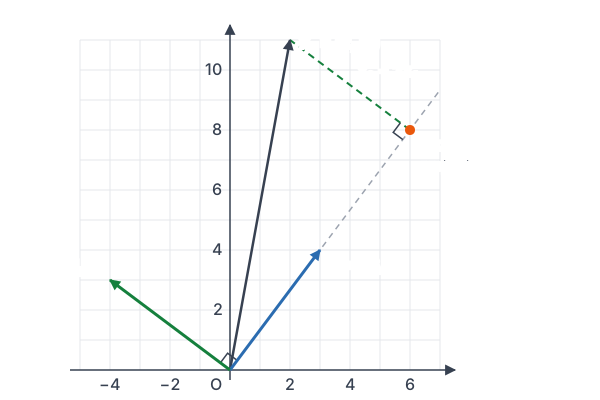
Start with x₁ as it is. The second vector x₂ leans partly along x₁. Remove that part, which is the vector projection of x₂ onto x₁, and what is left points straight away from x₁. Each later vector gets the same treatment against every vector already built.
The Gram-Schmidt formulas
Let {x₁, …, xₚ} be a basis for a subspace W of ℝⁿ. Define
v_1 = x_1, \qquad v_2 = x_2 - \frac{x_2 \cdot v_1}{v_1 \cdot v_1}\,v_1, \qquad v_3 = x_3 - \frac{x_3 \cdot v_1}{v_1 \cdot v_1}\,v_1 - \frac{x_3 \cdot v_2}{v_2 \cdot v_2}\,v_2and in general, subtract one projection for each vector already built:
v_k = x_k - \frac{x_k \cdot v_1}{v_1 \cdot v_1}\,v_1 - \frac{x_k \cdot v_2}{v_2 \cdot v_2}\,v_2 - \cdots - \frac{x_k \cdot v_{k-1}}{v_{k-1} \cdot v_{k-1}}\,v_{k-1}- Then {v₁, …, vₚ} is an orthogonal basis for W, and span{v₁, …, vₖ} = span{x₁, …, xₖ} at every stage.
- Each vₖ is xₖ minus its projection onto span{v₁, …, vₖ₋₁}, so it is orthogonal to everything built before it.
- Orthonormal basis: divide each vector by its length, uᵢ = vᵢ/‖vᵢ‖.
- Scaling is allowed: multiplying a vᵢ by a nonzero number keeps it orthogonal to the others. Clear fractions before the next step to keep the arithmetic simple.
- If some vₖ comes out as the zero vector, then xₖ was a combination of the earlier vectors, so the set was not linearly independent. Drop xₖ and continue.
How to use the Gram-Schmidt process
- Set v₁ = x₁.
- For x₂, compute the weight (x₂ · v₁)/(v₁ · v₁) and subtract that many v₁’s from x₂ to get v₂.
- For each later xₖ, compute one weight for every vector already built and subtract all of those pieces.
- Check that every new vector has dot product 0 with each earlier one.
- If you need an orthonormal basis, divide each vᵢ by ‖vᵢ‖.
Gram-Schmidt process examples
Example 1: Two vectors in ℝ²
Apply the Gram-Schmidt process to x_1 = \begin{bmatrix} 3 \\ 4 \end{bmatrix} and x_2 = \begin{bmatrix} 2 \\ 11 \end{bmatrix}. Then find an orthonormal basis.
v_1 = x_1 = \begin{bmatrix} 3 \\ 4 \end{bmatrix}Keep the first vector.
x_2 \cdot v_1 = 2(3) + 11(4) = 6 + 44 = 50
Dot product (see dot product).
v_1 \cdot v_1 = 3^2 + 4^2 = 9 + 16 = 25
Squared length of v₁.
\frac{50}{25} = 2Weight on v₁.
v_2 = \begin{bmatrix} 2 \\ 11 \end{bmatrix} - 2\begin{bmatrix} 3 \\ 4 \end{bmatrix} = \begin{bmatrix} 2 - 6 \\ 11 - 8 \end{bmatrix} = \begin{bmatrix} -4 \\ 3 \end{bmatrix}Subtract the projection.
v_1 \cdot v_2 = 3(-4) + 4(3) = -12 + 12 = 0
Check: v₁ and v₂ are orthogonal.
\|v_1\| = \sqrt{25} = 5,\quad \|v_2\| = \sqrt{16 + 9} = \sqrt{25} = 5Lengths.
u_1 = \begin{bmatrix} 3/5 \\ 4/5 \end{bmatrix},\quad u_2 = \begin{bmatrix} -4/5 \\ 3/5 \end{bmatrix}Divide each vector by its length.
Answer: the orthogonal basis is {(3, 4), (−4, 3)}, and the orthonormal basis is {(3/5, 4/5), (−4/5, 3/5)}.
Example 2: Clearing fractions
Find an orthogonal basis for the plane W = span{x₁, x₂} in ℝ³, where x_1 = \begin{bmatrix} 1 \\ 1 \\ 0 \end{bmatrix} and x_2 = \begin{bmatrix} 1 \\ 0 \\ 1 \end{bmatrix}.
v_1 = x_1 = \begin{bmatrix} 1 \\ 1 \\ 0 \end{bmatrix}Keep the first vector.
\frac{x_2 \cdot v_1}{v_1 \cdot v_1} = \frac{1 + 0 + 0}{1 + 1 + 0} = \frac{1}{2}Weight on v₁.
v_2 = \begin{bmatrix} 1 \\ 0 \\ 1 \end{bmatrix} - \frac{1}{2}\begin{bmatrix} 1 \\ 1 \\ 0 \end{bmatrix} = \begin{bmatrix} 1 - \tfrac{1}{2} \\ 0 - \tfrac{1}{2} \\ 1 - 0 \end{bmatrix} = \begin{bmatrix} \tfrac{1}{2} \\ -\tfrac{1}{2} \\ 1 \end{bmatrix}Subtract the projection (see subtracting fractions).
v_2' = 2v_2 = \begin{bmatrix} 1 \\ -1 \\ 2 \end{bmatrix}Multiply by 2 to clear fractions. The direction does not change.
v_1 \cdot v_2' = 1 - 1 + 0 = 0
Check orthogonality.
Answer: {(1, 1, 0), (1, −1, 2)} is an orthogonal basis for W.
Example 3: Three vectors in ℝ³
Apply the Gram-Schmidt process to x_1 = \begin{bmatrix} 1 \\ 2 \\ 2 \end{bmatrix}, x_2 = \begin{bmatrix} 3 \\ 3 \\ 0 \end{bmatrix} and x_3 = \begin{bmatrix} 1 \\ 0 \\ 5 \end{bmatrix}, and find an orthonormal basis for ℝ³.
v_1 = x_1 = \begin{bmatrix} 1 \\ 2 \\ 2 \end{bmatrix},\quad v_1 \cdot v_1 = 1 + 4 + 4 = 9Keep the first vector and find its squared length.
\frac{x_2 \cdot v_1}{v_1 \cdot v_1} = \frac{3 + 6 + 0}{9} = \frac{9}{9} = 1Weight of x₂ on v₁.
v_2 = \begin{bmatrix} 3 - 1 \\ 3 - 2 \\ 0 - 2 \end{bmatrix} = \begin{bmatrix} 2 \\ 1 \\ -2 \end{bmatrix}Subtract 1 times v₁.
v_2 \cdot v_2 = 4 + 1 + 4 = 9
Squared length of v₂.
\frac{x_3 \cdot v_1}{v_1 \cdot v_1} = \frac{1 + 0 + 10}{9} = \frac{11}{9}Weight of x₃ on v₁.
\frac{x_3 \cdot v_2}{v_2 \cdot v_2} = \frac{2 + 0 - 10}{9} = -\frac{8}{9}Weight of x₃ on v₂.
v_3 = \begin{bmatrix} 1 \\ 0 \\ 5 \end{bmatrix} - \frac{11}{9}\begin{bmatrix} 1 \\ 2 \\ 2 \end{bmatrix} + \frac{8}{9}\begin{bmatrix} 2 \\ 1 \\ -2 \end{bmatrix}Subtract both projections. Subtracting −8/9 of v₂ means adding 8/9 of it.
= \begin{bmatrix} \tfrac{9}{9} - \tfrac{11}{9} + \tfrac{16}{9} \\ 0 - \tfrac{22}{9} + \tfrac{8}{9} \\ \tfrac{45}{9} - \tfrac{22}{9} - \tfrac{16}{9} \end{bmatrix} = \begin{bmatrix} \tfrac{14}{9} \\ -\tfrac{14}{9} \\ \tfrac{7}{9} \end{bmatrix}Combine entry by entry over a common denominator.
v_3' = \frac{9}{7}v_3 = \begin{bmatrix} 2 \\ -2 \\ 1 \end{bmatrix}Multiply by 9/7 to clear fractions.
v_1 \cdot v_3' = 2 - 4 + 2 = 0,\quad v_2 \cdot v_3' = 4 - 2 - 2 = 0
Check orthogonality.
\|v_1\| = \|v_2\| = \|v_3'\| = \sqrt{9} = 3All three vectors have length 3.
Answer: the orthogonal basis is {(1, 2, 2), (2, 1, −2), (2, −2, 1)}. Dividing by 3 gives the orthonormal basis {(1/3, 2/3, 2/3), (2/3, 1/3, −2/3), (2/3, −2/3, 1/3)}.
Example 4: An orthonormal basis for a plane
Find an orthonormal basis for the plane W given by x − 2y + 3z = 0 in ℝ³.
x = 2y - 3z
Solve the equation for x. Here y and z are free.
\begin{bmatrix} x \\ y \\ z \end{bmatrix} = y\begin{bmatrix} 2 \\ 1 \\ 0 \end{bmatrix} + z\begin{bmatrix} -3 \\ 0 \\ 1 \end{bmatrix}Write the solutions in parametric vector form. This gives the basis x₁ = (2, 1, 0), x₂ = (−3, 0, 1).
\frac{x_2 \cdot v_1}{v_1 \cdot v_1} = \frac{-6 + 0 + 0}{4 + 1 + 0} = -\frac{6}{5}With v₁ = x₁, find the weight of x₂ on v₁.
v_2 = \begin{bmatrix} -3 \\ 0 \\ 1 \end{bmatrix} + \frac{6}{5}\begin{bmatrix} 2 \\ 1 \\ 0 \end{bmatrix} = \begin{bmatrix} -\tfrac{15}{5} + \tfrac{12}{5} \\ \tfrac{6}{5} \\ 1 \end{bmatrix} = \begin{bmatrix} -\tfrac{3}{5} \\ \tfrac{6}{5} \\ 1 \end{bmatrix}Subtracting −6/5 of v₁ means adding 6/5 of it.
v_2' = 5v_2 = \begin{bmatrix} -3 \\ 6 \\ 5 \end{bmatrix}Multiply by 5 to clear fractions.
v_1 \cdot v_2' = -6 + 6 + 0 = 0
Check orthogonality.
-3 - 2(6) + 3(5) = -3 - 12 + 15 = 0
Check that v₂′ is still in the plane.
\|v_1\| = \sqrt{5},\quad \|v_2'\| = \sqrt{9 + 36 + 25} = \sqrt{70}Lengths.
Answer: an orthonormal basis for W is {(2, 1, 0)/√5, (−3, 6, 5)/√70}.
Example 5: Separating level, trend and curve in data
A coach records a runner’s weekly mileage for four weeks. To split any four-week pattern into a steady level, a straight-line trend and a curve, she wants orthogonal versions of the patterns x_1 = (1, 1, 1, 1), x_2 = (1, 2, 3, 4) and x_3 = (1, 4, 9, 16) (constant, linear and squared week numbers). Apply the Gram-Schmidt process.
v_1 = x_1 = (1, 1, 1, 1),\quad v_1 \cdot v_1 = 4
The level pattern stays as it is.
\frac{x_2 \cdot v_1}{v_1 \cdot v_1} = \frac{1 + 2 + 3 + 4}{4} = \frac{10}{4} = \frac{5}{2}Weight of x₂ on v₁.
v_2 = \left(1 - \tfrac{5}{2},\ 2 - \tfrac{5}{2},\ 3 - \tfrac{5}{2},\ 4 - \tfrac{5}{2}\right) = \left(-\tfrac{3}{2}, -\tfrac{1}{2}, \tfrac{1}{2}, \tfrac{3}{2}\right)Subtract 5/2 of v₁.
v_2' = 2v_2 = (-3, -1, 1, 3),\quad v_2' \cdot v_2' = 9 + 1 + 1 + 9 = 20
Clear fractions and find the squared length.
\frac{x_3 \cdot v_1}{v_1 \cdot v_1} = \frac{1 + 4 + 9 + 16}{4} = \frac{30}{4} = \frac{15}{2}Weight of x₃ on v₁.
\frac{x_3 \cdot v_2'}{v_2' \cdot v_2'} = \frac{-3 - 4 + 9 + 48}{20} = \frac{50}{20} = \frac{5}{2}Weight of x₃ on v₂′.
v_3 = x_3 - \tfrac{15}{2}v_1 - \tfrac{5}{2}v_2'Subtract both projections.
= \left(1 - \tfrac{15}{2} + \tfrac{15}{2},\ 4 - \tfrac{15}{2} + \tfrac{5}{2},\ 9 - \tfrac{15}{2} - \tfrac{5}{2},\ 16 - \tfrac{15}{2} - \tfrac{15}{2}\right)Work entry by entry.
= (1, -1, -1, 1)
Simplify each entry.
v_1 \cdot v_3 = 0,\quad v_2' \cdot v_3 = -3 + 1 - 1 + 3 = 0
Check orthogonality. The first sum is 1 − 1 − 1 + 1 = 0.
Answer: the orthogonal patterns are level (1, 1, 1, 1), trend (−3, −1, 1, 3) and curve (1, −1, −1, 1). Because they are orthogonal, the coach can find how much of each pattern is in her data with one dot product each. The level and trend pieces give the same line as the least-squares regression line.
Common mistakes
| Mistake | Example of the error | Fix |
|---|---|---|
| Projecting onto the old x’s instead of the new v’s | In Example 3, subtracting (x₃ · x₂)/(x₂ · x₂) x₂ gives a vector whose dot product with v₂ is −19/2, not 0 | Every projection uses v₁, v₂, …, the vectors you have already built. |
| Forgetting to divide by vᵢ · vᵢ | Writing v₂ = x₂ − 50v₁ in Example 1 | The weight is (x₂ · v₁)/(v₁ · v₁) = 50/25 = 2. |
| Adding the projection instead of subtracting it | v₂ = (2 + 6, 11 + 8) = (8, 19) in Example 1 | Subtract. Then check: (3, 4) · (8, 19) = 100, not 0, so this answer is wrong. |
| Calling an orthogonal basis orthonormal | Giving {(3, 4), (−4, 3)} as an orthonormal basis | Orthonormal vectors have length 1. Divide each by its length, 5. |
| Keeping a zero vector | Listing (0, 0, 0) as a basis vector when xₖ depends on earlier vectors | A zero vₖ means xₖ adds nothing new. Drop it. |
Related ideas
Projections. Each step computes vₖ = xₖ − proj xₖ, the projection onto span{v₁, …, vₖ₋₁}. That is the y − ŷ piece from Orthogonal Projections, so every vₖ is the part of xₖ that the earlier vectors cannot reach.
QR factorization. If the x’s are the columns of a matrix A, the orthonormal u’s form the columns of Q, and the weights from Gram-Schmidt fill an upper triangular matrix R with A = QR. The next lesson, QR Factorization, shows how.
Order matters. Running Gram-Schmidt on the same vectors in a different order gives a different orthogonal basis for the same subspace. Every order works.
On a computer. Rounding errors can slowly ruin orthogonality in long runs. Software uses a reordered version, modified Gram-Schmidt, or other methods that give the same answer in exact arithmetic.
Practice problems
- Apply the Gram-Schmidt process to x₁ = (1, 2) and x₂ = (4, 3).
- Turn your answer to Problem 1 into an orthonormal basis.
- Find an orthogonal basis for span{(1, 0, 1), (3, 2, 1)}.
- Find an orthogonal basis for span{(2, 1, 2), (1, 1, 0)} with integer entries.
- Apply the Gram-Schmidt process to x₁ = (1, 1, 0), x₂ = (1, 0, 1) and x₃ = (0, 1, 1).
- Apply the Gram-Schmidt process to x₁ = (1, 1, 1), x₂ = (1, 2, 3) and x₃ = (2, 3, 4). What happens, and why?
- Find an orthonormal basis for the plane x + y − z = 0.
- Repeat Problem 1 with the order switched: x₁ = (4, 3) and x₂ = (1, 2).
- Find an orthogonal basis for span{(1, 1, 1, 1), (0, 2, 2, 4)} in ℝ⁴.
- Show that v₂ = x₂ − ((x₂ · v₁)/(v₁ · v₁))v₁ is always orthogonal to v₁.
Show answers
1.
v_1 = (1, 2),\quad \frac{x_2 \cdot v_1}{v_1 \cdot v_1} = \frac{4 + 6}{1 + 4} = \frac{10}{5} = 2Keep x₁ and find the weight.
v_2 = (4 - 2, 3 - 4) = (2, -1)
Subtract 2v₁.
v_1 \cdot v_2 = 2 - 2 = 0
Check.
Answer: {(1, 2), (2, −1)}.
2.
\|v_1\| = \sqrt{1 + 4} = \sqrt{5},\quad \|v_2\| = \sqrt{4 + 1} = \sqrt{5}Lengths.
u_1 = \left(\tfrac{1}{\sqrt{5}}, \tfrac{2}{\sqrt{5}}\right),\quad u_2 = \left(\tfrac{2}{\sqrt{5}}, -\tfrac{1}{\sqrt{5}}\right)Divide by the lengths.
Answer: {(1, 2)/√5, (2, −1)/√5}.
3.
\frac{3 + 0 + 1}{1 + 0 + 1} = \frac{4}{2} = 2Weight of x₂ on v₁ = (1, 0, 1).
v_2 = (3 - 2, 2 - 0, 1 - 2) = (1, 2, -1)
Subtract 2v₁.
v_1 \cdot v_2 = 1 + 0 - 1 = 0
Check.
Answer: {(1, 0, 1), (1, 2, −1)}.
4.
\frac{2 + 1 + 0}{4 + 1 + 4} = \frac{3}{9} = \frac{1}{3}Weight of x₂ on v₁ = (2, 1, 2).
v_2 = \left(1 - \tfrac{2}{3},\ 1 - \tfrac{1}{3},\ 0 - \tfrac{2}{3}\right) = \left(\tfrac{1}{3}, \tfrac{2}{3}, -\tfrac{2}{3}\right)Subtract 1/3 of v₁.
v_2' = 3v_2 = (1, 2, -2)
Clear fractions.
v_1 \cdot v_2' = 2 + 2 - 4 = 0
Check.
Answer: {(2, 1, 2), (1, 2, −2)}.
5.
v_2 = (1, 0, 1) - \tfrac{1}{2}(1, 1, 0) = \left(\tfrac{1}{2}, -\tfrac{1}{2}, 1\right) \to (1, -1, 2)Same as Example 2, then multiply by 2.
\frac{x_3 \cdot v_1}{v_1 \cdot v_1} = \frac{0 + 1 + 0}{2} = \frac{1}{2},\quad \frac{x_3 \cdot v_2'}{v_2' \cdot v_2'} = \frac{0 - 1 + 2}{6} = \frac{1}{6}Weights of x₃.
v_3 = \left(0 - \tfrac{1}{2} - \tfrac{1}{6},\ 1 - \tfrac{1}{2} + \tfrac{1}{6},\ 1 - 0 - \tfrac{2}{6}\right) = \left(-\tfrac{2}{3}, \tfrac{2}{3}, \tfrac{2}{3}\right)Subtract both projections.
v_3' = \tfrac{3}{2}v_3 = (-1, 1, 1)Clear fractions.
v_1 \cdot v_3' = -1 + 1 + 0 = 0,\quad v_2' \cdot v_3' = -1 - 1 + 2 = 0
Check.
Answer: {(1, 1, 0), (1, −1, 2), (−1, 1, 1)}.
6.
\frac{1 + 2 + 3}{3} = 2,\quad v_2 = (1 - 2, 2 - 2, 3 - 2) = (-1, 0, 1)First two steps.
\frac{2 + 3 + 4}{3} = 3,\quad \frac{-2 + 0 + 4}{2} = 1Weights of x₃ on v₁ and v₂.
v_3 = (2 - 3 + 1,\ 3 - 3 - 0,\ 4 - 3 - 1) = (0, 0, 0)
Subtract 3v₁ and 1v₂.
Answer: v₃ is the zero vector because x₃ = x₁ + x₂. The three vectors are dependent, so drop x₃. The orthogonal basis of their span is {(1, 1, 1), (−1, 0, 1)}.
7.
z = x + y,\quad x_1 = (1, 0, 1),\ x_2 = (0, 1, 1)
Solve for z and read off a basis.
\frac{0 + 0 + 1}{2} = \frac{1}{2},\quad v_2 = \left(-\tfrac{1}{2}, 1, \tfrac{1}{2}\right) \to (-1, 2, 1)Subtract 1/2 of v₁, then multiply by 2.
\|v_1\| = \sqrt{2},\quad \|v_2'\| = \sqrt{1 + 4 + 1} = \sqrt{6}Lengths.
Answer: {(1, 0, 1)/√2, (−1, 2, 1)/√6}.
8.
\frac{4 + 6}{16 + 9} = \frac{10}{25} = \frac{2}{5}Weight of (1, 2) on v₁ = (4, 3).
v_2 = \left(1 - \tfrac{8}{5},\ 2 - \tfrac{6}{5}\right) = \left(-\tfrac{3}{5}, \tfrac{4}{5}\right) \to (-3, 4)Subtract, then multiply by 5.
Answer: {(4, 3), (−3, 4)}. It differs from Problem 1, but both are orthogonal bases of ℝ².
9.
\frac{0 + 2 + 2 + 4}{4} = \frac{8}{4} = 2Weight on v₁ = (1, 1, 1, 1).
v_2 = (0 - 2, 2 - 2, 2 - 2, 4 - 2) = (-2, 0, 0, 2) \to (-1, 0, 0, 1)
Subtract 2v₁, then divide by 2.
Answer: {(1, 1, 1, 1), (−1, 0, 0, 1)}.
10.
v_2 \cdot v_1 = x_2 \cdot v_1 - \frac{x_2 \cdot v_1}{v_1 \cdot v_1}(v_1 \cdot v_1)Distribute the dot product over the subtraction.
= x_2 \cdot v_1 - x_2 \cdot v_1 = 0
The v₁ · v₁ factors cancel.
Answer: v₂ · v₁ = 0 for any x₂ and any nonzero v₁, so v₂ is always orthogonal to v₁.
Gram-Schmidt process FAQ
What is the Gram-Schmidt process used for?
It builds an orthogonal or orthonormal basis for a subspace. With that basis you can find projections, coordinates and least-squares answers with simple dot products, and it gives the QR factorization of a matrix.
Does the order of the vectors matter?
The span does not change, but the vectors you get do. Any order gives a valid orthogonal basis, as Practice Problems 1 and 8 show.
What happens if the vectors are linearly dependent?
At some step you get the zero vector. That vector was a combination of the earlier ones, so you drop it and keep going.
What is the difference between an orthogonal and an orthonormal basis?
In an orthogonal basis every pair of vectors has dot product 0. An orthonormal basis also has every vector of length 1, which you get by dividing each vector by its length.
Summary
- v₁ = x₁, and each vₖ is xₖ minus its projections onto v₁, …, vₖ₋₁.
- Every weight is (xₖ · vᵢ)/(vᵢ · vᵢ), using the new v’s, not the original x’s.
- You may scale any vᵢ to clear fractions. Divide by lengths at the end for an orthonormal basis.
- Check each new vector with dot products. They should all be 0.
- A zero vector means the original set was dependent. Drop that vector.
Previous lesson: Orthogonal Projections
Next lesson: QR Factorization
Back to the Linear Algebra Index