
Probability
Probability is a number that tells how likely an event is to happen. It is always between 0 and 1. To find it, divide the number of ways the event can happen by the total number of outcomes: P(\text{event}) = \frac{\text{favorable outcomes}}{\text{total outcomes}}. For a fair coin, the probability of heads is \frac{1}{2}.
Before this lesson: You should know how to simplify fractions, change between fractions and decimals, and work with percentages and ratios.
What Probability Means
An outcome is one possible result, like rolling a 3 on a die. An event is one or more outcomes you care about, like rolling an even number. The favorable outcomes are the ones that make the event happen.
A probability of 0 means the event can’t happen. A probability of 1 means it is certain. Most events are in between.
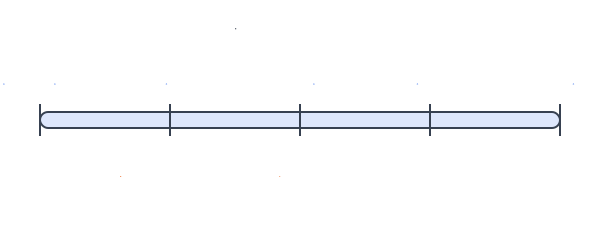
You can write a probability as a fraction, a decimal or a percent. For example, \frac{1}{4} = 0.25 = 25\%.
The Probability Formula
P(\text{event}) = \frac{\text{number of favorable outcomes}}{\text{total number of outcomes}}- This formula works when each outcome has the same chance, like the sides of a fair die. We say the outcomes are equally likely.
- The complement of an event is all the other outcomes. “Not rolling a 6” is the complement of “rolling a 6.”
- An event and its complement always add up to 1: P(\text{not } A) = 1 - P(A).
Worked Examples
Example 1: Rolling a die
You roll a fair 6-sided die. Find the probability of rolling a 4. Then find the probability of rolling an even number.
Step 1. There are 6 equally likely outcomes: 1, 2, 3, 4, 5, 6.
Step 2. Only one outcome is a 4, so P(4) = \frac{1}{6}.
Step 3. The even outcomes are 2, 4 and 6. That is 3 favorable outcomes, so P(\text{even}) = \frac{3}{6} = \frac{1}{2}.
Answer: P(4) = \frac{1}{6} and P(\text{even}) = \frac{1}{2}
Example 2: Picking from a bag
A bag holds 5 red, 3 blue and 2 green marbles. You pick one without looking. Find the probability that it is blue, and the probability that it is not blue.
Step 1. The total is 5 + 3 + 2 = 10 marbles.
Step 2. P(\text{blue}) = \frac{3}{10} = 0.3 = 30\%.
Step 3. Use the complement: P(\text{not blue}) = 1 - \frac{3}{10} = \frac{7}{10}.
Answer: P(\text{blue}) = \frac{3}{10} and P(\text{not blue}) = \frac{7}{10}
Example 3: Impossible and certain events
You roll a fair die. Find the probability of rolling a 7 and the probability of rolling a number less than 7.
Step 1. No side shows a 7, so there are 0 favorable outcomes: P(7) = \frac{0}{6} = 0. It is impossible.
Step 2. Every side is less than 7, so P(\text{less than } 7) = \frac{6}{6} = 1. It is certain.
Answer: 0 and 1
Example 4: Experimental probability
Ava flips a coin 50 times and gets 28 heads. What is the experimental probability of heads? How does it compare to the theoretical probability?
Step 1. Experimental probability uses what actually happened: \frac{28}{50} = 0.56.
Step 2. Theoretical probability uses the formula. A fair coin has 2 equal outcomes, so P(\text{heads}) = \frac{1}{2} = 0.5.
Step 3. The results are close but not the same. With more flips, the result usually gets closer to 0.5.
Answer: The experimental probability is 0.56, a little more than the theoretical 0.5.
Example 5: Word problem with a spinner
A spinner has 4 equal sections: red, blue, green and yellow. If you spin it 200 times, about how many times should it land on red?
Step 1. One of the 4 sections is red, so P(\text{red}) = \frac{1}{4}.
Step 2. Multiply by the number of spins: \frac{1}{4} \times 200 = 50.
Answer: About 50 times. The real count may be a bit more or less.
Common Mistakes with Probability
| Mistake | Example of the error | Fix |
|---|---|---|
| Comparing favorable to unfavorable | For 3 blue out of 10, writing \frac{3}{7} | Divide by the total: \frac{3}{10}. (3 to 7 is a ratio called odds.) |
| Getting a probability greater than 1 | P = \frac{10}{3} | The total always goes on the bottom. A probability is never more than 1. |
| Forgetting the complement adds to 1 | P(\text{not blue}) = \frac{3}{10} too | 1 - \frac{3}{10} = \frac{7}{10}. |
| Expecting the exact predicted count | “Exactly 50 of 200 spins will be red” | A prediction is about how many. Real results vary. |
| Using the formula on parts of different sizes | A spinner with one huge red part: P(\text{red}) = \frac{1}{4} | The formula needs parts of the same size. Use the size of each part instead. |
Listing Outcomes for Two Events
For two coin flips, list every possible outcome. This list is called the sample space: HH, HT, TH, TT. There are 4 equally likely outcomes.
Exactly one head happens in HT and TH, so P(\text{exactly one head}) = \frac{2}{4} = \frac{1}{2}. A table or tree diagram helps you list outcomes without missing any.
Practice Problems
- You roll a fair die. Find P(5).
- You roll a fair die. Find the probability of rolling a number greater than 4.
- A bag has 4 red and 6 yellow tiles. Find P(\text{red}).
- Using the same bag, find P(\text{not red}).
- You pick a card numbered 1 to 20 at random. Find the probability that it is a multiple of 5.
- You roll a fair die. What is the probability of rolling a 0?
- A player makes 18 of 24 free throws. What is her experimental probability of making a free throw?
- You flip two coins. Find the probability of getting two tails.
- The probability that a spinner lands on blue is 0.3. About how many times will it land on blue in 150 spins?
- Can a probability be 1.2? Explain.
Show answers
- \frac{1}{6}
- 5 and 6 are greater than 4: \frac{2}{6} = \frac{1}{3}
- \frac{4}{10} = \frac{2}{5}
- 1 - \frac{2}{5} = \frac{3}{5}
- 5, 10, 15 and 20: \frac{4}{20} = \frac{1}{5}
- 0. It is impossible.
- \frac{18}{24} = \frac{3}{4} = 0.75, or 75%
- The sample space is HH, HT, TH, TT. Only TT works: \frac{1}{4}
- 0.3 \times 150 = 45 times
- No. The favorable outcomes can never be more than the total, so a probability is never more than 1.
Probability FAQ
How do you find the probability of an event?
Count the favorable outcomes and the total outcomes. Divide the favorable count by the total, and simplify.
What is the difference between experimental and theoretical probability?
Theoretical probability comes from the formula. It tells what should happen. Experimental probability comes from what really happened when you tried it.
Can probability be written as a percent?
Yes. A probability of \frac{3}{10} is the same as 0.3 or 30%.
What does a probability of 0.5 mean?
It means the event has the same chance to happen as not to happen, like flipping heads on a fair coin.
Summary
- Probability = favorable outcomes ÷ total outcomes.
- Probability is always between 0 (impossible) and 1 (certain).
- P(\text{not } A) = 1 - P(A).
- Experimental probability comes from real trials. It gets closer to the formula’s value with more trials.
- To predict, multiply the probability by the number of trials.
Previous lesson: Box Plots
Next lesson: Variables in Math, the first lesson of Algebra 1. See the full Algebra 1 Index.
Back to the Pre-Algebra (Math Basics) Index