
Addition Rule and Mutually Exclusive Events
The addition rule in probability finds the chance that event A or event B happens: P(A or B) = P(A) + P(B) − P(A and B). You subtract the overlap so it isn’t counted twice. If A and B are mutually exclusive (they can’t both happen), the overlap is 0, so P(A or B) = P(A) + P(B).
Before this lesson: Probability Rules, Two-Way Tables and Fractions
What “or” means in probability
In probability, “A or B” means A happens, B happens, or both happen. It is also called the union of A and B, written A \cup B. “A and B” means both happen at once. It is called the intersection, written A \cap B.
Picture a deck of cards. Hearts and face cards (jack, queen, king) overlap: the jack, queen and king of hearts are in both groups. If you add the 13 hearts and the 12 face cards, those 3 cards get counted twice. The addition rule takes them out once.
The addition rule
P(A \text{ or } B) = P(A) + P(B) - P(A \text{ and } B)This is the general addition rule. It works for any two events.
Two events are mutually exclusive, or disjoint, if they can’t happen at the same time. Rolling a 1 and rolling a 6 on one die are mutually exclusive. For these events P(A \text{ and } B) = 0, and the rule becomes:
P(A \text{ or } B) = P(A) + P(B)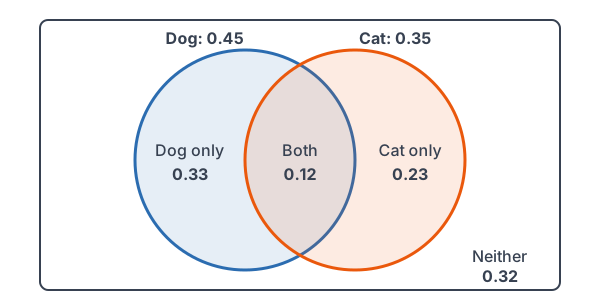
Addition rule examples
Example 1: Mutually exclusive events
One fair die is rolled. Find the probability of rolling a 1 or a 6.
\text{1 and 6 can't both happen}The events are mutually exclusive.
P(1) = \dfrac{1}{6}, \; P(6) = \dfrac{1}{6}Each face has probability 1/6.
P(1 \text{ or } 6) = \dfrac{1}{6} + \dfrac{1}{6}Add the probabilities.
\dfrac{1}{6} + \dfrac{1}{6} = \dfrac{2}{6}Add the numerators (see adding fractions).
\dfrac{2}{6} = \dfrac{1}{3}Simplify.
Answer: 1/3, or about 0.333.
Example 2: Events that overlap
One card is drawn from a standard 52-card deck. Find the probability that it is a heart or a face card.
P(\text{heart}) = \dfrac{13}{52}There are 13 hearts.
P(\text{face}) = \dfrac{12}{52}There are 12 face cards: 3 in each of 4 suits.
P(\text{heart and face}) = \dfrac{3}{52}The jack, queen and king of hearts are in both groups.
\dfrac{13}{52} + \dfrac{12}{52} - \dfrac{3}{52} = \dfrac{22}{52}Use the general addition rule.
\dfrac{22}{52} = \dfrac{11}{26}Simplify (see fractions).
\dfrac{11}{26} \approx 0.423Divide.
Answer: 11/26, or about 0.423. Counting the cards directly gives the same answer: 13 hearts plus the 9 face cards that are not hearts make 22 cards.
Example 3: Use a two-way table
A school surveys 200 students (example data):
| Plays a sport | No sport | Total | |
|---|---|---|---|
| Junior | 48 | 62 | 110 |
| Senior | 42 | 48 | 90 |
| Total | 90 | 110 | 200 |
Find the probability that a randomly chosen student is a junior or plays a sport.
P(\text{junior}) = \dfrac{110}{200}Use the Junior row total.
P(\text{sport}) = \dfrac{90}{200}Use the Plays a sport column total.
P(\text{junior and sport}) = \dfrac{48}{200}Use the cell where they meet.
\dfrac{110}{200} + \dfrac{90}{200} - \dfrac{48}{200} = \dfrac{152}{200}Use the general addition rule.
\dfrac{152}{200} = 0.76Divide.
Answer: 0.76. Check: the only students who are neither are the 48 seniors with no sport, and 200 - 48 = 152.
Example 4: The chance of neither
In a town, 45% of homes have a dog, 35% have a cat and 12% have both. Find the probability that a home has a dog or a cat, and the probability that it has neither.
P(D \text{ or } C) = 0.45 + 0.35 - 0.12Use the general addition rule.
0.45 + 0.35 = 0.80
Add.
0.80 - 0.12 = 0.68
Subtract the overlap.
P(\text{neither}) = 1 - 0.68“Neither” is the complement of “dog or cat” (see complement rule).
1 - 0.68 = 0.32
Subtract.
Answer: 0.68 have a dog or a cat, and 0.32 have neither. The Venn diagram above shows each region.
Example 5: Find the overlap (word problem)
A city survey finds that 60% of commuters ride the bus, 30% ride the train, and 75% ride the bus or the train. What percent ride both? Are the two events mutually exclusive?
0.75 = 0.60 + 0.30 - P(\text{both})Put the known values into the general addition rule.
0.60 + 0.30 = 0.90
Add.
0.75 = 0.90 - P(\text{both})Rewrite the equation.
P(\text{both}) = 0.90 - 0.75Solve for the overlap (see one-step equations).
0.90 - 0.75 = 0.15
Subtract.
Answer: 15% ride both. The events are not mutually exclusive, because the overlap is not 0.
Common mistakes
| Mistake | Example of the error | Fix |
|---|---|---|
| Forgetting to subtract the overlap | P(heart or face) = 13/52 + 12/52 = 25/52 | Subtract P(heart and face): 25/52 − 3/52 = 22/52. |
| Subtracting when events are mutually exclusive | Subtracting something for rolling a 1 or a 6 | Mutually exclusive events have no overlap, so just add. |
| Mixing up “or” and “and” | Using 0.12 when asked for dog or cat | “Or” is the union (0.68). “And” is the overlap (0.12). |
| A sum above 1 | Getting P(A or B) = 1.1 | You probably skipped the overlap; no probability can be more than 1. |
| Thinking “or” excludes both | Leaving out students who are juniors and play a sport | In statistics, “A or B” includes outcomes in both. |
| Calling overlapping events disjoint | Saying hearts and face cards are mutually exclusive | Check whether one outcome can be in both events. |
Related methods
Using a Venn diagram or a table
A Venn diagram, like the one above, shows each region so nothing is counted twice. A two-way table does the same job with counts. Both make the overlap easy to see.
The complement and “neither”
“Neither A nor B” is the complement of “A or B.” Find P(A or B) with the addition rule, then subtract from 1, as in Example 4. The next lesson, conditional probability, shows how to find a probability when you know that one event happened.
Practice problems
- One die is rolled. Find the probability of an even number or a 5.
- Are “roll a 2” and “roll an even number” mutually exclusive? Explain.
- One card is drawn from a 52-card deck. Find P(king or queen).
- One card is drawn from a 52-card deck. Find P(red card or king).
- P(A) = 0.5, P(B) = 0.3 and P(A and B) = 0.1. Find P(A or B).
- A and B are mutually exclusive, with P(A) = 0.4 and P(B) = 0.25. Find P(A or B) and P(A and B).
- Use the table in Example 3. Find the probability that a student is a senior or plays a sport.
- P(A or B) = 0.8, P(A) = 0.5 and P(B) = 0.45. Find P(A and B).
- Can two events with P(A) = 0.6 and P(B) = 0.5 be mutually exclusive? Explain.
- P(A) = 0.3, P(B) = 0.2 and P(A and B) = 0.05. Find the probability of neither A nor B.
Show answers
1.
\text{even: 2, 4, 6; and 5}The events don’t overlap, so they are mutually exclusive.
\dfrac{3}{6} + \dfrac{1}{6} = \dfrac{4}{6}Add.
\dfrac{4}{6} = \dfrac{2}{3}Simplify.
Answer: 2/3
2.
\text{2 is even}Rolling a 2 is in both events.
Answer: no; a roll of 2 is in both events, so they can happen together
3.
\dfrac{4}{52} + \dfrac{4}{52} = \dfrac{8}{52}A card can’t be both, so add.
\dfrac{8}{52} = \dfrac{2}{13}Simplify.
Answer: 2/13, or about 0.154
4.
\dfrac{26}{52} + \dfrac{4}{52} - \dfrac{2}{52} = \dfrac{28}{52}Subtract the 2 red kings, which are in both events.
\dfrac{28}{52} = \dfrac{7}{13}Simplify.
Answer: 7/13, or about 0.538
5.
0.5 + 0.3 - 0.1 = 0.7
Use the general addition rule.
Answer: 0.7
6.
0.4 + 0.25 = 0.65
Mutually exclusive, so add.
Answer: P(A or B) = 0.65 and P(A and B) = 0
7.
\dfrac{90}{200} + \dfrac{90}{200} - \dfrac{42}{200} = \dfrac{138}{200}Senior total, sport total, minus seniors who play a sport.
\dfrac{138}{200} = 0.69Divide.
Answer: 0.69
8.
0.5 + 0.45 = 0.95
Add P(A) and P(B).
0.95 - 0.8 = 0.15
Subtract P(A or B) to find the overlap.
Answer: 0.15
9.
0.6 + 0.5 = 1.1
If they were mutually exclusive, P(A or B) would be this sum.
Answer: no; P(A or B) would be 1.1, which is more than 1, so the events must overlap
10.
0.3 + 0.2 - 0.05 = 0.45
Find P(A or B).
1 - 0.45 = 0.55
Use the complement.
Answer: 0.55
Addition rule FAQ
What is the addition rule in probability?
It says P(A or B) = P(A) + P(B) − P(A and B). You add the two probabilities and subtract the overlap, which was counted twice.
What does mutually exclusive mean in probability?
Two events are mutually exclusive, or disjoint, if they can’t happen at the same time. For them, P(A and B) = 0, so P(A or B) = P(A) + P(B).
Are mutually exclusive events independent?
No. If two events with positive probabilities are mutually exclusive, knowing one happened tells you the other did not, so they are dependent. Independence is covered in Independent Events.
How do you find P(A and B) from P(A or B)?
Rearrange the addition rule: P(A and B) = P(A) + P(B) − P(A or B). Example 5 shows this.
Summary
- “A or B” means A, B or both. “A and B” means both at once.
- General addition rule: P(A \text{ or } B) = P(A) + P(B) - P(A \text{ and } B).
- Mutually exclusive (disjoint) events can’t happen together, so just add their probabilities.
- Venn diagrams and two-way tables show the overlap clearly.
- “Neither” is the complement of “or”: 1 - P(A \text{ or } B).
Previous lesson: Probability Rules
Next lesson: Conditional Probability
Back to the Statistics Index