
Independent Events
Two events are independent if knowing that one happened doesn’t change the probability of the other. In symbols, P(A | B) = P(A). For independent events, the multiplication rule is P(A and B) = P(A) · P(B). To test for independence, check whether either of these equations is true.
Before this lesson: Conditional Probability, Addition Rule and Mutually Exclusive Events and Probability Rules
What independence means
Flip a coin and roll a die. The coin can’t affect the die, so getting heads tells you nothing about rolling a 6. These events are independent.
Now draw two cards without putting the first back. If the first card is an ace, there are fewer aces left for the second draw. The second draw depends on the first, so these events are dependent.
Independence is about probabilities, not about whether events seem connected. You check it with numbers.
Test for independence and the multiplication rule
Events A and B are independent if any one of these is true (if one is true, they all are):
P(A \mid B) = P(A)
P(B \mid A) = P(B)
P(A \text{ and } B) = P(A) \cdot P(B)The last equation is the multiplication rule for independent events. It is the general multiplication rule, P(A \text{ and } B) = P(A) \cdot P(B \mid A), with P(B \mid A) replaced by P(B). It extends to more events: for independent A, B and C, multiply all three probabilities.
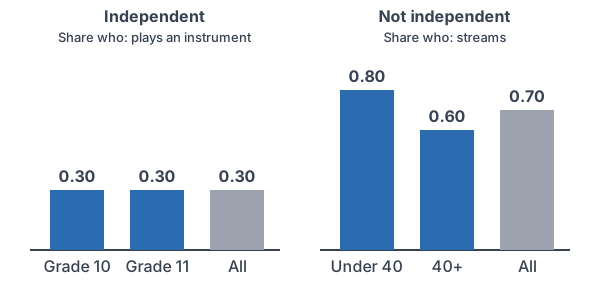
Independent events examples
Example 1: Test independence with a table
A school surveys 200 students about playing an instrument (example data):
| Plays | Doesn’t play | Total | |
|---|---|---|---|
| Grade 10 | 36 | 84 | 120 |
| Grade 11 | 24 | 56 | 80 |
| Total | 60 | 140 | 200 |
Are “plays an instrument” and “in grade 10” independent?
P(\text{plays}) = \dfrac{60}{200}Use the column total over the grand total.
\dfrac{60}{200} = 0.3Divide.
P(\text{plays} \mid \text{grade 10}) = \dfrac{36}{120}Use the Grade 10 row as the whole (see conditional probability).
\dfrac{36}{120} = 0.3Divide.
0.3 = 0.3
Compare the two probabilities.
Answer: yes. Knowing a student is in grade 10 doesn’t change the chance that the student plays an instrument, so the events are independent.
Example 2: Events that are not independent
In the streaming survey from the conditional probability lesson, 174 of 250 adults stream, and 96 of the 120 adults under 40 stream. Are “streams” and “under 40” independent?
P(\text{streams}) = \dfrac{174}{250}Overall share who stream.
\dfrac{174}{250} = 0.696Divide.
P(\text{streams} \mid \text{under 40}) = \dfrac{96}{120}Share of the under-40 group who stream.
\dfrac{96}{120} = 0.8Divide.
0.8 \ne 0.696
Compare the two probabilities.
Answer: no. Knowing a person is under 40 raises the chance of streaming from about 0.70 to 0.80, so the events are dependent.
Example 3: Use the multiplication rule
On a drive to school, the first traffic light is green 40% of the time, and the second is green 55% of the time. The lights work independently. Find the probability that both are green.
P(\text{both green}) = 0.40 \cdot 0.55The events are independent, so multiply.
0.40 \cdot 0.55 = 0.22
Multiply (see operations with decimals).
Answer: 0.22, so both lights are green on about 22% of drives.
Example 4: Test with the multiplication rule
P(A) = 0.3, P(B) = 0.5 and P(A and B) = 0.15. Are A and B independent?
P(A) \cdot P(B) = 0.3 \cdot 0.5
Multiply the two probabilities.
0.3 \cdot 0.5 = 0.15
Multiply.
0.15 = 0.15
Compare with P(A and B).
Answer: yes. P(A and B) equals P(A) · P(B), so A and B are independent.
Example 5: At least one works (word problem)
A building has 3 smoke alarms in a hallway. Each one fails 4% of the time, and they fail independently. Find the probability that at least one alarm works when there is smoke.
P(\text{all fail}) = 0.04 \cdot 0.04 \cdot 0.04The failures are independent, so multiply.
0.04^3 = 0.000064
Multiply (see exponents).
P(\text{at least one works}) = 1 - 0.000064“At least one works” is the complement of “all fail.”
1 - 0.000064 = 0.999936
Subtract.
Answer: about 0.99994. Extra independent alarms make a failure of the whole system very unlikely. This only works if the alarms really fail independently, for example if they don’t share one power supply.
Common mistakes
| Mistake | Example of the error | Fix |
|---|---|---|
| Multiplying dependent probabilities | P(two aces without replacement) = (4/52)(4/52) | Without replacement, use the conditional 3/51 for the second card. |
| Thinking mutually exclusive means independent | “Rolling a 1 and rolling a 6 can’t both happen, so they’re independent.” | Mutually exclusive events are dependent: if one happens, the other can’t. |
| Calling events independent because they seem unrelated | Assuming age and streaming are independent | Check with numbers: compare P(A | B) with P(A). |
| Adding instead of multiplying for “and” | P(both green) = 0.40 + 0.55 | For independent events, multiply for “and.” |
| Calling small differences “exactly equal” in data | Saying 0.31 and 0.30 prove dependence | With sample data, a tiny difference may be chance; later lessons test this. |
| Forgetting the complement for “at least one” | Adding 0.96 three times | Find P(none) by multiplying, then subtract from 1. |
Related methods
Mutually exclusive vs. independent
These two ideas are easy to mix up. Mutually exclusive events, from the addition rule lesson, can’t happen together. Independent events can happen together, and one doesn’t change the chance of the other. Two events with positive probabilities can’t be both.
Checking independence in a table
In a two-way table, the events are independent when every row has the same share in a column as the table as a whole. The chi-square test for independence decides whether differences in real data are too big to be chance.
Practice problems
- A coin is flipped and a die is rolled. Find P(heads and 6).
- A and B are independent, with P(A) = 0.6 and P(B) = 0.25. Find P(A and B).
- P(A) = 0.4, P(B) = 0.3 and P(A and B) = 0.15. Are A and B independent?
- Use the table in Example 1. Compare P(grade 11 | plays) with P(grade 11). Are the events independent?
- A student guesses on 4 multiple-choice questions with 5 choices each. Find the probability of getting all 4 right.
- For the student in problem 5, find the probability of getting at least one right.
- A and B are mutually exclusive, with P(A) = 0.2 and P(B) = 0.3. Are they independent?
- The chance of rain is 0.3 on Saturday and 0.3 on Sunday, independently. Find the probability of no rain on either day.
- Two machines each work 90% of the time, independently. Find the probability that both work and the probability that at least one works.
- Two cards are drawn with replacement (the first is put back). Find the probability that both are aces.
Show answers
1.
\dfrac{1}{2} \cdot \dfrac{1}{6} = \dfrac{1}{12}The coin and die are independent, so multiply.
Answer: 1/12, or about 0.083
2.
0.6 \cdot 0.25 = 0.15
Multiply.
Answer: 0.15
3.
0.4 \cdot 0.3 = 0.12
Find P(A) · P(B).
0.12 \ne 0.15
Compare with P(A and B).
Answer: no, they are dependent
4.
\dfrac{24}{60} = 0.4P(grade 11 | plays): divide by the Plays column total.
\dfrac{80}{200} = 0.4P(grade 11): divide the row total by the grand total.
Answer: both are 0.4, so the events are independent
5.
\left(\dfrac{1}{5}\right)^4 = \dfrac{1}{625}Multiply 1/5 four times.
\dfrac{1}{625} = 0.0016Divide.
Answer: 1/625, or 0.0016
6.
\left(\dfrac{4}{5}\right)^4 = \dfrac{256}{625}Find P(all 4 wrong).
1 - \dfrac{256}{625} = \dfrac{369}{625}Use the complement.
\dfrac{369}{625} = 0.5904Divide.
Answer: 369/625, or 0.5904
7.
0.2 \cdot 0.3 = 0.06
This is what P(A and B) would be if they were independent.
\text{P(A and B)} = 0Mutually exclusive events can’t happen together.
Answer: no; P(A and B) = 0, which is not 0.06, so they are dependent
8.
1 - 0.3 = 0.7
Find P(no rain) for one day.
0.7 \cdot 0.7 = 0.49
Multiply for the two independent days.
Answer: 0.49
9.
0.9 \cdot 0.9 = 0.81
P(both work).
0.1 \cdot 0.1 = 0.01
P(both fail).
1 - 0.01 = 0.99
P(at least one works) is the complement.
Answer: 0.81 and 0.99
10.
\dfrac{4}{52} = \dfrac{1}{13}Simplify P(ace).
\dfrac{1}{13} \cdot \dfrac{1}{13} = \dfrac{1}{169}With replacement, the draws are independent.
Answer: 1/169, or about 0.0059
Independent events FAQ
How do you know if two events are independent?
Check whether P(A | B) = P(A), or whether P(A and B) = P(A) · P(B). If either is true, the events are independent.
What is the multiplication rule for independent events?
For independent events, P(A and B) = P(A) · P(B). For example, two independent lights that are green 40% and 55% of the time are both green 22% of the time.
Can events be both independent and mutually exclusive?
Not if both have positive probability. Mutually exclusive events can’t happen together, so one happening changes the other’s chance to 0.
What is the difference between independent and dependent events?
For independent events, one event doesn’t change the chance of the other. For dependent events, it does, as with drawing cards without replacement.
Summary
- Independent: knowing one event happened doesn’t change the other’s probability.
- Test: P(A | B) = P(A), or P(A and B) = P(A) · P(B).
- Multiplication rule for independent events: P(A \text{ and } B) = P(A) \cdot P(B).
- For “at least one,” multiply to find P(none), then subtract from 1.
- Mutually exclusive events with positive probabilities are never independent.
Previous lesson: Conditional Probability
Next lesson: Bayes’ Theorem
Back to the Statistics Index