
False Position Method
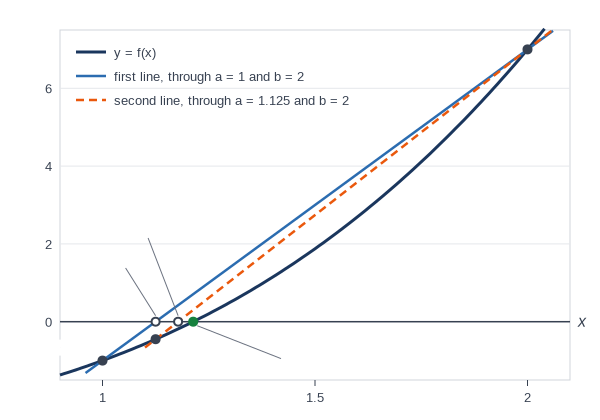
The false position method (also called regula falsi) finds a root of f(x) = 0 inside an interval [a, b] where f changes sign. It draws the secant line through (a, f(a)) and (b, f(b)), takes its x-intercept c as the new estimate, and keeps the part of the interval where the sign change remains, so the root stays trapped.
Before this lesson: Bisection Method and Secant Method
The idea: bisection’s safety with the secant method’s aim
The bisection method always cuts the interval at its midpoint. That is safe, because the root stays trapped, but it ignores the function values: if f(a) = −0.01 and f(b) = 50, the root is almost certainly very close to a, not in the middle.
The false position method uses those values. It joins (a, f(a)) and (b, f(b)) with a straight line, just like the secant method, and cuts the interval where that line crosses the x-axis. Then, as in bisection, it checks the sign of f(c) and keeps the subinterval whose endpoints still have opposite signs. By the intermediate value theorem, a continuous f must have a root in that subinterval.
False position method formula
c = b - f(b)\,\frac{b - a}{f(b) - f(a)} = \frac{a\,f(b) - b\,f(a)}{f(b) - f(a)}This is the secant formula with xₙ₋₁ = a and xₙ = b. The second form is shorter to type, but the first is safer on a computer near the root, because it adds a small correction to b instead of subtracting two nearly equal products.
- Find an interval [a, b] with f(a) and f(b) of opposite signs.
- Compute c with the formula, and then compute f(c).
- If f(c) has the same sign as f(a), replace a with c. Otherwise, replace b with c.
- Repeat with the new interval.
- Stop when |f(c)| is tiny or when two estimates c in a row agree to your tolerance. Unlike bisection, the interval width b − a usually does not shrink to 0, so do not use it as the stopping test.
How fast it is. The method always converges for a continuous f with a sign change, but usually only linearly: the error shrinks by about the same factor each step. That happens because one endpoint often gets stuck. When f is concave up or concave down on the whole interval, the line always lands on the same side of the root, so only one endpoint ever moves (Example 5).
False position method examples
Example 1: A cubic on [1, 2]
Use the false position method on x^3 + x - 3 = 0 on [1, 2]. Find c₁, c₂ and c₃, keeping 6 decimal places.
f(1) = 1 + 1 - 3 = -1, \; f(2) = 8 + 2 - 3 = 7
The signs differ, so [1, 2] holds a root.
c_1 = 2 - 7\cdot\frac{2 - 1}{7 - (-1)}Substitute a = 1 and b = 2 into the formula.
c_1 = 2 - 7\cdot\frac{1}{8}Subtract in the numerator and the denominator.
c_1 = 2 - 0.875
Multiply.
c_1 = 1.125
Subtract.
f(c_1) = 1.125^3 + 1.125 - 3 \approx -0.451172
Evaluate f at c₁.
[a, b] = [1.125, 2]
f(c₁) is negative, like f(a), so c₁ replaces a.
c_2 = 2 - 7\cdot\frac{2 - 1.125}{7 - (-0.451172)}Substitute the new a = 1.125.
c_2 = 2 - 7\cdot\frac{0.875}{7.451172}Subtract in the numerator and the denominator.
c_2 = 2 - 0.822018
Multiply and divide (6 decimal places).
c_2 = 1.177982
Subtract.
f(c_2) \approx -0.187401
Evaluate f at c₂.
[a, b] = [1.177982, 2]
Negative again, so c₂ replaces a.
c_3 = 2 - 7\cdot\frac{2 - 1.177982}{7 - (-0.187401)}Substitute the new a.
c_3 = 2 - 7\cdot\frac{0.822018}{7.187401}Subtract in the numerator and the denominator.
c_3 = 2 - 0.800585
Multiply and divide.
c_3 = 1.199415
Subtract.
f(c_3) \approx -0.075111
Evaluate f at c₃.
| step | a | b | c | f(c) |
|---|---|---|---|---|
| 1 | 1 | 2 | 1.125 | −0.451172 |
| 2 | 1.125 | 2 | 1.177982 | −0.187401 |
| 3 | 1.177982 | 2 | 1.199415 | −0.075111 |
| 4 | 1.199415 | 2 | 1.207914 | −0.029672 |
| 5 | 1.207914 | 2 | 1.211257 | −0.011655 |
Answer: c₃ ≈ 1.199415, and c₅ ≈ 1.211257 is within 0.0022 of the root 1.213412…. Notice that b = 2 never moves.
Example 2: Solving cos x = x
Solve \cos x = x (x in radians) with the false position method on [0, 1]. Do three steps.
f(x) = \cos x - x
Move everything to one side, so the equation is f(x) = 0.
f(0) = \cos 0 - 0 = 1
Evaluate f at a = 0, in radians.
f(1) = \cos 1 - 1 \approx -0.459698
Evaluate f at b = 1. The signs differ.
c_1 = 1 - (-0.459698)\cdot\frac{1 - 0}{-0.459698 - 1}Substitute into the formula.
c_1 = 1 - (-0.459698)\cdot\frac{1}{-1.459698}Subtract in the denominator.
c_1 = 1 - 0.314927
Multiply and divide.
c_1 = 0.685073
Subtract.
f(c_1) \approx 0.089300
Positive, like f(a), so the new interval is [0.685073, 1].
c_2 = 1 - (-0.459698)\cdot\frac{1 - 0.685073}{-0.459698 - 0.089300}Substitute the new a.
c_2 = 1 - (-0.459698)\cdot\frac{0.314927}{-0.548998}Subtract in the numerator and the denominator.
c_2 = 1 - 0.263701
Multiply and divide.
c_2 = 0.736299
Subtract.
f(c_2) \approx 0.004660
Positive again, so the new interval is [0.736299, 1].
c_3 = 1 - (-0.459698)\cdot\frac{1 - 0.736299}{-0.459698 - 0.004660}Substitute the new a.
c_3 = 1 - (-0.459698)\cdot\frac{0.263701}{-0.464358}Subtract in the numerator and the denominator.
c_3 = 1 - 0.261055
Multiply and divide.
c_3 = 0.738945
Subtract.
f(c_3) \approx 0.000235
Evaluate f at c₃.
Answer: x \approx 0.7389, with the root at 0.739085… still trapped in [0.738945, 1]. Three bisection steps on [0, 1] would only narrow it to an interval of width 0.125.
Example 3: When does a medicine level drop to 15 mg/L?
After a dose, the concentration of a medicine in the blood is C(t) = 30t\,e^{-0.5t} mg/L, where t is in hours. It peaks at t = 2 hours. When, after the peak, does it fall to 15 mg/L? Use [2, 6] and three steps.
f(t) = 30t\,e^{-0.5t} - 15Subtract 15 so the equation is f(t) = 0.
f(2) = 60e^{-1} - 15 \approx 7.072766Evaluate f at a = 2.
f(6) = 180e^{-3} - 15 \approx -6.038328Evaluate f at b = 6. The signs differ.
c_1 = 6 - (-6.038328)\cdot\frac{6 - 2}{-6.038328 - 7.072766}Substitute into the formula.
c_1 = 6 - (-6.038328)\cdot\frac{4}{-13.111094}Subtract in the denominator.
c_1 = 6 - 1.842204
Multiply and divide.
c_1 = 4.157796
Subtract.
f(c_1) \approx 0.600212
Positive, like f(a), so the new interval is [4.157796, 6].
c_2 = 6 - (-6.038328)\cdot\frac{6 - 4.157796}{-6.038328 - 0.600212}Substitute the new a.
c_2 = 6 - (-6.038328)\cdot\frac{1.842204}{-6.638540}Subtract in the numerator and the denominator.
c_2 = 6 - 1.675644
Multiply and divide.
c_2 = 4.324356
Subtract.
f(c_2) \approx -0.071344
Negative, like f(b), so this time b moves: the new interval is [4.157796, 4.324356].
c_3 = 4.324356 - (-0.071344)\cdot\frac{4.324356 - 4.157796}{-0.071344 - 0.600212}Substitute the new b.
c_3 = 4.324356 - (-0.071344)\cdot\frac{0.166560}{-0.671556}Subtract in the numerator and the denominator.
c_3 = 4.324356 - 0.017695
Multiply and divide.
c_3 = 4.306661
Subtract.
f(c_3) \approx -0.000306
Evaluate f: almost 0.
Answer: about 4.307 hours, or roughly 4 hours 18 minutes after the dose. A fourth step gives 4.306585, so the answer has settled.
Example 4: A case where false position is slow
Use the false position method on x^{10} - 1 = 0 on [0, 1.3]. The root is x = 1.
f(0) = -1, \; f(1.3) = 1.3^{10} - 1 \approx 12.785849Evaluate f at both endpoints.
c_1 = 1.3 - 12.785849\cdot\frac{1.3 - 0}{12.785849 - (-1)}Substitute into the formula.
c_1 = 1.3 - 12.785849\cdot\frac{1.3}{13.785849}Subtract in the denominator.
c_1 = 1.3 - 1.205700
Multiply and divide.
c_1 = 0.094300
Subtract.
f(c_1) = 0.0943^{10} - 1 \approx -1.000000Negative, so c₁ replaces a.
c_2 = 1.3 - 12.785849\cdot\frac{1.3 - 0.0943}{12.785849 - (-1.000000)}Substitute the new a.
c_2 = 1.3 - 12.785849\cdot\frac{1.2057}{13.785849}Subtract in the numerator and the denominator.
c_2 = 1.3 - 1.118241
Multiply and divide.
c_2 = 0.181759
Subtract.
| step | a | c | f(c) | error |c − 1| |
|---|---|---|---|---|
| 1 | 0 | 0.094300 | −1.000000 | 0.905700 |
| 2 | 0.094300 | 0.181759 | −1.000000 | 0.818241 |
| 3 | 0.181759 | 0.262874 | −0.999998 | 0.737126 |
| 4 | 0.262874 | 0.338105 | −0.999980 | 0.661895 |
| 5 | 0.338105 | 0.407878 | −0.999873 | 0.592122 |
Answer: after five steps the estimate is only 0.407878, still 0.59 from the root. The graph is almost flat near 0 and very steep near 1.3, so every line lands far to the left, and b = 1.3 never moves. Bisection would have the root within 1.3/2⁵ ≈ 0.04 after five steps.
Example 5: Which endpoint gets stuck?
Explain why b = 2 never moved in Example 1, and compare the errors of bisection, false position and the secant method on x^3 + x - 3 = 0 from [1, 2].
f'(x) = 3x^2 + 1
Differentiate f(x) = x³ + x − 3.
f''(x) = 6x
Differentiate again.
f''(x) \gt 0 \text{ on } [1, 2]6x is positive for every x in [1, 2], so f is concave up there (see concavity).
A concave-up graph lies below each of its secant lines. So every line from (a, f(a)) to (2, 7) crosses the x-axis to the left of the root, f(c) is always negative, and only a moves. Here are the errors |estimate − 1.213412| for the first five new points of each method:
| new point | bisection | false position | secant |
|---|---|---|---|
| 1 | 0.286588 | 0.088412 | 0.088412 |
| 2 | 0.036588 | 0.035430 | 0.035430 |
| 3 | 0.088412 | 0.013997 | 0.002212 |
| 4 | 0.025912 | 0.005498 | 0.000054 |
| 5 | 0.005338 | 0.002155 | less than 0.000001 |
Answer: f is concave up on [1, 2], so the right endpoint stays fixed. False position starts like the secant method (the first two points match) but then falls behind, shrinking the error by a factor of only about 2.5 per step, while the secant method speeds up.
Common mistakes
| Mistake | Example of the error | Fix |
|---|---|---|
| Starting without a sign change | Using [−2, 2] for f(x) = x² − 1, where f(−2) = f(2) = 3 | Check that f(a) and f(b) have opposite signs before the first step. |
| Replacing the wrong endpoint | f(c) < 0 and f(a) < 0, but c replaces b | Replace the endpoint whose f-value has the same sign as f(c). |
| Using the midpoint | c = (a + b)/2 | That is bisection. False position uses c = b - f(b)\frac{b - a}{f(b) - f(a)}. |
| Stopping when b − a is small | Waiting for b − a < 0.001 in Example 1 | b stays at 2, so b − a never gets small. Stop when |f(c)| is tiny or the estimates agree. |
| Using an old f-value | Keeping f(a) = −1 after a moves to 1.125 | Each time an endpoint moves, use the new f-value with it. |
| Rounding too early | Rounding c₁ to 1.1 | Keep at least 6 decimal places until the end. |
Related methods
False position vs. bisection and the secant method
Bisection and false position both keep the root bracketed, so both always converge. False position is usually faster than bisection, but not always (Example 4). The secant method keeps no bracket, so it can fail, but when it works it converges with order about 1.618, faster than false position’s linear rate.
The Illinois method
A simple fix for the stuck endpoint is the Illinois method: when the same endpoint is kept twice in a row, halve its stored f-value before the next step. That tilts the next line toward the stuck side and restores fast convergence while keeping the root bracketed.
Measuring speed
Linear convergence (bisection, false position, fixed-point iteration), order 1.618 (secant) and order 2 (Newton’s method) are compared carefully in Order of Convergence.
Practice problems
- Do one step of the false position method for f(x) = x^2 - 7 on [2, 3], and give the new interval.
- Do two steps for x^3 - 2x - 5 = 0 on [2, 3].
- Do two steps for e^{-x} = x on [0, 1].
- Show that b - f(b)\frac{b - a}{f(b) - f(a)} = \frac{a\,f(b) - b\,f(a)}{f(b) - f(a)}.
- Explain why the false position method cannot start on [−2, 2] for f(x) = x^2 - 1, and give an interval that works for the positive root.
- Approximate √10 with three steps of false position on [3, 4], using f(x) = x² − 10.
- Suppose a = 1, b = 3, f(1) = −2 and f(3) = 6. Find c.
- Do two steps for \ln x + x = 2 on [1, 2].
- For f(x) = x^2 - 10 on [3, 4], predict which endpoint stays fixed, and check your answer against Problem 6.
- Using C(t) = 30t\,e^{-0.5t} from Example 3, find when the concentration has dropped to 20 mg/L after the peak. Do two steps on [2, 4].
Show answers
1.
f(2) = 4 - 7 = -3, \; f(3) = 9 - 7 = 2
The signs differ.
c_1 = 3 - 2\cdot\frac{3 - 2}{2 - (-3)}Substitute into the formula.
c_1 = 3 - 2\cdot\frac{1}{5}Subtract in the numerator and the denominator.
c_1 = 3 - 0.4
Multiply.
c_1 = 2.6
Subtract.
f(c_1) = 2.6^2 - 7 = -0.24
Negative, like f(a), so c₁ replaces a.
Answer: c₁ = 2.6, and the new interval is [2.6, 3].
2.
f(2) = 8 - 4 - 5 = -1, \; f(3) = 27 - 6 - 5 = 16
The signs differ.
c_1 = 3 - 16\cdot\frac{3 - 2}{16 - (-1)}Substitute into the formula.
c_1 = 3 - 16\cdot\frac{1}{17}Subtract in the numerator and the denominator.
c_1 = 3 - 0.941176
Multiply and divide (6 decimal places).
c_1 = 2.058824
Subtract.
f(c_1) \approx -0.390795
Negative, so the new interval is [2.058824, 3].
c_2 = 3 - 16\cdot\frac{3 - 2.058824}{16 - (-0.390795)}Substitute the new a.
c_2 = 3 - 16\cdot\frac{0.941176}{16.390795}Subtract in the numerator and the denominator.
c_2 = 3 - 0.918736
Multiply and divide.
c_2 = 2.081264
Subtract.
Answer: c₂ ≈ 2.081264 (the root is 2.094551…)
3.
f(x) = e^{-x} - xMove x to the left side.
f(0) = 1, \; f(1) = e^{-1} - 1 \approx -0.632121The signs differ.
c_1 = 1 - (-0.632121)\cdot\frac{1 - 0}{-0.632121 - 1}Substitute into the formula.
c_1 = 1 - (-0.632121)\cdot\frac{1}{-1.632121}Subtract in the denominator.
c_1 = 1 - 0.387300
Multiply and divide.
c_1 = 0.612700
Subtract.
f(c_1) \approx -0.070814
Negative, like f(b), so c₁ replaces b: the new interval is [0, 0.612700].
c_2 = 0.612700 - (-0.070814)\cdot\frac{0.612700 - 0}{-0.070814 - 1}Substitute the new b.
c_2 = 0.612700 - (-0.070814)\cdot\frac{0.612700}{-1.070814}Subtract in the denominator.
c_2 = 0.612700 - 0.040518
Multiply and divide.
c_2 = 0.572182
Subtract.
Answer: c₂ ≈ 0.572182 (the root is 0.567143…)
4.
b - f(b)\frac{b - a}{f(b) - f(a)} = \frac{b\big(f(b) - f(a)\big) - f(b)(b - a)}{f(b) - f(a)}Write b over the common denominator.
= \frac{b\,f(b) - b\,f(a) - b\,f(b) + a\,f(b)}{f(b) - f(a)}Expand the numerator (see distributive property).
= \frac{a\,f(b) - b\,f(a)}{f(b) - f(a)}The terms b f(b) cancel.
Answer: shown
5.
f(-2) = 4 - 1 = 3, \; f(2) = 4 - 1 = 3
Evaluate f at both endpoints.
Answer: f(−2) and f(2) are both positive, so there is no sign change to trap a root (in fact [−2, 2] holds two roots, −1 and 1). An interval such as [0, 2] works, since f(0) = −1 and f(2) = 3.
6.
f(3) = -1, \; f(4) = 6
The signs differ.
c_1 = 4 - 6\cdot\frac{4 - 3}{6 - (-1)}Substitute into the formula.
c_1 = 4 - 6\cdot\frac{1}{7}Subtract in the numerator and the denominator.
c_1 = 4 - 0.857143
Multiply and divide.
c_1 = 3.142857
Subtract.
f(c_1) \approx -0.122450
Negative, so the new interval is [3.142857, 4].
c_2 = 4 - 6\cdot\frac{4 - 3.142857}{6 - (-0.122450)}Substitute the new a.
c_2 = 4 - 6\cdot\frac{0.857143}{6.122450}Subtract in the numerator and the denominator.
c_2 = 4 - 0.840000
Multiply and divide.
c_2 = 3.160000
Subtract.
f(c_2) = 3.16^2 - 10 = -0.0144
Negative, so the new interval is [3.16, 4].
c_3 = 4 - 6\cdot\frac{4 - 3.16}{6 - (-0.0144)}Substitute the new a.
c_3 = 4 - 6\cdot\frac{0.84}{6.0144}Subtract in the numerator and the denominator.
c_3 = 4 - 0.837989
Multiply and divide.
c_3 = 3.162011
Subtract.
Answer: √10 ≈ 3.162011 (the true value is 3.162278…)
7.
c = 3 - 6\cdot\frac{3 - 1}{6 - (-2)}Substitute into the formula.
c = 3 - 6\cdot\frac{2}{8}Subtract in the numerator and the denominator.
c = 3 - 1.5
Multiply.
c = 1.5
Subtract.
Answer: c = 1.5
8.
f(1) = \ln 1 + 1 - 2 = -1
Use f(x) = ln x + x − 2.
f(2) = \ln 2 + 2 - 2 \approx 0.693147
The signs differ.
c_1 = 2 - 0.693147\cdot\frac{2 - 1}{0.693147 - (-1)}Substitute into the formula.
c_1 = 2 - 0.693147\cdot\frac{1}{1.693147}Subtract in the numerator and the denominator.
c_1 = 2 - 0.409384
Multiply and divide.
c_1 = 1.590616
Subtract.
f(c_1) \approx 0.054737
Positive, like f(b), so the new interval is [1, 1.590616].
c_2 = 1.590616 - 0.054737\cdot\frac{1.590616 - 1}{0.054737 - (-1)}Substitute the new b.
c_2 = 1.590616 - 0.054737\cdot\frac{0.590616}{1.054737}Subtract in the numerator and the denominator.
c_2 = 1.590616 - 0.030651
Multiply and divide.
c_2 = 1.559965
Subtract.
Answer: c₂ ≈ 1.559965 (the root is 1.557146…)
9.
f''(x) = 2 \gt 0
Differentiate x² − 10 twice.
Answer: f is concave up on [3, 4] and f is increasing, as in Example 5, so each line lands left of the root, f(c) is negative, and b = 4 stays fixed. Problem 6 agrees: a moved from 3 to 3.142857 to 3.16 while b stayed at 4.
10.
f(t) = 30t\,e^{-0.5t} - 20Subtract 20 so the equation is f(t) = 0.
f(2) = 60e^{-1} - 20 \approx 2.072766Evaluate f at a = 2.
f(4) = 120e^{-2} - 20 \approx -3.759766Evaluate f at b = 4. The signs differ.
c_1 = 4 - (-3.759766)\cdot\frac{4 - 2}{-3.759766 - 2.072766}Substitute into the formula.
c_1 = 4 - (-3.759766)\cdot\frac{2}{-5.832532}Subtract in the denominator.
c_1 = 4 - 1.289240
Multiply and divide.
c_1 = 2.710760
Subtract.
f(c_1) \approx 0.969026
Positive, so the new interval is [2.710760, 4].
c_2 = 4 - (-3.759766)\cdot\frac{4 - 2.710760}{-3.759766 - 0.969026}Substitute the new a.
c_2 = 4 - (-3.759766)\cdot\frac{1.289240}{-4.728792}Subtract in the numerator and the denominator.
c_2 = 4 - 1.025048
Multiply and divide.
c_2 = 2.974952
Subtract.
Answer: about 2.97 hours after two steps (more steps approach 3.024 hours, about 3 hours 1 minute).
False position method FAQ
What is the formula for the false position method?
c = b - f(b)\,\frac{b - a}{f(b) - f(a)}, which equals \frac{a\,f(b) - b\,f(a)}{f(b) - f(a)}. Then keep the subinterval, [a, c] or [c, b], whose endpoints have opposite signs.
What is the difference between the false position method and the secant method?
Both use the same line formula. The secant method always uses the two newest points, even if they are on the same side of the root. False position always uses two points with opposite signs, so the root stays bracketed.
Why is it called regula falsi?
Regula falsi is Latin for “rule of false position.” The name comes from an old method of solving equations by trying a false guess and then correcting it in proportion to the error, which is what the straight-line step does.
Does the false position method always converge?
Yes, if f is continuous and f(a) and f(b) have opposite signs. But it can be slow when one endpoint gets stuck (Example 4); the Illinois method fixes that.
Summary
- Start with [a, b] where f(a) and f(b) have opposite signs.
- Compute c = b - f(b)\,\frac{b - a}{f(b) - f(a)}, the x-intercept of the line through the endpoints.
- Replace the endpoint whose f-value has the same sign as f(c), so the root stays trapped.
- Convergence is guaranteed but usually linear; one endpoint often stays fixed when f is concave up or down.
- Stop when |f(c)| is tiny or the estimates agree, not when b − a is small.
Previous lesson: Secant Method
Next lesson: Order of Convergence
Back to the Numerical Methods Index