
Secant Method
The secant method finds a root of f(x) = 0 without using derivatives. Start with two guesses x₀ and x₁, draw the secant line through their points on the graph, and use the place where that line crosses the x-axis as the next guess. Repeating this step usually closes in on the root very quickly.
Before this lesson: Newton’s Method and Bisection Method
The idea: swap the tangent line for a secant line
Newton’s method follows tangent lines, so every step needs the derivative f′(xₙ). Sometimes f′ is messy, expensive to compute, or not available at all, for example when f(x) comes from a spreadsheet or a simulation.
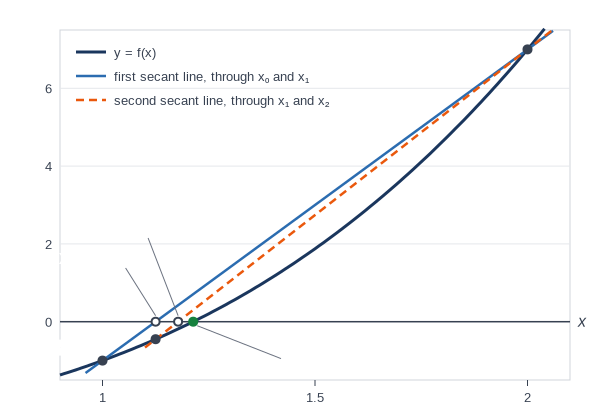
The secant method replaces the tangent line with a secant line: the line through two points on the graph, (xₙ₋₁, f(xₙ₋₁)) and (xₙ, f(xₙ)). Its slope is a difference quotient, the same quantity that the definition of the derivative takes the limit of, so it is a good stand-in for f′(xₙ) when the two points are close.
The new guess xₙ₊₁ is where the secant line crosses the x-axis. Then the oldest point is dropped, and the next secant line goes through the two newest points.
Secant method formula
x_{n+1} = x_n - f(x_n)\,\frac{x_n - x_{n-1}}{f(x_n) - f(x_{n-1})}Where it comes from: the secant line through (xₙ, f(xₙ)) has slope m = \frac{f(x_n) - f(x_{n-1})}{x_n - x_{n-1}}, so in point-slope form it is y = f(x_n) + m(x - x_n). Setting y = 0 and solving gives x = x_n - \frac{f(x_n)}{m}, which is the formula above. It is Newton’s formula with f′(xₙ) replaced by the secant slope m.
- Write the equation as f(x) = 0 and choose two starting values x₀ and x₁ near the root. They do not have to be on opposite sides of it.
- Compute f(x₀) and f(x₁).
- Use the formula to find x₂, then compute f(x₂).
- Drop the oldest value and repeat with the two newest: x₁ and x₂ give x₃, and so on.
- Stop when |xₙ₊₁ − xₙ| is below your tolerance, or when |f(xₙ₊₁)| is tiny.
How fast it is. Near a simple root p, the errors eₙ = |xₙ − p| follow e_{n+1} \approx C\,e_n e_{n-1}, where C = \left|\frac{f''(p)}{2f'(p)}\right|. That makes the order of convergence \varphi = \frac{1 + \sqrt{5}}{2} \approx 1.618, the golden ratio: each step multiplies the number of correct digits by about 1.6. Newton’s method has order 2, but it needs both f and f′ at every step, while the secant method needs just one new value of f.
Secant method examples
Example 1: A cubic equation, step by step
Use the secant method on x^3 + x - 3 = 0 with x₀ = 1 and x₁ = 2. Find x₂ through x₅, keeping 6 decimal places.
f(x_0) = 1^3 + 1 - 3 = -1
Evaluate f at x₀ = 1.
f(x_1) = 2^3 + 2 - 3 = 7
Evaluate f at x₁ = 2.
x_2 = 2 - 7\cdot\frac{2 - 1}{7 - (-1)}Substitute into the formula with n = 1.
x_2 = 2 - 7\cdot\frac{1}{8}Subtract in the numerator and the denominator.
x_2 = 2 - 0.875
Multiply.
x_2 = 1.125
Subtract.
f(x_2) = 1.125^3 + 1.125 - 3 \approx -0.451172
Evaluate f at the new point.
x_3 = 1.125 - (-0.451172)\cdot\frac{1.125 - 2}{-0.451172 - 7}Use the two newest points, x₁ = 2 and x₂ = 1.125.
x_3 = 1.125 - (-0.451172)\cdot\frac{-0.875}{-7.451172}Subtract in the numerator and the denominator.
x_3 = 1.125 - (-0.052982)
Multiply and divide (6 decimal places).
x_3 = 1.177982
Subtract.
f(x_3) \approx -0.187401
Evaluate f.
x_4 = 1.177982 - (-0.187401)\cdot\frac{1.177982 - 1.125}{-0.187401 - (-0.451172)}Use x₂ and x₃.
x_4 = 1.177982 - (-0.187401)\cdot\frac{0.052982}{0.263771}Subtract in the numerator and the denominator.
x_4 = 1.177982 - (-0.037642)
Multiply and divide.
x_4 = 1.215624
Subtract.
f(x_4) \approx 0.012002
Evaluate f.
x_5 = 1.215624 - 0.012002\cdot\frac{1.215624 - 1.177982}{0.012002 - (-0.187401)}Use x₃ and x₄.
x_5 = 1.215624 - 0.012002\cdot\frac{0.037642}{0.199403}Subtract in the numerator and the denominator.
x_5 = 1.215624 - 0.002266
Multiply and divide.
x_5 = 1.213358
Subtract.
| n | xₙ | f(xₙ) | |xₙ − xₙ₋₁| |
|---|---|---|---|
| 0 | 1 | −1 | — |
| 1 | 2 | 7 | 1 |
| 2 | 1.125 | −0.451172 | 0.875 |
| 3 | 1.177982 | −0.187401 | 0.052982 |
| 4 | 1.215624 | 0.012002 | 0.037642 |
| 5 | 1.213358 | −0.000291 | 0.002266 |
Answer: x \approx 1.2134. The root is 1.213412…, so x₅ is off by about 0.000054. For comparison, bisection on [1, 2] needs 15 halvings before its error bound 1/2ⁿ drops below 0.00006.
Example 2: Solving x = e^(−x)
In fixed-point iteration, repeating x_{n+1} = e^{-x_n} from x₀ = 0 gave only 0.500473 after four steps. Use the secant method on the same equation with x₀ = 0 and x₁ = 1.
f(x) = x - e^{-x}Move everything to one side, so the equation is f(x) = 0.
f(x_0) = 0 - e^{0} = -1Evaluate f at x₀ = 0.
f(x_1) = 1 - e^{-1} \approx 0.632121Evaluate f at x₁ = 1.
x_2 = 1 - 0.632121\cdot\frac{1 - 0}{0.632121 - (-1)}Substitute into the formula.
x_2 = 1 - 0.632121\cdot\frac{1}{1.632121}Subtract in the numerator and the denominator.
x_2 = 1 - 0.387300
Divide.
x_2 = 0.612700
Subtract.
f(x_2) = 0.612700 - e^{-0.612700} \approx 0.070814Evaluate f.
x_3 = 0.612700 - 0.070814\cdot\frac{0.612700 - 1}{0.070814 - 0.632121}Use x₁ and x₂.
x_3 = 0.612700 - 0.070814\cdot\frac{-0.387300}{-0.561307}Subtract in the numerator and the denominator.
x_3 = 0.612700 - 0.048861
Multiply and divide.
x_3 = 0.563839
Subtract.
f(x_3) \approx -0.005181
Evaluate f.
x_4 = 0.563839 - (-0.005181)\cdot\frac{0.563839 - 0.612700}{-0.005181 - 0.070814}Use x₂ and x₃.
x_4 = 0.563839 - (-0.005181)\cdot\frac{-0.048861}{-0.075995}Subtract in the numerator and the denominator.
x_4 = 0.563839 - (-0.003331)
Multiply and divide.
x_4 = 0.567170
Subtract.
Answer: x \approx 0.567170, within 0.000027 of the root 0.567143…. With the same number of steps, the secant method is far ahead of fixed-point iteration.
Example 3: Watching the error shrink
Approximate √5 with f(x) = x² − 5, x₀ = 2 and x₁ = 3. Then test the error model e_{n+1} \approx C\,e_n e_{n-1}.
f(2) = 4 - 5 = -1, \; f(3) = 9 - 5 = 4
Evaluate f at both starting values.
x_2 = 3 - 4\cdot\frac{3 - 2}{4 - (-1)}Substitute into the formula.
x_2 = 3 - 4\cdot\frac{1}{5}Subtract in the numerator and the denominator.
x_2 = 3 - 0.8
Multiply.
x_2 = 2.2
Subtract.
The next steps use the same arithmetic, each with the two newest points:
| n | xₙ | f(xₙ) | correction | error eₙ = |xₙ − √5| |
|---|---|---|---|---|
| 1 | 3 | 4 | — | 0.763932 |
| 2 | 2.2 | −0.16 | 0.8 | 0.036068 |
| 3 | 2.230769 | −0.023670 | −0.030769 | 0.005299 |
| 4 | 2.236111 | 0.000192 | −0.005342 | 0.000043 |
| 5 | 2.236068 | 0.000000 | 0.000043 | less than 0.0000001 |
C = \frac{|f''(\sqrt{5})|}{2|f'(\sqrt{5})|} = \frac{2}{2 \cdot 2\sqrt{5}}Use f′(x) = 2x and f″(x) = 2 (see higher-order derivatives).
C = \frac{1}{2\sqrt{5}} \approx 0.223607Simplify and divide.
e_4 \approx C\,e_3 e_2 = 0.223607(0.005299)(0.036068)
Apply the error model.
e_4 \approx 0.000043
Multiply.
Answer: √5 ≈ 2.236068, and the model predicts e₄ ≈ 0.000043, which matches the table. The errors go 0.036, 0.0053, 0.000043, then less than 0.0000001: the number of correct digits grows by a factor of about 1.6 each step.
Example 4: When the secant method breaks down
Try to solve x² − 4 = 0 starting from x₀ = −1 and x₁ = 1. Then restart from x₀ = 1 and x₁ = 3.
f(-1) = (-1)^2 - 4 = -3
Evaluate f at x₀ = −1.
f(1) = 1^2 - 4 = -3
Evaluate f at x₁ = 1.
f(x_1) - f(x_0) = -3 - (-3) = 0
This is the denominator of the formula.
The formula divides by 0. Geometrically, the secant line through (−1, −3) and (1, −3) is horizontal, so it never reaches the x-axis. Choose new starting values:
f(1) = -3, \; f(3) = 9 - 4 = 5
Evaluate f at x₀ = 1 and x₁ = 3.
x_2 = 3 - 5\cdot\frac{3 - 1}{5 - (-3)}Substitute into the formula.
x_2 = 3 - 5\cdot\frac{2}{8}Subtract in the numerator and the denominator.
x_2 = 3 - 1.25
Multiply.
x_2 = 1.75
Subtract.
| n | xₙ | f(xₙ) |
|---|---|---|
| 2 | 1.75 | −0.9375 |
| 3 | 1.947368 | −0.207758 |
| 4 | 2.003559 | 0.014249 |
| 5 | 1.999953 | −0.000188 |
Answer: the first start fails because f(x₀) = f(x₁); the second start reaches 1.999953 by x₅, closing in on the root 2. A bad start can also send the iterates away from the root, because, unlike bisection, the secant method does not keep the root trapped between two points.
Example 5: The interest rate on a car loan
A $15,000 car loan is paid off with 48 monthly payments of $360. The monthly interest rate r (as a percent) solves 360\cdot\frac{1 - (1 + r/100)^{-48}}{r/100} = 15000, the present value of an annuity formula. No algebra step isolates r, and the derivative is messy, so use the secant method with r₀ = 0.5 and r₁ = 1, keeping f to the cent.
f(r) = 360\cdot\frac{1 - (1 + r/100)^{-48}}{r/100} - 15000Subtract 15,000 so the equation is f(r) = 0.
f(0.5) \approx 328.91
Evaluate f at r₀ = 0.5.
f(1) \approx -1329.37
Evaluate f at r₁ = 1.
r_2 = 1 - (-1329.37)\cdot\frac{1 - 0.5}{-1329.37 - 328.91}Substitute into the formula.
r_2 = 1 - (-1329.37)\cdot\frac{0.5}{-1658.28}Subtract in the numerator and the denominator.
r_2 = 1 - 0.400828
Multiply and divide.
r_2 = 0.599172
Subtract.
f(r_2) \approx -21.55
Evaluate f.
r_3 = 0.599172 - (-21.55)\cdot\frac{0.599172 - 1}{-21.55 - (-1329.37)}Use r₁ and r₂.
r_3 = 0.599172 - (-21.55)\cdot\frac{-0.400828}{1307.82}Subtract in the numerator and the denominator.
r_3 = 0.599172 - 0.006605
Multiply and divide.
r_3 = 0.592567
Subtract.
f(r_3) \approx 1.45
Evaluate f.
r_4 = 0.592567 - 1.45\cdot\frac{0.592567 - 0.599172}{1.45 - (-21.55)}Use r₂ and r₃.
r_4 = 0.592567 - 1.45\cdot\frac{-0.006605}{23.00}Subtract in the numerator and the denominator.
r_4 = 0.592567 - (-0.000416)
Multiply and divide.
r_4 = 0.592983
Subtract.
|f(r_4)| \lt 0.01
Evaluate f: the payments now match the loan to the cent.
12r_4 = 12(0.592983) \approx 7.12
Multiply by 12 for the yearly rate.
Answer: the monthly rate is about 0.593%, an annual rate (APR) of about 7.12%.
Common mistakes
| Mistake | Example of the error | Fix |
|---|---|---|
| Mixing the order of the points | \frac{x_n - x_{n-1}}{f(x_{n-1}) - f(x_n)} | Use the same order on top and bottom: \frac{x_n - x_{n-1}}{f(x_n) - f(x_{n-1})}. |
| Keeping the first point forever | Using x₀ = 1 in every step of Example 1 | Each step uses the two newest values; drop the oldest one. |
| Expecting the root to stay trapped | Assuming every new value lies between the two before it | The secant method keeps no bracket. Use bisection or false position when you need one. |
| Rounding too early | Rounding x₂ to 1.1 in Example 1 | Keep at least 6 decimal places until the end. |
| Ignoring equal function values | f(x₀) = f(x₁) = −3 in Example 4 | The formula divides by 0. Choose new starting values. |
| Using degree mode | Calculator in degrees for cos x = x | Use radians. |
Related methods
The secant method also drives the shooting method for boundary value problems, where it adjusts the guessed starting slope until the solution hits the far boundary value.
Secant method vs. Newton’s method
Newton’s method converges with order 2 and the secant method with order about 1.618, so Newton takes fewer steps. But each Newton step needs f and f′, while each secant step needs one new f value. If f′ costs about as much as f, two secant steps cost the same as one Newton step and gain a factor of about 1.618² ≈ 2.6 in correct digits, more than Newton’s 2. That is why the secant method is often faster in practice.
Bisection and false position
Bisection always converges once f changes sign on [a, b], but it gains only one binary digit per step. The secant method is much faster but carries no guarantee. False Position Method combines them: it uses secant lines but keeps the root bracketed.
Where 1.618 comes from
If eₙ is about 10 to the power −kₙ, the error model e_{n+1} \approx C\,e_n e_{n-1} makes kₙ₊₁ ≈ kₙ + kₙ₋₁, a Fibonacci-style recurrence relation. Its growth rate is the golden ratio φ ≈ 1.618. Order of Convergence makes this idea precise for all iterative methods.
Practice problems
- Do one step of the secant method for f(x) = x^2 - 7 with x₀ = 2 and x₁ = 3.
- Do two steps for x^3 - 2x - 5 = 0 with x₀ = 2 and x₁ = 3.
- Do two steps for \cos x = x (in radians) with x₀ = 0 and x₁ = 1.
- Approximate √10 with three steps, using f(x) = x² − 10, x₀ = 3 and x₁ = 4.
- Show that the secant formula can also be written x_{n+1} = \frac{x_{n-1}f(x_n) - x_n f(x_{n-1})}{f(x_n) - f(x_{n-1})}.
- Explain why the secant method cannot start from x₀ = 1 and x₁ = 8 for f(x) = x^2 - 9x.
- Do two steps for e^x = 4 with x₀ = 1 and x₁ = 2, and compare with the exact answer ln 4.
- A secant iteration has errors e₃ = 0.01 and e₄ = 0.002, and C = 0.5. Estimate e₅.
- Do two steps for \ln x + x = 2 with x₀ = 1 and x₁ = 2.
- You deposit $150 a month for 60 months and want $10,000. The monthly rate r (as a percent) solves 150\cdot\frac{(1 + r/100)^{60} - 1}{r/100} = 10000 (the future value of an annuity). Do two secant steps from r₀ = 0.25 and r₁ = 0.5, keeping f to the cent.
Show answers
1.
f(2) = 4 - 7 = -3
Evaluate f at x₀ = 2.
f(3) = 9 - 7 = 2
Evaluate f at x₁ = 3.
x_2 = 3 - 2\cdot\frac{3 - 2}{2 - (-3)}Substitute into the formula.
x_2 = 3 - 2\cdot\frac{1}{5}Subtract in the numerator and the denominator.
x_2 = 3 - 0.4
Multiply.
x_2 = 2.6
Subtract.
Answer: x₂ = 2.6 (the root is √7 ≈ 2.645751)
2.
f(2) = 8 - 4 - 5 = -1
Evaluate f at x₀ = 2.
f(3) = 27 - 6 - 5 = 16
Evaluate f at x₁ = 3.
x_2 = 3 - 16\cdot\frac{3 - 2}{16 - (-1)}Substitute into the formula.
x_2 = 3 - 16\cdot\frac{1}{17}Subtract in the numerator and the denominator.
x_2 = 3 - 0.941176
Multiply and divide (6 decimal places).
x_2 = 2.058824
Subtract.
f(x_2) \approx -0.390795
Evaluate f.
x_3 = 2.058824 - (-0.390795)\cdot\frac{2.058824 - 3}{-0.390795 - 16}Use x₁ and x₂.
x_3 = 2.058824 - (-0.390795)\cdot\frac{-0.941176}{-16.390795}Subtract in the numerator and the denominator.
x_3 = 2.058824 - (-0.022440)
Multiply and divide.
x_3 = 2.081264
Subtract.
Answer: x₃ ≈ 2.081264 (the root is 2.094551…; more steps close the gap)
3.
f(0) = \cos 0 - 0 = 1
Use f(x) = cos x − x, evaluated in radians.
f(1) = \cos 1 - 1 \approx -0.459698
Evaluate f at x₁ = 1.
x_2 = 1 - (-0.459698)\cdot\frac{1 - 0}{-0.459698 - 1}Substitute into the formula.
x_2 = 1 - (-0.459698)\cdot\frac{1}{-1.459698}Subtract in the denominator.
x_2 = 1 - 0.314927
Multiply and divide.
x_2 = 0.685073
Subtract.
f(x_2) \approx 0.089300
Evaluate f.
x_3 = 0.685073 - 0.089300\cdot\frac{0.685073 - 1}{0.089300 - (-0.459698)}Use x₁ and x₂.
x_3 = 0.685073 - 0.089300\cdot\frac{-0.314927}{0.548998}Subtract in the numerator and the denominator.
x_3 = 0.685073 - (-0.051226)
Multiply and divide.
x_3 = 0.736299
Subtract.
Answer: x₃ ≈ 0.736299 (the root is 0.739085…)
4.
f(3) = 9 - 10 = -1, \; f(4) = 16 - 10 = 6
Evaluate f at both starting values.
x_2 = 4 - 6\cdot\frac{4 - 3}{6 - (-1)}Substitute into the formula.
x_2 = 4 - 6\cdot\frac{1}{7}Subtract in the numerator and the denominator.
x_2 = 4 - 0.857143
Multiply and divide.
x_2 = 3.142857
Subtract.
f(x_2) = 3.142857^2 - 10 \approx -0.122450
Evaluate f.
x_3 = 3.142857 - (-0.122450)\cdot\frac{3.142857 - 4}{-0.122450 - 6}Use x₁ and x₂.
x_3 = 3.142857 - (-0.122450)\cdot\frac{-0.857143}{-6.122450}Subtract in the numerator and the denominator.
x_3 = 3.142857 - (-0.017143)
Multiply and divide.
x_3 = 3.160000
Subtract.
f(x_3) = 3.16^2 - 10 = -0.0144
Evaluate f.
x_4 = 3.16 - (-0.0144)\cdot\frac{3.16 - 3.142857}{-0.0144 - (-0.122450)}Use x₂ and x₃.
x_4 = 3.16 - (-0.0144)\cdot\frac{0.017143}{0.108050}Subtract in the numerator and the denominator.
x_4 = 3.16 - (-0.002285)
Multiply and divide.
x_4 = 3.162285
Subtract.
Answer: √10 ≈ 3.162285 (the true value is 3.162278…)
5.
x_{n+1} = \frac{x_n\big(f(x_n) - f(x_{n-1})\big) - f(x_n)(x_n - x_{n-1})}{f(x_n) - f(x_{n-1})}Write xₙ over the common denominator and combine.
x_{n+1} = \frac{x_n f(x_n) - x_n f(x_{n-1}) - x_n f(x_n) + x_{n-1}f(x_n)}{f(x_n) - f(x_{n-1})}Expand the numerator (see distributive property).
x_{n+1} = \frac{x_{n-1}f(x_n) - x_n f(x_{n-1})}{f(x_n) - f(x_{n-1})}The terms xₙf(xₙ) cancel.
Answer: shown. Near the root this form subtracts two nearly equal products, so the original form is safer on a computer (see loss of significance).
6.
f(1) = 1 - 9 = -8
Evaluate f at x₀ = 1.
f(8) = 64 - 72 = -8
Evaluate f at x₁ = 8.
f(x_1) - f(x_0) = -8 - (-8) = 0
Find the denominator of the formula.
Answer: the formula would divide by 0. The secant line through (1, −8) and (8, −8) is horizontal and never crosses the x-axis. Start from other values, such as 8 and 10.
7.
f(1) = e - 4 \approx -1.281718
Use f(x) = eˣ − 4 and evaluate at x₀ = 1.
f(2) = e^2 - 4 \approx 3.389056
Evaluate f at x₁ = 2.
x_2 = 2 - 3.389056\cdot\frac{2 - 1}{3.389056 - (-1.281718)}Substitute into the formula.
x_2 = 2 - 3.389056\cdot\frac{1}{4.670774}Subtract in the numerator and the denominator.
x_2 = 2 - 0.725588
Multiply and divide.
x_2 = 1.274412
Subtract.
f(x_2) \approx -0.423402
Evaluate f.
x_3 = 1.274412 - (-0.423402)\cdot\frac{1.274412 - 2}{-0.423402 - 3.389056}Use x₁ and x₂.
x_3 = 1.274412 - (-0.423402)\cdot\frac{-0.725588}{-3.812458}Subtract in the numerator and the denominator.
x_3 = 1.274412 - (-0.080582)
Multiply and divide.
x_3 = 1.354994
Subtract.
Answer: x₃ ≈ 1.354994. Since ln 4 ≈ 1.386294, the error is still about 0.0313; the curve bends sharply between 1 and 2, so the first steps are slow.
8.
e_5 \approx C\,e_4 e_3
Use the secant error model.
e_5 \approx 0.5(0.002)(0.01)
Substitute.
e_5 \approx 0.00001
Multiply.
Answer: about 0.00001
9.
f(1) = \ln 1 + 1 - 2 = -1
Use f(x) = ln x + x − 2 and evaluate at x₀ = 1.
f(2) = \ln 2 + 2 - 2 \approx 0.693147
Evaluate f at x₁ = 2.
x_2 = 2 - 0.693147\cdot\frac{2 - 1}{0.693147 - (-1)}Substitute into the formula.
x_2 = 2 - 0.693147\cdot\frac{1}{1.693147}Subtract in the numerator and the denominator.
x_2 = 2 - 0.409384
Multiply and divide.
x_2 = 1.590616
Subtract.
f(x_2) \approx 0.054737
Evaluate f.
x_3 = 1.590616 - 0.054737\cdot\frac{1.590616 - 2}{0.054737 - 0.693147}Use x₁ and x₂.
x_3 = 1.590616 - 0.054737\cdot\frac{-0.409384}{-0.638410}Subtract in the numerator and the denominator.
x_3 = 1.590616 - 0.035100
Multiply and divide.
x_3 = 1.555516
Subtract.
Answer: x₃ ≈ 1.555516 (the root is 1.557146…)
10.
f(r) = 150\cdot\frac{(1 + r/100)^{60} - 1}{r/100} - 10000Subtract 10,000 so the equation is f(r) = 0.
f(0.25) \approx -302.99
Evaluate f at r₀ = 0.25.
f(0.5) \approx 465.50
Evaluate f at r₁ = 0.5.
r_2 = 0.5 - 465.50\cdot\frac{0.5 - 0.25}{465.50 - (-302.99)}Substitute into the formula.
r_2 = 0.5 - 465.50\cdot\frac{0.25}{768.49}Subtract in the numerator and the denominator.
r_2 = 0.5 - 0.151433
Multiply and divide.
r_2 = 0.348567
Subtract.
f(r_2) \approx -8.97
Evaluate f.
r_3 = 0.348567 - (-8.97)\cdot\frac{0.348567 - 0.5}{-8.97 - 465.50}Use r₁ and r₂.
r_3 = 0.348567 - (-8.97)\cdot\frac{-0.151433}{-474.47}Subtract in the numerator and the denominator.
r_3 = 0.348567 - (-0.002863)
Multiply and divide.
r_3 = 0.351430
Subtract.
Answer: about 0.3514% per month. A third step gives 0.351515%, about 4.22% per year.
Secant method FAQ
What is the secant method formula?
x_{n+1} = x_n - f(x_n)\,\frac{x_n - x_{n-1}}{f(x_n) - f(x_{n-1})}. It needs two starting values, and each step uses the two newest ones.
What is the difference between the secant method and Newton’s method?
Newton’s method uses the tangent line, so it needs the derivative. The secant method uses the line through the last two points, so it needs only values of f. Newton takes fewer steps; the secant method does less work per step.
What is the order of convergence of the secant method?
About 1.618, the golden ratio \frac{1 + \sqrt{5}}{2}, for a simple root and starting values close enough to it. That is faster than linear (bisection, fixed-point iteration) but slower than Newton’s quadratic convergence.
Does the secant method always converge?
No. It can fail when f(xₙ) = f(xₙ₋₁), and from poor starting values it can wander away from the root. When you need a guarantee, use bisection, or start with a few bisection steps and then switch to the secant method.
Summary
- The secant method finds a root of f(x) = 0 from two starting values and no derivatives.
- Formula: x_{n+1} = x_n - f(x_n)\,\frac{x_n - x_{n-1}}{f(x_n) - f(x_{n-1})}; each step uses the two newest points.
- It is Newton’s method with f′(xₙ) replaced by the slope of a secant line.
- Near a simple root the order of convergence is about 1.618, with e_{n+1} \approx C\,e_n e_{n-1}.
- It fails if f(xₙ) = f(xₙ₋₁), and it does not keep the root bracketed.
Previous lesson: Fixed-Point Iteration
Next lesson: False Position Method
Back to the Numerical Methods Index