
Order of Convergence
The order of convergence measures how fast an iterative method closes in on its limit. If the errors satisfy e_{n+1} \approx \lambda\,e_n^{\alpha}, the method has order α. Order 1 (linear) adds about the same number of correct digits each step; order 2 (quadratic) roughly doubles the number of correct digits each step.
Before this lesson: Fixed-Point Iteration, Newton’s Method and Secant Method
Why speed needs a precise measure
Every root-finding method in this unit produces a sequence x₀, x₁, x₂, … that converges to a root p. Writing eₙ = |xₙ − p| for the error, the question is how eₙ₊₁ compares with eₙ.
In fixed-point iteration the error shrinks by roughly the same factor each step, so each step adds a fixed number of correct digits. In Newton’s method the new error is roughly the square of the old one, so an error of 0.01 becomes about 0.0001 and then 0.00000001. The exponent on eₙ is what separates these behaviors.
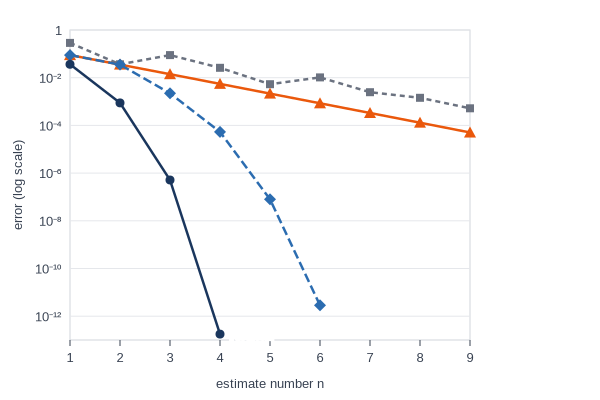
Order of convergence definition
A sequence xₙ → p with errors eₙ = |xₙ − p| has order of convergence α ≥ 1 and asymptotic error constant λ if
\lim_{n \to \infty} \frac{e_{n+1}}{e_n^{\alpha}} = \lambda, \quad 0 \lt \lambda \lt \infty- Linear (α = 1): needs λ < 1. Each step multiplies the error by about λ, adding about −log₁₀ λ correct digits.
- Superlinear (α > 1): the ratio eₙ₊₁/eₙ goes to 0. The secant method has α = (1 + √5)/2 ≈ 1.618.
- Quadratic (α = 2): the number of correct digits roughly doubles each step. Newton’s method at a simple root is quadratic.
Estimating the order from data
Taking logarithms of e_{n+1} \approx \lambda e_n^{\alpha} for two consecutive steps and dividing gives
\alpha \approx \frac{\ln(e_{n+1}/e_n)}{\ln(e_n/e_{n-1})}When the root is unknown, use the step sizes dₙ = |xₙ₊₁ − xₙ| in place of the errors. For a fast method, dₙ is almost exactly eₙ.
Order of a fixed-point iteration
For x_{n+1} = g(x_n) with fixed point p, a Taylor polynomial of g about p shows:
- If g′(p) ≠ 0 (and |g′(p)| < 1), convergence is linear with λ = |g′(p)|.
- If g′(p) = 0 and g″(p) ≠ 0, convergence is quadratic with \lambda = \frac{|g''(p)|}{2}.
Newton’s method is the fixed-point iteration g(x) = x - \frac{f(x)}{f'(x)}, and g′(p) = 0 at a simple root. That is why it is quadratic, with \lambda = \left|\frac{f''(p)}{2f'(p)}\right|.
| Method | Order α | Error constant λ |
|---|---|---|
| Bisection | 1 (for the error bound) | \frac{1}{2} |
| False position | usually 1 | depends on f and the stuck endpoint |
| Fixed-point iteration | 1 if g′(p) ≠ 0 | |g′(p)| |
| Secant method | φ ≈ 1.618 | \left|\frac{f''(p)}{2f'(p)}\right|^{0.618} |
| Newton’s method (simple root) | 2 | \left|\frac{f''(p)}{2f'(p)}\right| |
| Newton’s method (double root) | 1 | \frac{1}{2} |
Order of convergence examples
Example 1: Linear convergence in fixed-point iteration
Fixed-point iteration for x = e^(−x) from x₀ = 0 gives x₄ = 0.500473, x₅ = 0.606244, x₆ = 0.545396 and x₇ = 0.579612. The fixed point is p ≈ 0.567143. Find the error ratios and compare them with |g′(p)|.
e_4 = |0.500473 - 0.567143| = 0.066670
Subtract and take the absolute value (see absolute error).
e_5 = |0.606244 - 0.567143| = 0.039101
Same for x₅.
e_6 = |0.545396 - 0.567143| = 0.021747
Same for x₆.
e_7 = |0.579612 - 0.567143| = 0.012469
Same for x₇.
\frac{e_5}{e_4} = \frac{0.039101}{0.066670} \approx 0.5865Divide consecutive errors.
\frac{e_6}{e_5} = \frac{0.021747}{0.039101} \approx 0.5562Divide.
\frac{e_7}{e_6} = \frac{0.012469}{0.021747} \approx 0.5734Divide.
g'(x) = -e^{-x}Differentiate g(x) = e^(−x) (see derivatives of exponential functions).
|g'(p)| = e^{-0.567143} \approx 0.567143At the fixed point, e^(−p) = p.
Answer: the ratios settle near 0.567 = |g′(p)|, so the convergence is linear with λ ≈ 0.567. Each step adds only about −log₁₀ 0.567 ≈ 0.25 correct digits, so it takes about 4 steps per digit.
Example 2: Quadratic convergence in Newton’s method
Newton’s method for f(x) = x² − 2 from x₀ = 1 gives exactly x₁ = 3/2, x₂ = 17/12 and x₃ = 577/408. Check that \frac{e_{n+1}}{e_n^2} approaches \left|\frac{f''(p)}{2f'(p)}\right|.
e_1 = |1.5 - 1.414214| \approx 0.085786
Use √2 ≈ 1.41421356.
e_2 = |1.416667 - 1.414214| \approx 0.002453
17/12 ≈ 1.4166667.
e_3 = |1.4142157 - 1.4142136| \approx 0.0000021
577/408 ≈ 1.4142157.
\frac{e_2}{e_1^2} = \frac{0.002453}{0.085786^2} \approx 0.3333Square e₁, then divide.
\frac{e_3}{e_2^2} \approx \frac{0.0000021239}{0.0000060177} \approx 0.3529Use more digits: e₃ ≈ 0.0000021239 and e₂² ≈ 0.0000060177.
\lambda = \frac{|f''(\sqrt{2})|}{2|f'(\sqrt{2})|} = \frac{2}{2(2\sqrt{2})}f′(x) = 2x and f″(x) = 2.
\lambda = \frac{1}{2\sqrt{2}} \approx 0.3536Simplify and divide.
Answer: eₙ₊₁/eₙ² approaches 0.3536, so the convergence is quadratic. The errors go from about 0.09 to 0.002 to 0.000002, and x₄ is off by only about 0.0000000000016: the number of correct decimal places roughly doubles each step.
Example 3: Estimating the order without knowing the root
Newton’s method for x³ + x − 3 = 0 from x₀ = 1 gives x₁ = 1.25, x₂ = 1.214285714, x₃ = 1.213412176 and x₄ = 1.213411663. Estimate α from the step sizes.
d_0 = |1.25 - 1| = 0.25
Step sizes dₙ = |xₙ₊₁ − xₙ|.
d_1 = |1.214285714 - 1.25| = 0.035714286
Subtract.
d_2 = |1.213412176 - 1.214285714| = 0.000873538
Subtract.
d_3 = |1.213411663 - 1.213412176| = 0.000000513
Subtract.
\alpha \approx \frac{\ln(0.000873538/0.035714286)}{\ln(0.035714286/0.25)}Use the estimate with dₙ in place of eₙ (see properties of logarithms).
\alpha \approx \frac{-3.7108}{-1.9459} \approx 1.91Take the logarithms and divide.
\alpha \approx \frac{\ln(0.000000513/0.000873538)}{\ln(0.000873538/0.035714286)}Shift one step later.
\alpha \approx \frac{-7.4400}{-3.7108} \approx 2.00Take the logarithms and divide.
Answer: the estimates 1.91 and 2.00 point to α = 2, as expected for Newton’s method. Estimates from the first steps are rough; the later ones are more reliable.
Example 4: Two iterations for √3
Both g_1(x) = \frac{1}{2}\left(x + \frac{3}{x}\right) and g_2(x) = x - \frac{x^2 - 3}{4} have the fixed point p = √3. Find the order and λ for each.
g_1'(x) = \frac{1}{2}\left(1 - \frac{3}{x^2}\right)Differentiate g₁ (see power rule).
g_1'(\sqrt{3}) = \frac{1}{2}\left(1 - \frac{3}{3}\right) = 0Substitute x = √3.
g_1''(x) = \frac{3}{x^3}Differentiate again.
g_1''(\sqrt{3}) = \frac{3}{3\sqrt{3}} = \frac{1}{\sqrt{3}}Substitute; (√3)³ = 3√3.
\lambda_1 = \frac{1}{2} \cdot \frac{1}{\sqrt{3}} \approx 0.2887Use λ = |g″(p)|/2.
g_2'(x) = 1 - \frac{x}{2}Differentiate g₂.
g_2'(\sqrt{3}) = 1 - \frac{\sqrt{3}}{2} \approx 0.1340Substitute x = √3.
Answer: g₁ (which is Newton’s method for x² − 3) converges quadratically with λ ≈ 0.289. g₂ converges only linearly, with λ ≈ 0.134, so it gains about 0.87 digits per step.
Example 5: How many steps does an engineer need?
A simulation needs a root to within 10⁻¹², and the first estimate is off by 0.1. Method A converges linearly with λ = 0.5. Method B converges quadratically with e_{n+1} \approx e_n^2. About how many steps does each need?
0.1(0.5)^n \le 10^{-12}Method A: the error after n steps is about 0.1(0.5)ⁿ.
(0.5)^n \le 10^{-11}Divide both sides by 0.1.
n\,\ln(0.5) \le \ln(10^{-11})Take the natural logarithm of both sides.
n \ge \frac{\ln(10^{-11})}{\ln(0.5)} \approx 36.54Divide by ln 0.5, which is negative, so the inequality flips.
n = 37
Round up to a whole number of steps.
e_1 \approx 0.1^2 = 0.01
Method B: square the error each step.
e_2 \approx 0.01^2 = 0.0001
Square again.
e_3 \approx 0.0001^2 = 10^{-8}Square again.
e_4 \approx (10^{-8})^2 = 10^{-16}Now below 10⁻¹².
Answer: Method A needs about 37 steps; Method B needs 4. Even if each step of B costs twice as much, B is far faster. This is why quadratic methods are preferred once the iterates are close to the root.
Common mistakes
| Mistake | Example of the error | Fix |
|---|---|---|
| Using early iterates to estimate α | Getting α ≈ 1.91 from the first steps in Example 3 and calling it “not quadratic” | The definition is a limit. Use later steps, and expect early estimates to be rough. |
| Forgetting the exponent | Checking eₙ₊₁/eₙ for Newton and finding it goes to 0 | For order 2, check eₙ₊₁/eₙ², which tends to a nonzero constant. |
| Thinking order alone decides speed | Assuming a linear method with λ = 0.01 is slow | λ matters too: λ = 0.01 adds 2 digits per step. |
| Assuming Newton is always quadratic | Newton on f(x) = (x − 1)² | At a multiple root Newton is only linear (Practice Problem 6). |
| Using errors near round-off level | Estimating α from errors around 10⁻¹⁶ | Round-off dominates there; use errors well above machine precision. |
| Mixing up order and number of steps | “Order 2 means it takes 2 steps” | Order describes how the error shrinks per step, not how many steps are needed. |
Related ideas
When the error of a method behaves like a constant times h^p, two estimates with different steps can be combined to cancel that term; see Richardson extrapolation.
Speed per unit of work
Order counts steps, but steps can cost different amounts. If one evaluation of f or f′ costs one unit, Newton gains order 2 per 2 units (about √2 ≈ 1.414 per unit), while the secant method gains order 1.618 per unit. That is why the secant method often wins in practice.
Guaranteed but linear methods
The bisection method and the false position method are only linear, but they keep the root bracketed. Practical solvers, such as Brent’s method, start with bracketing steps and switch to faster superlinear steps once they are close.
Order in other numerical methods
The word order also describes how the error of a formula depends on a step size h, for example the trapezoidal rule (error proportional to h²) and Simpson’s rule (h⁴). That is a related idea, measured in h instead of in steps.
Practice problems
- A method has errors 0.2, 0.1, 0.05 and 0.025. Find its order and λ.
- A method has errors 0.1, 0.01, 0.0001 and 0.00000001. Find its order and λ.
- Estimate α from three consecutive errors 0.05, 0.004 and 0.00002.
- Fixed-point iteration xₙ₊₁ = cos xₙ converges to p ≈ 0.739085. Find its order and λ.
- Show that Newton’s method for f(x) = x² − a, which is g(x) = \frac{1}{2}\left(x + \frac{a}{x}\right), has g′(√a) = 0, and find λ.
- Show that Newton’s method for f(x) = (x − 1)² converges only linearly, and find λ.
- A linear method has λ = 0.1. How many steps reduce an error of 1 to below 10⁻¹⁰?
- A method satisfies e_{n+1} \approx 0.5\,e_n^2 and e₀ = 0.1. Estimate e₁, e₂ and e₃.
- Bisection on [1, 2] has the error bound 1/2ⁿ after n steps. How many steps guarantee an error below 10⁻⁶?
- An engineer’s fixed-point iteration has |g′(p)| ≈ 0.9, and each step takes 2 milliseconds. About how long does it take to reduce the error by a factor of 10⁸?
Show answers
1.
\frac{0.1}{0.2} = \frac{0.05}{0.1} = \frac{0.025}{0.05} = 0.5Divide consecutive errors.
Answer: linear (α = 1) with λ = 0.5
2.
\frac{0.01}{0.1^2} = \frac{0.0001}{0.01^2} = \frac{0.00000001}{0.0001^2} = 1Divide each error by the square of the one before.
Answer: quadratic (α = 2) with λ = 1
3.
\alpha \approx \frac{\ln(0.00002/0.004)}{\ln(0.004/0.05)}Substitute into the estimate.
\alpha \approx \frac{\ln(0.005)}{\ln(0.08)}Divide inside each logarithm.
\alpha \approx \frac{-5.2983}{-2.5257} \approx 2.10Take the logarithms and divide.
Answer: α ≈ 2.1, so the method looks quadratic.
4.
g'(x) = -\sin x
Differentiate g(x) = cos x (see derivatives of trig functions).
|g'(0.739085)| = \sin(0.739085) \approx 0.6736
Substitute p (in radians).
Answer: linear with λ ≈ 0.674, since g′(p) ≠ 0.
5.
g'(x) = \frac{1}{2}\left(1 - \frac{a}{x^2}\right)Differentiate.
g'(\sqrt{a}) = \frac{1}{2}\left(1 - \frac{a}{a}\right) = 0Substitute x = √a.
g''(x) = \frac{a}{x^3}Differentiate again.
g''(\sqrt{a}) = \frac{a}{a\sqrt{a}} = \frac{1}{\sqrt{a}}Substitute x = √a.
Answer: g′(√a) = 0, so the convergence is quadratic with λ = |g″(√a)|/2 = 1/(2√a).
6.
g(x) = x - \frac{(x - 1)^2}{2(x - 1)}Newton’s formula with f′(x) = 2(x − 1).
g(x) = x - \frac{x - 1}{2}Cancel one factor of x − 1.
x_{n+1} - 1 = \frac{x_n - 1}{2}Subtract 1 from both sides and simplify.
Answer: eₙ₊₁ = eₙ/2 exactly, so the convergence is linear with λ = 1/2.
7.
1(0.1)^n \lt 10^{-10}The error after n steps.
n \gt 10
Since 0.1ⁿ = 10⁻ⁿ, compare exponents.
Answer: 11 steps (after exactly 10 steps the error is about 10⁻¹⁰, so one more step brings it below)
8.
e_1 \approx 0.5(0.1)^2 = 0.005
Square 0.1, then multiply by 0.5.
e_2 \approx 0.5(0.005)^2 = 0.0000125
Square, then multiply.
e_3 \approx 0.5(0.0000125)^2 \approx 0.000000000078
Square, then multiply.
Answer: e₁ ≈ 0.005, e₂ ≈ 0.0000125, e₃ ≈ 7.8 × 10⁻¹¹
9.
\frac{1}{2^n} \lt 10^{-6}Set the bound below the tolerance.
2^n \gt 10^6
Take reciprocals, which flips the inequality.
2^{19} = 524288, \; 2^{20} = 1048576Compare powers of 2 with 1,000,000.
Answer: 20 steps
10.
(0.9)^n \le 10^{-8}Each step multiplies the error by about 0.9.
n \ge \frac{\ln(10^{-8})}{\ln(0.9)} \approx 174.8Take logarithms and divide by ln 0.9, which is negative.
n = 175
Round up.
175 \cdot 2 = 350
Multiply by 2 ms per step.
Answer: about 175 steps, or 350 milliseconds. Newton’s method from a good start would need only about 3 or 4 steps.
Order of convergence FAQ
What does order of convergence mean?
It is the exponent α in e_{n+1} \approx \lambda\,e_n^{\alpha}. It tells you how the error at one step depends on the error at the step before: α = 1 is linear, α = 2 is quadratic.
What is the difference between linear and quadratic convergence?
Linear convergence multiplies the error by a constant λ < 1 each step, adding a fixed number of digits. Quadratic convergence squares the error (times λ), so the number of correct digits roughly doubles each step.
How do you find the order of convergence from a table of iterates?
Compute errors (or step sizes, if the root is unknown) and use \alpha \approx \frac{\ln(e_{n+1}/e_n)}{\ln(e_n/e_{n-1})} on the latest steps that are still well above round-off.
What is the order of convergence of the secant method?
About 1.618, the golden ratio. It is superlinear: faster than bisection and fixed-point iteration, but slower per step than Newton’s method.
Summary
- Order α and constant λ are defined by \frac{e_{n+1}}{e_n^{\alpha}} \to \lambda.
- Linear (α = 1, λ < 1) adds a fixed number of digits per step; quadratic (α = 2) doubles them.
- Fixed-point iteration is linear with λ = |g′(p)|, unless g′(p) = 0, which gives quadratic convergence.
- Newton is quadratic at simple roots and linear at multiple roots; the secant method has order about 1.618.
- Estimate α from data with \alpha \approx \frac{\ln(e_{n+1}/e_n)}{\ln(e_n/e_{n-1})}.
Previous lesson: False Position Method
Next lesson: Lagrange Interpolation
Back to the Numerical Methods Index