
Poisson Process
A Poisson process models events that happen at random times at a constant average rate λ. The number of events in any time interval of length t has a Poisson distribution with mean λt, counts in non-overlapping intervals are independent, and the times between events are independent exponential random variables with mean 1/λ.
Before this lesson: Poisson Distribution, Exponential Distribution and Independent Events
Counts and waits from one random stream
Picture emails landing in an inbox at random moments, 6 per hour on average. You can ask two kinds of questions about this stream. How many emails come in the next 15 minutes? How long until the next one?
A Poisson process answers both. The count in a stretch of time is Poisson, and the gap between emails is exponential. Both use the same rate λ, so one number describes the whole stream.
Poisson process formulas
Let N(t) be the number of events from time 0 to time t. A Poisson process with rate \lambda \gt 0 has three properties.
- N(0) = 0, and the count in any interval of length t is Poisson with mean λt.
- Counts in non-overlapping intervals are independent.
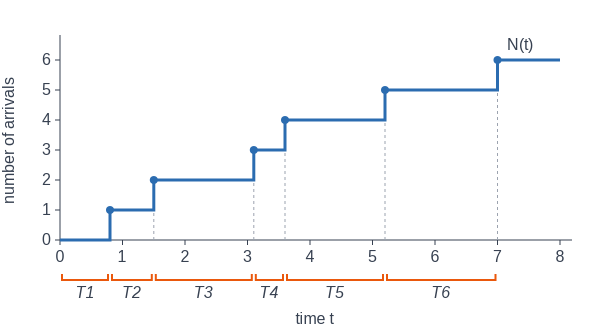
- The times between events, T1, T2, T3 and so on, are independent, and each one is Exp(λ).
P(N(t) = k) = \dfrac{e^{-\lambda t}(\lambda t)^k}{k!}, \qquad E(N(t)) = \operatorname{Var}(N(t)) = \lambda tTwo more rules handle events of different types. Splitting: if each event is type A with probability p, independently, the type A events form a Poisson process with rate pλ. Merging: two independent Poisson processes together form one Poisson process with rate λ1 + λ2, and each event comes from the first process with probability λ1/(λ1 + λ2).
\text{Splitting: } p\lambda \text{ and } (1-p)\lambda, \qquad \text{Merging: } \lambda_1 + \lambda_2Steps
- Put the rate and the time in the same units.
- Find the mean count for the interval: λt.
- For a count, use the Poisson formula with that mean. For a wait, use the exponential distribution with rate λ.
- For several intervals that don’t overlap, multiply their probabilities.
Poisson process examples
Example 1: Emails in an inbox (word problem)
Emails arrive as a Poisson process with a rate of 6 per hour. Find the probability of exactly 2 emails in the next 15 minutes, the probability of no email in the next 20 minutes, and the expected wait for the next email.
\lambda t = 6(0.25) = 1.5
Change 15 minutes to 0.25 hour and multiply by the rate.
P(N = 2) = \dfrac{e^{-1.5}(1.5)^2}{2!}Use the Poisson formula with mean 1.5.
P(N = 2) = \dfrac{0.22313 \times 2.25}{2} \approx 0.2510Evaluate and divide.
\lambda t = 6 \cdot \dfrac{1}{3} = 2Change 20 minutes to 1/3 hour and multiply.
P(N = 0) = e^{-2} \approx 0.1353No events: the Poisson formula with k = 0.
E(T) = \dfrac{1}{6} \text{ hour} = 10 \text{ minutes}The wait is Exp(6), with mean 1/λ.
Answer: about 0.2510, about 0.1353, and 10 minutes. The second answer is also the exponential right tail: waiting more than 1/3 hour has probability e^(−6/3).
Example 2: Two separate time windows
Cars pass a checkpoint as a Poisson process with a rate of 3 per minute. Find the probability of exactly 2 cars in the first minute and exactly 4 cars in the next two minutes.
P(N_1 = 2) = \dfrac{e^{-3}3^2}{2!} = \dfrac{9}{2}e^{-3}The first minute has mean 3.
P(N_2 = 4) = \dfrac{e^{-6}6^4}{4!} = 54e^{-6}The next two minutes have mean 3 × 2 = 6, and 1296/24 = 54.
P(\text{both}) = \dfrac{9}{2}e^{-3} \cdot 54e^{-6}The windows don’t overlap, so the counts are independent: multiply.
P(\text{both}) = 243e^{-9} \approx 0.0300Multiply the numbers and add the exponents (see exponent rules).
Answer: about 0.0300.
Example 3: When did the only event happen?
Visits to a small website form a Poisson process with rate λ per minute. Exactly one visit came during a 10-minute stretch. Find the probability that it came in the first 4 minutes.
P(T_1 \le 4 \mid N(10) = 1) = \dfrac{P(N(4) = 1 \text{ and } N(4, 10) = 0)}{P(N(10) = 1)}Use the definition of conditional probability; N(4, 10) counts the visits from minute 4 to minute 10.
P(T_1 \le 4 \mid N(10) = 1) = \dfrac{4\lambda e^{-4\lambda} \cdot e^{-6\lambda}}{10\lambda e^{-10\lambda}}The windows don’t overlap, so multiply; use the Poisson formula with k = 1 and k = 0.
P(T_1 \le 4 \mid N(10) = 1) = \dfrac{4}{10} = 0.4Combine e^(−4λ)e^(−6λ) = e^(−10λ) and cancel.
Answer: 0.4, whatever the rate is. Given one event in [0, 10], its time is uniform on [0, 10] (see uniform distribution).
Example 4: Splitting customers (word problem)
Customers enter a store as a Poisson process with a rate of 20 per hour. Each one buys something with probability 0.3, independently. Find the probability that at least 2 customers buy something in the next 30 minutes.
\lambda_B = 0.3(20) = 6 \text{ per hour}Splitting: the buyers form a Poisson process with rate pλ.
\lambda_B t = 6(0.5) = 3
Mean number of buyers in half an hour.
P(N \ge 2) = 1 - P(N = 0) - P(N = 1)
Use the complement rule.
P(N \ge 2) = 1 - e^{-3} - 3e^{-3} = 1 - 4e^{-3}Poisson formula with k = 0 and k = 1; combine like terms.
P(N \ge 2) \approx 1 - 0.1991 = 0.8009
Evaluate.
Answer: about 0.8009.
Example 5: Merging calls and texts (word problem)
A support line gets calls as a Poisson process with rate 4 per hour and, independently, texts with rate 2 per hour. Find the probability that no message of either kind arrives in the next 15 minutes, and the probability that the next message is a call.
\lambda = 4 + 2 = 6 \text{ per hour}Merging: add the rates.
P(T \gt 0.25) = e^{-6(0.25)} = e^{-1.5} \approx 0.2231The first wait is Exp(6); use the right-tail formula.
P(\text{call first}) = \dfrac{4}{4 + 2} = \dfrac{2}{3}Each merged event is a call with probability λ1/(λ1 + λ2).
Answer: about 0.2231, and 2/3.
Common mistakes
| Mistake | Example of the error | Fix |
|---|---|---|
| Using the hourly rate for a shorter window | Mean 6 for a 15-minute window in Example 1 | Multiply the rate by the time: 6 × 0.25 = 1.5. |
| Mixing units | λ = 6 per hour with t = 15 minutes, so λt = 90 | Write t in hours (0.25) or λ per minute (0.1). |
| Treating overlapping windows as independent | Multiplying P(N(0, 2) = 3) by P(N(1, 3) = 2) | Only non-overlapping windows are independent; split the time into separate pieces first. |
| Using the full rate for one type | Mean 10 buyers per half hour in Example 4 | A subtype has rate pλ: 0.3 × 20 = 6 per hour, so 3 per half hour. |
| Adding probabilities instead of rates when merging | P(no message) = e^(−1) + e^(−0.5) in Example 5 | Add the rates first: λ = 6, so P = e^(−1.5). |
Related ideas
Waiting for several events
The time until the first event is exponential. The time until the nth event is a sum of n independent exponential gaps, and it follows the Gamma Distribution, the next lesson.
Where the Poisson process comes from
Split [0, t] into n tiny slots, each with an event with probability λt/n. The count is then binomial with n trials, and as n grows it becomes Poisson with mean λt. This is why the Poisson process fits rare events spread over many small chances.
Arrival times given the count
Given N(t) = n, the n arrival times act like n independent uniform points on [0, t], sorted in order. Example 3 is the case n = 1.
Practice problems
- Events occur as a Poisson process with rate 4 per hour. Find the probability of exactly 3 events in one hour.
- Events occur at rate 2 per minute. Find the mean and variance of the number of events in 5 minutes.
- A rare machine fault happens at rate 0.5 per day. Find the probability of no fault in a 7-day week.
- Buses arrive as a Poisson process with rate 3 per hour. Find the expected wait for the next bus and the probability of waiting more than 40 minutes.
- Events occur at rate 2 per hour. Find the probability of no events in the first hour and exactly 2 events in the next two hours.
- Exactly one event happened in [0, 5]. Find the probability that it happened after time 4.
- Orders arrive at rate 10 per hour, and 40% of them are rush orders, independently. Find the probability of no rush order in the next 15 minutes.
- Two independent processes have rates 1.5 and 2.5 per hour. Find the probability of at least one event in the next 30 minutes.
- For the processes in problem 8, find the probability that the next event comes from the first process.
- Events occur at rate 1 per minute. Find P(N(2) ≥ 2).
Show answers
1.
P(N = 3) = \dfrac{e^{-4}4^3}{3!} = \dfrac{64}{6}e^{-4}Use the Poisson formula with mean 4.
P(N = 3) \approx 10.667 \times 0.018316 \approx 0.1954
Evaluate.
Answer: about 0.1954
2.
\lambda t = 2(5) = 10
Mean count for 5 minutes.
E(N) = \operatorname{Var}(N) = 10For a Poisson count, the mean and variance are both λt.
Answer: mean 10, variance 10
3.
\lambda t = 0.5(7) = 3.5
Mean number of faults in a week.
P(N = 0) = e^{-3.5} \approx 0.0302Poisson formula with k = 0.
Answer: about 0.0302
4.
E(T) = \dfrac{1}{3} \text{ hour} = 20 \text{ minutes}The wait is Exp(3), with mean 1/λ.
P\left(T \gt \dfrac{2}{3}\right) = e^{-3 \cdot \frac{2}{3}} = e^{-2} \approx 0.135340 minutes is 2/3 hour; use the right-tail formula.
Answer: 20 minutes; about 0.1353
5.
P(N_1 = 0) = e^{-2}First hour: mean 2, k = 0.
P(N_2 = 2) = \dfrac{e^{-4}4^2}{2!} = 8e^{-4}Next two hours: mean 4, k = 2.
P(\text{both}) = e^{-2} \cdot 8e^{-4} = 8e^{-6} \approx 0.0198Non-overlapping windows: multiply.
Answer: about 0.0198
6.
P(T_1 \gt 4 \mid N(5) = 1) = \dfrac{5 - 4}{5} = 0.2Given one event, its time is uniform on [0, 5].
Answer: 0.2
7.
\lambda_R = 0.4(10) = 4 \text{ per hour}Splitting: rate pλ.
P(N = 0) = e^{-4(0.25)} = e^{-1} \approx 0.3679Mean 1 in 15 minutes; k = 0.
Answer: about 0.3679
8.
\lambda = 1.5 + 2.5 = 4
Merging: add the rates.
P(N \ge 1) = 1 - e^{-4(0.5)} = 1 - e^{-2} \approx 0.8647Complement of no events in half an hour.
Answer: about 0.8647
9.
P(\text{first process}) = \dfrac{1.5}{1.5 + 2.5} = 0.375Rate of the first process over the total rate.
Answer: 0.375
10.
P(N \ge 2) = 1 - e^{-2} - 2e^{-2}Mean 2; subtract P(N = 0) and P(N = 1).
P(N \ge 2) = 1 - 3e^{-2} \approx 1 - 0.4060 = 0.5940Combine like terms and evaluate.
Answer: about 0.5940
Poisson process FAQ
What is a Poisson process?
It is a model for events that happen one at a time, at random, at a constant average rate. Counts in any window are Poisson, and the gaps between events are exponential.
What is the difference between a Poisson distribution and a Poisson process?
A Poisson distribution describes one count, like the number of calls in one hour. A Poisson process describes the whole stream of events over time, so it gives the counts for every window and the waiting times between events.
Why are the times between events exponential?
Waiting longer than t for the next event means zero events in a window of length t. That has Poisson probability e^(−λt), which is exactly the exponential right tail.
What are the assumptions of a Poisson process?
Events happen one at a time, the average rate stays constant, and what happens in one time window does not affect any window that doesn’t overlap it. If the rate changes, for example by time of day, a basic Poisson process is not the right model.
Summary
- The count in a window of length t is Poisson with mean λt.
- Counts in non-overlapping windows are independent, so their probabilities multiply.
- The gaps between events are independent Exp(λ) waits with mean 1/λ.
- Splitting gives rates pλ, and merging adds rates.
- Given one event in [0, t], its time is uniform on [0, t].
Previous lesson: Exponential Distribution
Next lesson: Gamma Distribution
Back to the Probability Theory Index