
Strong Induction
Strong induction is a proof method that proves a statement P(n) for every integer n ≥ a. You check one or more base cases, then prove P(k + 1) while assuming that P(a), P(a + 1), …, P(k) are all true. Use it when each case depends on several earlier cases, not just the one before.
Before this lesson: Mathematical Induction and Proof by Contradiction
What is strong induction?
In ordinary mathematical induction, the inductive step assumes P(k) and proves P(k + 1). Strong induction, also called complete induction, lets you assume more: every case from P(a) up to P(k). That matters when P(k + 1) depends on a case further back, such as P(k − 3) or a factor of k + 1.
Picture a staircase where some steps are reached by a long stride. To stand on step k + 1, you may need to push off from step k − 3 instead of step k. Strong induction lets you use any step you have already reached.
The strong induction principle
Let P(n) be a statement about integers n ≥ a, and let b ≥ a. Suppose that both of these hold:
P(a),\ P(a+1),\ \dots,\ P(b) \text{ are true}\big(P(a) \land P(a+1) \land \cdots \land P(k)\big) \to P(k+1) \text{ for every } k \ge bThen P(n) is true for every integer n ≥ a. The cases a through b are the base cases. The assumption that P(a) through P(k) are all true is the strong inductive hypothesis.
| Feature | Ordinary induction | Strong induction |
|---|---|---|
| Inductive hypothesis | P(k) only | P(a), P(a + 1), …, P(k) |
| Typical base cases | One | As many as the step reaches back |
| Good for | Sums and formulas where case k + 1 uses case k | Factoring, postage, recurrences that use several earlier terms |
| What it can prove | P(n) for all n ≥ a | The same statements: the two methods are equivalent |
How to write a proof by strong induction
- Define P(n) and the first value a.
- Check enough base cases. If the step uses P(k + 1 − d), check the first d cases.
- State the strong inductive hypothesis: for some k ≥ b, P(j) is true for every j with a ≤ j ≤ k.
- Prove P(k + 1), and check that every earlier case you use lies between a and k.
- Conclude that P(n) is true for every integer n ≥ a.
Strong induction examples
Example 1: A bound on Fibonacci numbers
The Fibonacci numbers are F1 = 1, F2 = 1 and Fn = Fn−1 + Fn−2 for n ≥ 3. Prove that F_n \lt 2^n for every n ≥ 1.
F_1 = 1 \lt 2 = 2^1
Base case n = 1.
F_2 = 1 \lt 4 = 2^2
Base case n = 2. Two base cases are needed because each term uses the two before it.
F_j \lt 2^j \text{ for } 1 \le j \le kStrong inductive hypothesis, for some k ≥ 2.
F_{k+1} = F_k + F_{k-1}Use the Fibonacci rule; it applies because k + 1 ≥ 3.
F_{k+1} \lt 2^k + 2^{k-1}Apply the hypothesis to Fk and Fk−1; both k and k − 1 lie between 1 and k.
2^k + 2^{k-1} \lt 2^k + 2^kReplace 2^{k-1} with the larger 2^k.
2^k + 2^k = 2^{k+1}Two copies of 2^k make 2 \cdot 2^k = 2^{k+1} (see exponent rules).
F_{k+1} \lt 2^{k+1}Chain the three results.
Answer: by strong induction, F_n \lt 2^n for every n ≥ 1. For example, F_{10} = 55 \lt 1024.
Example 2: Postage stamps (word problem)
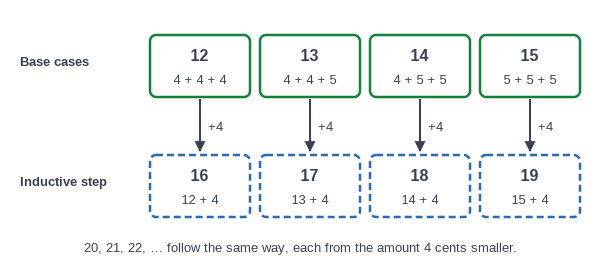
A post office sells only 4-cent and 5-cent stamps. Prove that every postage amount of 12 cents or more can be made exactly. Let P(n) be the statement “n cents can be made with 4-cent and 5-cent stamps.”
12 = 4 + 4 + 4
Base case: three 4-cent stamps.
13 = 4 + 4 + 5
Base case: two 4s and a 5.
14 = 4 + 5 + 5
Base case: one 4 and two 5s.
15 = 5 + 5 + 5
Base case: three 5-cent stamps.
P(j) \text{ for } 12 \le j \le kStrong inductive hypothesis, for some k ≥ 15.
k + 1 = (k - 3) + 4
Split k + 1 cents into k − 3 cents plus one 4-cent stamp.
12 \le k - 3 \le k
Since k ≥ 15, k − 3 ≥ 12, so P(k − 3) is part of the hypothesis.
P(k+1)
Make k − 3 cents, then add one 4-cent stamp.
Answer: every amount of at least 12 cents can be made. For example, 23 = 19 + 4 = 15 + 4 + 4 = 5 + 5 + 5 + 4 + 4. The proof needs four base cases because the step reaches back 4 cents, and the starting point matters: 11 cents can’t be made.
Example 3: Every integer is a product of primes
Prove that every integer n ≥ 2 is a prime or a product of primes.
2 \text{ is prime}Base case n = 2.
P(j) \text{ for } 2 \le j \le kStrong inductive hypothesis: for some k ≥ 2, each integer from 2 to k is a prime or a product of primes.
k + 1 \text{ is prime}Case 1: if k + 1 is prime, P(k + 1) is true.
k + 1 = ab,\ 2 \le a \le k,\ 2 \le b \le k
Case 2: otherwise k + 1 = ab with 1 \lt a \lt k + 1, and then b = (k + 1)/a also lies strictly between 1 and k + 1.
a = p_1 \cdots p_r,\ b = q_1 \cdots q_s
Apply the hypothesis to a and b: each is a prime or a product of primes.
k + 1 = p_1 \cdots p_r\, q_1 \cdots q_s
Multiply the two factorizations.
Answer: every integer n ≥ 2 is a prime or a product of primes. Ordinary induction gets stuck here, because knowing that 59 is prime says nothing about 60. Strong induction uses 60 = 6 · 10 and the factorizations of 6 and 10, as in prime factorization.
Example 4: Proving a formula for a recurrence
A sequence has a1 = 1, a2 = 5 and an = an−1 + 2an−2 for n ≥ 3. Prove that a_n = 2^n + (-1)^n for every n ≥ 1.
a_1 = 1 = 2^1 + (-1)^1
Base case n = 1: 2 − 1 = 1.
a_2 = 5 = 2^2 + (-1)^2
Base case n = 2: 4 + 1 = 5.
a_j = 2^j + (-1)^j \text{ for } 1 \le j \le kStrong inductive hypothesis, for some k ≥ 2.
a_{k+1} = a_k + 2a_{k-1}Use the recurrence; it applies because k + 1 ≥ 3.
a_{k+1} = 2^k + (-1)^k + 2\big(2^{k-1} + (-1)^{k-1}\big)Substitute the hypothesis for ak and ak−1.
a_{k+1} = 2^k + (-1)^k + 2^k + 2(-1)^{k-1}Distribute the 2 (distributive property); 2 \cdot 2^{k-1} = 2^k.
a_{k+1} = 2^{k+1} + (-1)^k + 2(-1)^{k-1}Add 2^k + 2^k = 2^{k+1}.
a_{k+1} = 2^{k+1} - (-1)^{k-1} + 2(-1)^{k-1}Rewrite (-1)^k = -(-1)^{k-1}.
a_{k+1} = 2^{k+1} + (-1)^{k-1}Combine like terms: −1 + 2 = 1 copy of (-1)^{k-1}.
a_{k+1} = 2^{k+1} + (-1)^{k+1}(-1)^{k+1} = (-1)^{k-1} \cdot (-1)^2 = (-1)^{k-1}.
Answer: a_n = 2^n + (-1)^n for every n ≥ 1. Check: a3 = 5 + 2 · 1 = 7, and 23 + (−1)3 = 8 − 1 = 7.
Example 5: Every positive integer has a binary form
Prove that every positive integer n is a sum of distinct powers of 2.
1 = 2^0
Base case n = 1.
P(j) \text{ for } 1 \le j \le kStrong inductive hypothesis, for some k ≥ 1.
k + 1 = 2m,\ 1 \le m \le k
Case 1: k + 1 is even. Then m = (k + 1)/2 is at least 1 and less than k + 1.
m = 2^{e_1} + \cdots + 2^{e_r}Apply the hypothesis to m, with distinct exponents e1, …, er.
k + 1 = 2^{e_1 + 1} + \cdots + 2^{e_r + 1}Multiply by 2; the exponents all go up by 1, so they stay distinct.
k + 1 = 2m + 1,\ 1 \le m \le k
Case 2: k + 1 is odd. Since k + 1 ≥ 3, m = k/2 is at least 1.
k + 1 = 2^{e_1 + 1} + \cdots + 2^{e_r + 1} + 2^0Write 2m as in Case 1 and add 20 = 1. Every exponent in 2m is at least 1, so 20 is new.
Answer: every positive integer is a sum of distinct powers of 2. For example, 13 = 2 · 6 + 1, 6 = 2 · 3 and 3 = 2 · 1 + 1, which gives 13 = 8 + 4 + 1 = 23 + 22 + 20.
Common mistakes
| Mistake | Example of the error | Fix |
|---|---|---|
| Too few base cases | Checking only 12 cents in the postage proof, then writing 13 = 9 + 4 | 9 is below 12, so the hypothesis doesn’t cover it. Check 12, 13, 14 and 15 first. |
| Using a case below the start | Proving F2 from F1 + F0 when the sequence starts at F1 | Check n = 1 and n = 2 as base cases and start the step at k ≥ 2, so k − 1 ≥ 1. |
| Assuming what you want to prove | “Assume P(j) for every j ≤ k + 1” | The hypothesis stops at k. P(k + 1) is the goal. |
| Not checking the size of the earlier cases | “k + 1 = ab, so a and b factor by the hypothesis” | Say why 2 ≤ a ≤ k and 2 ≤ b ≤ k: neither factor is 1 or k + 1. |
| Thinking strong induction proves more | “This needs strong induction because ordinary induction is too weak to prove it” | The two methods prove exactly the same statements. Strong induction just gives a more useful hypothesis. |
Related ideas
Strong induction is equivalent to the well-ordering principle: every nonempty set of positive integers has a least element. So a strong induction proof can be rewritten as a “smallest counterexample” proof by contradiction: if P(n) failed for some n, take the least such n and use the true earlier cases to show P(n) holds after all. The inductive step itself is usually a direct proof. Sequences defined from earlier terms, like those in Examples 1 and 4, return in the recurrence relations unit later in this course.
Practice problems
- Prove that every amount of 8 cents or more can be made with 3-cent and 5-cent stamps. List the base cases and the step.
- A sequence starts at a1 and has an = an−1 + an−3 for n ≥ 4. How many base cases does a strong induction proof about an need?
- Let a1 = 2, a2 = 4 and an = 2an−1 − an−2 for n ≥ 3. Prove that an = 2n.
- Let a0 = 2, a1 = 3 and an = 3an−1 − 2an−2 for n ≥ 2. Prove that a_n = 2^n + 1 for every n ≥ 0.
- Prove that the Fibonacci numbers satisfy F_n \ge \left(\tfrac{3}{2}\right)^{n-2} for every n ≥ 1.
- Prove that every integer n ≥ 2 has a prime divisor.
- Prove that every amount of 18 cents or more can be made with 4-cent and 7-cent stamps.
- Find the error: “Base case: 12 = 4 + 4 + 4. Step: assume every amount from 12 to k cents can be made; then k + 1 = (k − 3) + 4. So every amount of at least 12 cents can be made with 4-cent and 5-cent stamps.”
- A chocolate bar has n squares. Each break splits one piece into two smaller pieces. Prove that it always takes exactly n − 1 breaks to separate the bar into single squares.
- Let a1 = 1, a2 = 2, a3 = 3 and an = an−1 + an−2 + an−3 for n ≥ 4. Prove that a_n \lt 2^n for every n ≥ 1.
Show answers
1.
8 = 3 + 5
Base case.
9 = 3 + 3 + 3
Base case.
10 = 5 + 5
Base case.
k + 1 = (k - 2) + 3
For k ≥ 10, assume every amount from 8 to k cents can be made. Since k − 2 ≥ 8, make k − 2 cents and add a 3-cent stamp.
Answer: three base cases (8, 9 and 10 cents); the step adds a 3-cent stamp to k − 2 cents
2.
a_{k+1} = a_k + a_{k-2}The step for k + 1 uses ak−2, which is 3 places back.
k - 2 \ge 1
For ak−2 to be covered, k ≥ 3, so the first step proves a4.
Answer: three base cases, n = 1, 2 and 3
3.
a_1 = 2 = 2(1),\ a_2 = 4 = 2(2)
Base cases n = 1 and n = 2.
a_{k+1} = 2a_k - a_{k-1}For k ≥ 2, assume aj = 2j for 1 ≤ j ≤ k. Use the recurrence.
a_{k+1} = 2(2k) - 2(k - 1)Substitute the hypothesis.
a_{k+1} = 4k - 2k + 2Distribute.
a_{k+1} = 2k + 2Combine like terms.
a_{k+1} = 2(k + 1)Factor out 2.
Answer: an = 2n for every n ≥ 1, so the sequence is the arithmetic sequence 2, 4, 6, …
4.
a_0 = 2 = 2^0 + 1,\ a_1 = 3 = 2^1 + 1
Base cases n = 0 and n = 1.
a_{k+1} = 3a_k - 2a_{k-1}For k ≥ 1, assume a_j = 2^j + 1 for 0 ≤ j ≤ k. Use the recurrence.
a_{k+1} = 3(2^k + 1) - 2(2^{k-1} + 1)Substitute the hypothesis.
a_{k+1} = 3 \cdot 2^k + 3 - 2^k - 2Distribute; 2 \cdot 2^{k-1} = 2^k.
a_{k+1} = 2 \cdot 2^k + 1Combine like terms.
a_{k+1} = 2^{k+1} + 1Multiply powers of 2.
Answer: a_n = 2^n + 1 for every n ≥ 0
5.
F_1 = 1 \ge \tfrac{2}{3} = \left(\tfrac{3}{2}\right)^{-1}Base case n = 1.
F_2 = 1 \ge 1 = \left(\tfrac{3}{2}\right)^{0}Base case n = 2.
F_{k+1} = F_k + F_{k-1}For k ≥ 2, assume F_j \ge \left(\tfrac{3}{2}\right)^{j-2} for 1 ≤ j ≤ k.
F_{k+1} \ge \left(\tfrac{3}{2}\right)^{k-2} + \left(\tfrac{3}{2}\right)^{k-3}Apply the hypothesis to Fk and Fk−1.
\left(\tfrac{3}{2}\right)^{k-2} + \left(\tfrac{3}{2}\right)^{k-3} = \left(\tfrac{3}{2}\right)^{k-3} \cdot \tfrac{5}{2}Factor out \left(\tfrac{3}{2}\right)^{k-3}, since 3/2 + 1 = 5/2.
\left(\tfrac{3}{2}\right)^{k-3} \cdot \tfrac{5}{2} \ge \left(\tfrac{3}{2}\right)^{k-3} \cdot \tfrac{9}{4}5/2 = 10/4, which is at least 9/4.
\left(\tfrac{3}{2}\right)^{k-3} \cdot \tfrac{9}{4} = \left(\tfrac{3}{2}\right)^{k-1}9/4 = (3/2)2; add the exponents.
Answer: F_{k+1} \ge \left(\tfrac{3}{2}\right)^{k-1}, so F_n \ge \left(\tfrac{3}{2}\right)^{n-2} for every n ≥ 1
6.
2 \mid 2
Base case: 2 is prime and divides itself.
k + 1 \text{ is prime}For k ≥ 2, assume each of 2, …, k has a prime divisor. Case 1: k + 1 is prime, so it is its own prime divisor.
k + 1 = ab,\ 2 \le a \le k
Case 2: k + 1 is composite, with a factor a strictly between 1 and k + 1.
p \mid a
By the hypothesis, a has a prime divisor p.
p \mid k + 1
p divides a and a divides k + 1, so p divides k + 1.
Answer: every integer n ≥ 2 has a prime divisor
7.
18 = 4 + 7 + 7
Base case.
19 = 4 + 4 + 4 + 7
Base case.
20 = 4 + 4 + 4 + 4 + 4
Base case.
21 = 7 + 7 + 7
Base case.
k + 1 = (k - 3) + 4
For k ≥ 21, assume every amount from 18 to k cents can be made. Since k − 3 ≥ 18, make k − 3 cents and add a 4-cent stamp.
Answer: every amount of at least 18 cents can be made (17 cents can’t)
8.
k = 12:\ k - 3 = 9 \lt 12
The first step, from 12 to 13 cents, uses 9 cents, which the hypothesis doesn’t cover.
Answer: there are too few base cases; 13, 14 and 15 cents must also be checked before the step works
9.
1 - 1 = 0
Base case n = 1: a single square needs 0 breaks.
a + b = k + 1,\ 1 \le a \le k,\ 1 \le b \le k
For k ≥ 1, assume a bar of j squares needs j − 1 breaks for 1 ≤ j ≤ k. The first break splits a bar of k + 1 squares into pieces of a and b squares.
(a - 1) + (b - 1) + 1
Count the breaks: those for each piece (by the hypothesis) plus the first break.
(a - 1) + (b - 1) + 1 = a + b - 1
Combine like terms.
a + b - 1 = k
Substitute a + b = k + 1.
Answer: a bar of n squares always takes exactly n − 1 breaks, no matter how you break it
10.
a_1 = 1 \lt 2,\ a_2 = 2 \lt 4,\ a_3 = 3 \lt 8
Three base cases, because each term uses the three before it.
a_{k+1} = a_k + a_{k-1} + a_{k-2}For k ≥ 3, assume a_j \lt 2^j for 1 ≤ j ≤ k. Use the recurrence.
a_{k+1} \lt 2^k + 2^{k-1} + 2^{k-2}Apply the hypothesis to the three terms.
2^k + 2^{k-1} + 2^{k-2} = 2^{k-2}(4 + 2 + 1)Factor out 2^{k-2}.
2^{k-2}(4 + 2 + 1) = 7 \cdot 2^{k-2}Add 4 + 2 + 1.
7 \cdot 2^{k-2} \lt 8 \cdot 2^{k-2} = 2^{k+1}7 is less than 8, and 8 \cdot 2^{k-2} = 2^3 \cdot 2^{k-2} = 2^{k+1}.
Answer: a_n \lt 2^n for every n ≥ 1
Strong induction FAQ
What is the difference between strong induction and regular induction?
Regular induction assumes only P(k) to prove P(k + 1). Strong induction assumes P(a), P(a + 1), …, P(k), so the step can use any earlier case.
When should you use strong induction?
Use it when case k + 1 depends on a case other than k, such as a factor of k + 1, an amount a few units smaller, or a recurrence that uses two or more earlier terms.
How many base cases do you need for strong induction?
You need as many as the step reaches back. If proving P(k + 1) uses P(k + 1 − d), check the first d cases, as in the postage proof with four base cases.
Is strong induction stronger than weak induction?
No. The two methods prove exactly the same statements, and each can be rewritten as the other. “Strong” refers only to the larger hypothesis, which often makes the proof easier to write.
Summary
- Strong induction proves P(n) for all n ≥ a by checking base cases and proving P(k + 1) from P(a), …, P(k).
- Check as many base cases as the step reaches back, and make sure every case you use lies between a and k.
- It is the natural tool for factorizations, postage problems and recurrences that use several earlier terms.
- Strong induction, ordinary induction and the well-ordering principle are equivalent.
- A strong induction proof can also be written as a smallest-counterexample proof by contradiction.
Previous lesson: Proof by Contradiction
Next lesson: Sets and Subsets
Back to the Discrete Math Index