
Tangent Planes
A tangent plane to the surface z = f(x, y) at (a, b) is the plane that touches the surface there and has the same slopes in the x and y directions. Its equation is z = f(a, b) + fx(a, b)(x − a) + fy(a, b)(y − b). Near the point, the plane approximates the function.
Before this lesson: Partial Derivatives, Equation of a Plane and Linear Approximation
What a tangent plane is
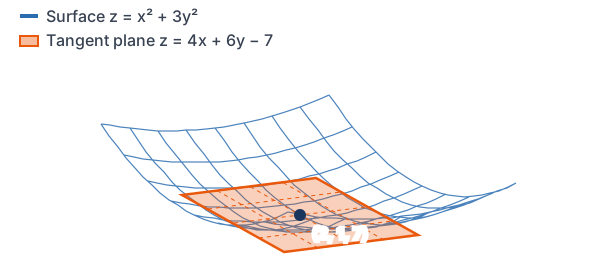
Zoom in on a smooth surface and it starts to look flat. The flat piece it looks like is the tangent plane. In one variable, a curve looks like its tangent line up close; this is the same idea one dimension higher.
The tangent plane has to match the surface’s slope in the x direction, which is f_x(a, b), and its slope in the y direction, which is f_y(a, b). It also has to pass through the point (a, b, f(a, b)). Those three facts pin down exactly one plane.
Tangent plane equation
z = f(a, b) + f_x(a, b)(x - a) + f_y(a, b)(y - b)
- Linearization: the right side is called the linearization L(x, y). For (x, y) near (a, b), f(x, y) ≈ L(x, y). This is linear approximation in two variables.
- Total differential: a small change in the inputs changes z by about dz = f_x \, dx + f_y \, dy.
- Surfaces F(x, y, z) = k: the tangent plane at (x_0, y_0, z_0) is F_x(x - x_0) + F_y(y - y_0) + F_z(z - z_0) = 0, with the partials evaluated at the point.
- Normal vector: for z = f(x, y), the vector \langle f_x, f_y, -1 \rangle is perpendicular to the tangent plane. For F(x, y, z) = k, use \langle F_x, F_y, F_z \rangle.
- When it works: if f_x and f_y are continuous near (a, b), then f is differentiable there and the tangent plane is a good fit.
Tangent plane examples
Example 1: Tangent plane to a paraboloid
Find the tangent plane to z = x² + 3y² at the point (2, 1, 7).
f(2, 1) = 2^2 + 3(1)^2 = 7
Check that the point is on the surface.
f_x = 2x
Find the partial derivative with respect to x.
f_x(2, 1) = 2(2) = 4
Evaluate at (2, 1).
f_y = 6y
Partial derivative with respect to y.
f_y(2, 1) = 6(1) = 6
Evaluate at (2, 1).
z = 7 + 4(x - 2) + 6(y - 1)
Substitute into the tangent plane equation.
z = 7 + 4x - 8 + 6y - 6
Distribute.
z = 4x + 6y - 7
Combine the constants.
Answer: the tangent plane is z = 4x + 6y − 7.
Example 2: Linear approximation of a square root
Use a linear approximation to estimate √(3.02² + 3.97²).
f(x, y) = \sqrt{x^2 + y^2}, \quad (a, b) = (3, 4)Pick a nearby point where f is easy to find.
f(3, 4) = \sqrt{9 + 16} = 5Evaluate f.
f_x = \dfrac{x}{\sqrt{x^2 + y^2}}Chain rule in x.
f_x(3, 4) = \dfrac{3}{5} = 0.6Evaluate.
f_y = \dfrac{y}{\sqrt{x^2 + y^2}}Chain rule in y.
f_y(3, 4) = \dfrac{4}{5} = 0.8Evaluate.
L = 5 + 0.6(3.02 - 3) + 0.8(3.97 - 4)
Substitute into the linearization.
= 5 + 0.6(0.02) + 0.8(-0.03)
Subtract inside the parentheses.
= 5 + 0.012 - 0.024
Multiply.
= 4.988
Add and subtract.
Answer: √(3.02² + 3.97²) ≈ 4.988. A calculator gives 4.98812…, so the estimate is off by about 0.0001.
Example 3: A logarithm surface
Find the tangent plane to z = ln(x − 2y) at the point where x = 3 and y = 1.
f(3, 1) = \ln(3 - 2) = \ln 1 = 0
Find the z-coordinate of the point.
f_x = \dfrac{1}{x - 2y}The derivative of ln u is u′/u, and the x-derivative of x − 2y is 1.
f_x(3, 1) = \dfrac{1}{1} = 1Evaluate.
f_y = \dfrac{-2}{x - 2y}The y-derivative of x − 2y is −2.
f_y(3, 1) = \dfrac{-2}{1} = -2Evaluate.
z = 0 + 1(x - 3) - 2(y - 1)
Substitute into the tangent plane equation.
z = x - 3 - 2y + 2
Distribute.
z = x - 2y - 1
Combine the constants.
Answer: the tangent plane at (3, 1, 0) is z = x − 2y − 1.
Example 4: A surface given by an equation
Find the tangent plane and the normal line to the ellipsoid x² + 2y² + 3z² = 21 at (1, 2, 2).
1^2 + 2(2)^2 + 3(2)^2 = 1 + 8 + 12 = 21
Check that the point is on the surface.
F_x = 2x = 2
Let F = x² + 2y² + 3z², differentiate with respect to x, and evaluate at x = 1.
F_y = 4y = 8
Differentiate with respect to y; evaluate at y = 2.
F_z = 6z = 12
Differentiate with respect to z; evaluate at z = 2.
2(x - 1) + 8(y - 2) + 12(z - 2) = 0
Substitute into the tangent plane formula for F = k.
(x - 1) + 4(y - 2) + 6(z - 2) = 0
Divide both sides by 2.
x - 1 + 4y - 8 + 6z - 12 = 0
Distribute.
x + 4y + 6z = 21
Add 21 to both sides.
x = 1 + t, \quad y = 2 + 4t, \quad z = 2 + 6t
Normal line: start at the point and move along the normal vector ⟨1, 4, 6⟩ (see equations of lines in 3D).
Answer: the tangent plane is x + 4y + 6z = 21, and the normal line is x = 1 + t, y = 2 + 4t, z = 2 + 6t.
Example 5: Estimating a change in volume (word problem)
A cone has radius 5 cm and height 12 cm, so its volume is V = (1/3)πr²h. The radius grows to 5.1 cm while the height shrinks to 11.8 cm. Estimate the change in volume.
V_r = \dfrac{2}{3}\pi rhHold h constant and differentiate with respect to r.
V_r(5, 12) = \dfrac{2}{3}\pi(5)(12) = 40\piEvaluate at r = 5 and h = 12.
V_h = \dfrac{1}{3}\pi r^2Hold r constant and differentiate with respect to h.
V_h(5, 12) = \dfrac{1}{3}\pi(25) = \dfrac{25\pi}{3}Evaluate at r = 5.
dr = 0.1, \quad dh = -0.2
The changes in radius and height.
dV = 40\pi(0.1) + \dfrac{25\pi}{3}(-0.2)Use the total differential dV = V_r dr + V_h dh.
= 4\pi - \dfrac{5\pi}{3}Multiply.
= \dfrac{7\pi}{3}Subtract: 12π/3 − 5π/3.
\approx 7.33
Use π ≈ 3.14159.
Answer: the volume grows by about 7.33 cm³. The exact change is about 7.24 cm³, so the estimate is close. The growing radius adds more volume than the shrinking height takes away.
Common mistakes
| Mistake | Example of the error | Fix |
|---|---|---|
| Leaving out f(a, b) | z = 4(x − 2) + 6(y − 1) for Example 1 | This plane passes through (2, 1, 0), not the point on the surface. Start with z = 7 + …. |
| Not evaluating the partials | z = 7 + 2x(x − 2) + 6y(y − 1) | That is not a plane. Plug (a, b) into f_x and f_y first, so the coefficients are numbers. |
| Wrong sign in the normal vector | Using ⟨4, 6, 1⟩ as the normal for z = 4x + 6y − 7 | Rewrite as 4x + 6y − z = 7; the normal is ⟨4, 6, −1⟩. |
| Using the approximation far from the point | For z = x² + 3y², L(4, 3) = 27, but f(4, 3) = 43 | Linear approximation is only accurate close to (a, b). |
| Dropping the z term for F(x, y, z) = k | Writing 2(x − 1) + 8(y − 2) = 0 in Example 4 | Include F_z(z - z_0); every variable gets a term. |
Related methods
One-variable linear approximation
With only one input, the tangent plane formula becomes the tangent line y = f(a) + f′(a)(x − a) from linear approximation in Calculus 1. The two-variable version just adds a second slope term.
Total differential and error estimates
The total differential dz = f_x \, dx + f_y \, dy estimates how measurement errors in x and y affect z. It is the same calculation as Example 5, which is the two-variable version of differentials.
Normal lines
The line through the point in the direction of the normal vector is the normal line. It is perpendicular to the surface, and you write it with the parametric equations of a line.
Practice problems
- Find the tangent plane to z = 3x² − xy + y² at (1, 2, 5).
- Find the tangent plane to z = xy² at (2, −1, 2).
- Find the tangent plane to z = eˣ cos y at (0, 0, 1).
- Find the tangent plane to z = √(25 − x² − y²) at (3, 0, 4).
- Find the linearization of f(x, y) = x/y at (6, 3), and use it to estimate f(6.3, 2.9).
- Use a linear approximation to estimate (1.98)³(3.01)².
- Find the tangent plane to x² + y² − z² = 4 at (2, 1, 1).
- Find the tangent plane to xyz = 6 at (1, 2, 3).
- Find the normal line to z = x² + y² at (1, 2, 5).
- A metal plate is 20 cm long and 15 cm wide. Heating stretches the length by 0.04 cm and the width by 0.03 cm. Use the total differential to estimate the change in area.
Show answers
1.
f_x = 6x - y
Partial with respect to x.
f_x(1, 2) = 6 - 2 = 4
Evaluate at (1, 2).
f_y = -x + 2y
Partial with respect to y.
f_y(1, 2) = -1 + 4 = 3
Evaluate at (1, 2).
z = 5 + 4(x - 1) + 3(y - 2)
Substitute into the tangent plane equation.
z = 5 + 4x - 4 + 3y - 6
Distribute.
z = 4x + 3y - 5
Combine the constants.
Answer: z = 4x + 3y − 5
2.
f_x = y^2, \quad f_x(2, -1) = 1
Partial in x, evaluated.
f_y = 2xy, \quad f_y(2, -1) = -4
Partial in y, evaluated.
z = 2 + 1(x - 2) - 4(y + 1)
Substitute; note y − (−1) = y + 1.
z = 2 + x - 2 - 4y - 4
Distribute.
z = x - 4y - 4
Combine the constants.
Answer: z = x − 4y − 4
3.
f_x = e^x\cos y, \quad f_x(0, 0) = 1
Partial in x, evaluated.
f_y = -e^x\sin y, \quad f_y(0, 0) = 0
Partial in y, evaluated.
z = 1 + 1(x - 0) + 0(y - 0)
Substitute.
z = 1 + x
Simplify.
Answer: z = 1 + x
4.
f_x = \dfrac{-x}{\sqrt{25 - x^2 - y^2}}, \quad f_x(3, 0) = -\dfrac{3}{4}Chain rule in x; the root is √16 = 4 at the point.
f_y = \dfrac{-y}{\sqrt{25 - x^2 - y^2}}, \quad f_y(3, 0) = 0Chain rule in y.
z = 4 - \dfrac{3}{4}(x - 3)Substitute.
z = 4 - \dfrac{3}{4}x + \dfrac{9}{4}Distribute.
z = -\dfrac{3}{4}x + \dfrac{25}{4}Add the constants: 4 + 9/4 = 25/4.
Answer: z = −(3/4)x + 25/4, or 3x + 4z = 25
5.
f(6, 3) = \dfrac{6}{3} = 2Evaluate f at (6, 3).
f_x = \dfrac{1}{y} = \dfrac{1}{3}Partial in x at y = 3.
f_y = -\dfrac{x}{y^2} = -\dfrac{6}{9} = -\dfrac{2}{3}Partial in y at (6, 3).
L(x, y) = 2 + \dfrac{1}{3}(x - 6) - \dfrac{2}{3}(y - 3)Write the linearization.
L(6.3, 2.9) = 2 + \dfrac{1}{3}(0.3) - \dfrac{2}{3}(-0.1)Substitute.
= 2 + 0.1 + 0.0667
Multiply.
\approx 2.167
Add.
Answer: f(6.3, 2.9) ≈ 2.167 (the true value is about 2.172)
6.
f = x^3y^2, \quad f(2, 3) = 8(9) = 72
Choose f and the nearby point (2, 3).
f_x = 3x^2y^2 = 3(4)(9) = 108
Partial in x at (2, 3).
f_y = 2x^3y = 2(8)(3) = 48
Partial in y at (2, 3).
L = 72 + 108(-0.02) + 48(0.01)
Use dx = −0.02 and dy = 0.01.
= 72 - 2.16 + 0.48
Multiply.
= 70.32
Add and subtract.
Answer: about 70.32 (the true value is about 70.33)
7.
F_x = 2x = 4
Let F = x² + y² − z²; partial in x at x = 2.
F_y = 2y = 2
Partial in y at y = 1.
F_z = -2z = -2
Partial in z at z = 1.
4(x - 2) + 2(y - 1) - 2(z - 1) = 0
Tangent plane formula.
2(x - 2) + (y - 1) - (z - 1) = 0
Divide by 2.
2x - 4 + y - 1 - z + 1 = 0
Distribute.
2x + y - z = 4
Add 4 to both sides: −4 − 1 + 1 = −4.
Answer: 2x + y − z = 4
8.
F_x = yz = 6
Let F = xyz; partial in x at (1, 2, 3).
F_y = xz = 3
Partial in y.
F_z = xy = 2
Partial in z.
6(x - 1) + 3(y - 2) + 2(z - 3) = 0
Tangent plane formula.
6x - 6 + 3y - 6 + 2z - 6 = 0
Distribute.
6x + 3y + 2z = 18
Add 18 to both sides.
Answer: 6x + 3y + 2z = 18
9.
f_x = 2x = 2, \quad f_y = 2y = 4
Partials at (1, 2).
\langle 2, 4, -1 \rangle
The normal vector is ⟨f_x, f_y, −1⟩.
x = 1 + 2t, \quad y = 2 + 4t, \quad z = 5 - t
Start at (1, 2, 5) and move along the normal.
Answer: x = 1 + 2t, y = 2 + 4t, z = 5 − t
10.
A = lw, \quad A_l = w = 15, \quad A_w = l = 20
Partials of the area at l = 20 and w = 15.
dA = 15(0.04) + 20(0.03)
Total differential with dl = 0.04 and dw = 0.03.
= 0.6 + 0.6
Multiply.
= 1.2
Add.
Answer: the area grows by about 1.2 cm² (exactly 1.2012 cm²).
Tangent planes FAQ
What is the equation of a tangent plane?
For z = f(x, y) at (a, b), it is z = f(a, b) + fx(a, b)(x − a) + fy(a, b)(y − b). It uses the value of f and both partial derivatives at the point.
How is a tangent plane used for linear approximation?
Near (a, b), the surface and its tangent plane are very close, so the plane’s height L(x, y) estimates f(x, y). The closer (x, y) is to (a, b), the better the estimate.
How do you find the tangent plane to a surface like x² + y² + z² = 9?
Write the surface as F(x, y, z) = k. The gradient ⟨Fx, Fy, Fz⟩ at the point is a normal vector, so the plane is Fx(x − x₀) + Fy(y − y₀) + Fz(z − z₀) = 0.
When does a surface not have a tangent plane?
At points where the surface has a sharp edge or point, like the tip of the cone z = √(x² + y²). There the partial derivatives do not exist, so no single plane fits.
Summary
- The tangent plane to z = f(x, y) at (a, b) is z = f(a, b) + fx(a, b)(x − a) + fy(a, b)(y − b).
- Near (a, b), f(x, y) ≈ L(x, y), the linearization.
- The total differential dz = f_x \, dx + f_y \, dy estimates small changes.
- For F(x, y, z) = k, use Fx(x − x₀) + Fy(y − y₀) + Fz(z − z₀) = 0.
- The normal vector is ⟨fx, fy, −1⟩, or ⟨Fx, Fy, Fz⟩.
Previous lesson: Partial Derivatives
Next lesson: Multivariable Chain Rule
Back to the Calculus 3 Index