
Existence and Uniqueness Theorem
The existence and uniqueness theorem says that if f(x, y) and its partial derivative ∂f/∂y are continuous in a rectangle around (x₀, y₀), then the initial-value problem y′ = f(x, y), y(x₀) = y₀ has exactly one solution on some interval around x₀. For a linear equation, the solution exists and is unique wherever p(x) and q(x) are continuous.
Before this lesson: First-Order Linear Differential Equations, Partial Derivatives, Continuity and Slope Fields
The idea: one starting point, one solution curve
An initial-value problem gives a starting point (x₀, y₀) and a rule for the slope at every point. It seems obvious that following the slopes from the start traces out exactly one curve. Usually it does, but not always.
Two things can go wrong. A solution might not exist at all, or several different curves might leave the same starting point. The theorem gives simple conditions on f that rule out both problems, so you know your answer is the only one before you solve.
Uniqueness has a picture, too. Where the conditions hold, two solution curves can never cross or touch, because at the shared point they would be two solutions of the same initial-value problem.
The existence and uniqueness theorem
For nonlinear equations
y' = f(x, y), \qquad y(x_0) = y_0
- Existence: if f is continuous on an open rectangle R that contains (x₀, y₀), then at least one solution exists on some interval around x₀.
- Uniqueness: if ∂f/∂y is also continuous on R, then there is exactly one solution on some interval around x₀.
The theorem only promises a solution on some interval, which can be much shorter than the rectangle. It doesn’t tell you how long that interval is.
For linear equations
y' + p(x)\,y = q(x), \qquad y(x_0) = y_0
If p and q are continuous on an open interval I that contains x₀, then the problem has exactly one solution, and it exists on all of I. Here you can predict the interval before you solve.
How to apply the theorem
- Write the equation as y′ = f(x, y), or as y′ + p(x)y = q(x) if it is linear.
- Linear: find every x where p or q is undefined or not continuous. The answer is the largest open interval that contains x₀ and avoids all of them.
- Nonlinear: find where f is continuous and where ∂f/∂y is continuous.
- If both hold at (x₀, y₀), a unique solution exists near x₀. If not, the theorem makes no promise: there may be no solution, one solution or many.
| Equation | What to check | Unique solution guaranteed |
|---|---|---|
| y' + p(x)y = q(x) | p and q continuous | On the whole interval around x_0 |
| y' = f(x, y) | f and \partial f/\partial y continuous | On some interval around x_0 |
| y' = 3y^{2/3}, y(0) = 0 | \partial f/\partial y = 2y^{-1/3} undefined at y = 0 | No guarantee (two solutions exist) |
Existence and uniqueness theorem examples
Example 1: The interval for a linear equation
Find the largest interval on which (x − 3)y′ + (ln x)y = 2x, y(1) = 2, is sure to have a unique solution.
y' + \dfrac{\ln x}{x - 3}\,y = \dfrac{2x}{x - 3}Divide every term by x − 3 to get standard form.
p(x) = \dfrac{\ln x}{x - 3},\quad q(x) = \dfrac{2x}{x - 3}Identify p and q.
x \gt 0
ln x is defined and continuous only for positive x.
x \ne 3
Both denominators are 0 at x = 3.
0 \lt x \lt 3
Choose the largest open interval that contains x₀ = 1 and avoids x ≤ 0 and x = 3.
Answer: a unique solution exists on the interval (0, 3). With y(5) = −1 instead, the interval would be (3, ∞).
Example 2: A trig coefficient
Find the largest interval on which y′ + (tan x)y = sec x, y(π) = 0, is sure to have a unique solution.
p(x) = \tan x,\quad q(x) = \sec x
The equation is already in standard form.
\cos x = 0
Both tan x = sin x/cos x and sec x = 1/cos x are undefined where cos x = 0.
x = \tfrac{\pi}{2} + k\piSolve for x (see solving trig equations).
\tfrac{\pi}{2} \lt x \lt \tfrac{3\pi}{2}The nearest bad points on either side of x₀ = π are π/2 and 3π/2.
Answer: a unique solution exists on (π/2, 3π/2). The theorem says nothing about the solution beyond those asymptote lines of tan x.
Example 3: Where a nonlinear equation is safe
For y′ = (x + y)/(x − y), find every starting point (x₀, y₀) where the theorem guarantees a unique solution.
f(x, y) = \dfrac{x + y}{x - y}f is a quotient of polynomials, so it is continuous wherever x − y ≠ 0.
\dfrac{\partial f}{\partial y} = \dfrac{(x - y)(1) - (x + y)(-1)}{(x - y)^2}Differentiate with respect to y with the quotient rule, holding x fixed.
\dfrac{\partial f}{\partial y} = \dfrac{2x}{(x - y)^2}Simplify the numerator: x − y + x + y = 2x.
y_0 \ne x_0
Both f and ∂f/∂y are continuous everywhere except on the line y = x.
Answer: every starting point off the line y = x has a unique solution. For example, y(1) = 3 does, but the theorem makes no promise for y(2) = 2.
Example 4: When uniqueness fails
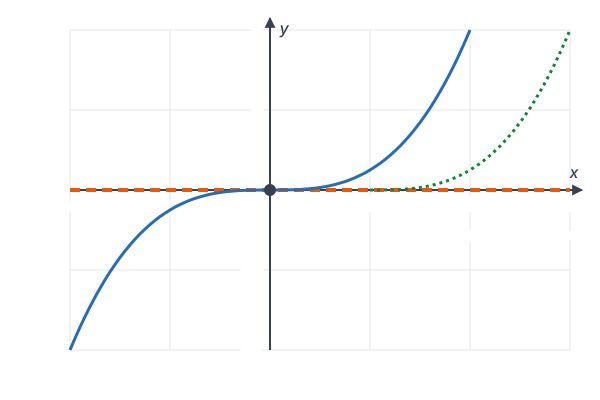
Show that y′ = 3y^(2/3), y(0) = 0, has more than one solution, and explain why the theorem allows it.
f(x, y) = 3y^{2/3}f is continuous for every y, so a solution exists.
\dfrac{\partial f}{\partial y} = 2y^{-1/3}Differentiate with the power rule: 3 · (2/3) = 2.
2y^{-1/3} = \dfrac{2}{\sqrt[3]{y}}This is undefined at y = 0, so the uniqueness part doesn’t apply at (0, 0).
y = 0:\quad y' = 0 = 3(0)^{2/3}Check the constant function y = 0. It solves the equation and y(0) = 0.
y = x^3:\quad y' = 3x^2
Differentiate the second candidate, y = x³.
3\left(x^3\right)^{2/3} = 3x^2Simplify the right side with the power of a power rule (see exponent rules). It matches y′, and y(0) = 0.
Answer: y = 0 and y = x³ both solve the problem. So does the curve that stays at 0 until any x = a ≥ 0 and then follows y = (x − a)³, so there are infinitely many solutions.
Example 5: When did the tank empty? (word problem)
Water drains from a tank by Torricelli’s law, dh/dt = −0.5√h, where h is the depth in feet and t is in minutes. (a) If h(0) = 4, find h(t) and when the tank empties. (b) You find the tank empty at t = 10. Can the equation tell you when it emptied?
\dfrac{dh}{\sqrt{h}} = -0.5\,dt(a) Separate the variables (for positive h). See separable differential equations.
2\sqrt{h} = -0.5t + CIntegrate both sides: the antiderivative of h^(−1/2) is 2h^(1/2).
2\sqrt{4} = CSubstitute t = 0 and h = 4.
C = 4
Simplify: 2 · 2 = 4.
\sqrt{h} = 2 - 0.25tSubstitute C = 4 and divide every term by 2.
h = (2 - 0.25t)^2
Square both sides. This holds while 2 − 0.25t ≥ 0.
0.25t = 2
The tank is empty when √h = 0. Add 0.25t to both sides.
t = 8
Divide both sides by 0.25.
\dfrac{\partial f}{\partial h} = -\dfrac{0.25}{\sqrt{h}}(b) For f(h) = −0.5√h, differentiate with respect to h. This is undefined at h = 0.
h = \left(\dfrac{T - t}{4}\right)^2 \text{ for } t \le T, \quad h = 0 \text{ after}For any emptying time T up to 10, this function solves the equation and gives h(10) = 0.
Answer: (a) h = (2 − 0.25t)², and the tank is empty at t = 8 minutes (after that, h stays 0). (b) No. Because ∂f/∂h is not continuous at h = 0, the problem h(10) = 0 has many solutions: the tank could have emptied at minute 8, at minute 3, or never held water at all.
Common mistakes
| Mistake | Example of the error | Fix |
|---|---|---|
| Thinking failed conditions mean no solution | “∂f/∂y is undefined at (0, 0), so y' = 3y^{2/3}, y(0) = 0, has no solution.” | The theorem is only one-way. That problem has many solutions. |
| Checking only f | Saying y' = 3y^{2/3} has a unique solution because f is continuous | Continuity of f gives existence. Uniqueness also needs ∂f/∂y continuous. |
| Differentiating with respect to x | Checking ∂f/∂x for f = \dfrac{x + y}{x - y} | The theorem uses ∂f/∂y, the derivative in the y-direction. |
| Skipping standard form | Reading p = ln x from (x - 3)y' + (\ln x)y = 2x | Divide by x − 3 first: p = \dfrac{\ln x}{x - 3}. |
| Using an interval that misses x₀ | Answering (3, ∞) when y(1) = 2 | The interval must contain x₀ = 1, so it is (0, 3). |
| Expecting a nonlinear solution to last the whole rectangle | y' = y^2, y(0) = 2, with f smooth everywhere | The solution y = \dfrac{2}{1 - 2x} blows up at x = 1/2. |
Related ideas
Why solution curves don’t cross
In a slope field where f and ∂f/∂y are continuous, each point lies on exactly one solution curve. That is why the curves fill the plane like nonoverlapping threads, and why an equilibrium solution acts as a wall that other solutions can’t pass through.
How the theorem is proved
The usual proof, called Picard iteration, starts with the guess y₀ and repeats yₙ₊₁(x) = y₀ + ∫ f(t, yₙ(t)) dt from x₀ to x. When ∂f/∂y is continuous, these guesses get closer and closer to one function, the unique solution. That is why the theorem is also called the Picard–Lindelöf theorem.
Numerical methods
Euler’s method and the Runge-Kutta Method follow one curve step by step from (x₀, y₀). The theorem is what makes “the” solution meaningful: if many curves left the starting point, a numerical method could follow any of them.
Practice problems
- Find the largest interval on which (x + 2)y′ + 3y = x, y(0) = 1, is sure to have a unique solution.
- Find the largest interval for y′ + y/(x − 4) = √x, y(1) = 0.
- Find the largest interval for (t² − 9)y′ + ty = eᵗ, y(−5) = 2.
- Find the largest interval for y′ + (ln t)y = cot t, y(2) = 1.
- For y′ = ln(x + y), find every starting point where a unique solution is guaranteed.
- For y′ = (y² + 1)/(x² − 1), find every starting point where a unique solution is guaranteed.
- Does the theorem guarantee a unique solution of y′ = y^(1/3), y(2) = 0? Show that y = 0 and y = (2(x − 2)/3)^(3/2), for x ≥ 2, are both solutions.
- Solve y′ = y², y(0) = 2, and find the interval where the solution exists. Do the theorem’s conditions hold?
- Explain why two different solution curves of y′ = sin(xy) can never cross.
- A tank drains by dh/dt = −0.3√h with h(0) = 9 feet. Find h(t) and the time when it empties. If you only knew that h(25) = 0, could you find when it emptied?
Show answers
1.
y' + \dfrac{3}{x + 2}\,y = \dfrac{x}{x + 2}Divide every term by x + 2.
x \ne -2
p and q are continuous except where x + 2 = 0.
-2 \lt x \lt \infty
Take the interval that contains x₀ = 0.
Answer: (−2, ∞)
2.
p(x) = \dfrac{1}{x - 4},\quad q(x) = \sqrt{x}The equation is already in standard form.
x \ne 4,\quad x \gt 0
p fails at x = 4; √x is continuous on an open interval only for positive x.
0 \lt x \lt 4
Take the interval that contains x₀ = 1.
Answer: (0, 4)
3.
t^2 - 9 = 0
Dividing by t² − 9 fails where it is 0.
t = \pm 3
Solve: t² = 9.
-\infty \lt t \lt -3
Take the interval that contains t₀ = −5.
Answer: (−∞, −3)
4.
t \gt 0
ln t needs positive t.
t \ne k\pi
cot t = cos t/sin t is undefined where sin t = 0.
0 \lt t \lt \pi
Take the interval that contains t₀ = 2, since 2 is between 0 and π ≈ 3.14.
Answer: (0, π)
5.
x + y \gt 0
f = ln(x + y) is continuous only where x + y is positive.
\dfrac{\partial f}{\partial y} = \dfrac{1}{x + y}Differentiate with respect to y. This is continuous where x + y ≠ 0.
Answer: every starting point with x₀ + y₀ positive (above the line y = −x)
6.
x^2 - 1 \ne 0
f is a quotient, continuous where its denominator isn’t 0.
\dfrac{\partial f}{\partial y} = \dfrac{2y}{x^2 - 1}Differentiate with respect to y. It is continuous where x ≠ ±1.
Answer: every starting point with x₀ ≠ 1 and x₀ ≠ −1
7.
\dfrac{\partial f}{\partial y} = \tfrac{1}{3}y^{-2/3}Differentiate y^(1/3). This is undefined at y = 0, so there is no guarantee.
y = 0:\quad y' = 0 = 0^{1/3}The zero function works, and y(2) = 0.
y' = \tfrac{3}{2}\left(\tfrac{2(x - 2)}{3}\right)^{1/2}\cdot\tfrac{2}{3}Differentiate the second function with the chain rule.
y' = \left(\tfrac{2(x - 2)}{3}\right)^{1/2}Multiply: (3/2)(2/3) = 1.
y^{1/3} = \left(\tfrac{2(x - 2)}{3}\right)^{1/2}Raise y to the 1/3 power: (3/2)(1/3) = 1/2. This matches y′.
Answer: no guarantee, and indeed both functions solve the problem
8.
-y^{-1} = x + CSeparate (y^(−2) dy = dx) and integrate.
-\tfrac{1}{2} = CSubstitute x = 0 and y = 2.
y = \dfrac{1}{\tfrac{1}{2} - x} = \dfrac{2}{1 - 2x}Solve for y, then multiply the top and bottom by 2.
x \lt \tfrac{1}{2}The solution blows up at x = 1/2; keep the side that contains x₀ = 0.
Answer: y = 2/(1 − 2x) on (−∞, 1/2). The conditions hold everywhere (f = y² and ∂f/∂y = 2y are continuous), yet the solution still has a finite interval.
9.
\dfrac{\partial f}{\partial y} = x\cos(xy)Differentiate sin(xy) with respect to y with the chain rule.
Answer: f and ∂f/∂y are continuous everywhere, so through any point there is only one solution. If two curves crossed, the crossing point would start two different solutions.
10.
2\sqrt{h} = -0.3t + CSeparate the variables and integrate, as in Example 5.
C = 2\sqrt{9} = 6Substitute t = 0 and h = 9.
\sqrt{h} = 3 - 0.15tDivide every term by 2.
h = (3 - 0.15t)^2
Square both sides.
t = \dfrac{3}{0.15} = 20Set 3 − 0.15t = 0 and solve.
Answer: h = (3 − 0.15t)², empty at t = 20 minutes. Knowing only h(25) = 0 is not enough: ∂f/∂h is undefined at h = 0, so many emptying times fit.
Existence and uniqueness theorem FAQ
What does the existence and uniqueness theorem say?
For y′ = f(x, y) with y(x₀) = y₀, if f and ∂f/∂y are continuous near (x₀, y₀), there is exactly one solution on some interval around x₀. For linear equations, the interval is the whole interval where p and q are continuous.
What happens if the conditions of the theorem are not met?
The theorem makes no promise. The problem might have no solution, exactly one, or infinitely many, like y′ = 3y^(2/3) with y(0) = 0.
How do you find the interval of existence for a linear equation?
Put the equation in the form y′ + p(x)y = q(x). Mark every x where p or q is discontinuous, and take the largest open interval between those points that contains x₀.
Can two solutions of a differential equation cross?
Not where f and ∂f/∂y are continuous. A crossing point would be a starting point with two solutions, which the theorem rules out.
Summary
- For y′ = f(x, y), y(x₀) = y₀: f continuous gives existence; f and ∂f/∂y continuous give exactly one solution near x₀.
- For linear equations, the unique solution lives on the whole interval around x₀ where p and q are continuous.
- Put a linear equation in standard form before finding p and q.
- The theorem is one-way: when its conditions fail, there may still be solutions, sometimes many.
- Nonlinear solutions can blow up, so the guaranteed interval may be short.
- Where the conditions hold, solution curves never cross.
Previous lesson: Substitution for Homogeneous Equations
Next lesson: Autonomous Equations and Phase Lines
Back to the Differential Equations Index