
Autonomous Equations and Phase Lines
An autonomous differential equation has the form dy/dt = f(y): the rate of change depends only on y, not on t. Its equilibrium solutions are the constant solutions y = c where f(c) = 0. A phase line marks these values with arrows showing where y increases or decreases, so you can tell whether each equilibrium is stable, unstable or semistable.
Before this lesson: Slope Fields, Logistic Differential Equations, Polynomial Inequalities and Existence and Uniqueness Theorem
The idea: read the future from the sign of f(y)
In dy/dt = f(y), time never appears on the right side. So every row of the slope field looks the same: at height y, the slope is f(y) no matter what t is. Shifting a solution left or right gives another solution.
That means you can learn a lot without solving. Where f(y) is positive, y increases; where it is negative, y decreases; where it is 0, y stays put. Those stay-put values are the equilibrium solutions, also called critical points.
A phase line packs this into one vertical number line: dots at the equilibria and an arrow on each interval between them, pointing up where f(y) is positive and down where it is negative.
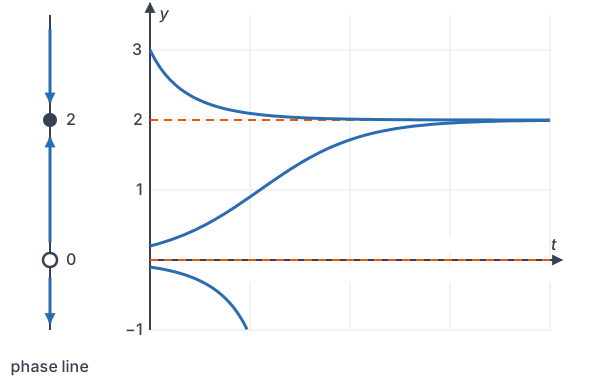
Autonomous differential equations: equilibria and stability
\dfrac{dy}{dt} = f(y), \qquad f(c) = 0 \;\Rightarrow\; y = c \text{ is an equilibrium solution}| Type | Arrows on the phase line | Signs of f near c | Derivative test |
|---|---|---|---|
| Stable (sink) | Both point toward c | f positive below c, negative above | f'(c) \lt 0 |
| Unstable (source) | Both point away from c | f negative below c, positive above | f'(c) \gt 0 |
| Semistable (node) | One toward, one away | Same sign on both sides | f'(c) = 0 (test fails) |
The derivative test is quick, but when f′(c) = 0 it tells you nothing. The sign chart always works.
How to draw a phase line
- Solve f(y) = 0 to find every equilibrium.
- Mark the equilibria on a vertical line. They split it into intervals.
- Pick a test value in each interval and find the sign of f there.
- Draw an up arrow where f is positive and a down arrow where f is negative.
- Classify each equilibrium from the arrows on its two sides.
Solutions never cross an equilibrium line, by the existence and uniqueness theorem, when f′ is continuous. A solution that starts between two equilibria stays between them.
Autonomous differential equation examples
Example 1: A sign chart
Find and classify the equilibrium solutions of dy/dt = y(y − 3).
y(y - 3) = 0
Set f(y) = 0.
y = 0 \text{ or } y = 3Set each factor equal to 0.
f(-1) = (-1)(-4) = 4
Test below 0: positive, so y increases (arrow up, toward 0).
f(1) = (1)(-2) = -2
Test between 0 and 3: negative, so y decreases (arrow down, toward 0).
f(4) = (4)(1) = 4
Test above 3: positive, so y increases (arrow up, away from 3).
Answer: y = 0 is stable (both arrows point toward it) and y = 3 is unstable. A solution starting at y(0) = 2 decreases toward 0; one starting at y(0) = 4 grows without bound.
Example 2: The derivative test
Classify the equilibria of dy/dt = y³ − 9y with the derivative test.
y(y^2 - 9) = 0
Set f(y) = 0 and factor out y (see factoring out the GCF).
y(y - 3)(y + 3) = 0
Factor the difference of squares.
y = -3,\ 0,\ 3
Set each factor equal to 0.
f'(y) = 3y^2 - 9
Differentiate f with the power rule.
f'(-3) = 27 - 9 = 18
Positive, so y = −3 is unstable.
f'(0) = -9
Negative, so y = 0 is stable.
f'(3) = 27 - 9 = 18
Positive, so y = 3 is unstable.
Answer: y = 0 is stable; y = −3 and y = 3 are unstable.
Example 3: A semistable equilibrium
Find and classify the equilibria of dy/dt = (y − 2)²(y + 1).
y = 2 \text{ or } y = -1Set each factor of f(y) equal to 0.
f(-2) = (16)(-1) = -16
Test below −1: negative, arrow down (away from −1).
f(0) = (4)(1) = 4
Test between −1 and 2: positive, arrow up (away from −1, toward 2).
f(3) = (1)(4) = 4
Test above 2: positive, arrow up (away from 2).
f'(2) = 0
The derivative test fails at y = 2, which is why the sign chart is needed.
Answer: y = −1 is unstable and y = 2 is semistable. Solutions just below 2 creep up toward it, but solutions just above 2 move away.
Example 4: Sketching solutions with concavity
For dy/dt = 2y − y², find the equilibria and decide where solutions are concave up or down.
y(2 - y) = 0
Factor f(y) = 2y − y² and set it equal to 0.
y = 0 \text{ or } y = 2Set each factor equal to 0. The phase line shows 0 is unstable and 2 is stable.
\dfrac{d^2y}{dt^2} = f'(y)\,\dfrac{dy}{dt}Differentiate dy/dt = f(y) with respect to t, using the chain rule.
\dfrac{d^2y}{dt^2} = (2 - 2y)(2y - y^2)Substitute f′(y) = 2 − 2y and dy/dt = 2y − y².
2 - 2y = 0
The second factor is 0 only at the equilibria, so find where the first factor is 0.
y = 1
Solve for y.
Answer: between 0 and 1 both factors are positive, so solutions are concave up; between 1 and 2 the first factor is negative, so they are concave down. A solution starting between 0 and 2 is an S-shaped curve with its inflection point at y = 1, half of the stable value. Above 2 solutions are concave up as they fall toward 2, and below 0 they are concave down as they fall away.
Example 5: Fishing a population (word problem)
A lake’s fish population P follows dP/dt = 0.5P(1 − P/1000) − 80, where t is in years and 80 fish are caught each year. Find the equilibria and say what happens if the population starts at 300 or at 150.
0.5P\left(1 - \dfrac{P}{1000}\right) - 80 = 0Set dP/dt = 0.
0.5P - 0.0005P^2 - 80 = 0
Distribute 0.5P.
P^2 - 1000P + 160000 = 0
Multiply every term by −2000.
(P - 200)(P - 800) = 0
Factor the trinomial (see factoring trinomials).
P = 200 \text{ or } P = 800Set each factor equal to 0.
f(100) = 45 - 80 = -35
Test below 200: 0.5(100)(0.9) = 45. Negative, so the population falls.
f(500) = 125 - 80 = 45
Test between: 0.5(500)(0.5) = 125. Positive, so it rises.
f(900) = 45 - 80 = -35
Test above 800: 0.5(900)(0.1) = 45. Negative, so it falls.
Answer: P = 200 is unstable and P = 800 is stable. Starting at 300, the population grows toward 800. Starting at 150, it keeps falling until the fish are gone, so 200 is a tipping point. Without fishing, the growth term 0.5P(1 − P/1000) is at most 125 (at P = 500), so any catch above 125 fish per year leaves no equilibrium at all and the population collapses.
Common mistakes
| Mistake | Example of the error | Fix |
|---|---|---|
| Setting f′(y) = 0 to find equilibria | Solving 2 − 2y = 0 for y' = 2y - y^2 | Equilibria come from f(y) = 0: y = 0 and y = 2. |
| Pointing the arrows the wrong way | Drawing a down arrow where f(y) is positive | Positive f means y increases: arrow up. |
| Trusting the derivative test when f′(c) = 0 | Calling y = 2 stable for y' = (y - 2)^2(y + 1) | Use the sign chart: arrows go up on both sides, so it is semistable. |
| Calling an equation autonomous when t appears | y' = y - t | Autonomous means the right side has no t at all. |
| Thinking solutions cross an equilibrium | A curve starting at 1 for y' = 2y - y^2 going above 2 | It approaches 2 but never reaches or passes it. |
| Classifying from one side only | Calling c stable because the arrow below points up | Check both sides; arrows must point toward c from both. |
Related ideas
Logistic growth and harvesting
Logistic differential equations are autonomous: dP/dt = kP(1 − P/M) has an unstable equilibrium at 0 and a stable one at the carrying capacity M. Subtracting a harvest, as in Example 5, moves the equilibria and can remove them.
Slope fields
In the slope field of an autonomous equation, the slopes are the same along every horizontal line, and the equilibria are horizontal rows of flat segments. The phase line is the slope field squeezed onto one vertical line.
Systems
For two linked equations, the phase line becomes a phase plane. That is covered in Phase Portraits, where equilibria are again classified as stable or unstable.
Practice problems
- Which are autonomous? (a) dy/dt = y² − t (b) dy/dt = 4 − y²
- Find and classify the equilibria of dy/dt = 4 − y².
- Find and classify the equilibria of dy/dt = y(y − 1)(y − 2).
- Find and classify the equilibria of dy/dt = y²(4 − y).
- Use the derivative test to classify the equilibria of dy/dt = cos y between 0 and 2π.
- Classify the equilibrium of dy/dt = e^y − 1.
- For dy/dt = y(y − 3), find the limit of y(t) as t → ∞ when y(0) = 1, y(0) = 3 and y(0) = −2.
- For dy/dt = 3y − y², where are solutions between 0 and 3 concave up, and where concave down?
- A cup of coffee cools by dT/dt = −0.1(T − 70), with T in °F. Find and classify the equilibrium and explain it.
- A deer population follows dP/dt = 0.4P(1 − P/500) − 32, with 32 deer hunted per year. Find and classify the equilibria, and find the largest yearly harvest that still leaves an equilibrium.
Show answers
1.
y' = y^2 - t
(a) The right side contains t, so it is not autonomous.
y' = 4 - y^2
(b) The right side depends only on y, so it is autonomous.
Answer: only (b)
2.
(2 - y)(2 + y) = 0
Factor the difference of squares and set it equal to 0.
y = -2 \text{ or } y = 2Set each factor equal to 0.
f(-3) = -5,\quad f(0) = 4,\quad f(3) = -5
Test each interval: down, up, down.
Answer: y = −2 is unstable and y = 2 is stable
3.
y = 0,\ 1,\ 2
Set each factor equal to 0.
f(-1) = -6,\quad f(0.5) = 0.375
Test below 0 and between 0 and 1: down, then up.
f(1.5) = -0.375,\quad f(3) = 6
Test between 1 and 2 and above 2: down, then up.
Answer: 0 is unstable, 1 is stable, 2 is unstable
4.
y = 0 \text{ or } y = 4Set each factor equal to 0.
f(-1) = 5,\quad f(1) = 3,\quad f(5) = -25
Test each interval: up, up, down.
Answer: y = 0 is semistable (up on both sides) and y = 4 is stable
5.
\cos y = 0 \Rightarrow y = \tfrac{\pi}{2},\ \tfrac{3\pi}{2}Solve f(y) = 0 between 0 and 2π.
f'(y) = -\sin y
Differentiate cos y.
f'\!\left(\tfrac{\pi}{2}\right) = -1,\quad f'\!\left(\tfrac{3\pi}{2}\right) = 1Evaluate at each equilibrium.
Answer: y = π/2 is stable and y = 3π/2 is unstable
6.
e^{y} - 1 = 0 \Rightarrow y = 0e^y = 1 only at y = 0.
f'(0) = e^{0} = 1Positive.
Answer: y = 0 is unstable
7.
y(0) = 1
Starts between 0 and 3, where y decreases, so y(t) → 0.
y(0) = 3
Starts at an equilibrium, so y stays at 3.
y(0) = -2
Starts below 0, where y increases, so y(t) → 0.
Answer: 0, 3 and 0
8.
y'' = (3 - 2y)(3y - y^2)
Use y″ = f′(y)f(y) with f′(y) = 3 − 2y.
3 - 2y = 0 \Rightarrow y = 1.5
3y − y² is positive between 0 and 3, so only 3 − 2y changes sign.
Answer: concave up for y between 0 and 1.5; concave down for y between 1.5 and 3
9.
-0.1(T - 70) = 0
Set dT/dt = 0.
T = 70
Divide both sides by −0.1 and add 70.
f'(T) = -0.1
Negative, so T = 70 is stable.
Answer: T = 70 °F is stable: the coffee approaches room temperature, as in Newton’s law of cooling
10.
P^2 - 500P + 40000 = 0
Set dP/dt = 0 and multiply every term by −1250.
(P - 100)(P - 400) = 0
Factor the trinomial.
f(50) = -14,\quad f(250) = 18,\quad f(450) = -14
Test each interval: down, up, down.
0.4(250)(0.5) = 50
The growth term 0.4P(1 − P/500) is largest at P = 250.
Answer: P = 100 is unstable and P = 400 is stable; a harvest above 50 deer per year leaves no equilibrium
Autonomous differential equations FAQ
What is an autonomous differential equation?
It is an equation dy/dt = f(y) whose right side depends only on y, not on the independent variable t. Logistic growth and Newton’s law of cooling are common examples.
How do you find equilibrium solutions?
Solve f(y) = 0. Each root c gives a constant solution y = c, because a constant has derivative 0.
How do you tell if an equilibrium is stable or unstable?
Check the sign of f(y) just below and just above c. If solutions move toward c from both sides, it is stable; away from both sides, unstable; toward on one side and away on the other, semistable. Or use f′(c): negative means stable and positive means unstable.
What is a phase line?
It is a vertical number line for y with the equilibria marked and an arrow on each interval showing whether y increases or decreases there. It summarizes every solution’s long-run behavior.
Summary
- An autonomous equation has the form dy/dt = f(y), with no t on the right side.
- Equilibrium solutions y = c come from f(c) = 0.
- On the phase line, arrows point up where f is positive and down where f is negative.
- Stable: arrows point toward c. Unstable: away. Semistable: one of each.
- Derivative test: f′(c) negative means stable, positive means unstable, 0 means use the sign chart.
- Solutions never cross equilibria; concavity comes from y″ = f′(y)f(y).
Previous lesson: Existence and Uniqueness Theorem
Next lesson: Mixing Problems
Back to the Differential Equations Index