
Phase Portraits
A phase portrait is a picture of many solution curves of a system x′ = Ax in the x₁x₂-plane, with arrows showing which way each solution moves. For a 2 × 2 linear system, the trace and determinant of A decide the picture: a saddle, node, spiral, center or improper node, and whether the origin is stable.
Before this lesson: Solving Linear Systems with Eigenvalues, Complex Eigenvalues, Repeated Eigenvalues and Autonomous Equations and Phase Lines
What a phase portrait shows
Each solution x(t) = (x₁(t), x₂(t)) of a system traces a curve in the plane as t changes. That curve is called a trajectory (or orbit), and the plane is the phase plane. Time does not appear on the axes; arrows show the direction of motion instead.
A point where x′ = 0 is an equilibrium point (or critical point). For x′ = Ax with det A ≠ 0, the only equilibrium is the origin. The phase portrait shows whether nearby solutions move toward it, away from it, or around it. It is the two-dimensional version of a phase line from autonomous differential equations.
The trace-determinant test
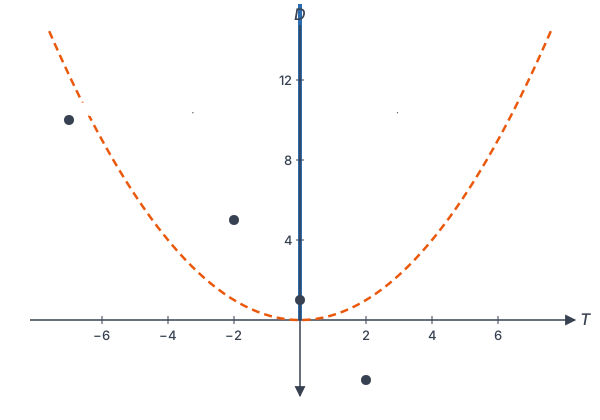
For A = [a b; c d], the trace is T = a + d and the determinant is D = ad − bc. The characteristic polynomial uses only these two numbers:
\lambda^2 - T\lambda + D = 0,\qquad T = a + d,\quad D = ad - bc
The eigenvalues multiply to D and add to T. So if D is negative, they are real with opposite signs. If D is positive, they have the same sign (or are complex), and T tells you which sign. The discriminant T² − 4D separates real eigenvalues from complex ones.
| Condition | Eigenvalues | Origin is | Stability |
|---|---|---|---|
| D \lt 0 | real, opposite signs | saddle | unstable |
| D \gt 0,\ T^2 - 4D \gt 0 | real, same sign | node | stable if T \lt 0, unstable if T \gt 0 |
| D \gt 0,\ T^2 - 4D \lt 0,\ T \ne 0 | complex, \alpha \pm \beta i | spiral | stable if T \lt 0, unstable if T \gt 0 |
| T = 0,\ D \gt 0 | pure imaginary, \pm \beta i | center | stable, but not asymptotically |
| T^2 = 4D,\ D \gt 0 | repeated | improper node or star | stable if T \lt 0, unstable if T \gt 0 |
A stable node is also called a sink, an unstable node a source, and spirals are also called spiral points or foci. Asymptotically stable means every nearby solution tends to the origin. A center is stable (nearby solutions stay nearby) but not asymptotically stable, because solutions circle forever.
How to sketch a phase portrait
- Find T and D, and use the table to name the equilibrium and its stability.
- For a saddle or node, find the eigenvalues and eigenvectors. Draw each eigenvector line: these are straight-line solutions, with arrows in if λ is negative and out if λ is positive.
- For a node, most trajectories meet the origin tangent to the slow eigenvector (the λ closer to 0) and are parallel to the fast one far away.
- For a spiral or center, find the direction of rotation: at the point (1, 0), x′ = (a, c). If c is positive, solutions turn counterclockwise; if c is negative, clockwise.
- Sketch a few trajectories that follow these rules, with arrows.
Phase portrait examples
Example 1: A saddle point
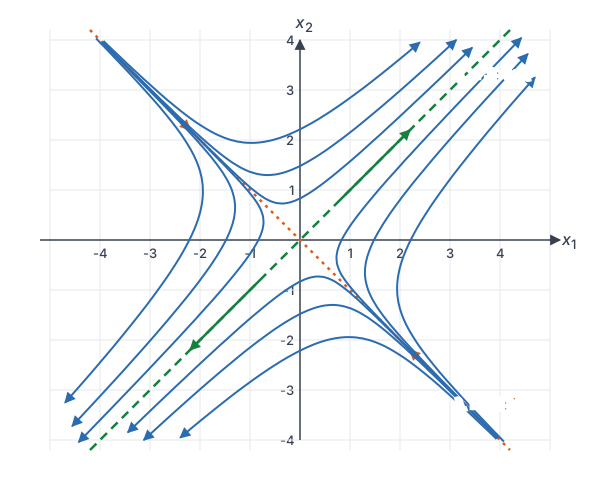
Classify the origin for x′ = [1 2; 2 1]x and sketch the phase portrait.
T = 1 + 1 = 2
Add the diagonal entries.
D = (1)(1) - (2)(2) = -3
Use D = ad − bc.
D \lt 0 \Rightarrow \text{saddle}A negative determinant means real eigenvalues of opposite sign.
\lambda^2 - 2\lambda - 3 = (\lambda - 3)(\lambda + 1)
Write λ² − Tλ + D and factor the trinomial.
\lambda = 3,\quad \lambda = -1
Set each factor equal to 0.
A - 3I = \begin{bmatrix} -2 & 2 \\ 2 & -2 \end{bmatrix} \Rightarrow \mathbf{v}_1 = \begin{bmatrix} 1 \\ 1 \end{bmatrix}Solve −2v₁ + 2v₂ = 0, as in eigenvalues and eigenvectors.
A + I = \begin{bmatrix} 2 & 2 \\ 2 & 2 \end{bmatrix} \Rightarrow \mathbf{v}_2 = \begin{bmatrix} 1 \\ -1 \end{bmatrix}Solve 2v₁ + 2v₂ = 0.
\mathbf{x} = c_1e^{3t}\begin{bmatrix} 1 \\ 1 \end{bmatrix} + c_2e^{-t}\begin{bmatrix} 1 \\ -1 \end{bmatrix}Write the general solution.
Answer: the origin is a saddle, which is unstable. Solutions on the line x₂ = −x₁ (λ = −1) move straight in; solutions on the line x₂ = x₁ (λ = 3) move straight out. Every other trajectory comes in near the first line and leaves along the second, since e^(3t) wins as t grows.
Example 2: A stable node
Classify the origin for x′ = [−4 1; 2 −3]x and find the direction in which trajectories enter the origin.
T = -4 + (-3) = -7
Add the diagonal entries.
D = (-4)(-3) - (1)(2) = 10
Use D = ad − bc.
T^2 - 4D = 49 - 40 = 9 \gt 0
Compute the discriminant; the eigenvalues are real and different.
\lambda = \dfrac{-7 \pm \sqrt{9}}{2} = \dfrac{-7 \pm 3}{2}Solve λ² + 7λ + 10 = 0 with the quadratic formula.
\lambda_1 = -2,\quad \lambda_2 = -5
Both are negative, so the origin is a stable node.
A + 2I = \begin{bmatrix} -2 & 1 \\ 2 & -1 \end{bmatrix} \Rightarrow \mathbf{v}_1 = \begin{bmatrix} 1 \\ 2 \end{bmatrix}Solve −2v₁ + v₂ = 0.
A + 5I = \begin{bmatrix} 1 & 1 \\ 2 & 2 \end{bmatrix} \Rightarrow \mathbf{v}_2 = \begin{bmatrix} 1 \\ -1 \end{bmatrix}Solve v₁ + v₂ = 0.
\mathbf{x} = c_1e^{-2t}\begin{bmatrix} 1 \\ 2 \end{bmatrix} + c_2e^{-5t}\begin{bmatrix} 1 \\ -1 \end{bmatrix}Write the general solution.
Answer: a stable node (sink). The e^(−5t) term dies out faster, so as t → ∞ almost every trajectory enters the origin tangent to the slow eigenvector (1, 2). Far from the origin (t → −∞) the e^(−5t) term is largest, so trajectories there are nearly parallel to (1, −1).
Example 3: A stable spiral
Classify the origin for x′ = [−1 −4; 1 −1]x and find the direction of rotation.
T = -1 + (-1) = -2
Add the diagonal entries.
D = (-1)(-1) - (-4)(1) = 5
Use D = ad − bc.
T^2 - 4D = 4 - 20 = -16 \lt 0
A negative discriminant means complex eigenvalues.
\lambda = \dfrac{-2 \pm \sqrt{-16}}{2} = -1 \pm 2iUse the quadratic formula with √−16 = 4i.
A\begin{bmatrix} 1 \\ 0 \end{bmatrix} = \begin{bmatrix} -1 \\ 1 \end{bmatrix}Test the point (1, 0): x′ is the first column of A.
Answer: the real part −1 is negative, so the origin is a stable spiral (spiral sink). At (1, 0) the velocity has a positive x₂-part, so it points up: solutions turn counterclockwise. With β = 2, each turn takes 2π/2 = π time units and shrinks distances by a factor of e^(−π) ≈ 0.043, as in complex eigenvalues.
Example 4: A center
Classify the origin for x′ = [2 −5; 1 −2]x.
T = 2 + (-2) = 0
Add the diagonal entries.
D = (2)(-2) - (-5)(1) = 1
Use D = ad − bc.
\lambda^2 + 1 = 0 \Rightarrow \lambda = \pm i
With T = 0 the equation is λ² + D = 0.
A\begin{bmatrix} 1 \\ 0 \end{bmatrix} = \begin{bmatrix} 2 \\ 1 \end{bmatrix}Test the point (1, 0); the x₂-part is positive.
Answer: the origin is a center. Every trajectory is a closed ellipse traveled counterclockwise, once every 2π/1 = 2π time units. The center is stable but not asymptotically stable: solutions stay near the origin but never approach it. A small change in A that makes T nonzero turns it into a spiral.
Example 5: Damping a spring (word problem)
A 1 kg mass hangs on a spring with spring constant 4 N/m and damping constant c, so y″ + cy′ + 4y = 0. Write it as a system and classify the origin for c = 0, 2, 4 and 5.
\mathbf{x}' = \begin{bmatrix} 0 & 1 \\ -4 & -c \end{bmatrix}\mathbf{x}Let x₁ = y and x₂ = y′, as in systems of differential equations.
T = -c,\quad D = (0)(-c) - (1)(-4) = 4
Find the trace and determinant.
T^2 - 4D = c^2 - 16
Compute the discriminant.
c = 0:\ T = 0 \Rightarrow \text{center}No damping.
c = 2:\ c^2 - 16 = -12 \lt 0 \Rightarrow \text{stable spiral}T = −2 is negative.
c = 4:\ c^2 - 16 = 0 \Rightarrow \text{stable improper node}λ = −2 is repeated, and A is not −2I.
c = 5:\ c^2 - 16 = 9 \gt 0 \Rightarrow \text{stable node}λ = (−5 ± 3)/2 = −1 and −4.
Answer: c = 0 gives a center (the mass oscillates forever), c = 2 a stable spiral (underdamped), c = 4 a stable improper node (critically damped) and c = 5 a stable node (overdamped). These are the damping cases from spring-mass systems, seen as phase portraits of position against velocity.
Common mistakes
| Mistake | Example of the error | Fix |
|---|---|---|
| Adding bc in the determinant | For [1 2; 2 1], D = 1 + 4 = 5 | D = ad − bc = 1 − 4 = −3, a saddle. |
| Calling a negative trace stable when D is negative | [−3 2; 2 1] has T = −2, so it is stable | D = −7 is negative, so it is a saddle, which is always unstable. |
| Reading the rotation from the wrong entry | Using b = −4 in Example 3 to say clockwise | At (1, 0), x′ = (a, c); use the sign of c. |
| Using the fast eigenvector for the tangent direction | Saying Example 2 trajectories enter along (1, −1) | They enter along the eigenvector whose λ is closest to 0. |
| Calling a center asymptotically stable | Saying solutions of Example 4 tend to the origin | Closed orbits keep their size; a center is stable only. |
| Forgetting the border case | Calling T² = 4D a node or a spiral | Equal eigenvalues give an improper node or a star. |
Related ideas
When the determinant is zero
If D = 0, then 0 is an eigenvalue and Ax = 0 has a whole line of solutions. Every point on that line is an equilibrium, and the other trajectories are straight lines parallel to the second eigenvector. These cases are rare in models and are not part of the table.
Nonlinear systems
Most real models are nonlinear. Near an equilibrium, a nonlinear system usually behaves like a linear one, so the same table classifies it. Nonlinear Systems and Stability shows how to find that linear system with the Jacobian matrix.
Practice problems
- Classify the origin for x′ = [2 1; 1 2]x.
- Classify the origin for x′ = [1 3; 3 1]x.
- Classify the origin for x′ = [−2 −3; 3 −2]x.
- Classify the origin for x′ = [0 2; −8 0]x.
- Classify the origin for x′ = [−3 1; −1 −1]x.
- For x′ = [1 3; 3 1]x, find the straight-line solutions and say which come in and which go out.
- For x′ = [−2 −3; 3 −2]x, find the direction of rotation.
- For x′ = [−3 1; 1 −3]x, classify the origin and find the direction in which trajectories enter it.
- For y″ + cy′ + 9y = 0 with c ≥ 0, find the values of c that make the origin a stable spiral.
- For x′ = [4 −2; 3 −1]x, classify the origin and find the direction in which trajectories leave it.
Show answers
1.
T = 4,\quad D = 4 - 1 = 3
Trace 2 + 2; determinant (2)(2) − (1)(1).
T^2 - 4D = 16 - 12 = 4 \gt 0
Real, different eigenvalues.
\lambda = \dfrac{4 \pm 2}{2} = 3,\ 1Both positive.
Answer: unstable node (source)
2.
T = 2,\quad D = 1 - 9 = -8
Trace 1 + 1; determinant (1)(1) − (3)(3).
D \lt 0
Opposite-sign eigenvalues.
Answer: saddle (unstable); the eigenvalues are 4 and −2
3.
T = -4,\quad D = 4 + 9 = 13
Determinant (−2)(−2) − (−3)(3).
T^2 - 4D = 16 - 52 = -36 \lt 0
Complex eigenvalues.
\lambda = \dfrac{-4 \pm 6i}{2} = -2 \pm 3iUse √−36 = 6i.
Answer: stable spiral (real part −2)
4.
T = 0,\quad D = 0 - (2)(-8) = 16
Find the trace and determinant.
\lambda^2 + 16 = 0 \Rightarrow \lambda = \pm 4i
Pure imaginary eigenvalues.
Answer: center (stable, not asymptotically stable)
5.
T = -4,\quad D = 3 - (1)(-1) = 4
Determinant (−3)(−1) − (1)(−1).
T^2 - 4D = 16 - 16 = 0
Repeated eigenvalue λ = T/2 = −2.
A \ne -2I
A is not a multiple of I, so there is only one eigenvector.
Answer: stable improper node, as in repeated eigenvalues
6.
\lambda^2 - 2\lambda - 8 = (\lambda - 4)(\lambda + 2)
λ² − Tλ + D with T = 2, D = −8.
A - 4I = \begin{bmatrix} -3 & 3 \\ 3 & -3 \end{bmatrix} \Rightarrow \mathbf{v} = \begin{bmatrix} 1 \\ 1 \end{bmatrix}For λ = 4: −3v₁ + 3v₂ = 0.
A + 2I = \begin{bmatrix} 3 & 3 \\ 3 & 3 \end{bmatrix} \Rightarrow \mathbf{v} = \begin{bmatrix} 1 \\ -1 \end{bmatrix}For λ = −2: 3v₁ + 3v₂ = 0.
Answer: e^(4t)(1, 1) moves out along x₂ = x₁; e^(−2t)(1, −1) moves in along x₂ = −x₁
7.
A\begin{bmatrix} 1 \\ 0 \end{bmatrix} = \begin{bmatrix} -2 \\ 3 \end{bmatrix}Test the point (1, 0).
Answer: the x₂-part 3 is positive, so solutions turn counterclockwise
8.
T = -6,\quad D = 9 - 1 = 8
Determinant (−3)(−3) − (1)(1).
\lambda^2 + 6\lambda + 8 = (\lambda + 2)(\lambda + 4)
Factor; λ = −2 and −4.
A + 2I = \begin{bmatrix} -1 & 1 \\ 1 & -1 \end{bmatrix} \Rightarrow \mathbf{v} = \begin{bmatrix} 1 \\ 1 \end{bmatrix}Eigenvector for the slow eigenvalue −2.
Answer: stable node; trajectories enter tangent to (1, 1) (the λ = −4 eigenvector is (1, −1))
9.
T = -c,\quad D = 9
The system matrix is [0 1; −9 −c].
c^2 - 36 \lt 0 \Rightarrow 0 \le c \lt 6
Spiral when T² − 4D is negative.
c \ne 0
c = 0 gives T = 0, a center.
Answer: 0 < c < 6 (c = 6 gives an improper node, c > 6 a node)
10.
T = 3,\quad D = -4 + 6 = 2
Determinant (4)(−1) − (−2)(3).
\lambda = \dfrac{3 \pm \sqrt{9 - 8}}{2} = 2,\ 1Both positive: an unstable node.
A - I = \begin{bmatrix} 3 & -2 \\ 3 & -2 \end{bmatrix} \Rightarrow \mathbf{v} = \begin{bmatrix} 2 \\ 3 \end{bmatrix}Eigenvector for the slow eigenvalue 1.
Answer: unstable node; trajectories leave the origin tangent to (2, 3) (the λ = 2 eigenvector is (1, 1))
Phase portraits FAQ
What is a phase portrait in differential equations?
It is a sketch of several trajectories of a system in the phase plane, with arrows for the direction of motion. It shows the long-term behavior of every solution without solving for each one.
How do you classify an equilibrium point with the trace and determinant?
Compute T = a + d and D = ad − bc. A negative D gives a saddle. With positive D, compare T² with 4D (larger: node, smaller: spiral, equal: repeated eigenvalue), and the sign of T gives the stability.
How can you tell if a spiral turns clockwise or counterclockwise?
Look at the velocity x′ = Ax at the point (1, 0), which is the first column (a, c) of A. If c is positive the motion there is upward, so the spiral turns counterclockwise; if c is negative it turns clockwise.
What is the difference between a node and a saddle?
At a node, all trajectories move toward the origin (stable) or all move away (unstable). At a saddle, solutions come in along one eigenvector and leave along the other, so a saddle is always unstable.
Summary
- A phase portrait shows trajectories of x′ = Ax in the phase plane, with arrows for direction.
- Use T = a + d and D = ad − bc: D < 0 gives a saddle, T² > 4D a node, T² < 4D a spiral (a center if T = 0), and T² = 4D an improper node or star.
- With D positive, negative T means stable and positive T means unstable.
- Eigenvector lines are straight-line solutions; node trajectories enter or leave tangent to the slow eigenvector.
- The first column of A gives the direction of rotation for spirals and centers.
Previous lesson: Repeated Eigenvalues
Next lesson: Nonlinear Systems and Stability
Back to the Differential Equations Index