
Complex Eigenvalues
When the matrix in x′ = Ax has complex eigenvalues α ± βi, take α + βi and an eigenvector v = a + bi. The real and imaginary parts of e^(λt)v give two real solutions: e^(αt)(a cos βt − b sin βt) and e^(αt)(a sin βt + b cos βt). Trajectories spiral, or circle when α = 0.
Before this lesson: Solving Linear Systems with Eigenvalues, Complex Roots of the Characteristic Equation and Operations with Complex Numbers
Why complex eigenvalues mean rotation
A real 2 × 2 matrix has complex eigenvalues when its characteristic equation has a negative discriminant. They come in a conjugate pair α ± βi, and their eigenvectors are conjugates too. A matrix like this has no real direction that it only stretches: it turns every vector. So the solutions of x′ = Ax turn around the origin instead of moving along straight lines.
The eigenvalue method from solving linear systems with eigenvalues still gives a solution e^(λt)v, but it is complex. Euler’s formula splits it into a real part and an imaginary part, and because A is real, each part is a real solution on its own.
e^{(\alpha + \beta i)t} = e^{\alpha t}(\cos\beta t + i\sin\beta t)Euler’s formula, as in complex roots of the characteristic equation.
e^{\lambda t}\mathbf{v} = e^{\alpha t}(\cos\beta t + i\sin\beta t)(\mathbf{a} + i\mathbf{b})Write v = a + bi with real vectors a and b.
e^{\lambda t}\mathbf{v} = e^{\alpha t}\big[(\mathbf{a}\cos\beta t - \mathbf{b}\sin\beta t) + i(\mathbf{a}\sin\beta t + \mathbf{b}\cos\beta t)\big]Multiply out and use i² = −1 (see operations with complex numbers).
The general solution for complex eigenvalues
\mathbf{x}(t) = c_1e^{\alpha t}(\mathbf{a}\cos\beta t - \mathbf{b}\sin\beta t) + c_2e^{\alpha t}(\mathbf{a}\sin\beta t + \mathbf{b}\cos\beta t)Here α + βi is one eigenvalue (use β > 0) and a + bi is an eigenvector for it. The other eigenvalue, α − βi, gives the same two real solutions, so you only need one of the pair.
- α < 0: solutions spiral in to the origin (a spiral sink, or stable spiral).
- α > 0: solutions spiral out (a spiral source, or unstable spiral).
- α = 0: solutions travel around closed ellipses (a center), with period 2π/β.
To find the direction of rotation, look at the vector Ax at the point (1, 0). Its second entry is the lower-left entry of A. If it is positive, solutions turn counterclockwise; if negative, clockwise.
How to solve x′ = Ax with complex eigenvalues
- Solve det(A − λI) = 0 and write the roots as α ± βi.
- Find an eigenvector v for α + βi from one row of (A − λI)v = 0.
- Split v into real and imaginary parts: v = a + bi.
- Write x = c₁e^(αt)(a cos βt − b sin βt) + c₂e^(αt)(a sin βt + b cos βt).
- For an initial-value problem, set t = 0: c₁a + c₂b = x(0).
Complex eigenvalues examples
Example 1: A spiral sink
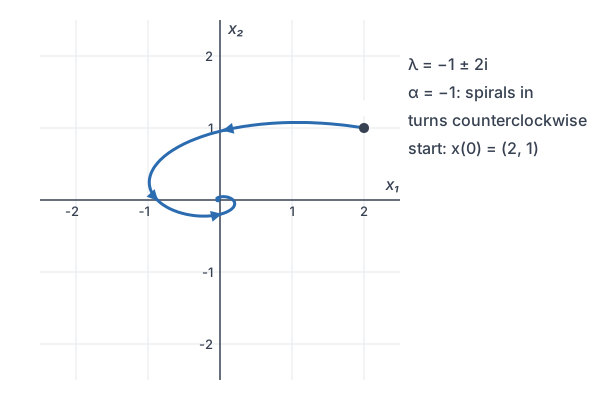
Solve x′ = [−1 −4; 1 −1]x with x(0) = (2, 1).
\det(A - \lambda I) = (-1 - \lambda)^2 + 4
Write the characteristic polynomial: (−1 − λ)(−1 − λ) − (−4)(1).
(-1 - \lambda)^2 + 4 = \lambda^2 + 2\lambda + 5
Expand and combine like terms.
\lambda = \dfrac{-2 \pm \sqrt{4 - 20}}{2} = \dfrac{-2 \pm 4i}{2}Use the quadratic formula; √−16 = 4i.
\lambda = -1 \pm 2i
Divide each term by 2, so α = −1 and β = 2.
(A - \lambda I)\mathbf{v} = \mathbf{0}:\ v_1 + (-1 - \lambda)v_2 = 0Use the second row of A − λI.
v_1 = (1 + \lambda)v_2 = 2i\,v_2
Substitute λ = −1 + 2i.
\mathbf{v} = \begin{bmatrix} 2i \\ 1 \end{bmatrix} = \begin{bmatrix} 0 \\ 1 \end{bmatrix} + i\begin{bmatrix} 2 \\ 0 \end{bmatrix}Choose v₂ = 1 and split into a + bi.
\mathbf{a}\cos 2t - \mathbf{b}\sin 2t = \begin{bmatrix} -2\sin 2t \\ \cos 2t \end{bmatrix}Real-part vector with a = (0, 1), b = (2, 0).
\mathbf{a}\sin 2t + \mathbf{b}\cos 2t = \begin{bmatrix} 2\cos 2t \\ \sin 2t \end{bmatrix}Imaginary-part vector.
\mathbf{x} = c_1e^{-t}\begin{bmatrix} -2\sin 2t \\ \cos 2t \end{bmatrix} + c_2e^{-t}\begin{bmatrix} 2\cos 2t \\ \sin 2t \end{bmatrix}Write the general solution.
c_1\begin{bmatrix} 0 \\ 1 \end{bmatrix} + c_2\begin{bmatrix} 2 \\ 0 \end{bmatrix} = \begin{bmatrix} 2 \\ 1 \end{bmatrix} \Rightarrow c_1 = 1,\ c_2 = 1Set t = 0, where sin 0 = 0 and cos 0 = 1.
\mathbf{x} = e^{-t}\begin{bmatrix} 2\cos 2t - 2\sin 2t \\ \cos 2t + \sin 2t \end{bmatrix}Add the two solutions.
Answer: x₁ = e^(−t)(2 cos 2t − 2 sin 2t) and x₂ = e^(−t)(cos 2t + sin 2t). Since α = −1 < 0, the solution spirals in to the origin. The lower-left entry of A is 1 > 0, so it turns counterclockwise, once every π time units.
Example 2: A center
Solve x′ = [2 −5; 1 −2]x with x(0) = (3, 1).
\lambda^2 - (2 + (-2))\lambda + (2(-2) - (-5)(1)) = \lambda^2 + 1
For a 2 × 2 matrix, det(A − λI) = λ² − (trace)λ + det A.
\lambda^2 + 1 = 0 \Rightarrow \lambda = \pm i
Solve: λ² = −1, so α = 0 and β = 1.
v_1 + (-2 - i)v_2 = 0 \Rightarrow v_1 = (2 + i)v_2
Use the second row of A − iI.
\mathbf{v} = \begin{bmatrix} 2 + i \\ 1 \end{bmatrix} = \begin{bmatrix} 2 \\ 1 \end{bmatrix} + i\begin{bmatrix} 1 \\ 0 \end{bmatrix}Choose v₂ = 1 and split into a + bi.
\mathbf{x} = c_1\begin{bmatrix} 2\cos t - \sin t \\ \cos t \end{bmatrix} + c_2\begin{bmatrix} 2\sin t + \cos t \\ \sin t \end{bmatrix}Use a cos t − b sin t and a sin t + b cos t; e^(0t) = 1.
2c_1 + c_2 = 3,\quad c_1 = 1
Set t = 0: c₁(2, 1) + c₂(1, 0) = (3, 1).
c_2 = 3 - 2 = 1
Substitute c₁ = 1.
\mathbf{x} = \begin{bmatrix} 3\cos t + \sin t \\ \cos t + \sin t \end{bmatrix}Add the two solutions and combine like terms.
Answer: x₁ = 3 cos t + sin t and x₂ = cos t + sin t. With α = 0, the solution goes around a closed ellipse and returns to (3, 1) every 2π time units. Check: x₁′ = −3 sin t + cos t, and 2x₁ − 5x₂ = 6 cos t + 2 sin t − 5 cos t − 5 sin t = cos t − 3 sin t.
Example 3: A spiral source
Solve x′ = [1 −1; 1 1]x with x(0) = (2, 0), and describe the motion.
\lambda^2 - 2\lambda + 2 = 0
Trace 2 and determinant 1 + 1 = 2.
\lambda = \dfrac{2 \pm \sqrt{4 - 8}}{2} = 1 \pm iUse the quadratic formula; √−4 = 2i.
v_1 + (1 - \lambda)v_2 = 0 \Rightarrow v_1 = i\,v_2
Use the second row with λ = 1 + i, so 1 − λ = −i.
\mathbf{v} = \begin{bmatrix} i \\ 1 \end{bmatrix} = \begin{bmatrix} 0 \\ 1 \end{bmatrix} + i\begin{bmatrix} 1 \\ 0 \end{bmatrix}Choose v₂ = 1 and split into a + bi.
\mathbf{x} = c_1e^{t}\begin{bmatrix} -\sin t \\ \cos t \end{bmatrix} + c_2e^{t}\begin{bmatrix} \cos t \\ \sin t \end{bmatrix}Write the general solution with α = 1, β = 1.
c_1\begin{bmatrix} 0 \\ 1 \end{bmatrix} + c_2\begin{bmatrix} 1 \\ 0 \end{bmatrix} = \begin{bmatrix} 2 \\ 0 \end{bmatrix} \Rightarrow c_1 = 0,\ c_2 = 2Set t = 0.
\mathbf{x} = 2e^{t}\begin{bmatrix} \cos t \\ \sin t \end{bmatrix}Substitute the constants.
Answer: x = 2e^t(cos t, sin t). The point stays at distance 2e^t from the origin while it turns counterclockwise at angle t, so it spirals outward. After one full turn (t = 2π), its distance has grown from 2 to 2e^(2π) ≈ 1071.
Example 4: A damped spring as a system (word problem)
A 1 kg mass hangs on a spring with spring constant 10 N/m and a damper with coefficient 2 N·s/m, so its position y in meters satisfies y″ + 2y′ + 10y = 0. It is pulled down to y(0) = 0.5 and released with y′(0) = 0. Solve with the system method, and find how much the swings shrink each cycle.
\mathbf{x}' = \begin{bmatrix} 0 & 1 \\ -10 & -2 \end{bmatrix}\mathbf{x}Let x₁ = y and x₂ = y′, as in systems of differential equations.
\lambda^2 + 2\lambda + 10 = 0 \Rightarrow \lambda = -1 \pm 3i
det(A − λI) = −λ(−2 − λ) + 10; the quadratic formula gives (−2 ± 6i)/2.
-\lambda v_1 + v_2 = 0 \Rightarrow \mathbf{v} = \begin{bmatrix} 1 \\ \lambda \end{bmatrix} = \begin{bmatrix} 1 \\ -1 + 3i \end{bmatrix}Use the first row of A − λI with v₁ = 1.
\mathbf{a} = \begin{bmatrix} 1 \\ -1 \end{bmatrix},\quad \mathbf{b} = \begin{bmatrix} 0 \\ 3 \end{bmatrix}Split v into real and imaginary parts.
c_1\begin{bmatrix} 1 \\ -1 \end{bmatrix} + c_2\begin{bmatrix} 0 \\ 3 \end{bmatrix} = \begin{bmatrix} 0.5 \\ 0 \end{bmatrix}Set t = 0: c₁a + c₂b = x(0).
c_1 = 0.5,\quad -0.5 + 3c_2 = 0 \Rightarrow c_2 = \tfrac{1}{6}Read c₁ from the first row, then solve the second.
y = x_1 = e^{-t}\left(0.5\cos 3t + \tfrac{1}{6}\sin 3t\right)First entries: c₁ · 1 · cos 3t + c₂ · 1 · sin 3t, since b has first entry 0.
T = \dfrac{2\pi}{3} \approx 2.09One cycle takes 2π/β seconds.
e^{-T} = e^{-2\pi/3} \approx 0.123The factor e^(αt) over one cycle.
Answer: y(t) = e^(−t)(0.5 cos 3t + (1/6) sin 3t) meters, the same answer the characteristic equation gives in spring-mass systems. Each cycle lasts about 2.09 seconds, and the swings shrink to about 12.3% of their size every cycle.
Example 5: Classifying without solving
For x′ = [−3 5; −2 1]x, find the eigenvalues, classify the origin and give the direction of rotation and the time for one turn.
\operatorname{tr}A = -3 + 1 = -2,\quad \det A = -3 - (-10) = 7Find the trace and the determinant.
\lambda^2 + 2\lambda + 7 = 0
det(A − λI) = λ² − (trace)λ + det A.
\lambda = \dfrac{-2 \pm \sqrt{4 - 28}}{2} = \dfrac{-2 \pm 2i\sqrt{6}}{2}Use the quadratic formula; √−24 = 2i√6 (see simplifying square roots).
\lambda = -1 \pm i\sqrt{6}Divide by 2, so α = −1 and β = √6.
A\begin{bmatrix} 1 \\ 0 \end{bmatrix} = \begin{bmatrix} -3 \\ -2 \end{bmatrix}Find the direction of motion at (1, 0).
T = \dfrac{2\pi}{\sqrt{6}} \approx 2.565Time for one turn.
Answer: λ = −1 ± i√6. Since α < 0, the origin is a spiral sink. At (1, 0) the motion points down (second entry −2), so solutions turn clockwise, about once every 2.565 time units.
Common mistakes
| Mistake | Example of the error | Fix |
|---|---|---|
| Using a plus sign in the first solution | e^(αt)(a cos βt + b sin βt) | It is a cos βt − b sin βt, from the real part of (cos βt + i sin βt)(a + bi). |
| Treating a and b as two eigenvectors | x = c₁e^(αt)a + c₂e^(αt)b | a and b are the parts of one complex eigenvector; they enter through the cos and sin combinations. |
| Using both conjugate eigenvalues | Writing four real solutions from α + βi and α − βi | One eigenvalue of the pair already gives both real solutions. |
| Swapping α and β | For λ = −1 ± 2i, writing e^(2t)(cos t, …) | α = −1 goes in the exponential; β = 2 goes inside cos and sin. |
| Dropping the factor e^(αt) | x = c₁(a cos 2t − b sin 2t) + … for λ = −1 ± 2i | Keep e^(−t); only a center (α = 0) has no exponential. |
| Reading the rotation from the wrong entry | Using the upper-right entry −4 of [−1 −4; 1 −1] and saying clockwise | Use the second entry of A(1, 0), the lower-left entry 1: counterclockwise. |
Related ideas
Trace and determinant
For a 2 × 2 matrix, the eigenvalues are complex exactly when (tr A)² − 4 det A < 0. Then α = (tr A)/2, so the trace alone tells you sink (negative), source (positive) or center (zero). Phase Portraits puts all cases on one trace-determinant chart.
Linear algebra view
The characteristic polynomial lesson finds complex eigenvalues of matrices. Here the new step is turning the complex eigenvector into two real solutions. If the eigenvalue repeats instead, see Repeated Eigenvalues.
Practice problems
- Find the eigenvalues of A = [1 −5; 1 −3].
- Find an eigenvector of A = [1 −5; 1 −3] for λ = −1 + i, and split it into a + bi.
- Write the general solution of x′ = [1 −5; 1 −3]x.
- Classify the origin for x′ = [0 2; −8 0]x and give the direction and period of the motion.
- Classify the origin for x′ = [2 −3; 3 2]x and give the direction of rotation.
- Solve x′ = [0 1; −9 0]x with x(0) = (1, 0).
- Solve x′ = [1 −1; 1 1]x with x(0) = (0, 3).
- Write y″ + 4y′ + 13y = 0 as a system, find the eigenvalues of its matrix and give the general solution for y.
- Check that x = e^(−t)(−2 sin 2t, cos 2t) solves x′ = [−1 −4; 1 −1]x.
- The eigenvalues of a system are −0.5 ± 4i. How long does one turn take, and by what factor does the distance from the origin shrink per turn?
Show answers
1.
\lambda^2 + 2\lambda + 2 = 0
Trace 1 + (−3) = −2 and determinant −3 + 5 = 2.
\lambda = \dfrac{-2 \pm \sqrt{4 - 8}}{2} = -1 \pm iUse the quadratic formula; √−4 = 2i.
Answer: λ = −1 ± i
2.
v_1 + (-3 - \lambda)v_2 = 0 \Rightarrow v_1 = (3 + \lambda)v_2
Use the second row of A − λI.
v_1 = (2 + i)v_2
Substitute λ = −1 + i.
Answer: v = (2 + i, 1), so a = (2, 1) and b = (1, 0)
3.
\mathbf{a}\cos t - \mathbf{b}\sin t = \begin{bmatrix} 2\cos t - \sin t \\ \cos t \end{bmatrix}α = −1, β = 1.
\mathbf{a}\sin t + \mathbf{b}\cos t = \begin{bmatrix} 2\sin t + \cos t \\ \sin t \end{bmatrix}Imaginary-part vector.
Answer: x = c₁e^(−t)(2 cos t − sin t, cos t) + c₂e^(−t)(2 sin t + cos t, sin t)
4.
\lambda^2 + 16 = 0 \Rightarrow \lambda = \pm 4i
Trace 0, determinant 0 − (2)(−8) = 16.
A\begin{bmatrix} 1 \\ 0 \end{bmatrix} = \begin{bmatrix} 0 \\ -8 \end{bmatrix}The motion at (1, 0) points down.
Answer: center (α = 0); clockwise; period 2π/4 = π/2 ≈ 1.571
5.
\lambda^2 - 4\lambda + 13 = 0 \Rightarrow \lambda = 2 \pm 3i
Trace 4, determinant 4 + 9 = 13; quadratic formula.
Answer: spiral source (α = 2 > 0); the lower-left entry 3 is positive, so counterclockwise
6.
\lambda^2 + 9 = 0 \Rightarrow \lambda = \pm 3i
Trace 0, determinant 9.
\mathbf{v} = \begin{bmatrix} 1 \\ 3i \end{bmatrix} = \begin{bmatrix} 1 \\ 0 \end{bmatrix} + i\begin{bmatrix} 0 \\ 3 \end{bmatrix}First row: −3i v₁ + v₂ = 0; take v₁ = 1.
\mathbf{x} = c_1\begin{bmatrix} \cos 3t \\ -3\sin 3t \end{bmatrix} + c_2\begin{bmatrix} \sin 3t \\ 3\cos 3t \end{bmatrix}Real and imaginary parts.
c_1 = 1,\quad 3c_2 = 0 \Rightarrow c_2 = 0
Set t = 0 and match (1, 0).
Answer: x = (cos 3t, −3 sin 3t)
7.
\mathbf{x} = c_1e^{t}\begin{bmatrix} -\sin t \\ \cos t \end{bmatrix} + c_2e^{t}\begin{bmatrix} \cos t \\ \sin t \end{bmatrix}General solution from Example 3.
c_2 = 0,\quad c_1 = 3
Set t = 0: c₁(0, 1) + c₂(1, 0) = (0, 3).
Answer: x = 3e^t(−sin t, cos t)
8.
\mathbf{x}' = \begin{bmatrix} 0 & 1 \\ -13 & -4 \end{bmatrix}\mathbf{x}Let x₁ = y and x₂ = y′.
\lambda^2 + 4\lambda + 13 = 0 \Rightarrow \lambda = \dfrac{-4 \pm 6i}{2} = -2 \pm 3iQuadratic formula; √(16 − 52) = √−36 = 6i.
Answer: y = e^(−2t)(c₁ cos 3t + c₂ sin 3t)
9.
x_1' = e^{-t}(2\sin 2t - 4\cos 2t)Product rule: −e^(−t)(−2 sin 2t) + e^(−t)(−4 cos 2t).
-x_1 - 4x_2 = e^{-t}(2\sin 2t - 4\cos 2t)Row 1 of Ax; it matches.
x_2' = e^{-t}(-\cos 2t - 2\sin 2t)Product rule on e^(−t) cos 2t.
x_1 - x_2 = e^{-t}(-2\sin 2t - \cos 2t)Row 2 of Ax; it matches.
Answer: yes, both rows match, so it is a solution
10.
T = \dfrac{2\pi}{4} = \dfrac{\pi}{2} \approx 1.571One turn takes 2π/β.
e^{-0.5\cdot\pi/2} = e^{-\pi/4} \approx 0.456The factor e^(αT).
Answer: about 1.571 time units per turn; the distance shrinks by a factor of about 0.456 per turn
Complex eigenvalues FAQ
What do complex eigenvalues mean for a system of differential equations?
They mean the solutions rotate around the equilibrium. The real part α decides whether they spiral in (α < 0), spiral out (α > 0) or go around closed loops (α = 0), and β sets how fast they turn.
How do you get real solutions from a complex eigenvector?
Multiply e^(αt)(cos βt + i sin βt) by the eigenvector a + bi and separate the result into real and imaginary parts. Each part is a real solution, and together they give the general solution.
Do I need to use both complex eigenvalues?
No. The conjugate eigenvalue α − βi gives the conjugate solution, whose real and imaginary parts are the same two functions up to sign. One eigenvalue of the pair is enough.
How do you tell if a spiral turns clockwise or counterclockwise?
Compute Ax at the point (1, 0), which is the first column of A. If its second entry is positive, the motion there points up and the rotation is counterclockwise; if negative, it is clockwise.
Summary
- Complex eigenvalues α ± βi of a real matrix come in conjugate pairs.
- For λ = α + βi with eigenvector a + bi, the real solutions are e^(αt)(a cos βt − b sin βt) and e^(αt)(a sin βt + b cos βt).
- α < 0 gives a spiral sink, α > 0 a spiral source and α = 0 a center with period 2π/β.
- The sign of the lower-left entry of A gives the direction of rotation.
- Initial values: c₁a + c₂b = x(0).
Previous lesson: Solving Linear Systems with Eigenvalues
Next lesson: Repeated Eigenvalues
Back to the Differential Equations Index