
Block Designs and Matched Pairs
A randomized block design is an experiment where you first sort subjects into groups of similar subjects, called blocks, and then randomly assign treatments within each block. A matched pairs design is a block design with blocks of two. Blocking removes variation the blocks cause, so the treatment effect is easier to see.
Before this lesson: Experimental Design, Sampling Methods and Mean, Median, Mode and Range
Why block?
In a completely randomized design, chance alone decides each subject’s group. That works, but subjects can differ in ways that change the response. Those differences add noise to the results.
Suppose you test a new exercise program on adults of all ages. Younger adults may improve more no matter which program they follow. Age is not what you want to study, but it still changes the response.
Blocking fixes this. You put subjects who are alike (here, by age) in the same block. Then you compare the treatments inside each block. Differences between blocks no longer get mixed up with differences between treatments.
Randomized block design
- Choose a variable that you expect to affect the response, such as age, sex or soil type.
- Sort the experimental units into blocks, so units in a block are alike on that variable.
- Within each block, randomly assign the units to the treatments.
- Compare the treatments within each block, and then combine the results.
A block is a group of experimental units that are alike in a way expected to affect the response. Blocks are formed before the treatments are assigned, and they are not something the researcher assigns.
Matched pairs design
A matched pairs design is a block design where each block has exactly two units. It comes in two forms.
- Two similar subjects: pair subjects who are alike (twins, or two patients with the same blood pressure). Within each pair, flip a coin to decide who gets which treatment.
- One subject, both treatments: each subject gets both treatments in a random order. Each person is compared with themselves, which removes the most variation.
In matched pairs, you look at the difference in each pair. The mean of those differences shows the treatment effect. A later lesson, the paired t-test, shows how to test whether that mean difference is real.
Block designs and matched pairs examples
Example 1: Set up a block design
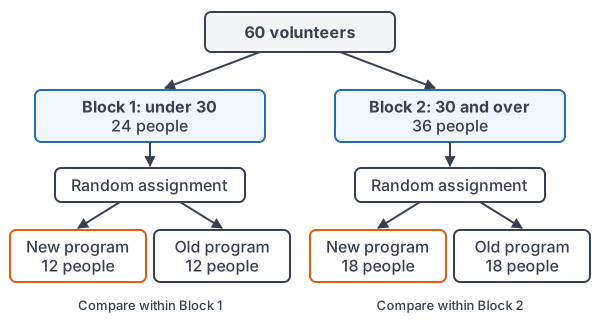
A gym has 60 volunteers to compare a new exercise program with the old one. Of them, 24 are under 30 and 36 are 30 or older. Age may affect fitness gains. Describe a randomized block design and find each group size.
\text{blocks: under 30, 30 and over}Block on age, since it may affect the response.
24 + 36 = 60
Check that every volunteer is in one block.
\dfrac{24}{2} = 12Split the under-30 block evenly between the two programs.
\dfrac{36}{2} = 18Split the older block evenly between the two programs.
12 + 18 = 30
Add to find the total for each program.
Answer: randomly assign 12 of the under-30 volunteers to each program and 18 of the older volunteers to each program. Each program gets 30 people, and results are compared within each age block.
Example 2: Compare treatments within blocks
The gym measures the gain in push-ups after 8 weeks (example data). Under 30: new program mean 9.4, old program mean 7.1. Age 30 and over: new program mean 6.3, old program mean 4.2. Find the treatment difference in each block.
9.4 - 7.1 = 2.3
Subtract the means in the under-30 block.
6.3 - 4.2 = 2.1
Subtract the means in the older block.
9.4 - 6.3 = 3.1
Compare the blocks: younger people gain more on the new program.
Answer: the new program is ahead by 2.3 push-ups in the younger block and 2.1 in the older block. The blocks differ by about 3 push-ups, which is more than the treatment effect. Blocking keeps that age gap from hiding the program effect.
Example 3: Matched pairs with each subject getting both treatments
Eight runners test two shoe models. Each runner runs 400 meters in both shoes, in an order chosen by a coin flip. Times in seconds (example data):
| Runner | 1 | 2 | 3 | 4 | 5 | 6 | 7 | 8 |
|---|---|---|---|---|---|---|---|---|
| Shoe A | 62.4 | 58.1 | 65.0 | 60.3 | 59.7 | 63.8 | 61.2 | 57.9 |
| Shoe B | 61.8 | 57.6 | 64.1 | 60.0 | 59.5 | 62.9 | 60.8 | 57.7 |
Find the difference A minus B for each runner and the mean difference.
62.4 - 61.8 = 0.6
Runner 1: subtract Shoe B’s time from Shoe A’s.
58.1 - 57.6 = 0.5
Runner 2.
65.0 - 64.1 = 0.9
Runner 3.
60.3 - 60.0 = 0.3
Runner 4.
59.7 - 59.5 = 0.2
Runner 5.
63.8 - 62.9 = 0.9
Runner 6.
61.2 - 60.8 = 0.4
Runner 7.
57.9 - 57.7 = 0.2
Runner 8.
0.6 + 0.5 + 0.9 + 0.3 + 0.2 + 0.9 + 0.4 + 0.2 = 4.0
Add the differences.
\bar{d} = \dfrac{4.0}{8} = 0.5Divide by the number of pairs to find the mean difference (see mean).
Answer: every runner was faster in Shoe B, by 0.5 seconds on average. The runners’ times range from about 58 to 65 seconds, but the pairing removes that spread. On a TI-84, enter Shoe A in L1 and Shoe B in L2, set L3 = L1 − L2, and run 1-Var Stats on L3 to get the same mean of 0.5. In Desmos, type mean(A − B) after entering both lists.
Example 4: Matched pairs with similar subjects
A doctor has 20 patients for a blood pressure drug study. She wants to pair patients with similar starting blood pressure. Describe the design.
\text{rank the 20 patients by blood pressure}Line them up from lowest to highest.
\dfrac{20}{2} = 10 \text{ pairs}Pair the two lowest, then the next two, and so on.
\text{heads: first patient gets the drug}Flip a coin within each pair to assign the treatments.
\text{other patient gets the placebo}Each pair has one of each treatment.
\text{response: drop in blood pressure}Compare the two patients in each pair.
Answer: form 10 pairs of patients with similar blood pressure. In each pair, a coin flip decides who gets the drug, and the other gets a placebo. The doctor studies the 10 differences in blood pressure drop.
Example 5: Fields as blocks (word problem)
A farmer tests 3 fertilizers (A, B and C) on 4 fields with different soil. Each field is split into 3 plots, and the fertilizers are randomly assigned to the plots within each field. Corn yields in bushels per plot (example data):
| Fertilizer | Field 1 | Field 2 | Field 3 | Field 4 |
|---|---|---|---|---|
| A | 42 | 38 | 51 | 45 |
| B | 47 | 41 | 55 | 49 |
| C | 40 | 37 | 50 | 44 |
How many plots are there in all, and what is the mean yield for each fertilizer?
4 \times 3 = 12
Multiply fields by plots per field to find the total plots.
42 + 38 + 51 + 45 = 176
Add the yields for Fertilizer A.
\dfrac{176}{4} = 44Divide by 4 fields to find A’s mean.
47 + 41 + 55 + 49 = 192
Add the yields for Fertilizer B.
\dfrac{192}{4} = 48Find B’s mean.
40 + 37 + 50 + 44 = 171
Add the yields for Fertilizer C.
\dfrac{171}{4} = 42.75Find C’s mean.
Answer: 12 plots. The mean yields are 44 for A, 48 for B and 42.75 for C. Field 3 is the best field for every fertilizer, and B wins in every field. Because each field got all three fertilizers, the soil differences don’t hide that pattern.
Common mistakes
| Mistake | Example of the error | Fix |
|---|---|---|
| Assigning subjects to blocks at random | Flipping a coin to decide who is in the “under 30” block | Blocks come from a trait the subjects already have. Randomize only the treatments. |
| Skipping randomization inside blocks | Giving the new program to the first 12 younger volunteers who sign up | Within each block, use chance to assign the treatments. |
| Comparing across blocks | Comparing young people on the new program with older people on the old one | Compare treatments within the same block. |
| Mixing up blocking and stratified sampling | “We blocked by grade, so we have a stratified random sample.” | Stratifying chooses who is in a sample. Blocking arranges an experiment you already have. |
| Not randomizing the order in matched pairs | Every runner wears Shoe A first, then gets tired for Shoe B | Flip a coin to decide which treatment each subject gets first. |
| Averaging each treatment instead of the differences | Finding the mean of Shoe A and the mean of Shoe B but ignoring the pairs | Find each pair’s difference, then the mean difference. |
Related methods
Blocking vs. stratified sampling
Blocking in an experiment is like stratifying in a survey. A stratified random sample, covered in sampling methods, picks people from each group. A block design takes the subjects you have and randomizes treatments within each group. Both use groups of similar units to reduce variation.
Measuring the variation you remove
You can see the benefit by finding the standard deviation of the raw times and of the differences. In Example 3 the times spread over 7 seconds, while the differences stay between 0.2 and 0.9 seconds. Tools for comparing distributions work on the differences, too.
Practice problems
- A school has 100 students to compare two study apps: 40 freshmen and 60 seniors. In a block design by grade, how many students in each grade use each app?
- Why might a researcher block on sex in a study of a sleep aid?
- Six volunteers taste two colas in an order set by a coin flip. What kind of design is this?
- Five people’s resting heart rates before and after a breathing exercise are: before 72, 80, 68, 75, 77; after 70, 76, 67, 71, 76. Find the mean difference (before minus after).
- An experiment has 3 treatments and three blocks of 12, 18 and 30 subjects. How many subjects in each block get each treatment, and how many get each treatment in all?
- In a matched pairs design where each subject gets both treatments, why is the order randomized?
- What is the main difference between blocking and stratified random sampling?
- A study uses 15 pairs of identical twins. In each pair, one twin gets a new tutoring method. How many subjects get the new method, and how are they chosen?
- Three blocks test two treatments. Block 1: T1 23, T2 27. Block 2: T1 31, T2 36. Block 3: T1 18, T2 21. Find the mean difference (T2 minus T1).
- A study of a reading program includes students from grades 3 to 12. Would you use a completely randomized design or a block design? Explain.
Show answers
1.
\dfrac{40}{2} = 20Split the freshmen evenly between the two apps.
\dfrac{60}{2} = 30Split the seniors evenly between the two apps.
Answer: 20 freshmen and 30 seniors use each app, chosen at random within each grade
2.
\text{sex may affect sleep}A block variable should be one that changes the response.
Answer: men and women may respond differently to the sleep aid, so blocking on sex removes that variation from the comparison
3.
\text{each subject gets both treatments}Each person is a block of two measurements.
Answer: a matched pairs design
4.
72 - 70 = 2
Person 1: before minus after.
80 - 76 = 4
Person 2.
68 - 67 = 1
Person 3.
75 - 71 = 4
Person 4.
77 - 76 = 1
Person 5.
2 + 4 + 1 + 4 + 1 = 12
Add the differences.
\dfrac{12}{5} = 2.4Divide by the number of pairs.
Answer: a mean drop of 2.4 beats per minute
5.
\dfrac{12}{3} = 4First block: divide by 3 treatments.
\dfrac{18}{3} = 6Second block.
\dfrac{30}{3} = 10Third block.
4 + 6 + 10 = 20
Add across blocks for each treatment.
Answer: 4, 6 and 10 per treatment in the three blocks, so 20 subjects get each treatment
6.
\text{order effects}Getting tired, warming up or learning the task can change the second result.
Answer: random order keeps an order effect from always helping or hurting the same treatment
7.
\text{sampling vs. experiment}Ask what the grouping is used for.
Answer: stratified sampling uses groups to choose a sample; blocking uses groups to assign treatments in an experiment
8.
\text{one twin per pair}Each pair sends one twin to the new method.
15 \times 1 = 15
Multiply pairs by one twin each.
Answer: 15 subjects; a coin flip in each pair decides which twin gets the new method
9.
27 - 23 = 4
Block 1.
36 - 31 = 5
Block 2.
21 - 18 = 3
Block 3.
4 + 5 + 3 = 12
Add the differences.
\dfrac{12}{3} = 4Divide by 3 blocks.
Answer: a mean difference of 4
10.
\text{grade affects reading}Older students read at a higher level no matter the program.
Answer: a block design with grade levels as blocks, so the large grade differences don’t hide the program’s effect
Block design and matched pairs FAQ
What is the difference between a randomized block design and a matched pairs design?
A matched pairs design is a special block design where each block has just two units, either two similar subjects or one subject who gets both treatments. A randomized block design can have blocks of any size.
What is blocking in statistics?
Blocking means grouping experimental units that are alike in a way that affects the response, then randomly assigning treatments within each group. It reduces variation, so treatment effects are easier to detect.
Is a randomized block design the same as stratified sampling?
No. Stratified sampling chooses a sample from groups in a population. A block design assigns treatments within groups of subjects in an experiment.
When should you use a matched pairs design?
Use it when there are two treatments and you can pair very similar units, or give each subject both treatments. It works well for before-and-after studies, twin studies and taste tests.
Summary
- A block is a group of units that are alike in a way expected to affect the response.
- In a randomized block design, treatments are assigned at random within each block.
- A matched pairs design uses blocks of two: two similar subjects, or one subject with both treatments in random order.
- Compare treatments within blocks. For matched pairs, find each difference and then the mean difference.
- Blocking removes variation the blocks cause, so the treatment effect is easier to see.
Previous lesson: Experimental Design
Next lesson: Probability Simulations
Back to the Statistics Index